

Weight and density of building materials: gravel, sand, soil and concrete per cubic yard and cubic metre
A cubic yard of gravel, crushed stone or sand weighs 1.22–2.16 short tons per yd3, depending on the rock and how it is graded, according to Vulcan Materials' 2026 density estimator. Loose, dry soil weighs less and concrete weighs more. This page brings together the published weights for aggregates, soil, concrete, grout, bags, boards, blocks and rebar in US and metric units. Each row names the supplier, maker or state highway study it comes from, and the full table is a free CSV download.
1.22–2.16US tons per cu yd
for gravel, crushed stone, screenings and sand in Vulcan Materials' estimator, from clean coarse stone to traprock crusher run
1.89–2.04US tons per cu yd
for concrete, from Quikrete's bagged-mix unit weight to the fresh ready-mix density in an NRMCA worked example
(National Ready Mixed Concrete Association and The Quikrete Companies)
0.89–1.43US tons per cu yd
for loose, dry natural soils measured in a Wisconsin highway study, before any water is added
(Wisconsin Highway Research Program / WisDOT (Cetin, Bulduk, Likos, Edil))
1.68tonnes per m³
for UK decorative gravel and chippings as supplied, worked out from a quarry's quantity table
What are the main findings?
- Gravel and stone vary more than most people expect: a cubic yard runs from 1.22–2.16 short tons per yd3 across Vulcan's products and rock types. Clean coarse stone is the lightest and crusher run the heaviest.
- Loose and compacted are different numbers: virgin base aggregate measured 90–107 lb/ft3 loose and dry in a Wisconsin study, well below the same stone once compacted.
- Compacted base is heavy: 1.5–1.98 short tons per compacted yd3 in place. The same material takes up 27–60% more room when loosened.
- Dry soil is lighter than stone: 0.89–1.43 short tons per yd3 for loose, dry natural soils, before moisture adds weight.
- Concrete is the heaviest common bulk material here: 1.89–2.04 short tons per yd3 by the Quikrete and NRMCA figures.
- UK decorative gravel is in the same band as US stone: about 1.68 tonnes per m3 as supplied.
- Drywall weight depends mostly on thickness and type: 1.25–2.2 lb/sq ft from lightweight half-inch board to fire-rated five-eighths.
These are published typical values, not weighbridge readings. Suppliers say their own figures can differ from plant to plant, and moisture changes the weight of sand and soil a lot. Use them to plan loads and orders, and confirm the figure your supplier sells by when it matters.
How much does a cubic yard of gravel weigh?
A cubic yard of gravel or crushed stone weighs 1.22–2.16 short tons per yd3, according to Vulcan Materials' density estimator. Across Vulcan Materials' density estimator, a cubic yard of aggregate weighs from 1.22 US tons (Coarse aggregate (clean stone) (Sandstone)) to 2.16 tons (Crushed stone base / crusher run (Traprock)), so stone type and grading can change the weight of a delivery by over 75%.
The type of product matters more than the type of rock. Clean coarse stone, the washed single-size gravel used for drainage and under sheds, has gaps between the stones and sits at the bottom of the range. Vulcan's estimator uses 90-102 lb/ft3 for clean coarse aggregate, about 1.22-1.38 short tons per cubic yard (1,442-1,634 kg/m3). Crusher run and other dense-graded base mixes contain fines that fill those gaps, so they sit at the top. Vulcan's estimator uses 130-160 lb/ft3 for crushed stone base / crusher run, about 1.76-2.16 short tons per cubic yard. Screenings, the stone dust used under pavers, fall between the two. Vulcan's estimator uses 110-124 lb/ft3 for screenings (stone dust), about 1.49-1.67 short tons per cubic yard.
Vulcan's figures do not say whether the stone is loose or compacted. Treat them as the supplier's selling figure for a delivered load. In the UK, the figure for decorative gravel is similar. UK decorative gravel works out at about 1.68 tonnes per cubic metre as supplied (1.42 US tons per cubic yard), per Long Rake Spar's quantity table.
To turn an area and depth into tons, use the gravel calculator. It asks which density to use, so you can enter the figure your quarry quotes. For a drive, the driveway gravel depth and layers guide sets out the sub-base and top layers before you work out the weight of each.
Which materials weigh the most per cubic yard?
Concrete and compacted crushed base are the heaviest bulk materials in the database. Clean coarse stone and loose, dry soil are the lightest. The chart shows the weight of one cubic yard for each row. Where a source gives a range, the bar shows the upper figure, and the full range is in the table below.
How much does a cubic yard of sand weigh?
A cubic yard of construction sand weighs roughly one and a half US tons. Vulcan's estimator uses 100-110 lb/ft3 for sand, about 1.35-1.49 short tons per cubic yard (1,602-1,762 kg/m3). Sand from sand-and-gravel deposits sits at the top of that band. Vulcan's estimator puts sand from sand-and-gravel deposits at 110 lb/ft3 (1,762 kg/m3), about 1.49 short tons per cubic yard.
Water is the big unknown with sand. The supplier figures are for the product as sold. A pile left out in the rain holds water in the gaps between grains and weighs more per yard. Very dry sand flows and settles. If you are paying by the ton, ask whether the yard weighs sand wet or dry, and if you are paying by the yard, ask how the bucket is filled.
How much does a cubic yard of topsoil weigh?
There is no single published figure for delivered US topsoil, and we have not found one from a producer or an extension service that we can cite. The closest measured figures are for natural soils. Loose, dry natural soils tested for WisDOT weighed 66-106 lb/ft3, about 0.89-1.43 tons per cubic yard (1.06-1.7 t/m3) before any moisture. Those are dry weights. Moist screened topsoil, as it usually arrives, weighs more.
A UK supplier publishes a figure for its blended topsoil as supplied. Melcourt's Topsoil Blended Loam has a bulk density of 900-1,200 kg/m3 (about 56-75 lb/ft3) as supplied. That is lighter than the dry natural soils in the Wisconsin tests, because blended topsoil contains organic matter, which is much lighter than mineral soil.
For ordering, volume is more reliable than weight. The topsoil for raised beds tool works in cubic yards, cubic metres and bags. The how deep topsoil should be guide gives the depths extension services recommend for lawns and beds. Mulch is in the same position: no source-backed bulk density exists in our fact base, so the bags of mulch for a bed tool counts by volume only.
How much does a cubic yard of concrete weigh?
A cubic yard of concrete weighs about two US tons. A cubic yard of concrete weighs about 1.89 tons at Quikrete's 140 lb/ft3 bagged-mix unit weight and 2.04 tons at the 151 lb/ft3 fresh density in NRMCA's ready-mix example (2.24-2.42 t/m3). In metric terms, that is a little over two tonnes per cubic metre.
The two figures measure slightly different things. Quikrete's is the unit weight it states for its bagged mix. NRMCA's is the fresh density of a ready-mix batch in a worked example. Real mixes vary with the aggregate, the air content and the water. For bagged concrete, weight is easier to see per bag than per yard. The bag table further down lists each bag size with its yield. A cubic yard of 80 lb bags is about 45 bags/yd³.
The concrete needed for a slab tool turns slab, footing and column sizes into cubic yards and bags. National production and use figures are on the cement and ready-mix production data page.
Does gravel weigh more loose or compacted?
Compacted gravel weighs more per cubic yard, because compaction squeezes out air. A loose cubic yard and a compacted cubic yard are not the same amount of stone. Virgin base aggregate measured 90-107 lb/ft3 loose and dry in WisDOT-funded tests (1.22-1.44 tons/yd3), well below the 124-154 lb/ft3 of the same material compacted. Compacted in place, Wisconsin base and backfill aggregates weighed 1.5-1.98 tons per cubic yard and expand 27-60% when loosened (WisDOT WHRP 0092-22-05, Table E2).
This is the most common reason a gravel order comes up short. You measure the finished, compacted volume of the drive or path, but the quarry sells loose stone. Loose aggregate takes up 27-60% more room than the same aggregate compacted, so loose volume is compacted volume x 1.27 to 1.60. An unpaved road specification from Penn State shows the same effect in depth: Penn State's Driving Surface Aggregate is placed 8 in loose to finish at 6 in compacted, or 6 in loose to 4.5 in, i.e. it loses about a quarter of its depth.
Correcting a common belief: one cubic yard of gravel does not always weigh about the same. Wisconsin dense-graded and crushed base aggregates weighed 1.77-1.98 short tons per compacted cubic yard in WisDOT-funded tests. Ask your supplier whether their tons-per-yard figure is for loose or compacted material, and compare like with like.
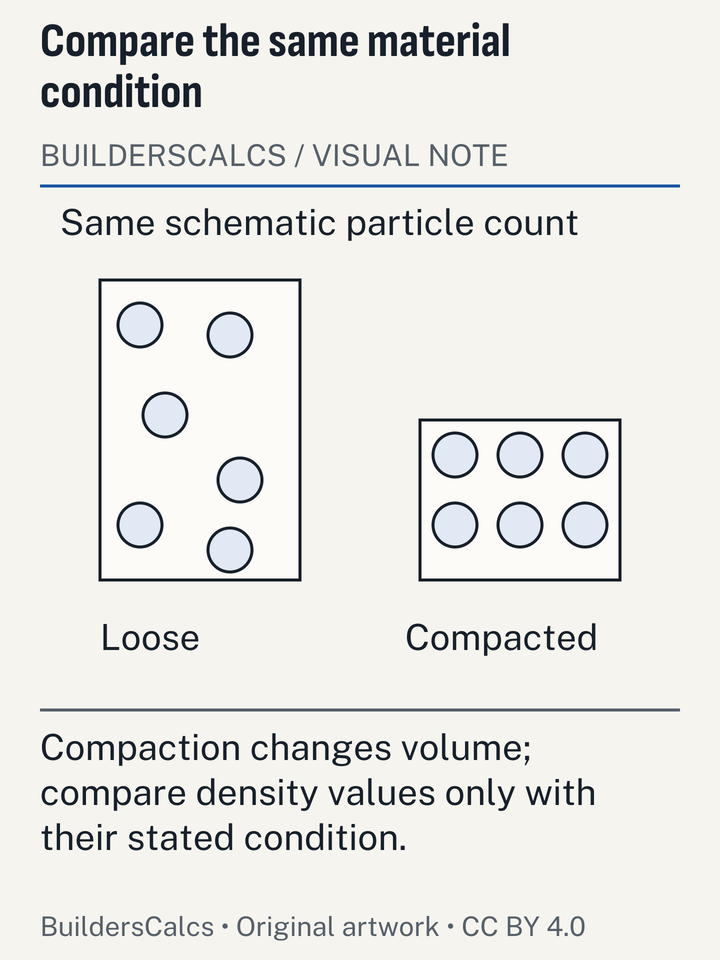
Illustration sources
What is the density of each material in lb/ft³ and kg/m³?
The full bulk-density table, with every row in pounds per cubic foot, kilograms per cubic metre and US tons per cubic yard. The condition column says whether the figure is for loose, compacted or as-supplied material. The Vulcan rows (screenings, crusher run, clean stone and sand by rock type) do not state a condition. The dense-graded base, breaker run, backfill, recycled base and soil rows come from the 2023 WisDOT-funded study. The UK gravel row comes from Long Rake Spar, the concrete rows from Quikrete and NRMCA, and the grout row from MAPEI.
| Material | Condition | lb/ft³ low | lb/ft³ high | kg/m³ low | kg/m³ high | US tons/yd³ low | US tons/yd³ high | Region |
|---|---|---|---|---|---|---|---|---|
| Screenings (Traprock) | as quoted by supplier (loose/compacted not stated) | 124 | 124 | 1,986 | 1,986 | 1.67 | 1.67 | US |
| Crushed stone base / crusher run (Traprock) | as quoted by supplier (loose/compacted not stated) | 160 | 160 | 2,563 | 2,563 | 2.16 | 2.16 | US |
| Coarse aggregate (clean stone) (Traprock) | as quoted by supplier (loose/compacted not stated) | 102 | 102 | 1,634 | 1,634 | 1.38 | 1.38 | US |
| Sand (Traprock) | as quoted by supplier (loose/compacted not stated) | 110 | 110 | 1,762 | 1,762 | 1.49 | 1.49 | US |
| Screenings (Limestone) | as quoted by supplier (loose/compacted not stated) | 113 | 113 | 1,810 | 1,810 | 1.53 | 1.53 | US |
| Crushed stone base / crusher run (Limestone) | as quoted by supplier (loose/compacted not stated) | 138 | 138 | 2,211 | 2,211 | 1.86 | 1.86 | US |
| Coarse aggregate (clean stone) (Limestone) | as quoted by supplier (loose/compacted not stated) | 96 | 96 | 1,538 | 1,538 | 1.3 | 1.3 | US |
| Sand (Limestone) | as quoted by supplier (loose/compacted not stated) | 106 | 106 | 1,698 | 1,698 | 1.43 | 1.43 | US |
| Screenings (Granite) | as quoted by supplier (loose/compacted not stated) | 113 | 113 | 1,810 | 1,810 | 1.53 | 1.53 | US |
| Crushed stone base / crusher run (Granite) | as quoted by supplier (loose/compacted not stated) | 145 | 145 | 2,323 | 2,323 | 1.96 | 1.96 | US |
| Coarse aggregate (clean stone) (Granite) | as quoted by supplier (loose/compacted not stated) | 96 | 96 | 1,538 | 1,538 | 1.3 | 1.3 | US |
| Sand (Granite) | as quoted by supplier (loose/compacted not stated) | 106 | 106 | 1,698 | 1,698 | 1.43 | 1.43 | US |
| Screenings (Sand & Gravel) | as quoted by supplier (loose/compacted not stated) | 112 | 112 | 1,794 | 1,794 | 1.51 | 1.51 | US |
| Crushed stone base / crusher run (Sand & Gravel) | as quoted by supplier (loose/compacted not stated) | 130 | 130 | 2,082 | 2,082 | 1.75 | 1.75 | US |
| Coarse aggregate (clean stone) (Sand & Gravel) | as quoted by supplier (loose/compacted not stated) | 98 | 98 | 1,570 | 1,570 | 1.32 | 1.32 | US |
| Sand (Sand & Gravel) | as quoted by supplier (loose/compacted not stated) | 110 | 110 | 1,762 | 1,762 | 1.49 | 1.49 | US |
| Screenings (Sandstone) | as quoted by supplier (loose/compacted not stated) | 110 | 110 | 1,762 | 1,762 | 1.49 | 1.49 | US |
| Crushed stone base / crusher run (Sandstone) | as quoted by supplier (loose/compacted not stated) | 138 | 138 | 2,211 | 2,211 | 1.86 | 1.86 | US |
| Coarse aggregate (clean stone) (Sandstone) | as quoted by supplier (loose/compacted not stated) | 90 | 90 | 1,442 | 1,442 | 1.22 | 1.22 | US |
| Sand (Sandstone) | as quoted by supplier (loose/compacted not stated) | 100 | 100 | 1,602 | 1,602 | 1.35 | 1.35 | US |
| Dense graded base 3/4 in | compacted in place | 133.3 | 137.8 | 2,136 | 2,207 | 1.8 | 1.86 | US |
| Dense graded base 1 1/4 in | compacted in place | 132.6 | 146.7 | 2,124 | 2,349 | 1.79 | 1.98 | US |
| Dense graded base 3 in | compacted in place | 131.9 | 138.5 | 2,112 | 2,219 | 1.78 | 1.87 | US |
| Breaker run | compacted in place | 134.8 | 138.5 | 2,160 | 2,219 | 1.82 | 1.87 | US |
| Select crushed material | compacted in place | 131.1 | 134.1 | 2,100 | 2,148 | 1.77 | 1.81 | US |
| Backfill structure (Grade A or B) | compacted in place | 111.1 | 127.4 | 1,780 | 2,041 | 1.5 | 1.72 | US |
| Backfill granular (Grade 1 or 2) | compacted in place | 120 | 123 | 1,922 | 1,970 | 1.62 | 1.66 | US |
| RAP base 1 1/4 in | compacted in place | 121.5 | 126.7 | 1,946 | 2,029 | 1.64 | 1.71 | US |
| RCA base 1 1/4 in | compacted in place | 122.2 | 129.6 | 1,958 | 2,076 | 1.65 | 1.75 | US |
| Base aggregate, virgin (stockpile) | loose, dry | 90 | 107 | 1,442 | 1,714 | 1.22 | 1.44 | US |
| Natural soils (14 tested) | loose, dry (add moisture for delivered weight) | 66 | 106 | 1,057 | 1,698 | 0.89 | 1.43 | US |
| Decorative gravel and chippings (UK) | loose, as supplied | 104.9 | 104.9 | 1,680 | 1,680 | 1.42 | 1.42 | UK |
| Concrete, bagged pre-mix (Quikrete Concrete Mix) | unit weight stated on maker data sheet | 140 | 140 | 2,243 | 2,243 | 1.89 | 1.89 | US |
| Concrete, ready-mix (NRMCA worked example) | fresh | 151 | 151 | 2,419 | 2,419 | 2.04 | 2.04 | all |
| Cementitious tile grout (MAPEI Ultracolor Plus) | density factor in maker's consumption formula | 99.9 | 99.9 | 1,600 | 1,600 | 1.35 | 1.35 | EU |
How much do bags of concrete, mortar, gravel and insulation weigh?
Bag weights and, where the maker states one, the volume each bag makes. US concrete bags come in several sizes, and the smaller bags make proportionally less concrete. UK and EU bags are sold by the kilogram and are not the same sizes as US bags. A bulk bag of aggregate in the UK is far heavier than any bag a person should lift.
| Product | Category | Bag (lb) | Bag (kg) | Yield (cu ft) | Yield (L) | Notes | Region |
|---|---|---|---|---|---|---|---|
| Quikrete Concrete Mix 1101 | Concrete | 40 | 18.1 | 0.3 | 8.5 | 90.0 bags per yd3; 117.7 per m3 | US |
| Quikrete Concrete Mix 1101 | Concrete | 50 | 22.6 | 0.375 | 10.6 | 72.0 bags per yd3; 94.2 per m3 | US |
| Quikrete Concrete Mix 1101 | Concrete | 60 | 27.2 | 0.45 | 12.7 | 60.0 bags per yd3; 78.5 per m3 | US |
| Quikrete Concrete Mix 1101 | Concrete | 80 | 36.2 | 0.6 | 17 | 45.0 bags per yd3; 58.9 per m3 | US |
| Quikrete Concrete Mix 1101 (regional) | Concrete | 90 | 40.8 | 0.675 | 19.1 | 40.0 bags per yd3; 52.3 per m3 | US |
| Sakrete High Strength Concrete Mix | Concrete | 40 | 18.1 | 0.3 | 8.5 | 90.0 bags per yd3; 117.7 per m3 | US |
| Sakrete High Strength Concrete Mix | Concrete | 60 | 27.2 | 0.45 | 12.7 | 60.0 bags per yd3; 78.5 per m3 | US |
| Sakrete High Strength Concrete Mix | Concrete | 80 | 36.2 | 0.6 | 17 | 45.0 bags per yd3; 58.9 per m3 | US |
| Sakrete High Strength Concrete Mix | Concrete | 90 | 40.8 | 0.68 | 19.3 | 39.7 bags per yd3; 51.9 per m3 | US |
| Quikrete Fast-Setting Concrete Mix 1004 | Concrete | 50 | 22.6 | 0.375 | 10.6 | 72.0 bags per yd3; 94.2 per m3 | US |
| Quikrete Fast-Setting Concrete Mix 1004 | Concrete | 60 | 27.2 | 0.45 | 12.7 | 60.0 bags per yd3; 78.5 per m3 | US |
| Sakrete Fast Setting Concrete Mix | Concrete | 50 | 22.6 | 0.38 | 10.8 | 71.1 bags per yd3; 92.9 per m3 | US |
| Sakrete Rapid Post (Canada) | Concrete | 66 | 30 | 0.5 | 14 | 54.0 bags per yd3; 70.6 per m3 | US |
| SAKRET Beton-Estrich fein (DE) | Concrete | 66.1 | 30 | 0.53 | 15 | EU | |
| Masonry grout, preblended (NCMA) | Masonry | 80 | 36.3 | 0.66 | 18.7 | US | |
| Sakrete Type N mortar mix | Masonry | 40 | 18.1 | None | None | lays about 20 bricks or 8 8 in blocks | US |
| Sakrete Type N mortar mix | Masonry | 60 | 27.2 | None | None | lays about 30 bricks or 11 8 in blocks | US |
| Sakrete Type N mortar mix | Masonry | 80 | 36.2 | None | None | lays about 40 bricks or 15 8 in blocks | US |
| Blown fiberglass insulation (Owens Corning AttiCat) | Insulation | 27.5 | 12.5 | None | None | US | |
| Blown cellulose insulation (GreenFiber INS515LD) | Insulation | 30 | 13.6 | None | None | US | |
| Polymeric joint sand (Alliance Gator) | Paving | 50 | 22.7 | None | None | US | |
| Post-fixing concrete (Blue Circle Postcrete) | Concrete | 44.1 | 20 | None | None | UK | |
| Tile grout (MAPEI Ultracolor Plus) | Tile setting | 50.7 | 23 | None | None | EU | |
| Decorative aggregate poly bag (UK) | Aggregate | 44.1 | 20 | None | None | UK | |
| Decorative aggregate bulk bag (UK, implied) | Aggregate | 1,763.7 | 800 | None | None | UK | |
| Type 1 MOT sub-base bulk bag (Tarmac) | Aggregate | 1,873.9 | 850 | None | None | UK | |
| All-purpose gravel (Quikrete No. 1151) | Aggregate | 50 | 22.7 | None | None | US |
How much do drywall, roof tiles and carpet weigh per square foot?
Sheet and surface materials are easier to compare by weight per area. Drywall weight depends on thickness and type. A 1/2 in lightweight drywall panel weighs about 1.25 lb/sq ft (6.1 kg/m2) versus 2.2 lb/sq ft (10.7 kg/m2) for 5/8 in Type X, so a 4x8 sheet runs about 40-70 lb. Concrete roof tiles are far heavier per square foot of roof than any wallboard, which is why a change of roof covering can need a structural check.
| Material | Basis | US value | US unit | Metric value | Metric unit | Region |
|---|---|---|---|---|---|---|
| Drywall 1/2 in lightweight (USG UltraLight) | per panel area | 1.25 | lb/sq ft | 6.1 | kg/m2 | US |
| Drywall 5/8 in Type X (USG Mold Tough Firecode X) | per panel area | 2.2 | lb/sq ft | 10.7 | kg/m2 | US |
| Concrete roof tile, Redland 49 at 282 mm gauge | laid weight per roof area | 10.4 | lb/sq ft | 51 | kg/m2 | UK |
| Concrete roof tile, Redland 49 at 307 mm gauge | laid weight per roof area | 9.6 | lb/sq ft | 47 | kg/m2 | UK |
| Carpet, US average broadloom and carpet tile (H2 2024) | per floor area | 4.22 | lb/sq yd | 2.29 | kg/m2 | US |
How much does a sheet of plasterboard or a retaining wall block weigh?
Weights per board, box or block, as the makers state them. UK plasterboard is sold in metric sheet sizes, so its weight per board is not directly comparable with a US 4 × 8 ft drywall panel.
| Material | Basis | US value | US unit | Metric value | Metric unit | Region |
|---|---|---|---|---|---|---|
| Plasterboard 12.5 mm, 1200 x 2400 mm, square edge (Knauf) | per board | 53.6 | lb/board | 24.333 | kg/board | UK |
| Plasterboard 12.5 mm, 1200 x 2400 mm, tapered edge (Knauf) | per board | 57.1 | lb/board | 25.92 | kg/board | UK |
| Plasterboard 12.5 mm, 1200 x 2700 mm, tapered edge (Knauf) | per board | 64.3 | lb/board | 29.16 | kg/board | UK |
| Plasterboard 12.5 mm, 1200 x 3000 mm, tapered edge (Knauf) | per board | 65.1 | lb/board | 29.52 | kg/board | UK |
| Plasterboard 12.5 mm, 900 x 1800 mm, tapered edge (Knauf) | per board | 28.2 | lb/board | 12.8 | kg/board | UK |
| Plasterboard 15 mm, 1200 x 2400 mm, square edge (Knauf) | per board | 64.1 | lb/board | 29.088 | kg/board | UK |
| Plasterboard 15 mm, 1200 x 2400 mm, tapered edge (Knauf) | per board | 64.7 | lb/board | 29.37 | kg/board | UK |
| Plasterboard 15 mm, 1200 x 2700 mm, tapered edge (Knauf) | per board | 72.1 | lb/board | 32.724 | kg/board | UK |
| Plasterboard 15 mm, 1200 x 3000 mm, tapered edge (Knauf) | per board | 99.2 | lb/board | 45 | kg/board | UK |
| Porcelain tile box 75x75 cm, 10.0 mm (Marazzi Plaster) | per box (1.13 m2, 2 pieces) | 55.1 | lb/box | 24.98 | kg/box | EU |
| Porcelain tile box 60x60 cm, 9.5 mm (Marazzi Plaster) | per box (1.08 m2, 3 pieces) | 46.3 | lb/box | 21.01 | kg/box | EU |
| Porcelain tile box 30x60 cm, 9.5 mm (Marazzi Plaster) | per box (1.08 m2, 6 pieces) | 46.5 | lb/box | 21.07 | kg/box | EU |
| Porcelain tile box 60x60 (20 mm outdoor) cm, 20 mm (Marazzi Plaster) | per box (0.72 m2, 2 pieces) | 73.9 | lb/box | 33.53 | kg/box | EU |
| Retaining wall block, AB Classic (8 x 12 x 18 in) | per unit | 75 | lb/unit | 34 | kg/unit | US |
| Retaining wall block, AB Stones (8 x 12 x 18 in) | per unit | 75 | lb/unit | 34 | kg/unit | US |
| Retaining wall block, AB Rocks (8 x 12 x 18 in) | per unit | 75 | lb/unit | 34 | kg/unit | US |
| Retaining wall block, AB Jumbo Junior (8 x 9.5 x 9 in) | per unit | 35 | lb/unit | 15.9 | kg/unit | US |
| Retaining wall block, AB Lite Stone (4 x 12 x 18 in) | per unit | 35 | lb/unit | 15.9 | kg/unit | US |
How much does rebar weigh per foot?
Rebar weight rises with the square of the bar diameter, so each size up adds more weight than the one before. These are the standard ASTM inch-pound bar sizes, as published by Caltrans and a steel distributor.
| Material | US value | US unit | Metric value | Metric unit |
|---|---|---|---|---|
| Rebar #3 (0.375 in / 9.5 mm) | 0.376 | lb/ft | 0.56 | kg/m |
| Rebar #4 (0.5 in / 12.7 mm) | 0.668 | lb/ft | 0.994 | kg/m |
| Rebar #5 (0.625 in / 15.9 mm) | 1.043 | lb/ft | 1.552 | kg/m |
| Rebar #6 (0.75 in / 19.0 mm) | 1.502 | lb/ft | 2.235 | kg/m |
| Rebar #7 (0.875 in / 22.2 mm) | 2.044 | lb/ft | 3.042 | kg/m |
| Rebar #8 (1.0 in / 25.4 mm) | 2.67 | lb/ft | 3.973 | kg/m |
How do you convert lb/ft³ to tons per cubic yard and kg/m³?
Multiply pounds per cubic foot by the number of cubic feet in a cubic yard, 27, then divide by the pounds in a US short ton to get tons per cubic yard. For kilograms per cubic metre, multiply pounds per cubic foot by 16.01846. Both factors are from NIST's guide to SI units.
A worked example from the table: Vulcan's estimator puts limestone crushed stone base (crusher run) at 138 lb/ft3 (2,211 kg/m3), about 1.86 short tons per cubic yard. That is the same stone in three units, with no rounding beyond the last digit shown.
Watch which ton is meant. A US short ton, a UK long ton and a metric tonne are three different weights. A US short ton (2,000 lb) is 907.18474 kg. A metric tonne is 1,000 kg. The construction unit conversions page has the rest of the factors.
| Conversion | Factor |
|---|---|
| kg/m3 per lb/ft3 | 16.01846 |
| cu ft per cu yd | 27 |
| lb per US short ton | 2,000 |
| kg per lb | 0.45359237 |
| m2 per sq ft | 0.09290304 |
| m2 per sq yd | 0.83612736 |
| m3 per cu ft | 0.028316846592 |
How do I use these weights to order material?
Work out the volume first, then convert to weight only if your supplier sells by the ton. Volume comes straight from your measurements. Weight adds a density that may not match your supplier's stone.
- For any bulk material, the cubic yards for any bulk material tool turns length, width and depth into cubic yards and cubic metres.
- For stone sold by the ton, the gravel calculator applies the density you choose.
- For beds and borders, the mulch depth by plant type guide sets the depth before you count bags.
- The other garden and hardscape tools are on the landscaping calculators page.
Allow extra for compaction and settling when the source says so. Check that a trailer or pickup is rated for the load before collecting stone, sand or soil yourself.
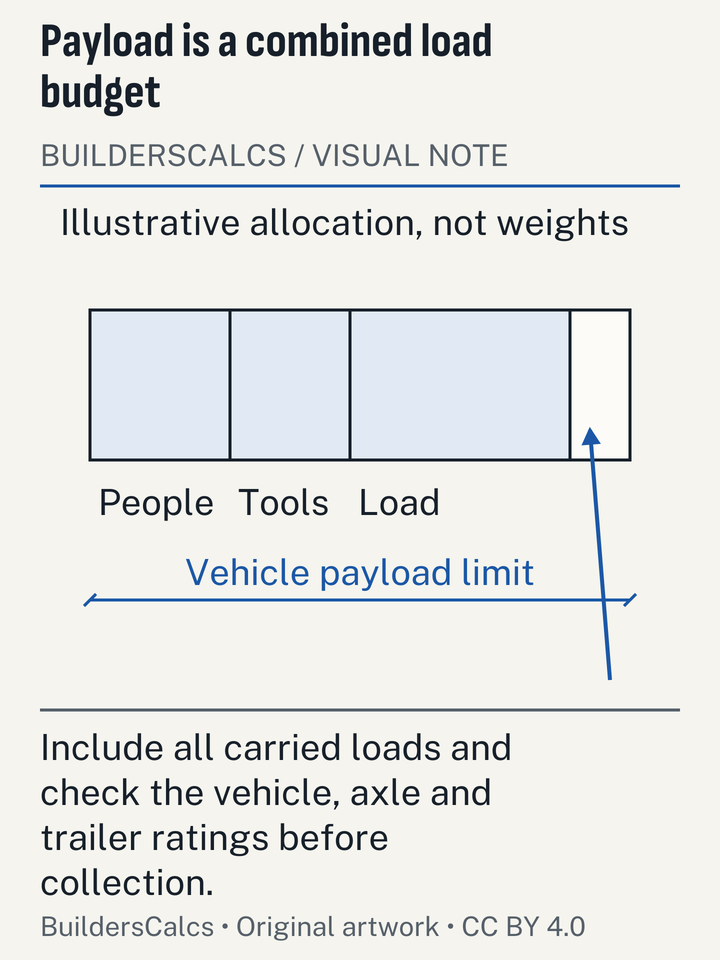
Illustration sources
How we built this data
Sources. Every row comes from a named published source: Vulcan Materials' online density estimator (2026), a 2023 Wisconsin Highway Research Program study for WisDOT that measured aggregates and soils loose and compacted, Long Rake Spar's UK quantity table, maker data sheets from Quikrete, Sakrete, MAPEI, USG, Knauf, BMI Redland, Allan Block, Marazzi, Owens Corning and GreenFiber, NRMCA's Concrete in Practice sheet, CARE's carpet survey, and Caltrans and Russel Metals rebar tables. All were read in October 2026.
Method. We recorded each figure in the unit the source used, then converted it to the other units with NIST SP 811 factors. Where a source gives a range, the table keeps both ends. Where a source states a single figure, low and high are the same. We kept the source's own description of the condition (loose, compacted, as supplied or not stated) and did not adjust any figure for moisture or compaction.
What we did not do. We did not weigh or test any material. We did not derive densities from bag weight and yield, because that would create new values no source states.
Limits. Supplier figures are typical values. Vulcan advises confirming them with the local plant. The Wisconsin figures are for Wisconsin materials. Moisture can add a lot of weight to sand and soil. There is no brick or concrete block unit weight in the database yet, no bulk density for mulch, and no delivered weight for moist US topsoil, because we have not found a source we can cite for any of them.
How to cite this page
You can reuse the tables and the CSV on this page under the Creative Commons Attribution 4.0 licence (CC BY 4.0). Credit BuildersCalcs and link to this page. The citation line in the box at the end of the page copies with one click.
When you quote a weight, please keep the condition and the unit with it, and name the original source where you can. A short form that works in most articles: 'a cubic yard of gravel weighs 1.22–2.16 US tons depending on the stone (Vulcan Materials data compiled by BuildersCalcs)'. Our part is the compilation, the unit conversions and the condition labels. The figures themselves belong to the sources named in each row.
Download the data
All the rows on this page in one file: bulk density, weight per area, length and piece, bag weights and yields, and conversion factors. Each row carries its region, condition, source IDs and the fact-base reference it came from.
Questions about material weights
Is a ton of gravel the same as a cubic yard?
No. A ton is a weight and a cubic yard is a volume. Depending on the stone, a cubic yard weighs 1.22–2.16 short tons per yd3, so a ton of light clean stone covers more ground than a ton of crusher run.
Why does my supplier's tons-per-yard figure differ from this table?
Quarries sell their own stone, with their own grading and moisture. Vulcan itself advises confirming its estimator values with the local plant. If the supplier's figure is for compacted material and you are buying loose stone, or the other way round, the difference can be large.
How heavy is wet sand or wet soil compared with dry?
Heavier, but by how much depends on how much water it holds, and none of our sources give a single figure for it. The soil weights here are dry. Treat any delivered weight of sand or soil as higher than the dry figure, especially after rain.
Why is there no figure for mulch or brick?
We only publish weights we can source. We have not found a bulk density for bagged mulch or a brick and block unit weight from a maker or standard that we can cite yet. They will be added when we do.
What is the difference between a short ton and a tonne?
They are different weights. A US short ton (2,000 lb) is 907.18474 kg. A metric tonne is 1,000 kg. So a tonne is the heavier of the two. UK quarries quote tonnes and US quarries quote short tons. Check which one a figure uses before you compare it.
Cite this page
You may reuse the figures and downloads on this page under CC BY 4.0. Please credit BuildersCalcs with a link to this page.
Sources (34)
- Allan Block Corporation
- AB Collection - block specifications (commercial installation manual), checked
- Alliance Designer Products (Alliance Gator)
- Alliance Reference Guide 2025 - Gator Maxx G2 / Gator Supersand G2 polymeric sand coverage, checked
- BMI Redland (UK)
- Redland 49 concrete roof tile technical data sheet (BS EN 490 / BS 5534:2014+A2:2018), checked
- California Department of Transportation
- Bridge Design Details 13.1 Reinforcement, Table 13.1.1 ASTM Standard Reinforcing Bar Data (Sept 2025), checked
- Carpet America Recovery Effort (CARE), filed with CalRecycle
- California Carpet Stewardship Program 2024 Annual Report, checked
- Concrete Masonry & Hardscapes Association (formerly NCMA)
- TEK 04-02A Estimating Concrete Masonry Materials, checked
- GreenFiber
- GreenFiber INS515LD Loose Fill Formula attic card (PM-6.3-324 Rev E), checked
- King Packaged Materials / Sika Canada (SAKRETE Canada)
- SAKRETE Rapid Post product data sheet, checked
- Knauf (UK)
- Knauf Wallboard 12.5mm product variants and packaging, checked
- Knauf Wallboard 15mm product variants and packaging, checked
- Long Rake Spar Co. Ltd (UK)
- Long Rake Spar Aggregates Brochure - Quantifying your requirements (Suitable Depths; Weight and Bags tables), checked
- MAPEI S.p.A.
- Ultracolor Plus technical data sheet (GB) - consumption table and formula, checked
- MKM Building Supplies (retailer listing of Tarmac product)
- Tarmac Building Products Type 1 MOT Bulk Bag 850 kg (product listing), checked
- Marazzi Group (Italy)
- Plaster collection catalogue - formats and packing table, checked
- Melcourt Industries Ltd (UK)
- Topsoil Blended Loam product page (specification and how to use), checked
- National Institute of Standards and Technology
- Handbook 44 (2026), Appendix C: General Tables of Units of Measurement, checked
- Special Publication 811 (2008), Guide for the Use of the International System of Units (SI), Appendix B.8, checked
- National Ready Mixed Concrete Association
- CIP 8 - Discrepancies in Yield (rev. 2016), checked
- Owens Corning
- AttiCat Expanding Blown-in PINK FIBERGLAS Insulation Application Instructions (Pub. 10009393-E), checked
- Penn State Center for Dirt and Gravel Roads
- Technical Bulletin: Driving Surface Aggregate (2025), checked
- Russel Metals
- Reinforcing bars (rebar) product page: ASTM A615 and CSA G30.18 tables, checked
- SAKRET Trockenbaustoffe Sachsen
- Technisches Merkblatt SAKRET Beton-Estrich fein BE fein, hosted by BayWa, checked
- SAKRETE of North America
- SAKRETE Fast Setting Concrete Mix technical data sheet, hosted by Home Depot, checked
- SAKRETE High Strength Concrete Mix technical data sheet (REV 7-10), hosted by Home Depot, checked
- SAKRETE Type N Mortar Mix technical data sheet (REV 7-10), hosted by Home Depot, checked
- Tarmac (Blue Circle)
- POSTCRETE product data sheet (April 2014), hosted by Wickes, checked
- The Quikrete Companies
- Data Sheet - QUIKRETE Sand & Gravel Products (rev. Nov 2020), checked
- QUIKRETE Concrete Mix No. 1101 Data Sheet (revised Oct 2022), checked
- QUIKRETE Fast-Setting Concrete Mix No. 1004 Data Sheet, checked
- UK Parliament (legislation.gov.uk)
- Weights and Measures Act 1985, Schedule 1, checked
- USG
- USG Sheetrock Brand Mold Tough Panels Firecode X 5/8 in. submittal sheet, checked
- USG Sheetrock Brand UltraLight Panels 1/2 in. submittal sheet, checked
- Vulcan Materials Company
- Construction Aggregates Calculator (density estimator by geology and product type), checked
- Wisconsin Highway Research Program / WisDOT (Cetin, Bulduk, Likos, Edil)
- Weight-Volume Relationships and Conversion Factors for Soils and Aggregates of Wisconsin, WHRP G22-05 (Dec 2023), checked
Every number on this page is taken from these documents. How we choose and check sources.