

Mulch depth and coverage: how deep and how many bags
Spread wood chip or bark mulch 2–3 in (50–75 mm) deep on most beds, and keep the total, last year's layer included, to 3–4 in (75–100 mm) at most. At 3 in, one cubic yard covers 108 sq ft (about 10 m²) and a 2 cu ft bag covers 8 sq ft. Going from 1 in to 2 in more than doubled weed control for some weeds in a 2019 University of Florida trial, but extension services warn that depth beyond 4 in harms plants.
How deep should mulch be?
Two to three inches suits most beds, with 3–4 in around trees and shrubs on free-draining ground and less on heavy or fine-textured material. The extension services broadly agree, but they differ at the edges:
- Trees and shrubs, well-drained soil: Iowa State recommends 3-4 in of wood chips or shredded bark around trees and shrubs on well-drained sites. (Iowa State University Extension and Outreach and Mississippi State University Extension (S. Collins-Smith))
- Heavy or wet soil: On heavy (clay) soils Iowa State advises a thinner 2-3 in layer; Rutgers caps compacted or poorly drained soils at 2 in. (Iowa State University Extension and Outreach and Rutgers Cooperative Extension (Crawford, Cabrera))
- The ceiling: Penn State says mulch should be no thicker than 3-4 in; Rutgers says total depth, including old mulch, should not exceed 3 in. (Penn State Extension (V. Cotrone) and Rutgers Cooperative Extension (Crawford, Cabrera))
- Fine mulches such as compost or fine bark: Rutgers advises fine-textured mulches be applied in 1-2 in layers. Fine material packs down and sheds water if it is laid thick.
- UK: The RHS says biodegradable mulches should be at least 5 cm (2 in) and ideally 7.5 cm (3 in) thick. (Royal Horticultural Society (UK))
Read together, a default of 2–3 in with 4 in as the maximum keeps you inside every source. The RHS minimum of 5 cm is a little over 2 in, so UK advice sits at the same depth expressed in metric.
Choosing within the range
- Coarse wood chip on sandy or free-draining soil: the deep end, 3–4 in.
- Clay, compacted or poorly drained soil: 2 in, or 2–3 in at most.
- Compost, leaf mould or fine bark: 1–2 in, topped up more often.
- Topping up an existing layer: measure what is there and add only the difference.
Does deeper mulch stop more weeds?
Up to about 2 in, clearly yes. In a University of Florida greenhouse trial, 2 inches of hardwood chip mulch alone cut garden spurge growth by 87% and eclipta by 83%, against 51% and 45% for 1 inch, per Saha et al., HortTechnology (2019). (American Society for Horticultural Science (Saha, Marble, Pearson et al., University of Florida))
The same study found that doubling the depth from 1 to 2 in improved control of large crabgrass by 147%, but no mulch on its own controlled more than 45% of crabgrass, which can germinate in darkness (American Society for Horticultural Science (Saha, Marble, Pearson et al., University of Florida)). That is one greenhouse study of three weed species, not a field rate, but the direction is plain: 1 in is too thin to rely on, and mulch alone will not stop every weed.
Why not go deeper still?
Because the evidence for harm sits above the recommended range, and the evidence base is thin. A 2026 systematic review in Arboriculture & Urban Forestry screened 1,200 papers and found only 11 studies that tested mulch depth on trees. Nearly all tested depths above the usual 5–10 cm (2–4 in), and harm was reported mostly above 10 cm (International Society of Arboriculture (Martin, Klein, Koeser, Hauer)). That supports the extension ceiling of 3–4 in rather than any precise cut-off.
How far should mulch stay from trunks and stems?
Keep it pulled back several inches, more for mature trees. Keep mulch off trunks and stems: Iowa State says at least 6 in from tree trunks; Rutgers says 3-5 in from young stems and 8-12 in from mature trunks. (Iowa State University Extension and Outreach, Rutgers Cooperative Extension (Crawford, Cabrera) and others) Mississippi State gives a tighter figure for stems, so the sources range from a couple of inches for small plants to a foot for large trees.
The misconception here is that a deep mound around a trunk protects the tree. Extension services call these mounds mulch volcanoes and warn that they restrict oxygen and water and invite rot, rodents and girdling roots (Iowa State University Extension and Outreach, Penn State Extension (V. Cotrone) and others). Spread mulch as a flat ring, or a shallow saucer, with bare ground at the trunk.
How do you work out how much mulch you need?
The method is area × depth, with one extra step for beds that already have mulch.
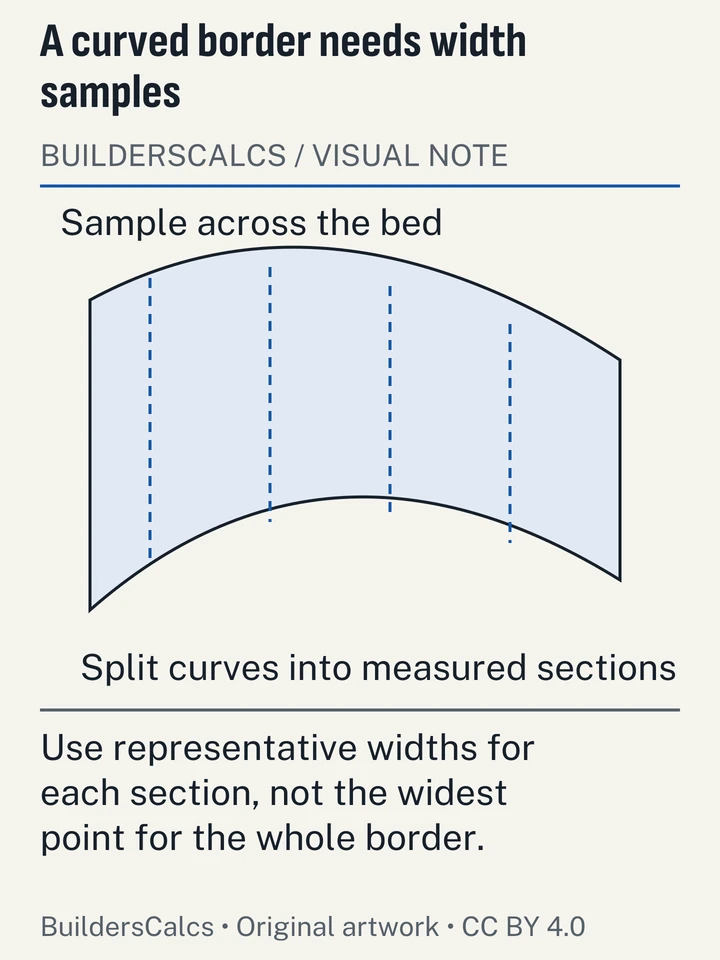
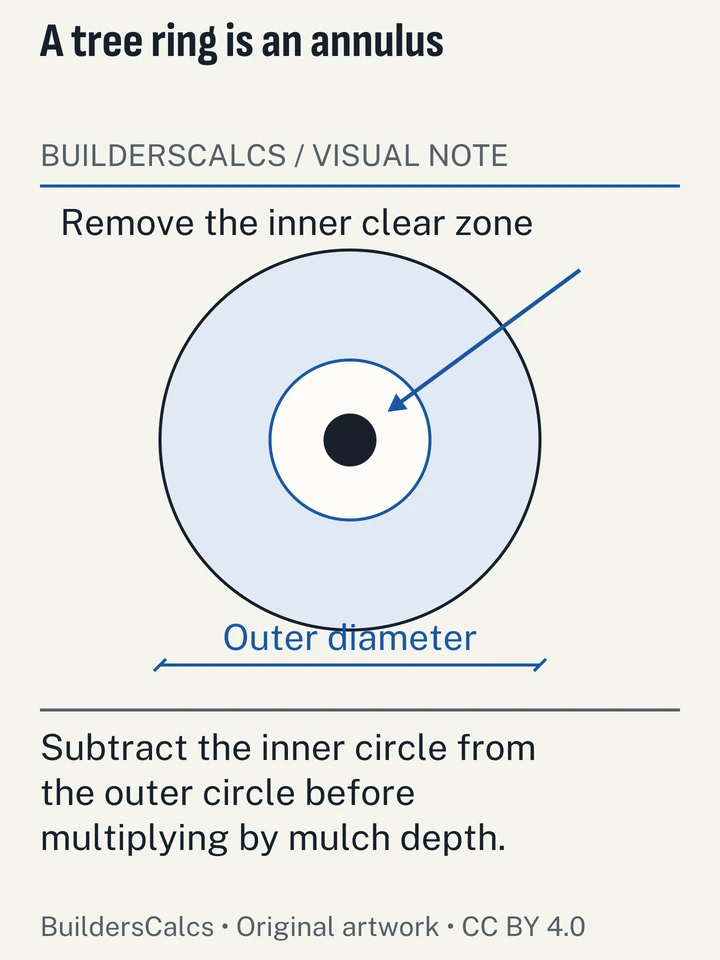
- Measure each bed. Length × width for rectangles, π × radius² for tree rings, and ½ × base × height for triangles. Add the pieces together.
- Check what is already there. Push a trowel through the old mulch in a few places and measure its depth. Rutgers counts old mulch toward the limit, so only the shortfall needs buying.
- Choose the depth to add. Target depth minus existing depth, using the ranges above.
- Calculate the volume. Area (sq ft) × depth (in) ÷ 12 = cubic feet; ÷ 27 = cubic yards. In metric, area (m²) × depth (cm) ÷ 100 = cubic metres, and × 1,000 for litres.
- Convert to bags or bulk. Divide cubic feet by the bag size and round up, or round cubic yards up to the supplier's delivery increment.
How much does a cubic yard of mulch cover?
A cubic yard covers 324 sq ft at 1 in and a quarter of that at 4 in. Divide your bed area by the figure for your depth to get cubic yards.
| Depth (in) | Depth (mm) | Sq ft covered | m² covered |
|---|---|---|---|
| 1 | 25 | 324 | 30.1 |
| 2 | 51 | 162 | 15.1 |
| 3 | 76 | 108 | 10 |
| 4 | 102 | 81 | 7.5 |
How many bags make a cubic yard?
| Bag size (cu ft) | Bags per cubic yard |
|---|---|
| 1.5 | 18 |
| 2 | 13.5 |
| 3 | 9 |
Worked examples: a border, a top-up and a tree ring
A 20 × 6 ft border, 3 in deep
The border takes 30 cu ft of mulch: 1.11 cu yd, 0.84 m³, or 15 bags of 2 cu ft.
- Area: 20 × 6 = 120 sq ft (11.1 m²).
- Volume: 120 × (3 ÷ 12) = 30 cu ft.
- Cubic yards: 30 ÷ 27 = 1.11. Check: 120 sq ft ÷ 108 sq ft per yard at 3 in = 1.11.
- Bags: 30 ÷ 2 = 15 bags of 2 cu ft. The Scotts label of 8 sq ft per bag at 3 in gives the same answer: 120 ÷ 8 = 15 (Scotts Miracle-Gro (label text as shown on Ace Hardware listing)).
- Metric at the RHS's 7.5 cm: 11.1 m² × 0.075 m = 0.84 m³, or about 836 L.
Topping up the same border
If 1 in of last year's mulch remains and you want 3 in in total, add 2 in: 120 × (2 ÷ 12) = 20 cu ft, or 10 bags. Adding a fresh 3 in on top would take the bed to 4 in, the very top of the range, and cost five more bags. Rutgers is explicit that the 3 in limit includes mulch left from previous years (Iowa State University Extension and Outreach, Penn State Extension (V. Cotrone) and others).
A tree ring 8 ft across
An 8 ft (2.4 m) ring at 3 in takes about 12.6 cu ft, or 7 bags.
- Radius: 4 ft. Area: π × 4² = 50.3 sq ft (4.7 m²).
- Volume: 50.3 × (3 ÷ 12) = 12.6 cu ft (0.36 m³).
- Bags: 12.6 ÷ 2 = 6.3, so 7 bags.
Leave the clearance around the trunk bare; on a large tree, that strip is a negligible saving.
The three examples side by side
| Bed | Depth added | Cubic feet | Cubic yards | Cubic metres | 2 cu ft bags |
|---|---|---|---|---|---|
| Border, 20 × 6 ft | 3 in | 30.0 | 1.11 | 0.85 | 15 |
| Same border, top-up | 2 in | 20.0 | 0.74 | 0.57 | 10 |
| Tree ring, 8 ft across | 3 in | 12.6 | 0.47 | 0.36 | 7 |
Bags or bulk, and how are UK bags sized?
Bags make sense up to about a cubic yard; beyond that, bulk is usually easier to handle. We found no published break-even point, because it depends on local prices, so compare the two quotes for your volume.
Read the bag before you buy. The label states a volume and often a coverage at a given depth; the guide to manufacturer coverage data explains how to check one against the other. UK bark is sold in litres, in a range of bag sizes we could not confirm from a manufacturer, so divide your volume in litres by whatever is printed on the bag. A cubic metre is 1,000 L.
Bark is now a big part of the UK market. Defra's 2023 datasheets show wood fibre and bark together made up 45.1% of all UK growing media by volume, more than peat (Department for Environment, Food & Rural Affairs (Defra)).
Making your own
Garden waste is a large, under-used source. EPA estimates Americans generated 35.4 million tons of yard trimmings in 2018, and 10.5 million tons still went to landfill (US Environmental Protection Agency). 2018 is EPA's latest national year, and mulch spread straight onto the land is not counted, so the real reuse figure is higher. Chipped prunings and leaves from your own garden cover the same area per cubic yard as bought mulch.
When do the coverage figures not hold?
- Settling and decay. Fresh mulch fluffs up and then settles, and organic mulch breaks down over the season. We found no extension figure for the percentage, so measure in spring and top up to depth rather than adding a fixed amount every year.
- Slopes. Fine mulch washes downhill. Use coarser chip on banks and expect to rake it back.
- Poorly drained beds. Stay at the thin end. A thick, wet layer over clay is exactly where the extension warnings about oxygen and rot apply.
- Soil that needs improving. Mulch on top does not replace soil depth. If the bed is thin or compacted, the topsoil depth for lawns and beds comes first, with the topsoil calculator for the volume.
- Gravel and stone mulches. These are sold by weight, not volume. Use the gravel figures, not this table.
For edging, soil and stone as well, the landscape supply calculators cover each material separately.
Bottom line
Spread 2–3 in on most beds, stay at the thin end on clay and with fine material, and never exceed 3–4 in in total. Count the old layer before buying, keep mulch off trunks, and work out bags from area × depth: a cubic yard covers 108 sq ft at 3 in, and a 2 cu ft bag about 8 sq ft.
Mulch depth questions
How many square feet does a 2 cu ft bag of mulch cover at 2 inches?
About 12 sq ft (1.1 m²): 2 cu ft ÷ (2 ÷ 12) ft = 12 sq ft. At 3 in, the Scotts label gives 8 sq ft.
Do I need to remove old mulch before adding more?
Not usually. Measure it, rake it to break any crust, and add only enough to reach your target depth. Remove some only if the total is already over 3–4 in or is piled against stems.
Is 1 inch of mulch enough to suppress weeds?
It is thin. In the 2019 University of Florida trial, 1 in of hardwood chip cut weed growth by roughly half or less, against more than 80% for 2 in, for the two broadleaf weeds tested.
How deep should mulch be around a tree?
Iowa State recommends 3–4 in on well-drained sites, spread as a flat ring with the mulch held back from the trunk, by at least 6 in in Iowa State's advice and 8–12 in for mature trees in Rutgers'.
Sources (26)
- Alliance Designer Products (Alliance Gator)
- Alliance Reference Guide 2025 - Gator Maxx G2 / Gator Supersand G2 polymeric sand coverage, checked
- American Society for Horticultural Science (Saha, Marble, Pearson et al., University of Florida)
- Mulch Type and Depth, Herbicide Formulation, and Postapplication Irrigation Volume Influence on Control of Common Landscape Weed Species. HortTechnology 29(1):65-77, checked
- Belgard (Oldcastle APG)
- Belgard Technical Resource Guide (BEL25-D-516650), pp. 17 and 27, checked
- CDC / NIOSH
- Revised NIOSH Lifting Equation, checked
- Canadian Centre for Occupational Health and Safety (CCOHS)
- NIOSH Lifting Equation - Assessing Relevant Handling Factors, checked
- Concrete Masonry & Hardscapes Association (CMHA, successor to ICPI)
- Tech Note PAV-TEC-002-22 - Construction of Interlocking Concrete Pavements (formerly ICPI Tech Spec 2), checked
- Department for Environment, Food & Rural Affairs (Defra)
- Annual use of peat and alternatives in the UK horticultural market 2021 to 2023 (growing media production datasheets), checked
- Interlocking Concrete Pavement Institute (ICPI)
- Tech Spec 10 - Application Guide for Interlocking Concrete Pavements, checked
- International Society of Arboriculture (Martin, Klein, Koeser, Hauer)
- Does Excess Mulch Depth Lead to Poor Tree Growth and Condition, Root Girdling, and Decay? A Systematic Literature Review. Arboriculture & Urban Forestry 52(1):93-108, checked
- Iowa State University Extension and Outreach
- How deep should the mulch layer be around trees and shrubs?, checked
- Johnson's Garden Centers (retailer listing)
- Grade-A All Bark Cedar Mulch (3 cu. ft.), checked
- Marshalls plc (UK)
- Drivesys Installation Guidelines, checked
- Driveway Setts Installation Details, checked
- How to lay block paving, checked
- Marshalls Driveways brochure 2020 - Driveline 50 / Standard Block Paving pack data, checked
- Melcourt Industries Ltd (UK)
- Ornamental Bark Mulch product page (specification and how to use), checked
- Mississippi State University Extension (S. Collins-Smith)
- How to mulch (Extension for Real Life blog), checked
- Paver manufacturer use & care guide (hosted by Lowe's; brand not named on sheet)
- 4x8 Holland Paver - Use & Care Guide, checked
- Penn State Extension (V. Cotrone)
- Learning How to Properly Mulch Can Save Your Tree (Aug 25, 2025), checked
- Royal Horticultural Society (UK)
- Mulches and mulching, checked
- Rutgers Cooperative Extension (Crawford, Cabrera)
- FS099 Problems With Over-Mulching Trees and Shrubs (July 2021), checked
- Scotts Miracle-Gro (label text as shown on Ace Hardware listing)
- Scotts Nature Scapes Color Enhanced Mulch 2 cu ft, checked
- Scotts Miracle-Gro (product listing on Lowe's)
- Scotts Nature Scapes Color Enhanced 1.5 cu ft Mulch, checked
- The Quikrete Companies
- Data Sheet - Patio Paver Sands (No. 1150-49, 1150-59), checked
- U.S. OSHA (eCFR)
- 29 CFR 1926.1153 Respirable crystalline silica, Table 1, checked
- US Environmental Protection Agency
- Yard Trimmings: Material-Specific Data (Facts and Figures about Materials, Waste and Recycling), checked
Every number on this page is taken from these documents. How we choose and check sources.