

Concrete calculator
Enter the size of a slab, footing or round hole and this concrete calculator returns the volume in cubic feet, cubic yards and cubic metres, then the number of premix bags to buy. The quick rule: one cubic yard is 27 cubic feet, and an 80 lb bag yields only 0.6 cu ft (17 L), so a cubic yard takes about 45 of those bags before any extra.
Concrete calculator
v1 · US and metricPick a shape, enter your measurements and the extra you want to allow. The result gives the volume in cubic feet, cubic yards and cubic metres and the number of premix bags.
Result
Enter your measurements and press Calculate.
Formula and assumptions
- Slab, patio or path:
Volume (cu ft) = length (ft) × width (ft) × thickness (in) ÷ 12; metric:Volume (m³) = length (m) × width (m) × thickness (mm) ÷ 1,000 - Footing or strip foundation:
Volume (cu ft) = length (ft) × width (in) ÷ 12 × depth (in) ÷ 12; metric:Volume (m³) = length (m) × width (mm) ÷ 1,000 × depth (mm) ÷ 1,000 - Round column or post hole:
Volume (cu ft) = π × (diameter (in) ÷ 24)² × height (ft); metric:Volume (m³) = π × (diameter (mm) ÷ 2,000)² × height (m) Bags = volume with extra ÷ bag yield, rounded up to a whole bag- Bag yields for US premix: 40 lb = 0.3 cu ft (8.5 L), 60 lb = 0.45 cu ft (12.7 L), 80 lb = 0.6 cu ft (17 L).
- The 20 kg figure uses Hanson's published pack yield of 0.009 m³. Tarmac lists 0.01 m³, which gives slightly fewer bags.
- The 25 kg figure uses SAKRET Premium-Beton's yield of 0.46–0.47 L/kg, taking the lower end so the count is not short.
- One cubic yard is 27 cubic feet, and one cubic foot is 0.028316846592 m³.
- Bag counts are rounded up to whole bags. Volumes are not rounded until they are shown.
How much concrete do I need for a 10 × 10 slab?
A 10 ft by 10 ft slab poured 4 in thick holds 33.33 cu ft, which is 1.23 cubic yards before any extra. With the calculator's default allowance added, order about 1.36 cu yd, or 62 bags of 80 lb premix. Those are the numbers the calculator shows when it first loads, so you can check them against the steps it prints under the result.
The metric equivalent is a 3 m by 3 m slab 100 mm thick: 0.9 m³ before extra and 0.99 m³ to order. In the UK that is 110 bags of 20 kg ready-to-use concrete; in Germany and other EU markets, 87 bags of 25 kg dry concrete. The counts differ so much because the bags themselves differ, which the bag tables further down explain.
Measure before you type. For a slab, check the form depth at several points and enter the average, because a dip in the subgrade swallows concrete you never see. For a strip footing that runs around a building, measure along the centre line of the trench so the corners are not counted twice. For a tube form or a post hole, enter the inside diameter. The calculator multiplies whatever you give it by the number of identical pours, so ten post holes of the same size are one entry, not ten.
If you already know the area in square feet or square metres, enter the area as the length and 1 as the width. The result is the same, because the calculator only multiplies the two.
How is concrete volume calculated?
Concrete volume is length times width times thickness, with all three in the same unit. The trap is the thickness, which is usually measured in inches or millimetres while the length is in feet or metres. Divide inches by 12 to get feet, or millimetres by 1,000 to get metres, before you multiply. Skip that step and the answer comes out 12 times too large in US units.
The calculator uses one formula per shape:
- Slab, patio or path: length (ft) × width (ft) × thickness (in) ÷ 12 = cubic feet. Metric: length (m) × width (m) × thickness (mm) ÷ 1,000 = m³.
- Footing or strip foundation: length (ft) × width (in) ÷ 12 × depth (in) ÷ 12 = cubic feet. Metric: length (m) × width (mm) ÷ 1,000 × depth (mm) ÷ 1,000.
- Round column or post hole: π × (diameter in inches ÷ 24)² × height (ft) = cubic feet. Dividing the diameter by 24 turns inches into a radius in feet in one step. Metric: π × (diameter in mm ÷ 2,000)² × height (m).
Cubic feet become cubic yards by dividing by 27 (National Institute of Standards and Technology and UK Parliament (legislation.gov.uk)). One cubic yard equals about 0.765 cubic metres. The extra you choose is applied as a multiplier, so 10% extra means volume × 1.10. Bags are the volume with extra divided by one bag's yield, rounded up, because nobody sells part of a bag.
Worked example: the default slab
10 ft × 10 ft × 4 in ÷ 12 = 33.33 cu ft. Then 33.33 ÷ 27 = 1.23 cu yd. Add 10%: 33.33 × 1.10 = 36.67 cu ft, or 1.36 cu yd. Divide by the 80 lb yield of 0.6 cu ft: 36.67 ÷ 0.6 = 61.1, rounded up to 62 bags. The same volume needs 82 bags of 60 lb mix or 123 bags of 40 lb mix. The table repeats the method for the other shapes with the figures the calculator uses. For the long-hand version with sketches of each shape, follow the concrete calculation method guide.
| Job | Inputs | Extra | Volume to order | Bags |
|---|---|---|---|---|
| Patio slab (US) | 10 ft × 10 ft × 4 in | 10% | 1.36 cu yd (36.67 cu ft) | 62 × 80 lb, 82 × 60 lb or 123 × 40 lb |
| Patio slab (metric) | 3 m × 3 m × 100 mm | 10% | 0.99 m³ | 110 × 20 kg UK premix or 87 × 25 kg EU dry mix |
| Strip footing (US) | 20 ft run, 16 in wide, 8 in deep | 0% | 0.66 cu yd (17.78 cu ft) | 30 × 80 lb |
| Strip footing (metric) | 6 m run, 400 mm wide, 200 mm deep | 10% | 0.53 m³ | 59 × 20 kg UK premix or 46 × 25 kg EU dry mix |
| Four round columns (US) | 12 in tubes, 4 ft high | 10% | 0.51 cu yd (13.82 cu ft) | 24 × 80 lb, 31 × 60 lb or 47 × 40 lb |
How many bags of concrete make a cubic yard?
About 45 bags of 80 lb concrete mix make one cubic yard, before any extra. The 60 lb size takes about 60 bags and the 40 lb size about 90. These counts come straight from the yields the manufacturers print: 0.3 cu ft (8.5 L) for a 40 lb bag, 0.45 cu ft (12.7 L) for 60 lb and 0.6 cu ft (17 L) for 80 lb (The Quikrete Companies and SAKRETE of North America).
A common mistake is to assume an 80 lb bag makes close to a cubic foot. It makes a little over half of one, which is why first-time estimates so often come up short. The same yields apply to the 40, 60 and 80 lb bags on the shelves of the big US home centres, since Quikrete and Sakrete publish identical figures for their standard mixes. The table lists every size they publish, including the regional 90 lb bag. The per-yard and per-m³ counts are computed from the yields; neither company prints a bags-per-yard chart of its own.
| Product | Bag (lb) | Bag (kg) | Yield (cu ft) | Yield (L) | Bags per cu yd | Bags per m³ | Source |
|---|---|---|---|---|---|---|---|
| Quikrete Concrete Mix 1101 | 40 | 18.1 | 0.3 | 8.5 | 90 | 117.7 | The Quikrete Companies |
| Quikrete Concrete Mix 1101 | 50 | 22.6 | 0.375 | 10.6 | 72 | 94.2 | The Quikrete Companies |
| Quikrete Concrete Mix 1101 | 60 | 27.2 | 0.45 | 12.7 | 60 | 78.5 | The Quikrete Companies |
| Quikrete Concrete Mix 1101 | 80 | 36.2 | 0.6 | 17 | 45 | 58.9 | The Quikrete Companies |
| Quikrete Concrete Mix 1101 (regional) | 90 | 40.8 | 0.675 | 19.1 | 40 | 52.3 | The Quikrete Companies |
| Sakrete High Strength Concrete Mix | 40 | 18.1 | 0.3 | 8.5 | 90 | 117.7 | SAKRETE of North America |
| Sakrete High Strength Concrete Mix | 60 | 27.2 | 0.45 | 12.7 | 60 | 78.5 | SAKRETE of North America |
| Sakrete High Strength Concrete Mix | 80 | 36.2 | 0.6 | 17 | 45 | 58.9 | SAKRETE of North America |
| Sakrete High Strength Concrete Mix | 90 | 40.8 | 0.68 | 19.3 | 39.7 | 51.9 | SAKRETE of North America |
| Quikrete Fast-Setting Concrete Mix 1004 | 50 | 22.6 | 0.375 | 10.6 | 72 | 94.2 | The Quikrete Companies |
| Quikrete Fast-Setting Concrete Mix 1004 | 60 | 27.2 | 0.45 | 12.7 | 60 | 78.5 | The Quikrete Companies |
| Sakrete Fast Setting Concrete Mix | 50 | 22.6 | 0.38 | 10.8 | 71.1 | 92.9 | SAKRETE of North America |
| Sakrete Rapid Post (Canada) | 66 | 30 | 0.5 | 14 | 54 | 70.6 | King Packaged Materials / Sika Canada (SAKRETE Canada) |
How do UK and EU concrete bags compare?
UK bags make far less concrete than US bags. A bag of Blue Circle ready-to-use concrete makes about 0.01 m³, so roughly 100 bags per m³. Hanson's bag is a little smaller again. A Hanson MaxiPack20 bag of Multipurpose or Instant Concrete makes about 0.009 m³. The two figures disagree slightly. The calculator uses Hanson's 0.009 m³ for its 20 kg result because the smaller yield gives the higher, safer bag count. If you buy Tarmac's Blue Circle bags, expect a few left over.
German and other EU dry mixes are sold by weight and their yield is quoted per kilogram. SAKRET Premium-Beton (Germany) yields about 0.46-0.47 litres of concrete per kg of dry mix (about 2 kg per m² per mm). The calculator takes the low end of that range for its 25 kg result, so each 25 kg bag is counted at 25 times the lower per-kilogram figure. These are single-manufacturer figures, so check the yield printed on the bag you buy. No sourced yield for a UK 25 kg concrete bag or a Holcim EU bag was available, so those products are not modelled.
| Product | Pack | Yield per pack | Bags per m³ | Region | Source |
|---|---|---|---|---|---|
| Blue Circle / Tarmac Multi-Purpose Concrete | bag (weight not printed on sheet) | ~0.01 m³ | 100 | UK | Tarmac (Blue Circle) |
| Blue Circle / Tarmac High Strength Concrete 40N | bag (weight not printed on sheet) | ~0.01 m³ | 100 | UK | Tarmac (Blue Circle) |
| Hanson Multipurpose Concrete | MaxiPack20 | ~0.009 m³ | 111.1 | UK | Hanson (Heidelberg Materials UK) |
| Hanson Instant Concrete | MaxiPack20 | ~0.009 m³ | 111.1 | UK | Hanson (Heidelberg Materials UK) |
| SAKRET Premium-Beton C30/37 | per kg | 0.46-0.47 L/kg | 2,128-2,174 kg dry mix per m³ | EU (DE) | SAKRET Trockenbaustoffe Europa |
| SAKRET Beton-Estrich fein | 30 kg | ~15 L | 66.7 | EU (DE) | SAKRET Trockenbaustoffe Sachsen |
What does the bag price box do?
The optional price box multiplies your bag count by the shelf price you type in, for the bag size you pick in the drop-down. Nothing else is added: no delivery, tools, rebar or gravel base. The calculator stores no prices, because concrete prices vary by store, region, bag size and week, and a figure saved today would be wrong for most readers soon after.
Prices do move. In the US Bureau of Labor Statistics producer price index, US producer prices for ready-mix concrete were 38.6% above the 2020 average in September 2026 and 2.3% up on a year earlier (BLS PPI). That index tracks what ready-mix producers charge, not what a bag costs at a store, but it shows how quickly a stored figure would date. Type the price from the shelf label or the store's website, then switch the bag size to compare 40, 60 and 80 lb bags, or 20 and 25 kg bags in metric mode. In metric mode the total is shown without a currency sign, so it works for pounds sterling or euros.
For larger pours, ask a ready-mix supplier to quote your cubic yard or cubic metre figure. Ready-mix is sold by the volume of fresh concrete discharged from the truck, in cubic yards or cubic metres. Minimum loads and short-load charges are set by each supplier, so they are not listed here.
How thick should a concrete slab be?
Most patios, walks and car-only driveways are poured 4 in thick, which is the calculator's default. Sidewalks should be at least 4 in (100 mm) thick; small slabs and bases are usually 4-6 in. Heavier use needs more. A driveway for passenger cars only can be 4 in (100 mm); use 5-6 in (125-150 mm) for trucks or heavy vehicles.
Many people believe the building code requires a 4 in house slab. It does not. The IRC requires concrete slab-on-ground floors in homes to be at least 3 1/2 in (89 mm) thick. The 4 in figure people remember is the manufacturers' advice for walks and patios, and the depth of the stone base below the slab (International Code Council / California Building Standards Commission via GoCodebook and UpCodes (Colorado DFPC Residential Code 2021, based on 2021 IRC)). Under an IRC slab, a 4 in (102 mm) base course of clean graded sand, gravel or crushed stone is required (with listed exceptions). Local amendments can add to this, so check with the building department for anything habitable. In the UK, Hanson recommends at least 100 mm of concrete for driveways on well-compacted foundations, and 75 mm for footpaths.
Bagged concrete also has a lower limit. Standard and fast-setting bagged concrete mixes are meant for pours 2 in (50 mm) thick or more. If you enter a thinner slab, the calculator still gives the volume but adds a warning, because a topping or patch that thin needs a different product.
| Use | Thickness (in) | Thickness (mm) | Who says so |
|---|---|---|---|
| House slab-on-ground (code minimum) | 3.5 | 89 | IRC R506.1 |
| Sidewalk | 4 min | 100 | Quikrete |
| Small slab / pad / base | 4–6 | 100–150 | Quikrete |
| Patio | 4 | 100 | Quikrete |
| Driveway, cars only | 4 | 100 | Quikrete |
| Driveway, trucks or heavy vehicles | 5–6 | 125–150 | Quikrete |
| Footpath (UK) | about 3 | 75 min | Hanson |
| Driveway (UK) | about 4 | 100 min | Hanson |
| Shed base (UK) | about 3 | 75 min | Hanson |
| Footing (code minimum) | 6 deep x 12 wide | 152 x 305 | IRC R403.1.1 |
How much extra concrete should I order?
NRMCA advises ordering at least 4-10% more concrete than the plan volume to cover waste, over-excavation and form movement. The calculator starts at the top of that range and lets you change it. The allowance is not padding. Pouring a 4 in slab just 1/8 in thicker than planned uses about 3% more concrete. Forms bow outward under the weight of wet concrete, subgrades are never perfectly flat, and some concrete stays in the mixer, the wheelbarrow and on the ground.
Some people expect the hardened slab to match the volume they paid for. Hardened concrete in place can be about 2% less in volume than the fresh concrete delivered. That is another reason to base orders on the fresh volume the calculator gives.
Lower figures exist, but they describe a different job. A 2023 study for the UK Mineral Products Association proposed 1–2% wastage for ready-mixed concrete on commercial and public projects, below the baseline long used in WRAP's Net Waste tool. That is measured site waste on professionally run projects, not an ordering allowance for a homeowner pouring bags into hand-built forms, so it is no reason to cut the extra on a patio. NRMCA does not split its 4–10% range by job type. A reasonable reading, not an NRMCA rule, is to keep the low end for rigid forms on a level, compacted base. The waste factor percentages by material guide compares concrete with tile, lumber and the rest.
With a ready-mix truck, there is one more step. Near the end of the pour, re-measure what is left and adjust the last 2 or 3 loads to avoid a short load. (National Ready Mixed Concrete Association, Cemstone and others)
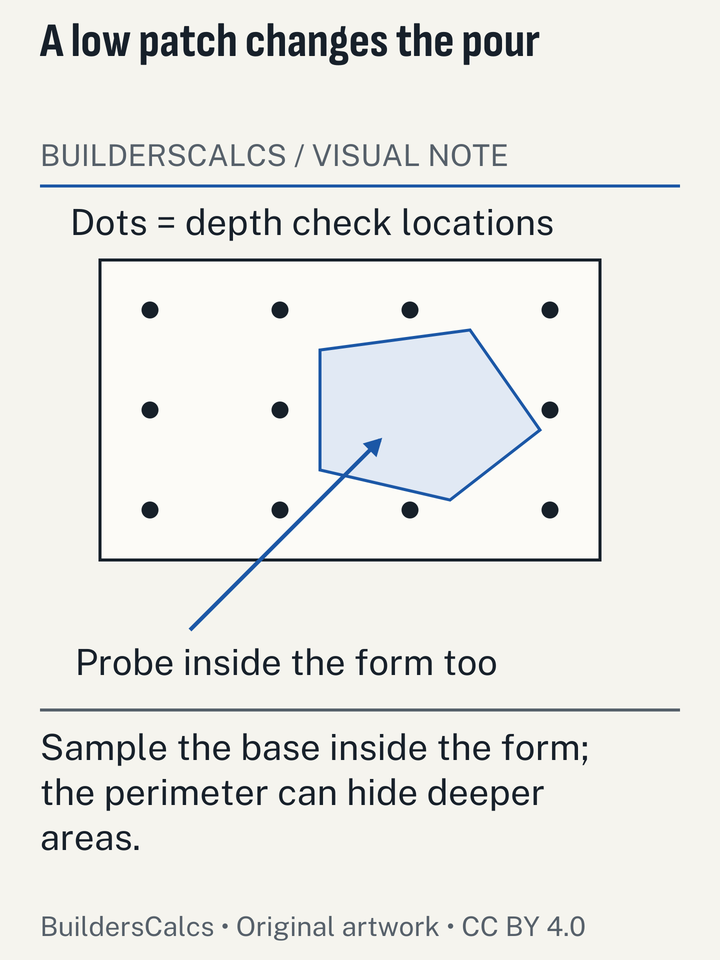
Illustration sources
- National Ready Mixed Concrete Association — CIP 8 - Discrepancies in Yield (rev. 2016)
- National Ready Mixed Concrete Association — CIP 31 - Ordering Ready Mixed Concrete
- Reusefully Ltd for the Mineral Products Association (MPA), Brick Development Association and BRMCA — Interim findings: wastage rates for blocks and ready mixed concrete (V3, 20 March 2023)
What changes between US and metric results?
The formula is the same, but the units and the bags change. In US mode, lengths are in feet and thicknesses in inches, and the result is in cubic yards with cubic feet and cubic metres alongside. In metric mode, lengths are in metres and thicknesses in millimetres, and the result leads with cubic metres. The unit switch converts any value you have typed, and keeps the choice for your next visit on the same device.
One cubic metre equals about 1.31 cubic yards. That matters when you compare quotes, because a US supplier prices by the cubic yard while a UK or EU supplier prices by the cubic metre. US results list 40, 60 and 80 lb bags; metric results list 20 kg UK premix and 25 kg EU dry mix. Bag weight is not a reliable guide to yield across markets, so the calculator uses each product's published yield rather than converting by weight.
In the UK and Ireland, a concrete strip foundation is the same shape as a US footing, so the footing mode covers both. Metric bag counts round up just as US ones do.
When is the result wrong or not enough?
The calculator handles flat slabs, rectangular footings and straight round holes. Several common jobs fall outside that:
- Sloped or tapered slabs. Enter the average thickness. A slab sloped for drainage, or one with thickened edges, holds more concrete than its nominal thickness suggests.
- Steps. Calculate each step as a small slab and add the landing separately. The calculator has no step mode.
- Irregular shapes. Split the area into rectangles and run each one, or use the area trick from the first section.
- Bell-shaped or flared holes. A hole wider at the bottom holds more than a straight cylinder, so measure the widest point or add more extra.
- Post holes with fast-setting mix. Fast-setting post mix is poured dry into the hole, with its own per-hole charts. The post hole calculator uses those charts.
- Structural sizing. The calculator tells you how much concrete fills a shape; it does not tell you what size a footing must be. IRC concrete footings must be at least 12 in (305 mm) wide and 6 in (152 mm) deep. Loads, soil and frost depth can push that up, and anything carrying a house, a deck or a retaining wall should follow your local code or an engineer.
- The base, forms and reinforcement. Gravel, sand, form boards and rebar are not in the result. The gravel calculator sizes the base course.
Weight is a separate question from volume. Quikrete Concrete Mix has a unit weight of about 140 lb/ft³ (2,242 kg/m³). NRMCA's worked ready-mix example uses a fresh density of 151 lb/ft³ (2,430 kg/m³). The two differ, so use density only to estimate weight for a trailer or a floor load, never to work out volume.
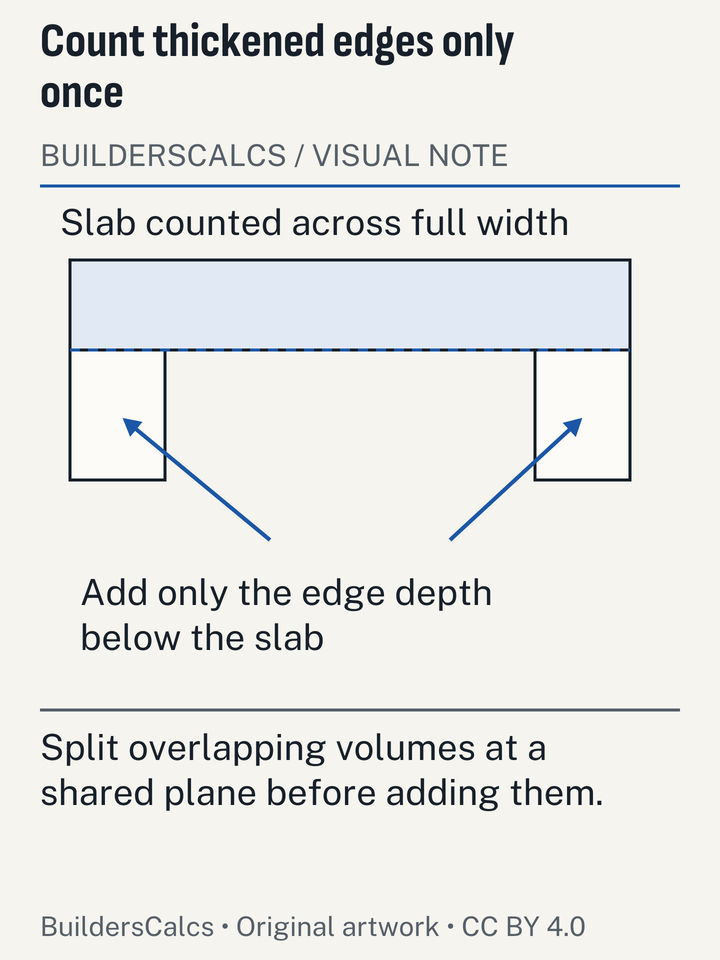
Illustration sources
- International Code Council / California Building Standards Commission via GoCodebook — 2025 California Residential Code Section R403 Footings
- MyBuildingPermit.com (Washington municipal permitting consortium) — Inspection Checklist: Residential Footing and Foundation (2021 IRC with WA amendments, Sept 2024)
- The Quikrete Companies — QUIKRETE Concrete Mix No. 1101 Data Sheet (revised Oct 2022)
- National Ready Mixed Concrete Association — CIP 8 - Discrepancies in Yield (rev. 2016)
How much concrete does the US pour each year?
Far more than any home project. NRMCA estimates US ready-mixed concrete production at 379,149,000 cubic yards (289.9 million cubic meters) in 2024, down about 5% from 400,024,000 cubic yards in 2023. The decline continued into 2025. US ready-mixed concrete production for January-June 2025 was 172.8 million cubic yards, 5.3% below the same period of 2024, per NRMCA's monthly production sheet. Most cement ends up in that ready-mix rather than in bags: An estimated 70% to 75% of US cement sales in 2025 went to ready-mixed concrete producers (USGS), and NRMCA's production model assumes 75% of shipped cement goes to ready mix.
UK figures are smaller and also falling. Great Britain ready-mixed concrete deliveries were 11.03 million cubic meters (about 14.4 million cubic yards at 1.308 yd3 per m3) in 2025, down from 15.33 million in 2021, per DBT's September 2026 building materials bulletin.
Those totals cover all ready-mix, from highways to house slabs. Our page on how much concrete is produced each year collects the full series with sources.
As an Amazon Associate I earn from qualifying purchases. Links to Amazon below can earn us a commission at no cost to you. Affiliate disclosure.
Tools for mixing and placing bagged concrete
Once you know the bag count, these are the items the job uses, picked from the manufacturers' published specifications. We have not handled or measured them. Links go to Amazon; see our affiliate disclosure.
-
QUIKRETE No. 1101

QUIKRETE Concrete Mix
The US bag yields in this calculator are this mix's published figures. An 80 lb bag yields approximately 0.60 cubic feet of concrete. Designed for pours 2 inches thick or more. Heavy bags; buy close to the job.
Check price on Amazon Opens Amazon in a new tab -
Jackson MBP

9 cu ft poly mixing box
A shallow tub for hand-mixing a few bags at a time with a hoe. Holds 9 cubic feet of material. The maker describes jobsite mixing in general rather than concrete specifically, and lists no weight.
Check price on Amazon Opens Amazon in a new tab -
True Temper R625

6 Cubic Foot Steel Wheelbarrow
For moving mixed concrete from the tub to the forms. Seamless steel tray holds 6 cubic feet. The manufacturer does not state a load rating, so do not fill it to the brim with wet concrete.
Check price on Amazon Opens Amazon in a new tab -
Kraft Tool Co. CF016PF

16" x 3-1/4" Square End Magnesium Hand Float with ProForm Handle
For the first pass over the surface after screeding. Blade is 16 inches long. Square ends let the float reach forms and corners.
Check price on Amazon Opens Amazon in a new tab
Which calculator do I need next?
A slab or footing rarely stands alone. Setting fence or deck posts in the same weekend? The post hole calculator gives bags per hole for fast-setting post mix. Building a wall on the new footing? The concrete block calculator counts blocks per square foot or square metre of wall, and the mortar calculator turns that block count into bags of mortar mix. To choose between a general-purpose, high-strength or fast-setting mix, read the concrete mix ratio chart.
The rest of the concrete calculator collection sits on its category page, with the key bag and code figures on one screen. If you want the bag yields on paper at the job, the printable construction charts include a concrete bag chart.
Concrete calculator questions
Can I use this concrete calculator on my phone like an app?
Yes. It runs in any phone browser with no download or account, and it remembers whether you chose US or metric units on that device. Every step of the working is shown under the result, so you can check the maths on site before you load the trailer.
Can I enter square feet instead of length and width?
Yes. Put the area in square feet in the length box and 1 in the width box, then enter the thickness in inches. The calculator multiplies the two, so the volume is the same. In metric mode, do the same with square metres and millimetres.
Why does the calculator default to adding extra concrete?
Because almost every pour uses more than the plan volume. NRMCA advises ordering at least 4-10% more concrete than the plan volume to cover waste, over-excavation and form movement. The calculator starts at the top of that range. Set the extra to zero if you only want the plain volume.
How much does a cubic yard of concrete weigh?
It depends on the mix. Quikrete gives about 140 lb/ft³ (2,242.5 kg/m³) for its bagged concrete, while NRMCA's ready-mix example uses 151 lb/ft³ (2,430 kg/m³). Multiply either by 27 for a cubic yard, and check that figure against your truck or trailer payload before loading.
Is it cheaper to mix bags or order ready-mix?
There is no single answer, because bag prices, delivery charges and minimum loads all vary by supplier. Enter your bag price to get the bag total, then ask a ready-mix plant to quote the cubic yard or cubic metre figure from the result, and compare the two. Remember the labour: one cubic yard is about 45 bags of 80 lb mix to lift and mix by hand.
Use this calculator on your site
Sources (40)
- AMES Companies (Home by AMES)
- Jackson 9 cu ft poly mixing box (MBP), checked
- True Temper 6 Cubic Foot Steel Wheelbarrow (R625), checked
- Cemstone
- Ready Mixed Concrete Customer Service Guidelines 2026, checked
- Department for Business and Trade (DBT), UK (data from ONS, DBT and Mineral Products Association)
- Monthly Bulletin of Building Materials and Components, September 2026 (Bulletin 617), data tables, checked
- Hanson (Heidelberg Materials UK)
- Instant Concrete technical data sheet, checked
- Multipurpose Concrete technical data sheet (updated August 2020), checked
- Health and Safety Executive (UK)
- Construction hazardous substances: Cement, checked
- Heidelberg Materials UK
- Ready-mixed concrete pricing guide, checked
- International Code Council / California Building Standards Commission via GoCodebook
- 2025 California Residential Code (based on 2024 IRC): Sections R402, R403, R506, checked
- 2025 California Residential Code Section R403 Footings, checked
- King Packaged Materials / Sika Canada (SAKRETE Canada)
- SAKRETE Rapid Post product data sheet, checked
- Kraft Tool Co.
- 16" x 3-1/4" Square End Magnesium Hand Float with ProForm Handle (CF016PF), checked
- MyBuildingPermit.com (Washington municipal permitting consortium)
- Inspection Checklist: Residential Footing and Foundation (2021 IRC with WA amendments, Sept 2024), checked
- National Institute of Standards and Technology
- Handbook 44 (2026), Appendix C: General Tables of Units of Measurement, checked
- NIST Guide to the SI (SP 811), Appendix B.9 conversion factors, checked
- Special Publication 811 (2008), Guide for the Use of the International System of Units (SI), Appendix B.8, checked
- National Ready Mixed Concrete Association
- CIP 31 - Ordering Ready Mixed Concrete, checked
- CIP 8 - Discrepancies in Yield (rev. 2016), checked
- National Ready Mixed Concrete Association (NRMCA)
- U.S. Ready Mixed Concrete Production industry fact sheet, 2024 edition (2023 production by state; 2022 total), checked
- U.S. Ready Mixed Concrete Production industry fact sheet, 2025 edition (monthly sheet and 2024 production by state), checked
- QUIKRETE
- Concrete Mix No. 1101 data sheet (rev. Oct 2022), checked
- Reusefully Ltd for the Mineral Products Association (MPA), Brick Development Association and BRMCA
- Interim findings: wastage rates for blocks and ready mixed concrete (V3, 20 March 2023), checked
- SAKRET Trockenbaustoffe Europa
- Technisches Merkblatt SAKRET Premium-Beton (Stand 02.12.2025), checked
- SAKRET Trockenbaustoffe Sachsen
- Technisches Merkblatt SAKRET Beton-Estrich fein BE fein, hosted by BayWa, checked
- SAKRETE of North America
- SAKRETE Fast Setting Concrete Mix technical data sheet, hosted by Home Depot, checked
- SAKRETE High Strength Concrete Mix technical data sheet (REV 7-10), hosted by Home Depot, checked
- Tarmac (Blue Circle)
- High Strength Concrete (40N) product data sheet (June 2014), hosted by Wickes, checked
- Multi-Purpose Concrete product data sheet (March 2014), hosted by Wickes, checked
- POSTCRETE product data sheet (April 2014), hosted by Wickes, checked
- The Quikrete Companies
- Project guide: Concrete Driveways and Curbs, checked
- Project guide: Concrete Patios, checked
- Project guide: Concrete Sidewalks and Small Slabs, checked
- QUIKRETE Concrete Mix No. 1101 Data Sheet (revised Oct 2022), checked
- QUIKRETE Fast-Setting Concrete Mix No. 1004 Data Sheet, checked
- Safety Data Sheet C1: Portland Cement Based Concrete Products (rev. Feb-23), checked
- U.S. Geological Survey (USGS), National Minerals Information Center
- Mineral Commodity Summaries 2026: Cement, checked
- UK Parliament (legislation.gov.uk)
- Weights and Measures Act 1985, Schedule 1, checked
- US Bureau of Labor Statistics
- Producer Price Index by commodity (series WPU0811, WPU083, WPU137, WPU1322, WPU1333, WPU1321, WPU1342, WPU1344, WPU1361, WPU1392, WPU0621, WPU1231, WPU1232, WPUIP2321001), checked
- US Occupational Safety and Health Administration (29 CFR, via Cornell LII)
- 29 CFR 1926.1153 Respirable crystalline silica (construction), checked
- UpCodes (Colorado DFPC Residential Code 2021, based on 2021 IRC)
- R506.1 Concrete floors on ground, checked
Every number on this page is taken from these documents. How we choose and check sources.