

Mulch calculator
Enter the bed size and pick a depth, and this mulch calculator gives the volume in cubic yards or cubic metres and the number of bags. A 10 × 10 ft bed covered 3 in (75 mm) deep holds 0.93 cubic yards; with the default settling allowance, that is 1.02 cu yd, or 14 bags of 2 cu ft. US extension services put the useful range between 2 in on heavy soil and 4 in at most.
Mulch calculator
v1 · US and metricEnter the bed size and pick a depth. The result gives the mulch in cubic yards or cubic metres and the number of bags for common bag sizes.
Result
Enter your measurements and press Calculate.
Formula and assumptions
- Rectangle or strip:
Volume (cu ft) = length (ft) × width (ft) × depth (in) ÷ 12; metric:Volume (m³) = length (m) × width (m) × depth (mm) ÷ 1,000 - Circle (ring around a tree):
Volume (cu ft) = π × (diameter (ft) ÷ 2)² × depth (in) ÷ 12; metric:Volume (m³) = π × (diameter (m) ÷ 2)² × depth (mm) ÷ 1,000 - I know the area:
Volume (cu ft) = area (sq ft) × depth (in) ÷ 12; metric:Volume (m³) = area (m²) × depth (mm) ÷ 1,000 Bags = volume with extra (cu ft) ÷ bag size (cu ft), rounded up; metric:Bags = volume with extra (L) ÷ bag size (L), rounded up- Depth choices come from Iowa State, Rutgers and Penn State Extension for the US (Iowa State University Extension and Outreach and Mississippi State University Extension (S. Collins-Smith)) and from the RHS for the UK (Royal Horticultural Society (UK)).
- Penn State says mulch should be no thicker than 3-4 in; Rutgers says total depth, including old mulch, should not exceed 3 in.
- US bag sizes are 1.5 cu ft, 2 cu ft and 3 cu ft. UK figures use 60 L bags and 0.6 m3 bulk bags.
- One cubic yard is 27 cubic feet, so a cubic yard fills thirteen and a half 2 cu ft bags.
- Bag counts are rounded up to whole bags.
How much mulch do I need for a 10 × 10 ft bed?
About one cubic yard. A 10 ft by 10 ft bed at 3 in holds 25 cu ft of mulch, and with 10% added for settling the calculator shows 27.5 cu ft, or 1.02 cu yd. In bags, that is 19 of the 1.5 cu ft size, 14 of 2 cu ft or 10 of 3 cu ft.
Metric mode opens on a 3 m by 3 m bed at the RHS ideal of 7.5 cm. That is 0.675 m³ before settling and 0.74 m³ after, which is 13 bags of 60 L or 2 of the 0.6 m3 bulk bags.
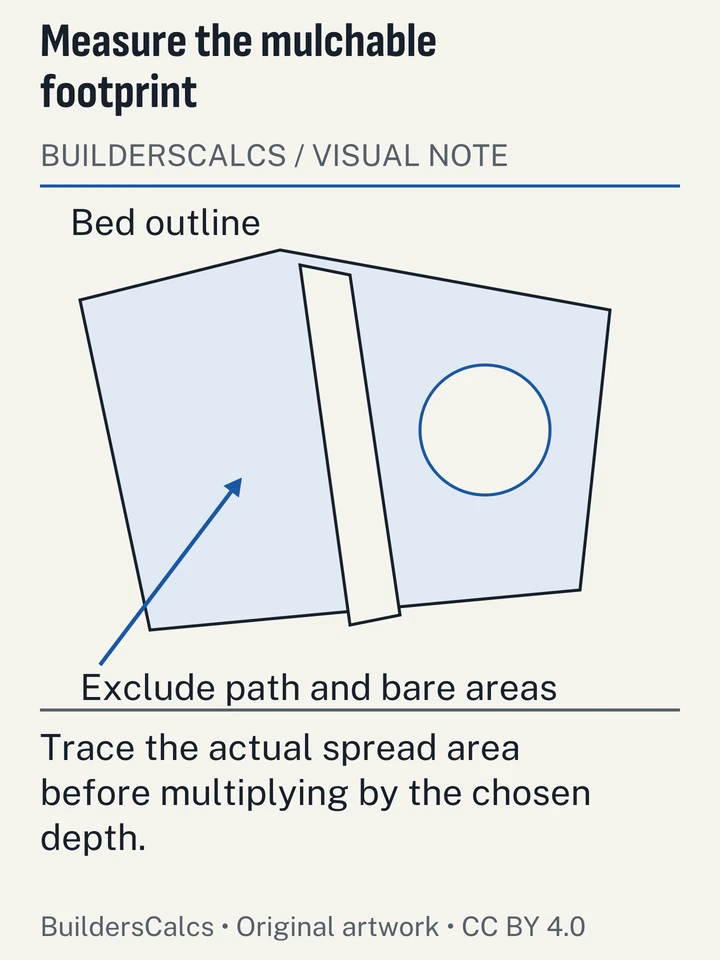
Measure the planted area you will actually cover. For a border, the length along the front and the average depth back to the fence or wall is usually close enough. For a ring around a tree, use the circle shape and enter the full width of the ring, not the radius. If you already know the area from a plan or another calculator, the I know the area option skips the measuring step.
How does the calculator work out mulch volume and bags?
Volume is area times depth, with the depth turned into the same unit as the area. In US mode: length (ft) × width (ft) × depth (in) ÷ 12 = cubic feet, and cubic feet ÷ 27 = cubic yards. For a circle the area is π × (diameter ÷ 2)². The settling allowance multiplies the volume, and each bag count is the volume with settling divided by the bag size, rounded up.
Metric mode has a neat shortcut, because one square metre covered one millimetre deep is exactly one litre. So 10 m² at 75 mm is 750 litres before settling, and the bag count is litres ÷ bag litres. That makes UK bag labels, which are in litres, easy to check by hand.
Worked example: a long border at the upper depth
A 200 sq ft border at 4 in, with 5% for settling. 200 × 4 ÷ 12 = 66.67 cu ft; × 1.05 = 70 cu ft; ÷ 27 = 2.59 cu yd. Bags: 70 ÷ 1.5 = 46.7, so 47; 70 ÷ 2 = 35; 70 ÷ 3 = 23.3, so 24.
If your bags are a size the calculator does not list, type it in the Your bag size box. A 3 in bed of 100 sq ft with 10% settling takes 11 bags of 2.5 cu ft.
| Bed | Depth | Settling | Volume | Bags |
|---|---|---|---|---|
| 10 × 10 ft | 3 in | 10% | 1.02 cu yd | 19 × 1.5, 14 × 2 or 10 × 3 cu ft |
| 3 × 3 m | 7.5 cm (RHS ideal) | 10% | 0.74 m³ | 13 × 60 L or 2 × 0.6 m³ bulk |
| Tree ring 6 ft across, clay soil | 2 in | 0% | 0.17 cu yd | 4 × 1.5, 3 × 2 or 2 × 3 cu ft |
| 200 sq ft border | 4 in | 5% | 2.59 cu yd | 47 × 1.5, 35 × 2 or 24 × 3 cu ft |
| 10 × 10 ft, custom depth | 6 in | 0% | 1.85 cu yd (with a warning) | 25 × 2 cu ft |
Which mulch depth should I choose?
For trees and shrubs on well-drained soil, 3 in, which is the calculator's US default. Around trees and shrubs on well-drained soil, 3 in (75 mm) is the low end of the 3-4 in layer Iowa State and Mississippi State recommend. On heavy clay or soggy ground, go thinner. On heavy clay or poorly drained soils keep mulch to about 2 in (50 mm): Rutgers caps it at 2 in and Iowa State advises 2-3 in. The upper preset is a ceiling, not a target: Penn State says mulch should be no thicker than 3-4 in; Rutgers says total depth, including old mulch, should not exceed 3 in.
The sources do not agree exactly, so the calculator offers each figure with its source rather than averaging them. In the UK, the RHS works in centimetres. The RHS says organic mulches should be at least 5 cm (2 in) thick. The RHS says organic mulches are ideally 7.5 cm (3 in) thick. Fine-textured materials such as shredded leaves or compost go on thinner still. Rutgers advises fine-textured mulches be applied in 1-2 in layers.
A common belief is that more mulch protects plants better. Extension services say the opposite: deep layers and mulch piled against trunks keep air and water from roots and invite rot. Keep mulch off trunks and stems: Iowa State says at least 6 in from tree trunks; Rutgers says 3-5 in from young stems and 8-12 in from mature trunks. If you choose a custom depth beyond 4 in, the result carries a warning.
The research on depth is thinner than the advice suggests. A 2026 systematic review screened 1,200 papers and found only 11 peer-reviewed studies that tested mulch depth on trees; all but two tested depths above the usual 5–10 cm (2–4 in), and harms were reported mostly above 10 cm (Martin et al., Arboriculture & Urban Forestry). On weeds, one greenhouse trial is often quoted: In a University of Florida greenhouse trial, 2 inches of hardwood chip mulch alone cut garden spurge growth by 87% and eclipta by 83%, against 51% and 45% for 1 inch, per Saha et al., HortTechnology (2019). That is one trial with potted weeds, not a field rate, but it supports staying at the depths above rather than going thinner to save money. The mulch depth and coverage guide goes through depth plant by plant.
Why does the calculator add 10% for settling?
Because fresh bark settles once it is spread and watered, and the only figure we found for how much comes from a UK mulch producer. Melcourt recommends allowing 5-10% extra bark mulch for natural settlement. The calculator starts at the top of Melcourt's range. No extension service we checked gives a settling percentage, so treat this as one producer's advice and lower it for fine, already-composted material.
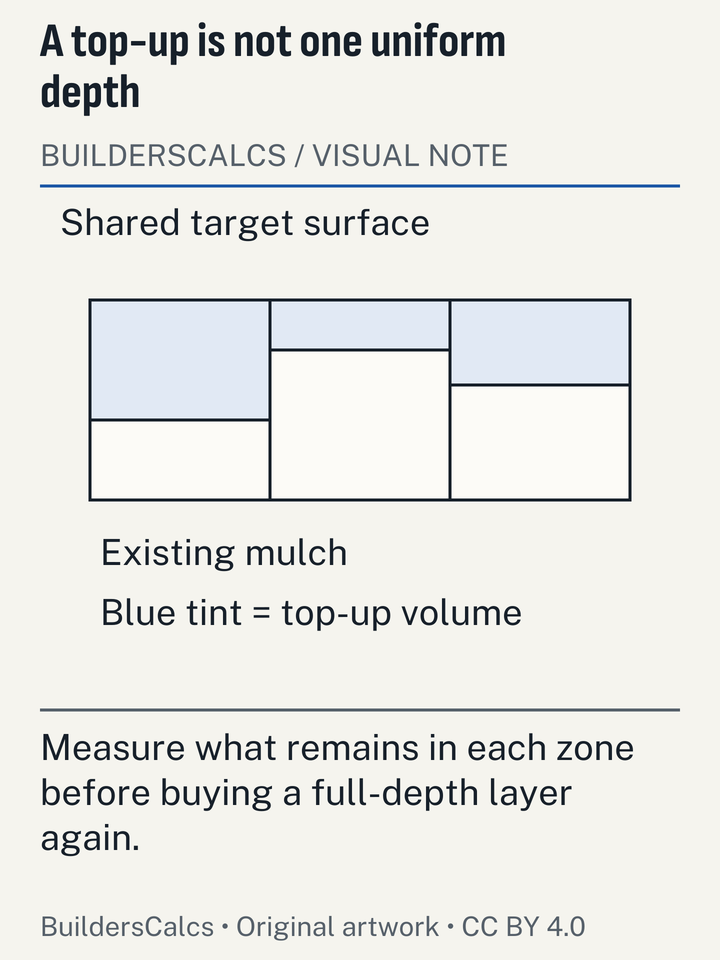
Topping up an old bed is different. Rutgers says the depth limit includes the mulch already there, so measure what is left and enter only the difference as the depth. Ordering a full new layer on top of last year's is how beds end up too deep.
How many bags of mulch fit in a cubic yard?
It depends on the bag, and US bags come in several sizes. The calculator lists three. Scotts Nature Scapes mulch is sold in 1.5 cu ft bags (42.5 L); one covers 6 sq ft 3 in deep. A common US mulch bag holds 2 cu ft (56.6 L); Scotts' label says it covers 8 sq ft 3 in deep. Some US bark mulch is sold in 3 cu ft (85 L) bags, which cover 12 sq ft 3 in deep. The 3 cu ft size is a single-source value: the only listing we found was a retailer's, with no maker's data sheet behind it, so check the bag before you rely on that count.
The 2 cu ft label is a useful check on the arithmetic. A 2 cu ft bag spread 3 in deep covers 8 sq ft, as printed on Scotts Nature Scapes mulch bags. The calculator's formula gives the same answer, which is a quick way to confirm you have entered the depth in inches.
| Bag size (cu ft) | Bags per cubic yard |
|---|---|
| 1.5 | 18 |
| 2 | 13.5 |
| 3 | 9 |
Bags or bulk mulch: what changes in the UK?
In the US, bulk mulch is sold by the cubic yard and bags by the cubic foot, so the calculator shows both. Above a cubic yard or so, the bag count gets long: the 200 sq ft border above needs 35 bags of the common size. We hold no price data, so the calculator cannot say where bulk becomes cheaper; that depends on your supplier's yard price and delivery charge. Price the cubic-yard figure against the bag count from the same result.
UK results switch to litres and bulk bags, using Melcourt's sizes. Melcourt bark mulches are sold in 60 litre (2.1 cu ft) bags. Melcourt's bulk bags hold 0.6 m3 (21 cu ft, 0.78 cu yd) of mulch. Other UK bark bags come in other sizes, but we found no maker's page listing them, so enter yours in the bag-size box in litres. Depth is in millimetres, and the presets follow the RHS.
Bark is now a large part of UK garden products, not just mulch. Wood fibre (1,055,510 m³) and bark (365,792 m³) together made up 45.1% of UK growing media volume in 2023, more than peat, per Defra's growing media datasheets.
When is the mulch result wrong?
- Old mulch still in the bed. The calculator assumes bare soil. Subtract what is there from the depth you enter.
- Stone or rubber mulch. These do not settle like bark and are bought by weight; for stone, use the tons of gravel for your area calculator instead.
- Steep banks. Mulch washes down slopes, so the top of the bank thins and the bottom thickens. Expect to top up.
- Weight for a trailer. The calculator gives volume only. We have no sourced weight for mulch, as the material weight and density table notes, and wet bark is far heavier than dry.
- New beds needing soil first. If the bed needs soil before mulch, size that layer with the cubic yards of soil or dirt calculator.
How much yard waste becomes mulch?
A lot of it starts as garden waste. Americans generated 35.4 million tons of yard trimmings in 2018 (12.1% of municipal solid waste), of which 22.3 million tons (63%) were composted, per EPA's Facts and Figures; 2018 is still EPA's latest national year and mulch spread directly on land is not counted. The rest goes elsewhere: 10.5 million tons of US yard trimmings were still landfilled in 2018, per EPA's Facts and Figures (the latest national year). Chipping your own prunings into the beds keeps them out of both figures, and the volume formula works the same for homemade chips as for bagged bark.
Which calculator or guide do I need next?
Before mulching a new bed, check the soil beneath. The guide to topsoil depth for lawns and beds sets out how deep the growing layer should be, and the topsoil calculator turns that into cubic yards or bulk bags. For gravel paths between beds, use the gravel calculator, which works by weight. The landscaping calculators page lists the rest, including paving and fencing.
Mulch calculator questions
Is a 60 litre bag of bark about the same as a 2 cubic foot bag?
Close. Melcourt bark mulches are sold in 60 litre (2.1 cu ft) bags. A US 2 cu ft bag is 56.6 L, so the UK bag holds slightly more. The calculator works out each size separately, so the counts will differ a little.
Why does the calculator use a different default depth in metric mode?
Because US and UK advice come from different bodies. US mode starts at the extension-service figure of 3 in; metric mode starts at the RHS ideal of 7.5 cm. The two are nearly the same depth, and either can be changed in the depth list.
How many 3 cu ft bags cover 100 square feet at 3 inches?
Nine without settling: 100 × 3 ÷ 12 = 25 cu ft, and 25 ÷ 3 = 8.3, rounded up. With the default 10% settling it becomes 10 bags. Check the bag, since that size comes from a retailer listing only.
Does the calculator allow for the gap around tree trunks?
No. A tree ring is treated as a full circle, and the bare ring at the trunk is small enough that the extra covers it. Do keep that gap clear when spreading, though; the advised clearance depends on the source and the age of the tree.
Use this mulch calculator on your own site
Sources (16)
- American Society for Horticultural Science (Saha, Marble, Pearson et al., University of Florida)
- Mulch Type and Depth, Herbicide Formulation, and Postapplication Irrigation Volume Influence on Control of Common Landscape Weed Species. HortTechnology 29(1):65-77, checked
- Department for Environment, Food & Rural Affairs (Defra)
- Annual use of peat and alternatives in the UK horticultural market 2021 to 2023 (growing media production datasheets), checked
- International Society of Arboriculture (Martin, Klein, Koeser, Hauer)
- Does Excess Mulch Depth Lead to Poor Tree Growth and Condition, Root Girdling, and Decay? A Systematic Literature Review. Arboriculture & Urban Forestry 52(1):93-108, checked
- Iowa State University Extension and Outreach
- How deep should the mulch layer be around trees and shrubs?, checked
- Johnson's Garden Centers (retailer listing)
- Grade-A All Bark Cedar Mulch (3 cu. ft.), checked
- Melcourt Industries Ltd (UK)
- Ornamental Bark Mulch product page (specification and how to use), checked
- Mississippi State University Extension (S. Collins-Smith)
- How to mulch (Extension for Real Life blog), checked
- National Institute of Standards and Technology
- Handbook 44 (2026), Appendix C: General Tables of Units of Measurement, checked
- Special Publication 811 (2008), Guide for the Use of the International System of Units (SI), Appendix B.8, checked
- Penn State Extension (V. Cotrone)
- Learning How to Properly Mulch Can Save Your Tree (Aug 25, 2025), checked
- Royal Horticultural Society (UK)
- Mulches and mulching, checked
- Rutgers Cooperative Extension (Crawford, Cabrera)
- FS099 Problems With Over-Mulching Trees and Shrubs (July 2021), checked
- Scotts Miracle-Gro (label text as shown on Ace Hardware listing)
- Scotts Nature Scapes Color Enhanced Mulch 2 cu ft, checked
- Scotts Miracle-Gro (product listing on Lowe's)
- Scotts Nature Scapes Color Enhanced 1.5 cu ft Mulch, checked
- UK Parliament (legislation.gov.uk)
- Weights and Measures Act 1985, Schedule 1, checked
- US Environmental Protection Agency
- Yard Trimmings: Material-Specific Data (Facts and Figures about Materials, Waste and Recycling), checked
Every number on this page is taken from these documents. How we choose and check sources.