

Topsoil calculator
Enter the area and the depth of new soil, and this topsoil calculator gives cubic yards or cubic metres, an approximate weight and a bag count. NMSU puts the least soil a lawn can grow in at 4 in, and a 10 × 10 ft patch at that depth takes 1.23 cubic yards; with the default allowance for settling, order 1.30 cu yd, or 24 bags of 1.5 cu ft. About 12.5 cubic yards of topsoil make a 4 in layer over 1,000 sq ft (exact geometry: 12.35 yd3).
Topsoil calculator
v1 · US and metricEnter the area and how deep the new soil needs to be. The result gives the volume, an approximate weight and the number of bags or bulk bags.
Result
Enter your measurements and press Calculate.
Formula and assumptions
- Rectangle (lawn, bed or raised bed):
Volume (cu ft) = length (ft) × width (ft) × depth (in) ÷ 12; metric:Volume (m³) = length (m) × width (m) × depth (mm) ÷ 1,000 - Circle:
Volume (cu ft) = π × (diameter (ft) ÷ 2)² × depth (in) ÷ 12; metric:Volume (m³) = π × (diameter (m) ÷ 2)² × depth (mm) ÷ 1,000 - I know the area:
Volume (cu ft) = area (sq ft) × depth (in) ÷ 12; metric:Volume (m³) = area (m²) × depth (mm) ÷ 1,000 Weight = volume (m³) × 900 to 1,200 kg/m³, shown in US tons; metric:Weight (tonnes) = volume (m³) × 900 to 1,200 kg/m³ ÷ 1,000- Depths come from NMSU and Utah State Extension and the Miracle-Gro garden soil label (New Mexico State University Cooperative Extension (B. Leinauer) and University of Tennessee Extension (Samples, Sorochan)).
- About 12.5 cubic yards of topsoil make a 4 in layer over 1,000 sq ft (exact geometry: 12.35 yd3).
- The weight range uses Melcourt's Topsoil Blended Loam has a bulk density of 900-1,200 kg/m3 (about 56-75 lb/ft3) as supplied. Other topsoils can be lighter or heavier, so check the supplier's figure if you buy by weight.
- US bags are 0.75 cu ft topsoil and 1.5 cu ft garden soil. UK figures use 20 L bags and 0.6 m3 bulk bags.
- Bag counts are rounded up to whole bags.
How many cubic yards of soil do I need for a 10 × 10 ft area?
1.30 cubic yards at the lawn minimum of 4 in, once the 5% settling allowance is added. The plain volume is 33.33 cu ft; with settling it is 35 cu ft. The calculator shows that as 47 bags of the 0.75 cu ft topsoil size or 24 of the 1.5 cu ft garden soil size, and an approximate weight of 0.98 to 1.31 US tons.
Metric mode opens on a 5 m by 4 m area 150 mm deep: 3 m³ before settling and 3.15 m³ after. That is 6 bulk bags of 0.6 m3, or 158 bags of 20 L, weighing roughly 2.84 to 3.78 tonnes.
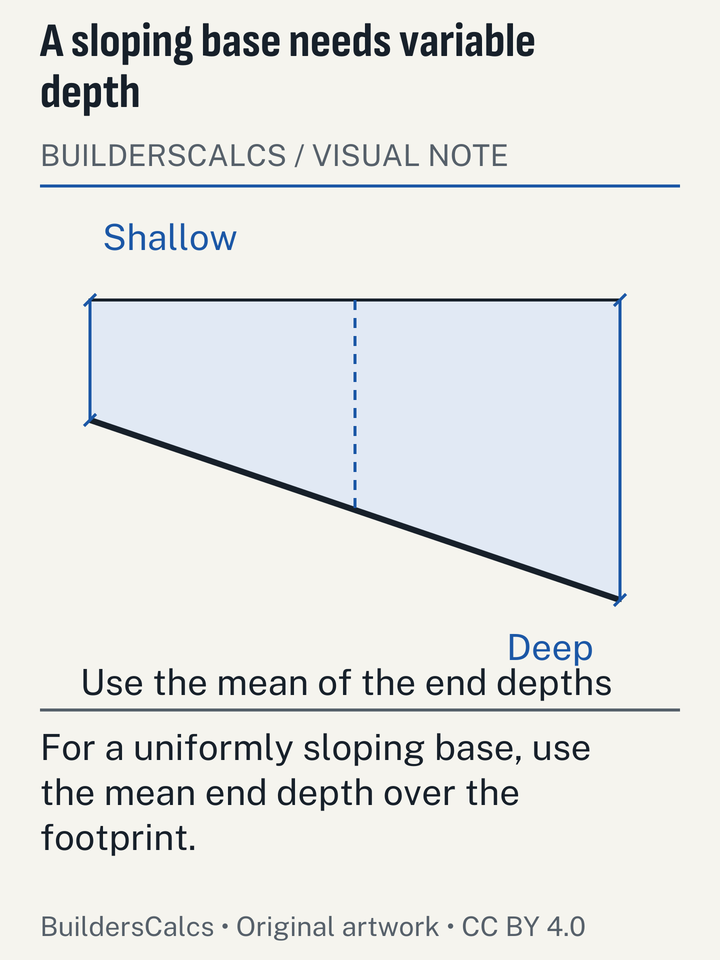
Measure the area you are covering and decide on the depth of new soil, not the total depth to subsoil. If a bed already has some decent soil, the gap between what is there and the depth you want is the number to enter. For a level-up job, such as filling a hollow in a lawn, measure the depth at several points and use a custom depth equal to the average.
How does the topsoil calculation work?
Area times depth gives the volume; the settling allowance increases it; the bag size divides it; and a density range turns it into weight. In US units: length (ft) × width (ft) × depth (in) ÷ 12 = cubic feet, then ÷ 27 for cubic yards. Circles use π × (diameter ÷ 2)². In metric, m² × mm ÷ 1,000 = m³, and m³ × 1,000 = litres for the bag count.
The weight step works in metric whichever mode you are in: m³ × 900–1200 kg/m3 gives a range in kilograms, shown in US tons and tonnes. It is a range because that is how the only source we have states it.
Worked example: a 4 × 8 ft raised bed
A raised bed 4 ft by 8 ft, filled 12 in deep, no extra. 4 × 8 × 12 ÷ 12 = 32 cu ft, which is 32 ÷ 27 = 1.19 cu yd. In bags, 32 ÷ 0.75 = 42.7, rounded up to 43, or 32 ÷ 1.5 = 21.3, rounded up to 22.
The calculator also agrees with a bag label. Miracle-Gro's label says three 1.5 cu ft bags cover 24 sq ft about 2 in deep, or four bags at 3 in. Enter 24 sq ft at the garden-soil depth with no extra and the result is 4 cu ft, or 3 bags of the 1.5 cu ft size, the same as the label.
| Job | Depth | Settling | Volume | Bags or bulk bags |
|---|---|---|---|---|
| 10 × 10 ft lawn patch | 4 in | 5% | 1.3 cu yd | 47 × 0.75 cu ft or 24 × 1.5 cu ft |
| 5 × 4 m area | 150 mm | 5% | 3.15 m³ | 158 × 20 L or 6 × 0.6 m³ bulk |
| 4 × 8 ft raised bed | 12 in | 0% | 1.19 cu yd | 43 × 0.75 cu ft or 22 × 1.5 cu ft |
| 24 sq ft bed, garden soil | 2 in | 0% | 0.15 cu yd | 3 × 1.5 cu ft |
| Circle 10 ft across | 6 in | 0% | 1.45 cu yd | 53 × 0.75 cu ft |
| 100 m² lawn (metric) | 4 in lawn minimum | 0% | 10.16 m³ | 17 × 0.6 m³ bulk or 254 × 40 L |
| Depth (in) | Depth (mm) | Cubic yards per 1,000 sq ft | m³ per 1,000 sq ft |
|---|---|---|---|
| 2 | 51 | 6.17 | 4.72 |
| 4 | 102 | 12.35 | 9.44 |
| 6 | 152 | 18.52 | 14.16 |
| 8 | 203 | 24.69 | 18.88 |
How deep should new topsoil be?
For a lawn, at least 4 in, and more if you can. NMSU says the absolute minimum soil depth for a lawn is 4 in, with 6 in or more recommended for deep roots. The calculator's depth list follows those sources:
- 2 in, garden soil: Miracle-Gro directs spreading 2-3 in of garden soil and mixing it into the top 6-8 in of native soil. This is a label direction, not an extension figure.
- 4 in and 6 in, lawns: Where soil is poor, add topsoil and organic matter to reach 4-6 in of total topsoil depth after firming.
- 6 in to 12 in, raised beds: USU says raised beds should be at least 6-12 in high; beds under 12 in should be open-bottomed over loosened soil.
A widespread idea is that an inch or two of good soil over hard subsoil is enough to start a lawn. Extension guides disagree: they set the minimum at the depths above and ask for the subsoil to be loosened first, so roots can carry on downward. The how deep topsoil should be guide explains the reasons and covers borders as well.
For UK lawns, the RHS gives a digging depth rather than a soil depth. Before turfing, the RHS says dig or rotovate to 20-25 cm (8-10 in) and let the ground settle, ideally five to six weeks. We found no British Standard or RHS figure for the depth of imported topsoil under a lawn, so metric mode opens on a custom 150 mm that you can change.
How much does a cubic yard of topsoil weigh?
About 0.76 to 1.01 US tons per cubic yard (0.69 to 0.92 tonnes per cubic yard) as supplied, if the one published figure we have is typical. The calculator's weight uses a single source, a UK producer's data for its own blended loam: Melcourt's Topsoil Blended Loam has a bulk density of 900-1,200 kg/m3 (about 56-75 lb/ft3) as supplied. We found no US producer or extension service that publishes a delivered topsoil weight, so the same UK figure is used in both modes.
Research figures for natural soil sit higher and wider. Loose dry unit weights of 14 natural soils tested for WisDOT ranged 66-106 lb/ft3 (about 0.89-1.43 short tons/yd3 dry, before moisture). Moisture adds more on top, and wet soil after rain can be much heavier than either figure. Before you load a trailer, ask the supplier for the weight of the material you are buying. The bulk density of gravel, soil and sand page sets soil next to stone and sand.
Check which ton a supplier means. The UK imperial gallon is about 20% larger than the US gallon, and the UK long ton is 2,240 pounds against the US short ton of 2,000 pounds, per NIST Handbook 44 (2026) Appendix C. The calculator shows US short tons and metric tonnes; a quote in long tons is about 12% heavier per ton than a US one.
Why does the calculator add 5% for settling?
Because loose, screened topsoil firms down after spreading and watering, and the only percentage we found comes from the same UK producer as the weight. Melcourt recommends allowing 5% extra topsoil for natural settlement. No extension guide we checked gives a settling allowance, and the extension depth targets are already stated as depths after firming. So 5% is one producer's advice, not a measured rule; set it to zero for plain volume, or raise it for very loose, fluffy loads.
Do not confuse settling with swell. Soil dug out of the ground takes more room in a pile than it did in place, which matters when you are excavating rather than filling. The cubic yards for any bulk material calculator covers that kind of plain volume job, and the RHS advice to let dug ground settle for several weeks before turfing applies whichever way you go.
What bag and bulk bag sizes does it use?
US results show two bag sizes. Scotts Premium Topsoil comes in 0.75 cu ft (21 L) bags; one covers 4 sq ft 2 in deep. Miracle-Gro All Purpose Garden Soil comes in 1.5 cu ft (42.5 L) bags. Topsoil and garden soil are not the same product: garden soil is meant to be mixed into the existing ground, topsoil to build depth. A cubic yard is 27 ÷ 0.75 = 36 of the smaller bags, which is why a lawn of any size is usually delivered loose by the yard.
UK results use Melcourt's packs. Melcourt topsoil is sold in 20 litre bags (17-21 kg each). Melcourt topsoil bulk bags hold 0.6 m3 and weigh 510-630 kg. Other brands sell different sizes, so enter yours in the bag-size box: in litres in metric mode and cubic feet in US mode.
Soil is a small but growing part of UK bagged products. UK growing media products used 215,880 cubic metres of soil or loam in 2023 (6.8% of all growing media volume), up from 191,258 m³ in 2021, per Defra's growing media datasheets.
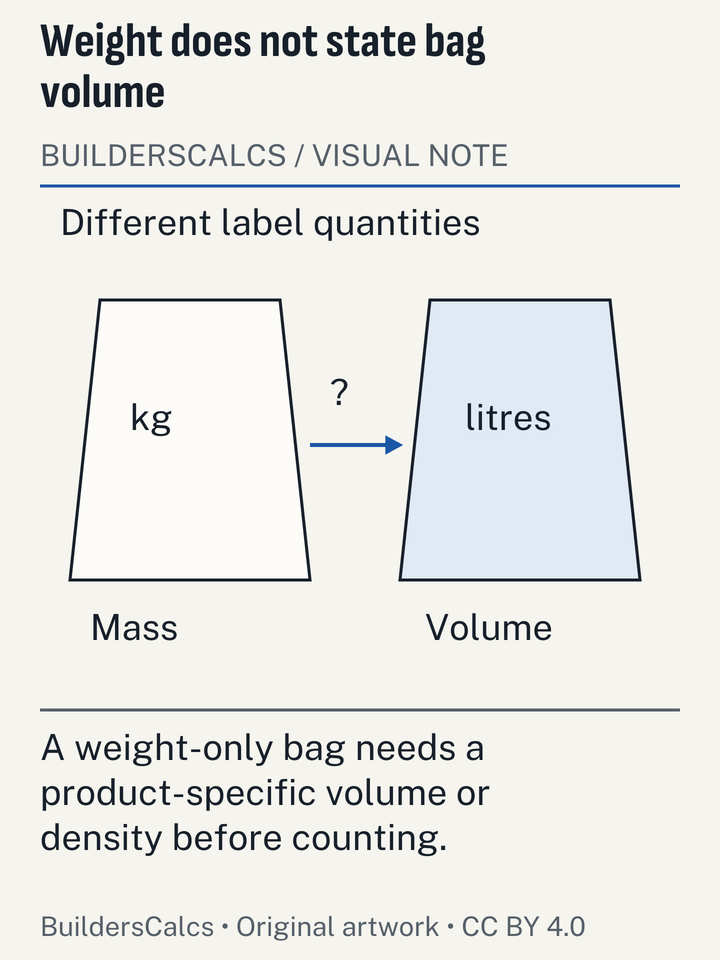
Illustration sources
- Scotts Miracle-Gro (label text as shown on Farm and Fleet listing) — Scotts Premium Topsoil 0.75 cu ft
- Scotts Miracle-Gro (label text as shown on Farm and Fleet listing) — Miracle-Gro All Purpose Garden Soil 1.5 cu ft
- NIST — Handbook 44 (2026), Appendix C: General Tables of Units of Measurement
- UK Parliament (legislation.gov.uk) — Weights and Measures Act 1985, Schedule 1
- Melcourt Industries Ltd (UK) — Topsoil Blended Loam product page (specification and how to use)
- Department for Environment, Food & Rural Affairs (Defra) — Annual use of peat and alternatives in the UK horticultural market 2021 to 2023 (growing media production datasheets)
When is the topsoil result wrong?
- Uneven ground. Levelling a sloping or lumpy yard needs the average depth of fill, which is usually much more than the depth at the high side.
- Mixing in. Garden soil dug into the top few inches of the bed does not add its full depth on top; the bed rises by less.
- Compacted subsoil. The calculator sizes the new layer only. Ground compacted by building work should be loosened first, or the lawn sits on a hard pan.
- Deep fill under raised beds. Tall beds are sometimes part-filled with coarser material; enter only the depth you will fill with soil.
- Weight. The range comes from one UK producer's loam. Your soil, and its water content, may differ.
Why is a few inches of topsoil worth buying?
Because the natural layer is easily lost under building and erosion. About 120 million acres of US land was developed by 2022, up 48 million acres (66%) since 1982, so 40% of all developed land was built in the last 40 years, per USDA NRCS's 2022 National Resources Inventory. New homes on that land often sit on subsoil left by grading. On farmland, the loss is gradual. US cropland lost about 4.75 tons of soil per acre per year in 2022 (2.67 t from water sheet-and-rill erosion and 2.08 t from wind), a 34% drop in erosion rates since 1982, per USDA NRCS's 2022 National Resources Inventory. These are national USDA figures for land use and cropland, not for gardens, but they show why imported soil is often needed before a lawn will take.
Which landscaping calculator do I need next?
Once the soil is down, a bed usually needs mulch: the mulch volume tool sizes it by depth and bag, and the guide on how deep to spread mulch explains the depths. For a path or a drainage layer, the gravel calculator works by weight. The full set of landscape supply calculators includes paving and fencing too.
Topsoil calculator questions
How much soil fills a 4 × 8 ft raised bed?
1.19 cubic yards for a bed 12 in deep, or about 0.59 cu yd for one 6 in deep. In bags that is 22 or 11 of the 1.5 cu ft size. Enter your bed's inside dimensions, since thick timber or block sides take up some of the outside measurement.
Is topsoil the same as garden soil in a bag?
No. Bagged garden soil is sold to be spread a little way and dug into the existing ground, while topsoil is the material you use to build depth for a lawn or a bed. The calculator lists one size of each in US mode, and the volume maths is the same for both.
Why is the weight shown as a range rather than one number?
Because the only source we have gives a range for its own product: Melcourt's Topsoil Blended Loam has a bulk density of 900-1,200 kg/m3 (about 56-75 lb/ft3) as supplied. Soil weight also changes with moisture. Use the upper figure when checking a trailer or truck load.
Can I use the topsoil calculator for fill dirt?
For volume, yes: cubic yards are cubic yards. The weight will not suit fill, which is denser and stonier than screened loam. Use the volume, then ask the supplier for the fill's weight per cubic yard or cubic metre.
Embed the topsoil calculator
Sources (14)
- Department for Environment, Food & Rural Affairs (Defra)
- Annual use of peat and alternatives in the UK horticultural market 2021 to 2023 (growing media production datasheets), checked
- Melcourt Industries Ltd (UK)
- Topsoil Blended Loam product page (specification and how to use), checked
- National Institute of Standards and Technology
- Handbook 44 (2026), Appendix C: General Tables of Units of Measurement, checked
- NIST Handbook 44 (2026), Appendix C: General Tables of Units of Measurement, checked
- Special Publication 811 (2008), Guide for the Use of the International System of Units (SI), Appendix B.8, checked
- New Mexico State University Cooperative Extension (B. Leinauer)
- Guide H-509 Turfgrass Establishment (rev. Dec 2016), checked
- Royal Horticultural Society (UK)
- How to lay turf, checked
- Scotts Miracle-Gro (label text as shown on Farm and Fleet listing)
- Miracle-Gro All Purpose Garden Soil 1.5 cu ft, checked
- Scotts Premium Topsoil 0.75 cu ft, checked
- UK Parliament (legislation.gov.uk)
- Weights and Measures Act 1985, Schedule 1, checked
- USDA Natural Resources Conservation Service and Iowa State University CSSM
- Summary Report: 2022 National Resources Inventory (September 2025), checked
- University of Tennessee Extension (Samples, Sorochan)
- W160-A Turfgrass Establishment: Preparing to Plant (2007), checked
- Utah State University Extension
- Raised Bed Gardening (Feb 2012), checked
- Wisconsin Highway Research Program / WisDOT (Cetin, Bulduk, Likos, Edil)
- Weight-Volume Relationships and Conversion Factors for Soils and Aggregates of Wisconsin, WHRP G22-05 (Dec 2023), checked
Every number on this page is taken from these documents. How we choose and check sources.