

Metric vs imperial in construction: conversions, lumber sizes and gallons
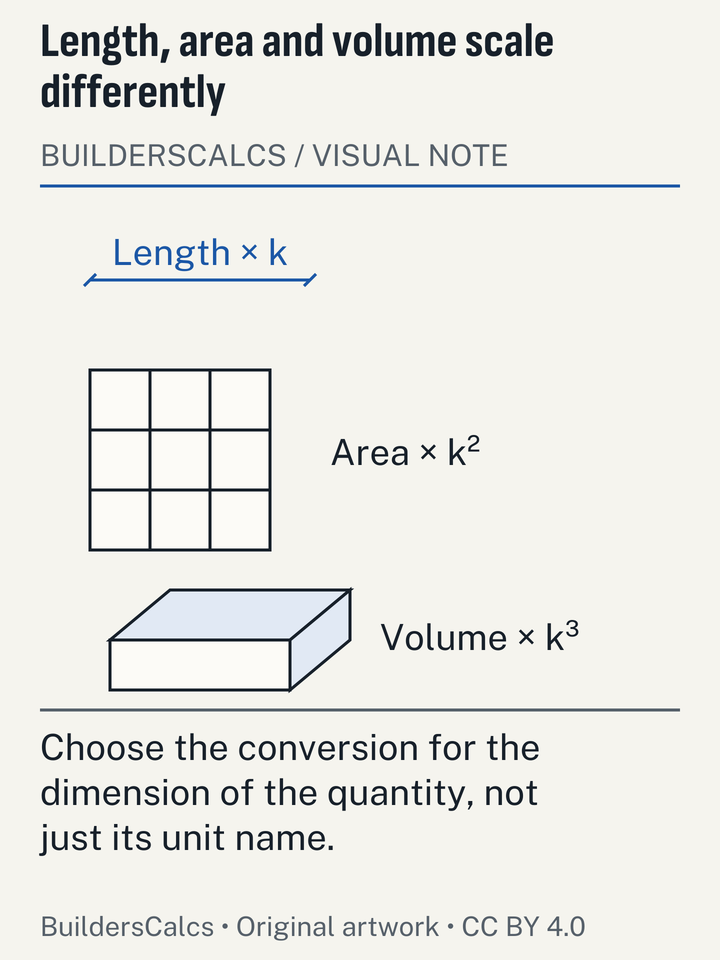
Every common imperial building unit has an exact metric definition. One inch is exactly 2.54 cm. One foot is exactly 0.3048 m. The traps are not the factors but the names: a US gallon is smaller than a UK gallon, a ton can mean three different weights, a 2×4 is not 2 in by 4 in, and a US drywall sheet is not the same size as a UK plasterboard sheet. Convert the number exactly, then check the product.
What are the exact conversion factors for building work?
The table gives the factors our calculators use, each from NIST or UK legislation. Most are exact by definition, so there is no rounding error until you round the answer. Multiply by the factor to go from imperial to metric; divide to go back.
| Quantity | Imperial or US unit | Metric equivalent | Exact? |
|---|---|---|---|
| Length | 1 inch | 2.54 cm | Exact |
| Length | 1 foot | 0.3048 m | Exact |
| Length | 1 yard | 0.9144 m | Exact |
| Area | 1 square foot | 0.09290304 m² | Exact |
| Area | 1 square yard | 0.83612736 m² | Exact |
| Volume | 1 cubic foot | 0.028316846592 m³ | Exact |
| Volume | 1 cubic yard | 0.764554857984 m³ | Exact |
| Volume | 1 cubic yard | 27 cu ft | Exact |
| Liquid | 1 US gallon | 3.785411784 L | Exact |
| Liquid | 1 UK (imperial) gallon | 4.54609 L | Exact |
| Mass | 1 pound | 0.45359237 kg | Exact |
| Mass | 1 US short ton (2,000 lb) | 907.18474 kg | Exact |
| Mass | 1 UK long ton (2,240 lb) | 1,016.0469088 kg | Exact |
| Density | 1 lb/ft³ | 16.01846 kg/m³ | Rounded |
| Density | 1 short ton per cu yd | 1,186.553 kg/m³ | Rounded |
| Load | 1 lb/ft² (psf) | 0.04788026 kPa | Rounded |
| Paint spread | 1 sq ft per US gallon | 0.024542 m² per L | Rounded |
| Thermal resistance | R-1 (ft²·°F·h/Btu) | RSI 0.1761102 (m²·K/W) | Rounded |
Which units have the same name but different sizes?
The gallon and the ton. The UK imperial gallon is about 20% larger than the US gallon, and the UK long ton is 2,240 pounds against the US short ton of 2,000 pounds, per NIST Handbook 44 (2026) Appendix C. A UK spread rate in square metres per litre and a US one in square feet per gallon can't be compared until both are in the same units, and a "ton" of gravel from a US quarry is lighter than a UK long ton and a little lighter than a metric tonne. When a supplier quotes in tons, ask which one.
The foot used to have a twin as well. The US survey foot was retired after 31 December 2022, leaving the international foot (exactly 0.3048 m) as the single US foot except for legacy uses, per NIST Handbook 44 (2026) Appendix C. The two differed only slightly, which mattered on long survey distances rather than on a building plot.
Why is a 2×4 not 2 inches by 4 inches?
Because 2×4 is a nominal size. A 2x4 is 1-1/2 in by 3-1/2 in when dry and dressed (38 x 89 mm). The rough-sawn board is planed and dried down to its dressed size, and PS 20 sets the minimum dressed size for each nominal size. So a wall of 2×4 studs is 3-1/2 in thick before sheathing, not 4 in.
UK studwork is sold in metric target sizes instead. CLS/ALS studwork is 38 mm thick in widths 63, 89, 114, 140, 184, 235 and 285 mm, with rounded arrises. A US 2×4 and a UK 38 × 89 mm CLS stud are the same section. A UK 47 × 100 mm sawn timber is not; it is thicker and wider than a 2×4. Lengths step differently too: US softwood lumber comes in 1 ft or 2 ft length multiples; 2 ft (even) lengths are usual for construction lumber. UK/Irish structural softwood lengths step in 300 mm increments.
| Nominal (in) | Actual thickness (in) | Actual width (in) | Thickness (mm) | Width (mm) |
|---|---|---|---|---|
| 1x2 | 0.75 | 1.5 | 19 | 38 |
| 1x3 | 0.75 | 2.5 | 19 | 64 |
| 1x4 | 0.75 | 3.5 | 19 | 89 |
| 1x6 | 0.75 | 5.5 | 19 | 140 |
| 1x8 | 0.75 | 7.25 | 19 | 184 |
| 1x10 | 0.75 | 9.25 | 19 | 235 |
| 1x12 | 0.75 | 11.25 | 19 | 286 |
| 5/4x6 | 1 | 5.5 | 25 | 140 |
| 2x2 | 1.5 | 1.5 | 38 | 38 |
| 2x3 | 1.5 | 2.5 | 38 | 64 |
| 2x4 | 1.5 | 3.5 | 38 | 89 |
| 2x6 | 1.5 | 5.5 | 38 | 140 |
| 2x8 | 1.5 | 7.25 | 38 | 184 |
| 2x10 | 1.5 | 9.25 | 38 | 235 |
| 2x12 | 1.5 | 11.25 | 38 | 286 |
| 4x4 | 3.5 | 3.5 | 89 | 89 |
| 4x6 | 3.5 | 5.5 | 89 | 140 |
| 6x6 | 5.5 | 5.5 | 140 | 140 |
How do sheet, bag and roll sizes differ between the US and UK?
Many products are made to round numbers in each system, so a converted size is close but not equal. That difference changes counts. The table pairs the products our calculators handle.
| Product | US | UK or EU | What it means for the count |
|---|---|---|---|
| Drywall / plasterboard sheet | A 4x8 ft sheet covers 32 sq ft (2.97 m2). | One 1200 x 2400 mm sheet covers 2.88 m2 (31.0 sq ft). | A UK board covers slightly less; don't reuse a US sheet count |
| Bagged concrete | An 80 lb bag of concrete mix yields about 0.60 cu ft (17 L). | A bag of Blue Circle ready-to-use concrete makes about 0.01 m³, so roughly 100 bags per m³. | UK bags yield much less each, so the count is higher |
| Wallpaper roll | A 20.5 in x 33 ft roll covers about 56.4 sq ft (5.24 m2) before pattern and trimming waste. | One 0.53 x 10.05 m roll covers 5.33 m2 (about 57.3 sq ft). | Similar area, different width and length |
| Roofing area unit | One roofing square is 100 sq ft (9.29 m2) of roof surface. | One roofing square equals 9.290 m2 (100 x 0.09290304). | UK roofs are priced and counted per m² |
| Roof pitch | US roof slope is stated as inches of rise per 12 in (1 ft) of horizontal run, e.g. 4:12. | UK roof tile data sheets state minimum pitch in degrees (e.g. 17.5 deg, 35 deg), not x:12. | Convert before checking a minimum pitch |
| Insulation performance | R-value of the insulation only | A U-value is the reciprocal of the total RSI of all layers including surface resistances, so it cannot be compared directly with an insulation-only R-value. | Not interchangeable without all the layers |
How do you convert R-values and roof pitch?
Multiply an imperial R-value by 0.1761 to get RSI (m2·K/W); multiply RSI by 5.678 for imperial R. So R-38 is about RSI 6.7. A UK U-value is different: it is the reciprocal of the whole wall or roof's resistance, surface films included, so 1 ÷ U is not the R-value of the insulation alone. That is a common mistake when comparing a US attic target with a UK Building Regulations limit.
Roof pitch converts with trigonometry, not a factor: the angle is the arctangent of rise over run. The table gives the common steps. A 6:12 roof is 26.6°, not 6° or 50°.
| Pitch (rise:12) | Angle (°) | Slope (%) | Area multiplier |
|---|---|---|---|
| 1:12 | 4.8 | 8.3 | 1.003 |
| 2:12 | 9.5 | 16.7 | 1.014 |
| 3:12 | 14 | 25 | 1.031 |
| 4:12 | 18.4 | 33.3 | 1.054 |
| 5:12 | 22.6 | 41.7 | 1.083 |
| 6:12 | 26.6 | 50 | 1.118 |
| 7:12 | 30.3 | 58.3 | 1.158 |
| 8:12 | 33.7 | 66.7 | 1.202 |
| 9:12 | 36.9 | 75 | 1.25 |
| 10:12 | 39.8 | 83.3 | 1.302 |
| 11:12 | 42.5 | 91.7 | 1.357 |
| 12:12 | 45 | 100 | 1.414 |
| 14:12 | 49.4 | 116.7 | 1.537 |
| 16:12 | 53.1 | 133.3 | 1.667 |
| 18:12 | 56.3 | 150 | 1.803 |
| 21:12 | 60.3 | 175 | 2.016 |
| 24:12 | 63.4 | 200 | 2.236 |
What happens when units get mixed up?
The best-documented case is not a building. NASA's Mars Climate Orbiter was lost in 1999 because ground software reported thruster impulse in pound-force seconds instead of newton-seconds, understating effects by a factor of 4.45; the probe reached about 57 km altitude against an 80 km survival minimum (NASA Mishap Investigation Board, 1999; old but still the standard unit-error case). The error was a missing conversion between two teams' software, the same kind of slip that happens when one supplier quotes in metric and the drawing is in feet.
On a building site the damage is smaller but real: a slab ordered in cubic metres from a volume worked in cubic yards, a paint order sized with UK spread rates and US gallons, or a timber list mixing nominal and actual sizes. The lesson for site work is simple: one unit system per calculation, with conversions done once, at a stated point. Our concrete calculator and brick calculator keep the whole sum in the unit you choose and convert only at the end.
Why does the US still build in feet and inches?
Not because the law requires it. US law has named the metric system the preferred system for US trade and commerce since 1988 and required federal agencies to use it in procurements, grants and business activities by the end of fiscal year 1992 where economically feasible (15 U.S.C. 205b). The law sets a preference for trade, not a rule for private building, and US lumber standards such as PS 20 still define sizes in inches.
The UK construction industry planned its changeover more than half a century ago. The British construction industry's metric programme, published by BSI in February 1967, aimed for metric design by the end of 1971 and metric building on site by the end of 1972, per a 1973 US National Bureau of Standards report (historic, still the main primary account). The pace in private practice was slower. Private-sector UK building projects reaching production drawings in metric rose from 11.5% of design work by September 1970 to 28% in the second quarter of 1971, while public bodies had designed in metric since 1969, per a 1973 US National Bureau of Standards report. Both figures come from a single 1973 report, still the main primary account of that changeover. In law, UK law defines the yard as exactly 0.9144 metre and the pound as exactly 0.45359237 kilogram, and lists imperial units such as the foot, inch and acre as usable for trade only as supplementary indications (Weights and Measures Act 1985, Schedule 1).
Across the EU, imperial figures may still appear on labels. EU Directive 2009/3/EC (11 March 2009) removed the 31 December 2009 cut-off, so imperial 'supplementary indications' may still appear beside metric units, provided the metric value predominates. That is why some European products show inches in small print beside the metric size.
What is the difference between a soft and a hard conversion?
A soft conversion relabels the same product in the other unit, usually rounded. A hard conversion changes the product to a round size in the new unit. Both are common in building, and confusing them causes miscounts.
- Tile: Custom lists a 12 in tile as 300 mm, a soft conversion; a true 12 in is 304.8 mm.
- Plasterboard: UK boards are hard-converted to 1200 mm wide; a US sheet is 48 in, which is 1219 mm.
- Studs: 38 × 89 mm CLS matches the US 2×4's dressed size, so it is effectively the same section.
Whenever a product is described in both systems, work from the size the maker actually produces.
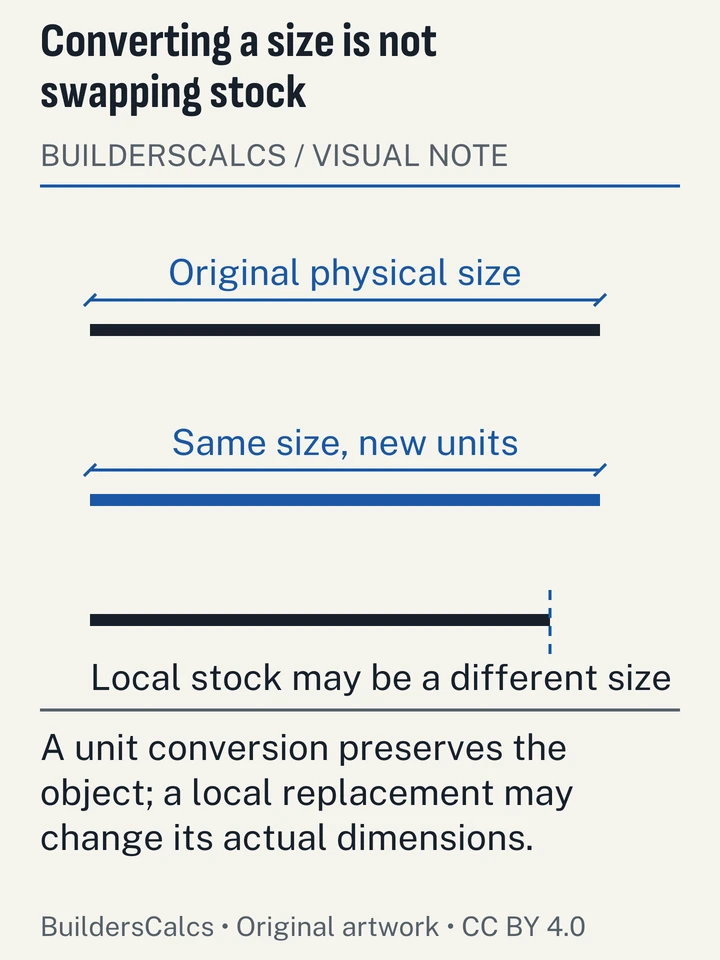
Illustration sources
How do you use these conversions with the calculators?
Pick one system for the whole job and let the tool convert. Use the area in square feet or square metres tool for floors and walls, and the volume in cubic yards or cubic metres tool for anything poured or spread. For loose materials sold by weight, the tons of gravel for your area tool asks which ton you mean. A printable concrete bag chart keeps US and UK bag counts on one sheet for site use. More method pages are in the measuring guides and references.
When is a straight conversion not enough?
- The product is different. A UK concrete bag or plasterboard sheet is not a converted US one; count with its own size.
- The code is different. US IECC R-values and UK U-values measure different things, and stair or pitch limits come from different rules, so convert to compare, not to comply.
- The size is nominal. Convert the actual dressed size of lumber, not the name.
- The ton or gallon is unstated. Ask before converting.
Summary
The factors are exact and easy: 2.54 cm per in to the inch and 0.3048 m per ft to the foot cover nearly everything. The mistakes come from names that mean different things in each country, from nominal sizes, and from products made to round numbers in their own system. Convert once, at a stated point, and count with the product's own size.
Unit conversion questions
Is a UK gallon bigger than a US gallon?
Yes. A UK gallon is 4.54609 L per UK gal and a US gallon 3.785411784 L per US gal, so the UK one is about a fifth larger. Spread rates quoted per gallon differ for the same reason.
How many square metres are in a roofing square?
One roofing square equals 9.290 m2 (100 x 0.09290304).
Is a metric tonne the same as a ton?
Not quite. A metric tonne is 1,000 kg per tonne, a US short ton 907.18474 kg per short ton and a UK long ton 1,016.0469088 kg per long ton.
What size is a 2×6 in millimetres?
A dry, dressed 2×6 is 1-1/2 × 5-1/2 in, which PS 20 gives as 38 × 140 mm (NIST / American Lumber Standard Committee and USDA Forest Service, Forest Products Laboratory).
Sources (30)
- Asphalt Roofing Manufacturers Association (ARMA)
- Residential Asphalt Roofing Manual - Design and Application Methods, 2014 edition (Ch. 5 Estimating; Ch. 6 Safety), checked
- BMI Redland (UK)
- Redland 49 concrete roof tile technical data sheet (BS EN 490 / BS 5534:2014+A2:2018), checked
- Brewster Home Fashions
- Westley Grey Plaid Wallpaper 4147-27384 product page, checked
- British Gypsum
- Gyproc WallBoard 12.5mm product page (articles list, EN 520 type), checked
- COFORD (Dept. of Agriculture, Food and the Marine, Ireland)
- Wood Technology Ireland No. 10: Timber sizes - solid timber for structural use (2020), checked
- City of Des Moines Permit & Development Center
- Residential Asphalt Shingle Requirements (2021 IRC Chapter 9, R905.2 and R908.3.1.1), checked
- Council of the European Communities (via legislation.gov.uk)
- Council Directive 80/181/EEC on units of measurement, Article 3 (consolidated 2020), checked
- Edinburgh Napier University, Centre for Wood Science and Technology
- EN 336 customary sizes (D. Ridley-Ellis, 2016), checked
- European Parliament and Council (via legislation.gov.uk)
- Directive 2009/3/EC amending Council Directive 80/181/EEC on units of measurement, checked
- Fine Homebuilding (Taunton Press), Mike Guertin
- Don't Fall Short on Shingles: How to Estimate Materials for Roofing Projects (excerpt from Roofing with Asphalt Shingles), checked
- International Code Council
- 2021 IECC Residential, Chapter 4 (Tables R402.1.2, R402.1.3; Sections R402.1.4, R402.2.1), checked
- Knauf (UK)
- Knauf Wallboard 12.5mm product variants and packaging, checked
- Marley (UK)
- Modern concrete interlocking roof tile - technical data, checked
- NASA
- Mars Climate Orbiter Mishap Investigation Board Phase I Report (10 Nov 1999), checked
- NIST / American Lumber Standard Committee
- Voluntary Product Standard PS 20-20, American Softwood Lumber Standard, checked
- National Bureau of Standards (now NIST), for HUD
- NBSIR 73-421: An Overview of the Factors Impacting Metrication of the U.S. Housing Industry (Dec 1973), incl. Appendix B on UK construction metrication, checked
- National Gypsum / ProForm Finishing Products
- ProForm Paper Joint Tape Technical Information (110936 Rev. 06/23), Materials Estimating and Coverage table, checked
- National Institute of Standards and Technology
- Handbook 44 (2026), Appendix C: General Tables of Units of Measurement, checked
- NIST Guide to the SI (SP 811), Appendix B.9 Factors for units listed by kind of quantity, checked
- NIST Handbook 44 (2026), Appendix C: General Tables of Units of Measurement, checked
- Special Publication 811 (2008), Guide for the Use of the International System of Units (SI), Appendix B.8, checked
- SAKRETE of North America
- SAKRETE High Strength Concrete Mix technical data sheet (REV 7-10), hosted by Home Depot, checked
- Tarmac (Blue Circle)
- High Strength Concrete (40N) product data sheet (June 2014), hosted by Wickes, checked
- Multi-Purpose Concrete product data sheet (March 2014), hosted by Wickes, checked
- The Quikrete Companies
- QUIKRETE Concrete Mix No. 1101 Data Sheet (revised Oct 2022), checked
- UK Government (DLUHC)
- Approved Document L, Volume 1: Dwellings, 2021 edition incorporating 2023 amendments (Tables 4.1-4.3), checked
- UK Parliament (legislation.gov.uk)
- Weights and Measures Act 1985, Schedule 1, checked
- US Government Publishing Office
- 15 U.S.C. 205b Declaration of policy (Metric Conversion Act, as amended 1988), United States Code 2023 edition, checked
- USDA Forest Service, Forest Products Laboratory
- Wood Handbook (FPL-GTR-282), Chapter 6: Commercial Lumber, Round Timbers, and Ties, checked
- Wickes (retailer)
- Arthouse White Brick Wallpaper 10.05m x 53cm listing, checked
Every number on this page is taken from these documents. How we choose and check sources.