

Cubic yard calculator
Enter the length, width and depth of an area and this cubic yard calculator gives the volume in cubic yards, cubic feet and cubic metres. The rule underneath is simple: One cubic yard is exactly 27 cubic feet. Work out cubic feet with the depth converted to feet, then divide by 27. A 10 × 10 ft area 4 in deep is 33.33 cu ft, which is 1.23 cubic yards or 0.944 m³.
Cubic yard calculator
v1 · US and metricPick the shape of the area, enter its size and depth, and the calculator gives the volume in cubic yards, cubic feet and cubic metres.
Result
Enter your measurements and press Calculate.
Formula and assumptions
- Rectangle or square:
Volume (cu ft) = length (ft) × width (ft) × depth (in) ÷ 12; metric:Volume (m³) = length (m) × width (m) × depth (mm) ÷ 1,000 - Circle:
Volume (cu ft) = π × (diameter (ft) ÷ 2)² × depth (in) ÷ 12; metric:Volume (m³) = π × (diameter (m) ÷ 2)² × depth (mm) ÷ 1,000 - Triangle:
Volume (cu ft) = ½ × base (ft) × height (ft) × depth (in) ÷ 12; metric:Volume (m³) = ½ × base (m) × height (m) × depth (mm) ÷ 1,000 Cubic yards = cubic feet ÷ 27; metric:Cubic yards = m³ ÷ 0.7646- One cubic yard is 27 cubic feet (National Institute of Standards and Technology and UK Parliament (legislation.gov.uk)) and 0.764554857984 m³.
- The depth is treated as even across the whole area. Measure it in several places and use the average.
- Results are not rounded until they are shown.
How do you calculate cubic yards?
Multiply the area in square feet by the depth in feet, then divide by 27. The depth is the step people get wrong, because it is almost always measured in inches. Divide inches by 12 before multiplying, or the answer comes out twelve times too large.
The calculator has three shapes, and each one only changes how the area is found:
- Rectangle or square: length × width × depth (in) ÷ 12 = cubic feet.
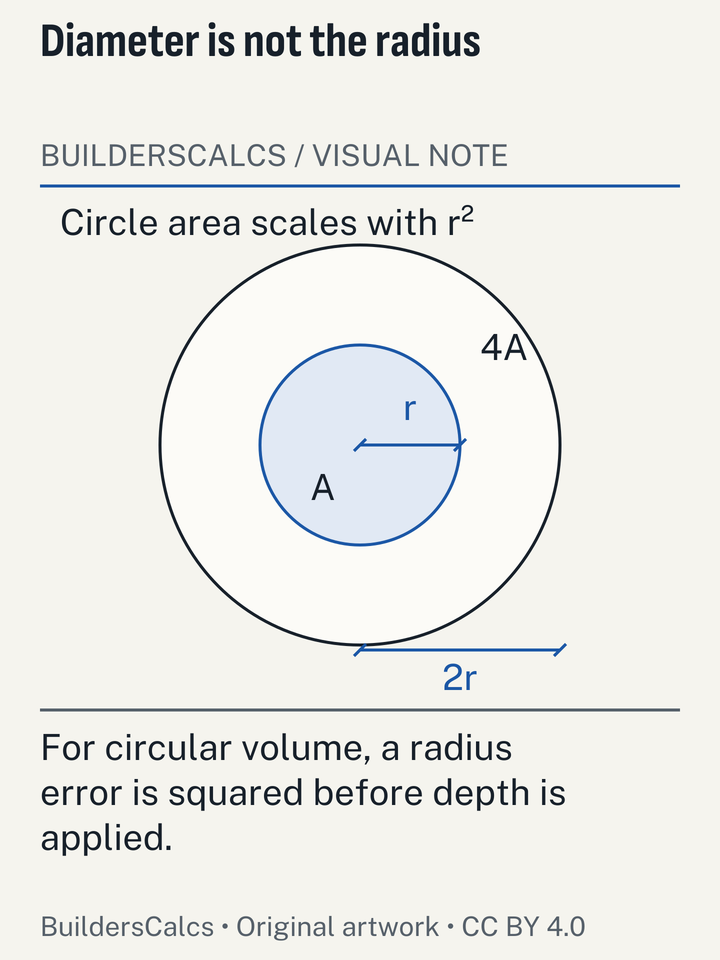
- Circle: π × (diameter ÷ 2)² × depth (in) ÷ 12 = cubic feet. Measure the diameter straight across through the centre.
- Triangle: ½ × base × height × depth (in) ÷ 12 = cubic feet. The height is measured at a right angle to the base, not along the sloping side.
Cubic feet ÷ 27 = cubic yards. In metric mode the inputs are metres and millimetres: m × m × mm ÷ 1,000 gives cubic metres, and the calculator also shows cubic yards and cubic feet so you can compare a UK or EU quote with a US one. The How many identical areas box multiplies the result, which saves running the same flower bed or footing pad several times. Nothing is rounded until the result is shown.
Worked example: three beds and an allowance
Three beds, each 10 ft by 10 ft and 4 in deep. One bed is 10 × 10 × 4 ÷ 12 = 33.33 cu ft. Three of them make 100 cu ft, which is 100 ÷ 27 = 3.70 cu yd. Add 10% in the extra box and the order becomes 110 cu ft, or 4.07 cu yd (3.115 m³). The calculator prints each of these steps under the result, so you can check them against your own arithmetic.
| Shape | Size | Depth | Extra | Cubic feet | Cubic yards | Cubic metres |
|---|---|---|---|---|---|---|
| Rectangle | 10 × 10 ft | 4 in | 0% | 33.33 | 1.23 | 0.944 |
| Rectangle (metric) | 3 × 3 m | 100 mm | 0% | 31.78 | 1.18 | 0.9 |
| Circle | 10 ft across | 3 in | 0% | 19.63 | 0.73 | 0.556 |
| Triangle | 12 ft base, 8 ft height | 6 in | 0% | 24 | 0.89 | 0.68 |
| Triangle (metric) | 4 m base, 2.5 m height | 150 mm | 0% | 26.49 | 0.98 | 0.75 |
| Three rectangles | 10 × 10 ft each | 4 in | 10% | 110 | 4.07 | 3.115 |
How do cubic feet, cubic yards and cubic metres convert?
A cubic yard is a cube 3 ft on each side, so it holds 3 × 3 × 3 = 27 cubic feet, not 3 and not 9. That is the most common mix-up with this unit: people divide square feet by 9 to get square yards, which is right for area, and then reuse 9, or divide by 3, for volume. Both give answers far too large.
- One cubic yard is 0.764554857984 m3. The calculator uses that exact figure, not a rounded one.
- One cubic metre equals about 1.31 cubic yards. So a supplier's price per cubic metre covers a little more material than the same price per cubic yard.
- One cubic foot equals about 0.0283 cubic metres (28.3 litres). That litre figure is handy for UK bags, which are labelled in litres.
- One cubic foot is 1,728 cubic inches.
All of these come from NIST's published conversion factors (National Institute of Standards and Technology). The metric and imperial conversion reference has the length and area factors that feed into them.
Depth is where unit errors start, so the table below gives common depths in feet and millimetres. Read across from the inches you measured and multiply the feet figure by your area in square feet for cubic feet.
| Depth (in) | Depth (ft) | Depth (mm) |
|---|---|---|
| 2 | 0.1667 | 50.8 |
| 3 | 0.25 | 76.2 |
| 3.5 | 0.2917 | 88.9 |
| 4 | 0.3333 | 101.6 |
| 5 | 0.4167 | 127 |
| 6 | 0.5 | 152.4 |
| 8 | 0.6667 | 203.2 |
| 10 | 0.8333 | 254 |
| 12 | 1 | 304.8 |
How much area does one cubic yard cover?
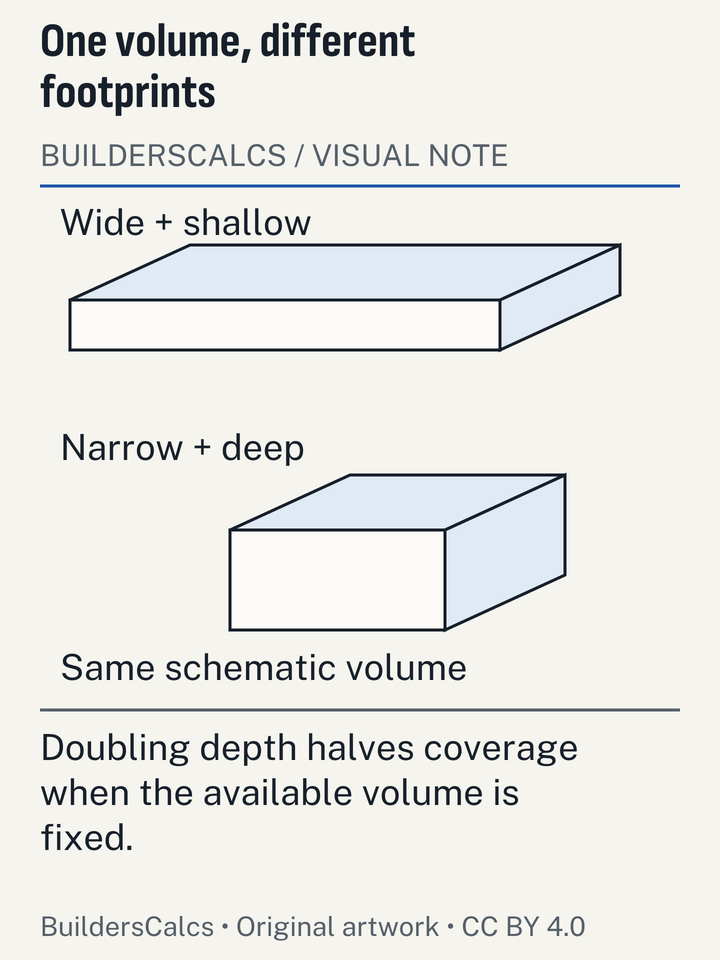
Coverage is the volume formula run backwards: double the depth and one cubic yard covers half the area, triple it and it covers a third. This is the volume formula run backwards, and it is useful when a delivery is already on the drive and you want to know how far it will go. The table gives the figures in both unit systems.
| Depth (in) | Depth (mm) | Area covered (sq ft) | Area covered (m²) |
|---|---|---|---|
| 1 | 25 | 324 | 30.1 |
| 2 | 51 | 162 | 15.1 |
| 3 | 76 | 108 | 10 |
| 4 | 102 | 81 | 7.5 |
Bulk by the yard or bags: how many bags make a cubic yard?
It depends entirely on the bag, because bags are sold by volume for soil and mulch but by weight for concrete and gravel. Some examples from the fact base:
- Mulch: 27 ÷ 1.5 = 18 bags of the 1.5 cu ft size, 13.5 of the 2 cu ft size or 9 of the 3 cu ft size. The largest of those is listed only by a retailer, not on a maker's data sheet.
- Bagged topsoil: 27 ÷ 0.75 = 36 bags of the 0.75 cu ft size.
- Concrete: About 45 bags of 80 lb concrete make one cubic yard (before waste).
- Gravel: bags are sold by weight, so the count depends on the stone's density. The gravel in cubic yards or tonnes calculator does that conversion.
In the UK, bulk bags take the place of loose yards for small orders. Melcourt's bark and topsoil bulk bags hold 0.6 m3, while gravel and sub-base bulk bags are sold by weight. We hold no price data, so the calculator cannot say where bulk becomes cheaper than bags. Price both from the volume you get here, and remember that one cubic yard of bags means dozens of trips with a wheelbarrow.
How much does a cubic yard weigh?
The calculator gives volume only, because the weight of a cubic yard depends on the material. Vulcan Materials' estimator puts clean coarse limestone at 96 lb/ft3 (1,538 kg/m3), limestone crusher run at 138 lb/ft3 (2,211 kg/m3) and sand at 110 lb/ft3 (1,762 kg/m3). Multiply a lb/ft³ figure by 27 for pounds per cubic yard, then convert to tons. A US short ton (2,000 lb) is 907.18474 kg.
Soil and mulch have far less reliable figures. The only topsoil density we found is a single UK producer's: Melcourt's Topsoil Blended Loam has a bulk density of 900-1,200 kg/m3 (about 56-75 lb/ft3) as supplied. For mulch, no authoritative weight per cubic yard exists in our sources at all. The tons per cubic yard by material page collects every density we hold, with its source, and the gravel and topsoil calculators turn volume into weight for you.
Should I add extra to the volume?
The calculator starts at 0% extra because it measures plain geometry, and no single source gives an allowance that suits every material. The right figure depends on what you are buying, and the material calculators each use the one their sources give:
- Ready-mix concrete: NRMCA advises ordering at least 4-10% more concrete than the plan volume to cover waste, over-excavation and form movement.
- Gravel and aggregate: the gravel calculator starts at the 10% default waste rate RICS gives for aggregate in its 2023 carbon-assessment standard, which is a site-waste figure rather than an ordering rule.
- Bark mulch: Melcourt recommends allowing 5-10% extra bark mulch for natural settlement. That is one producer's advice.
- Topsoil: Melcourt recommends allowing 5% extra topsoil for natural settlement. Also a single producer.
Compaction is a separate and much larger effect. Loose aggregate takes up 27-60% more room than the same aggregate compacted, so loose volume is compacted volume x 1.27 to 1.60. If the depth you entered is a finished, compacted depth and you are buying loose material by the yard, the extra box is where that expansion goes. The waste allowance by material explainer compares the allowances side by side.
When is the cubic yard result wrong?
The arithmetic is exact, so errors come from the inputs and from what happens to the material afterwards:
- Uneven depth. The calculator treats the depth as the same everywhere. Measure in several places and enter the average, especially in an old bed or a dug-out patch.
- Slopes and mounds. A bank or berm is not a flat slab. Split it into strips and average each strip's depth.
- Odd shapes. Break an L-shape or a kidney-shaped bed into rectangles, circles and triangles, run each, and add the results. The square footage calculator can total the area first if you prefer.
- Dug soil. Soil swells when it is dug out. In WisDOT-funded tests, every soil type took more room loose than in the ground, and clays swelled the most (Wisconsin Highway Research Program / WisDOT (Cetin, Bulduk, Likos, Edil)), so a hole's volume understates the spoil you will need to haul away.
- Weight limits. A trailer or a truck is limited by weight, not volume. Convert before you load, using the density page above.
How many cubic yards does the US build with each year?
Hundreds of millions of cubic yards of concrete alone. NRMCA estimates US ready-mixed concrete production at 379,149,000 cubic yards (289.9 million cubic meters) in 2024, down about 5% from 400,024,000 cubic yards in 2023. Stone and sand are counted by weight instead. USGS estimates 1.5 billion metric tons of crushed stone worth $27 billion was produced in the US in 2025 at 3,500 quarries, with 72% used as construction aggregate, mostly for roads. USGS estimates 870 million metric tons of construction sand and gravel worth $12.6 billion was produced in the US in 2025, with 42% used as portland cement concrete aggregate and 20% for road base. These are national estimates covering roads and commercial building as well as homes, so they say nothing about the size of any one order. They do show why yards and quarries quote in cubic yards and tons rather than in bags.
Which calculator gives more than volume?
This page answers "how many cubic yards". When you also need bags, tons or a depth that suits the job, the material calculators add that layer. To work out bags or cubic yards of concrete, use the concrete calculator, which adds the ready-mix overage and premix bag counts. The mulch volume tool offers extension-service depths and common bag sizes, and the cubic yards of soil or dirt calculator adds lawn and raised-bed depths, settling and an approximate weight. For how deep new soil should go, see how deep topsoil should be.
Everything else is in the full calculator directory.
Cubic yard calculator questions
How many cubic feet are in half a cubic yard?
Half of 27, which is 13.5 cubic feet. Bulk material is often sold in half-yard steps, and 13.5 cu ft is a little under seven bags of the 2 cu ft size.
Can I type the depth in feet instead of inches?
Not directly: the depth box is in inches in US mode and millimetres in metric mode, because that is how depths are usually measured. Multiply feet by 12 first, so a 1.5 ft deep trench is 18 in.
Is "a yard" of material at a landscape yard the same as a cubic yard?
Yes. Bulk soil, mulch, gravel and concrete suppliers say "a yard" to mean a cubic yard, measured loose in the bucket or the truck. That loose yard settles or compacts once spread, which is why the material calculators add an allowance.
How do I convert cubic metres to cubic yards?
One cubic metre equals about 1.31 cubic yards. So multiply cubic metres by that factor. Going the other way, One cubic yard is 0.764554857984 m3. Or switch the calculator's units: it shows all three units in either mode.
Can I use the calculator for a round hole or tube?
Yes, with the circle shape: enter the diameter and the depth. For a deep post hole, enter the depth in inches, so 3 ft becomes 36 in. For concrete in post holes, the post hole calculator also subtracts the post itself.
Add the cubic yard calculator to your site
Sources (22)
- Johnson's Garden Centers (retailer listing)
- Grade-A All Bark Cedar Mulch (3 cu. ft.), checked
- Melcourt Industries Ltd (UK)
- Ornamental Bark Mulch product page (specification and how to use), checked
- Topsoil Blended Loam product page (specification and how to use), checked
- National Institute of Standards and Technology
- Handbook 44 (2026), Appendix C: General Tables of Units of Measurement, checked
- NIST Guide to the SI (SP 811), Appendix B.9 conversion factors, checked
- Special Publication 811 (2008), Guide for the Use of the International System of Units (SI), Appendix B.8, checked
- National Ready Mixed Concrete Association
- CIP 31 - Ordering Ready Mixed Concrete, checked
- CIP 8 - Discrepancies in Yield (rev. 2016), checked
- National Ready Mixed Concrete Association (NRMCA)
- U.S. Ready Mixed Concrete Production industry fact sheet, 2024 edition (2023 production by state; 2022 total), checked
- U.S. Ready Mixed Concrete Production industry fact sheet, 2025 edition (monthly sheet and 2024 production by state), checked
- Penn State Center for Dirt and Gravel Roads
- Technical Bulletin: Driving Surface Aggregate (2025), checked
- Royal Institution of Chartered Surveyors (RICS)
- Whole life carbon assessment for the built environment, 2nd edition (professional standard, September 2023), checked
- SAKRETE of North America
- SAKRETE High Strength Concrete Mix technical data sheet (REV 7-10), hosted by Home Depot, checked
- Scotts Miracle-Gro (label text as shown on Ace Hardware listing)
- Scotts Nature Scapes Color Enhanced Mulch 2 cu ft, checked
- Scotts Miracle-Gro (label text as shown on Farm and Fleet listing)
- Scotts Premium Topsoil 0.75 cu ft, checked
- Scotts Miracle-Gro (product listing on Lowe's)
- Scotts Nature Scapes Color Enhanced 1.5 cu ft Mulch, checked
- The Quikrete Companies
- QUIKRETE Concrete Mix No. 1101 Data Sheet (revised Oct 2022), checked
- U.S. Geological Survey (USGS), National Minerals Information Center
- Mineral Commodity Summaries 2026 (full volume; Sand and Gravel (Construction) chapter), checked
- Mineral Commodity Summaries 2026: Stone (Crushed), checked
- UK Parliament (legislation.gov.uk)
- Weights and Measures Act 1985, Schedule 1, checked
- Vulcan Materials Company
- Construction Aggregates Calculator (density estimator by geology and product type), checked
- Wisconsin Highway Research Program / WisDOT (Cetin, Bulduk, Likos, Edil)
- Weight-Volume Relationships and Conversion Factors for Soils and Aggregates of Wisconsin, WHRP G22-05 (Dec 2023), checked
Every number on this page is taken from these documents. How we choose and check sources.