

Gravel calculator
Enter the area, the depth and the kind of stone, and this gravel calculator gives the volume in cubic yards or cubic metres, the weight in tons or tonnes, and the number of bags. Weight is volume times density, and density changes with the stone: Vulcan Materials puts clean crushed limestone at 96 lb/ft3 (1,538 kg/m3) and crusher run at 138 lb/ft3 (2,211 kg/m3). A 10 × 10 ft area 3 in deep, with 10% extra, needs 1.02 cu yd of clean stone, about 1.32 tons.
Gravel calculator
v1 · US and metricEnter the area, the depth and the kind of stone. The result gives the volume, the weight in tons or tonnes and the number of bags or bulk bags.
Result
Enter your measurements and press Calculate.
Formula and assumptions
- Rectangle (path, driveway, bed):
Volume (cu ft) = length (ft) × width (ft) × depth (in) ÷ 12; metric:Volume (m³) = length (m) × width (m) × depth (mm) ÷ 1,000 - Circle:
Volume (cu ft) = π × (diameter (ft) ÷ 2)² × depth (in) ÷ 12; metric:Volume (m³) = π × (diameter (m) ÷ 2)² × depth (mm) ÷ 1,000 Weight (tons) = volume with extra (cu ft) × density (lb/ft³) ÷ 2,000; metric:Weight (tonnes) = volume with extra (m³) × density (kg/m³) ÷ 1,000Bags = weight (lb) ÷ bag weight, rounded up; metric:Bags = weight (kg) ÷ bag weight, rounded up- Densities for US stone come from Vulcan Materials' estimator (Vulcan Materials Company). Stone from other quarries or geology can weigh more or less, so check the yard's figure when you order by the ton.
- The UK decorative gravel density of 1,680 kg/m3 (as supplied, loose) is worked back from Long Rake Spar's quantity table.
- US bags are 50 lb (22.6 kg) bags of all-purpose gravel. UK bags are 20 kg poly bags and 850 kg bulk bags.
- The volume is the finished depth. Aggregates take up 27-60% more volume loose than when compacted, so loose volume = compacted volume x 1.27 to 1.60.
- Bag counts are rounded up. A US ton here is the short ton of 2,000 lb.
How many tons of gravel do I need for a 10 × 10 ft area?
About 1.32 tons of clean crushed stone for a 10 ft by 10 ft area 3 in deep, once the default 10% extra is added. That is the calculator's opening result: 25 cu ft of space, 27.5 cu ft with the extra, which is 1.02 cubic yards. At 96 lb/ft3 that volume weighs 2,640 lb, so in bags it is 53 of the 50 lb (22.6 kg) size.
The metric default is a 3 m by 3 m area of UK decorative gravel 50 mm deep. With 10% extra that is about 0.5 m³, which weighs 0.83 tonnes at the supplied density, or 42 bags of 20 kg or a single 850 kg bulk bag.
Measure the area the stone will cover, inside any edging, and take the depth as the finished depth you want to see. For a round bed or a tree surround, switch the shape to circle and enter the diameter. Then pick the material. The choice matters more than most people expect, because a cubic yard of crusher run weighs far more than a cubic yard of clean stone, and the yard will load by weight.
How does the calculator turn cubic yards into tons?
It finds the volume, adds the extra, then multiplies by the material's density. In US units: length (ft) × width (ft) × depth (in) ÷ 12 gives cubic feet; × (1 + extra %) gives the volume to order; ÷ 27 gives cubic yards; and cubic feet × density in lb/ft³ ÷ 2,000 gives US tons. A US short ton (2,000 lb) is 907.18474 kg. In metric: m × m × mm ÷ 1,000 gives m³, and m³ × kg/m³ ÷ 1,000 gives tonnes. Bags are the weight divided by the bag weight, rounded up.
Worked example: a crusher run pad
A 20 ft by 10 ft shed pad, 4 in of crusher run, no extra. The volume is 20 × 10 × 4 ÷ 12 = 66.67 cu ft, or 2.47 cu yd. At 138 lb/ft3 that is 66.67 × 138 = 9,200 lb, or 4.6 tons (4.17 tonnes), and 184 bags of 50 lb. The result also carries a note, because crusher run is compacted after spreading. The same pad in clean stone would weigh about a third less, which is the whole case for choosing the material carefully.
If your quarry quotes its own density, pick Custom density and type it in. At 100 lb/ft³, a 10 × 10 ft area 3 in deep with no extra is 0.93 cu yd and 1.25 tons. To do the volume step by hand for an odd shape, the cubic yard calculator handles triangles too.
| Job | Material | Extra | Volume | Weight | Bags |
|---|---|---|---|---|---|
| 10 × 10 ft, 3 in | Clean crushed stone | 10% | 1.02 cu yd | 1.32 tons (1.2 tonnes) | 53 × 50 lb |
| 3 × 3 m, 50 mm | UK decorative gravel | 10% | 0.5 m³ | 0.83 tonnes | 42 × 20 kg or 1 bulk bag |
| 20 × 10 ft, 4 in | Crusher run | 0% | 2.47 cu yd | 4.6 tons (4.17 tonnes) | 184 × 50 lb |
| 8 ft circle, 2 in | Pea gravel | 10% | 0.34 cu yd | 0.45 tons (0.41 tonnes) | 19 × 50 lb |
| 10 × 10 ft, 3 in | Custom, 100 lb/ft³ | 0% | 0.93 cu yd | 1.25 tons (1.13 tonnes) | 50 × 50 lb |
| 4 × 2 m, 30 mm | Sand | 0% | 0.24 m³ | 0.42 tonnes | 22 × 20 kg |
How much does a cubic yard of gravel weigh?
Anywhere in a wide band, depending on the rock and how it is graded. Across Vulcan Materials' density estimator, a cubic yard of aggregate weighs from 1.22 US tons (Coarse aggregate (clean stone) (Sandstone)) to 2.16 tons (Crushed stone base / crusher run (Traprock)), so stone type and grading can change the weight of a delivery by over 75%. Clean stone with no fines has more air between the pieces and weighs least; crusher run, which mixes stone with dust, packs tighter and weighs most. Vulcan Materials publishes figures by geology and product, and the calculator's US presets use its limestone and sand-and-gravel rows (Vulcan Materials Company).
A popular rule of thumb gives one fixed weight for every yard of gravel. It can be badly wrong at either end: Vulcan's clean coarse stone sits well under it and its traprock crusher run well over. Vulcan also does not say whether its figures are loose or compacted, and WisDOT's tests found loose base far lighter than the same base compacted, so treat any single density as an estimate and ask the yard what its scale ticket assumes. The full table is below; the how much a yard of gravel weighs page puts it next to sand, soil and concrete.
In the UK, the decorative gravel preset uses 1,680 kg/m3 (as supplied, loose), worked back from one supplier's quantity table. That is a single-source figure for one product range.
| Geology | Product | lb/ft³ | US tons per cu yd | kg/m³ |
|---|---|---|---|---|
| Traprock | Screenings | 124 | 1.67 | 1,986 |
| Traprock | Crushed stone base / crusher run | 160 | 2.16 | 2,563 |
| Traprock | Coarse aggregate (clean stone) | 102 | 1.38 | 1,634 |
| Traprock | Sand | 110 | 1.49 | 1,762 |
| Limestone | Screenings | 113 | 1.53 | 1,810 |
| Limestone | Crushed stone base / crusher run | 138 | 1.86 | 2,211 |
| Limestone | Coarse aggregate (clean stone) | 96 | 1.3 | 1,538 |
| Limestone | Sand | 106 | 1.43 | 1,698 |
| Granite | Screenings | 113 | 1.53 | 1,810 |
| Granite | Crushed stone base / crusher run | 145 | 1.96 | 2,323 |
| Granite | Coarse aggregate (clean stone) | 96 | 1.3 | 1,538 |
| Granite | Sand | 106 | 1.43 | 1,698 |
| Sand & Gravel | Screenings | 112 | 1.51 | 1,794 |
| Sand & Gravel | Crushed stone base / crusher run | 130 | 1.75 | 2,082 |
| Sand & Gravel | Coarse aggregate (clean stone) | 98 | 1.32 | 1,570 |
| Sand & Gravel | Sand | 110 | 1.49 | 1,762 |
| Sandstone | Screenings | 110 | 1.49 | 1,762 |
| Sandstone | Crushed stone base / crusher run | 138 | 1.86 | 2,211 |
| Sandstone | Coarse aggregate (clean stone) | 90 | 1.22 | 1,442 |
| Sandstone | Sand | 100 | 1.35 | 1,602 |
How deep should gravel be?
It depends on the job and, for decorative stone, on the size of the stone. Long Rake Spar's UK guidance ties depth to stone size, from 20 mm for small chippings up to 75 mm for large pebbles. Long Rake Spar suggests about 30 mm depth for 8-14 mm gravel, chippings and pebbles. Long Rake Spar suggests about 50 mm depth for 14-20 mm gravel and for 20-40 mm slate. These are one supplier's figures, so they are a starting point.
Deeper is not better for loose decorative stone. The same supplier warns that too much aggregate sinks underfoot and gets kicked out of place, especially rounded stone, so a pea gravel path 6 in deep is harder to walk on than one at the suggested depth.
Structural jobs need a different kind of stone and more of it. Under pavers, the trade minimum is 4 in compacted (100 mm) of compacted base for foot traffic. For unpaved roads, Penn State's Driving Surface Aggregate for unpaved roads is placed 6-8 in loose and rolled to 4.5-6 in. We found no extension or DOT depth for a private gravel driveway, so the gravel for a driveway guide builds one up from those sources and explains the layers.
Illustration sources
- Long Rake Spar Co. Ltd (UK) — Long Rake Spar Aggregates Brochure - Quantifying your requirements (Suitable Depths; Weight and Bags tables)
- Concrete Masonry & Hardscapes Association (CMHA, successor to ICPI) — Tech Note PAV-TEC-002-22 - Construction of Interlocking Concrete Pavements (formerly ICPI Tech Spec 2)
- Interlocking Concrete Pavement Institute (ICPI) — Tech Spec 10 - Application Guide for Interlocking Concrete Pavements
- Penn State Center for Dirt and Gravel Roads — Technical Bulletin: Driving Surface Aggregate (2025)
| Depth (mm) | Weight per 10 m² (kg) | 20 kg bags | Bulk bags |
|---|---|---|---|
| 20 | 340 | 17 | 0.43 |
| 30 | 500 | 25 | 0.63 |
| 50 | 840 | 42 | 1.05 |
| 75 | 1,240 | 62 | 1.55 |
Does gravel shrink when it is compacted?
Yes, and by more than any waste allowance. Loose aggregate takes up 27-60% more room than the same aggregate compacted, so loose volume is compacted volume x 1.27 to 1.60. Penn State's unpaved-road aggregate loses about a quarter of its depth when rolled (Penn State Center for Dirt and Gravel Roads). Clean, single-size stone barely compacts, which is why the calculator only warns about this for crusher run and stone dust.
If you enter the depth you want after compaction and pick one of those two materials, the result is the compacted volume. Ask the supplier whether its tonnage is based on loose or compacted material: if loose, order more by the expansion above; if it already reflects compaction, the calculator's figure can stand.
Why does the calculator add 10% extra?
The 10% default is the site waste rate that RICS gives for aggregate in its 2023 whole-life carbon standard (Royal Institution of Chartered Surveyors (RICS)). RICS (2023) gives a default site waste rate of 10% for timber floor boards and aggregate, against 2% for structural timber frames and 1% for glass. It is a single source, and it was written to estimate the waste on building projects for carbon assessment, not as an ordering rule for a garden path. We found no quarry, trade association or extension service that states an overage for gravel orders, so this is the best published figure we have rather than a settled one.
The extra covers stone lost to the subgrade, spillage and a little rounding, but not compaction, which is far larger and handled above. Set the box to zero for a plain volume, or raise it for a soft, uneven base. The waste factor percentages by material explainer compares this figure with the allowances for other materials.
How is gravel sold in bags and bulk bags?
By weight, in both markets, which is why the bag count follows the density you pick. US results use the 50 lb (22.6 kg) bag of all-purpose gravel. Quikrete All-Purpose Gravel (No. 1151) comes in 50 lb (22.6 kg) bags with about a 3/8 in (9.5 mm) top size and meets ASTM C33. We found no manufacturer data sheet giving a bag's volume, so the count is weight ÷ bag weight, not volume ÷ bag volume.
UK results list 20 kg poly bags and 850 kg bulk bags. Bulk bags are not a fixed size: Tarmac's Type 1 MOT sub-base is sold in an 850 kg bulk bag. Long Rake Spar's table implies a bulk bag of roughly 800 kg (1,240 kg = 1.55 bulk bags). Check the merchant's listing before ordering several.
Watch the word "ton". A US ton is the short ton of 2,000 lb. A metric tonne is 1,000 kg. An older UK ton is longer again. A UK long ton (2,240 lb) is 1,016.047 kg. The calculator shows US tons in US mode and tonnes in metric mode, each with the other in brackets.
When is the gravel result wrong?
- Different rock. The presets use limestone and sand-and-gravel figures. Traprock and granite run heavier for the same product, so use the table or a custom density.
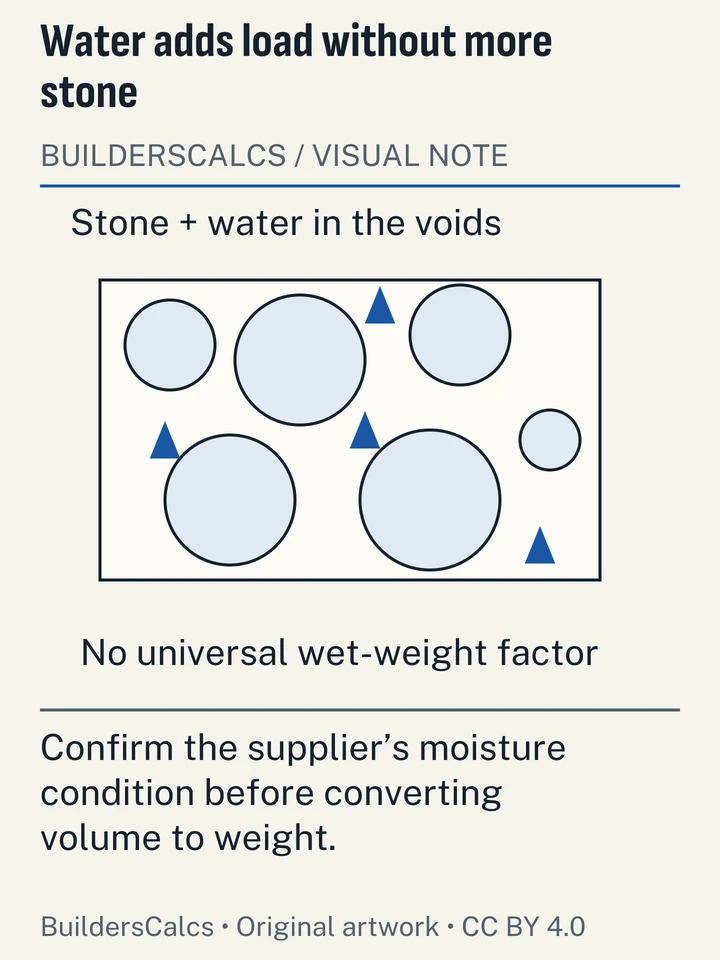
- Wet stone. Densities are for stone as tested; washed stone straight from the pile carries water and weighs more. No producer figure for that moisture was available.
- Loose versus compacted. Base stone needs the expansion described above if the depth is a finished one.
- Drainage trenches. A pipe or fabric-wrapped drain takes some of the volume; the calculator counts a solid block of stone.
- Walls and slabs. Backfill behind a wall follows the wall's geometry; the retaining wall calculator handles that drainage stone.
How much crushed stone and gravel is produced each year?
In the US, around one and a half billion metric tons of crushed stone a year. USGS estimates 1.5 billion metric tons of crushed stone worth $27 billion was produced in the US in 2025 at 3,500 quarries, with 72% used as construction aggregate, mostly for roads. USGS estimates 870 million metric tons of construction sand and gravel worth $12.6 billion was produced in the US in 2025, with 42% used as portland cement concrete aggregate and 20% for road base. Most of it goes into roads and concrete rather than garden paths, so these totals say nothing about the size or cost of a small load.
Great Britain sells far less, and recycled stone takes a growing share. Great Britain sales of sand and gravel fell to 40.97 million tonnes in 2025 from 53.77 million in 2021, with 17.09 million tonnes sold as sand for concreting, per DBT Table 4b. MPA estimates 74.7 million tonnes of recycled and secondary aggregates were used in Great Britain in 2024, just under a third of total construction aggregates supply. In the US, old concrete is a large source of recycled aggregate. In 2018, 301.2 million US tons of C&D concrete were sent to aggregate reuse and 71.2 million tons to landfill, per EPA's latest C&D estimate. Recycled base weighs differently from virgin stone, so use its own density if you buy it.
Which landscaping calculator comes next?
Gravel is often one layer of several. For planting beds next to a path, the bags of mulch for a bed calculator gives mulch by depth and bag size, and the topsoil calculator sizes the soil underneath. Paving over the stone? The pavers, base and bedding sand calculator works out the base and sand together with the pavers. The other landscape supply calculators are on the landscaping page.
Gravel calculator questions
How many 50 lb bags of gravel make a ton?
Forty. A US ton is 2,000 lb, and 2,000 ÷ 50 = 40 bags. A metric tonne is 44.1 bags of the same weight, so round up to 45. Past a ton or two, bulk delivery is usually far less lifting.
Does pea gravel weigh less than crushed stone?
Not by much when both are clean, single-size stone. Vulcan's figure for washed sand-and-gravel stone is 98 lb/ft3 (1,570 kg/m3), against 96 lb/ft3 (1,538 kg/m3) for clean crushed limestone. The big difference is between clean stone and anything with fines, such as crusher run or stone dust.
Can I use the gravel calculator for sand?
Yes. Choose Sand in the material list, which uses Vulcan's 110 lb/ft3 (1,762 kg/m3) figure. For the bedding sand under pavers, the paving calculator already includes it at the right depth.
Why does the result show a note for crusher run and stone dust?
Because those materials are compacted after spreading and lose a large part of their loose volume, while clean stone barely settles. The note reminds you to check whether the supplier's weight is loose or compacted and to order more if your depth is a finished one.
Embed this gravel calculator
Sources (17)
- Concrete Masonry & Hardscapes Association (CMHA, successor to ICPI)
- Tech Note PAV-TEC-002-22 - Construction of Interlocking Concrete Pavements (formerly ICPI Tech Spec 2), checked
- Department for Business and Trade (DBT), UK (data from ONS, DBT and Mineral Products Association)
- Monthly Bulletin of Building Materials and Components, September 2026 (Bulletin 617), data tables, checked
- Interlocking Concrete Pavement Institute (ICPI)
- Tech Spec 10 - Application Guide for Interlocking Concrete Pavements, checked
- Long Rake Spar Co. Ltd (UK)
- Long Rake Spar Aggregates Brochure - Quantifying your requirements (Suitable Depths; Weight and Bags tables), checked
- MKM Building Supplies (retailer listing of Tarmac product)
- Tarmac Building Products Type 1 MOT Bulk Bag 850 kg (product listing), checked
- Mineral Products Association (MPA), UK
- Profile of the UK Mineral Products Industry, 2025 Edition, checked
- National Institute of Standards and Technology
- Handbook 44 (2026), Appendix C: General Tables of Units of Measurement, checked
- Special Publication 811 (2008), Guide for the Use of the International System of Units (SI), Appendix B.8, checked
- Penn State Center for Dirt and Gravel Roads
- Technical Bulletin: Driving Surface Aggregate (2025), checked
- Royal Institution of Chartered Surveyors (RICS)
- Whole life carbon assessment for the built environment, 2nd edition (professional standard, September 2023), checked
- The Quikrete Companies
- Data Sheet - QUIKRETE Sand & Gravel Products (rev. Nov 2020), checked
- U.S. Geological Survey (USGS), National Minerals Information Center
- Mineral Commodity Summaries 2026 (full volume; Sand and Gravel (Construction) chapter), checked
- Mineral Commodity Summaries 2026: Stone (Crushed), checked
- UK Parliament (legislation.gov.uk)
- Weights and Measures Act 1985, Schedule 1, checked
- US Environmental Protection Agency (EPA), Office of Resource Conservation and Recovery
- Advancing Sustainable Materials Management: 2018 Fact Sheet, checked
- Vulcan Materials Company
- Construction Aggregates Calculator (density estimator by geology and product type), checked
- Wisconsin Highway Research Program / WisDOT (Cetin, Bulduk, Likos, Edil)
- Weight-Volume Relationships and Conversion Factors for Soils and Aggregates of Wisconsin, WHRP G22-05 (Dec 2023), checked
Every number on this page is taken from these documents. How we choose and check sources.