

How deep should topsoil be for lawns, beds and raised beds?
A new lawn needs at least 4 in (100 mm) of soil, and extension services recommend 6 in (150 mm) or more over loosened subsoil. Raised beds go deeper again. Spreading 4 in over 1,000 sq ft takes about 12.5 cu yd, or 9.4 m³ over 93 m², before any allowance for the soil firming down.
How deep should topsoil be for a new lawn?
At least 4 in (100 mm), and 6 in (150 mm) or more where you can manage it. That is the line New Mexico State and the University of Tennessee both draw (New Mexico State University Cooperative Extension (B. Leinauer) and University of Tennessee Extension (Samples, Sorochan)). Where soil is poor, add topsoil and organic matter to reach 4-6 in of total topsoil depth after firming. (New Mexico State University Cooperative Extension (B. Leinauer))
The phrase that matters is after firming. Loose soil spread from a barrow sits higher than it will once it has been rolled, walked on and rained on. Spread, firm, then measure again before seeding or turfing.
A common belief is that an inch or two of topsoil over hard subsoil is enough for new grass. The extension guides disagree: 4 in is the minimum, and the subsoil should be loosened first so roots and water can move down rather than sitting in a shallow layer on a hard pan (New Mexico State University Cooperative Extension (B. Leinauer), University of Tennessee Extension (Samples, Sorochan) and others).
UK lawns
The RHS frames it as preparation depth rather than a topsoil layer. Before turfing, the RHS says dig or rotovate to 20-25 cm (8-10 in) and let the ground settle, ideally five to six weeks. (Royal Horticultural Society (UK)) Figures of 150 mm for lawns and 300 mm for borders turn up in UK planning-application landscape specs, but we could not trace them to BS 3882 or to RHS text, so treat them as common practice rather than a standard.
How deep should soil be for borders and raised beds?
Deeper than a lawn. Shrubs and vegetables root further down than turf, and a raised bed has to hold all its own soil.
- Raised beds. USU says raised beds should be at least 6-12 in high; beds under 12 in should be open-bottomed over loosened soil. (Utah State University Extension) An open bottom lets roots carry on into the ground below, so a shallow bed borrows depth from the soil underneath.
- Improving an existing border. You rarely need to replace the soil. Miracle-Gro directs spreading 2-3 in of garden soil and mixing it into the top 6-8 in of native soil. (Scotts Miracle-Gro (label text as shown on Farm and Fleet listing)) That is a top-up of a few inches worked in, not a new layer sitting on top.
Bagged products are labelled by coverage. Miracle-Gro's label says three 1.5 cu ft bags cover 24 sq ft about 2 in deep, or four bags at 3 in. Those label counts line up closely with plain area × depth arithmetic, so you can work out bags yourself for any bed size.
How do you work out how much topsoil you need?
Five steps, and the second one is the one people skip.
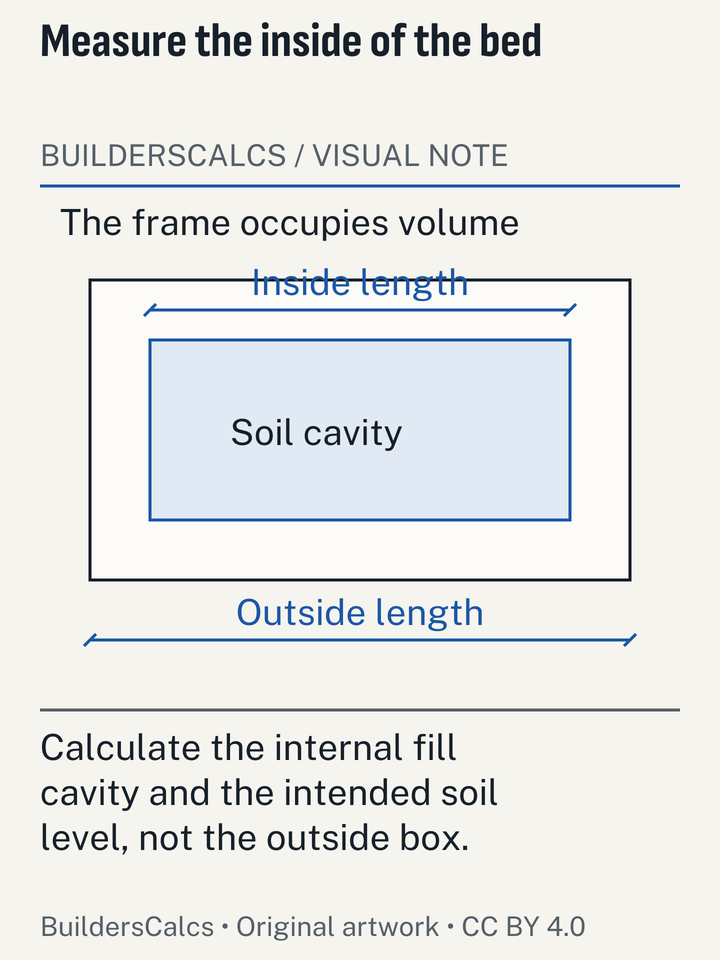
- Measure the area. Length × width in feet or metres. Split curved beds into rectangles and triangles.
- Probe the existing soil. Dig a few test holes with a spade and measure how much usable, crumbly soil is already there before you reach hard or stony subsoil. Only the shortfall needs buying.
- Calculate the volume. Area (sq ft) × depth to add (in) ÷ 12 = cubic feet; ÷ 27 = cubic yards. In metric, area (m²) × depth (mm) ÷ 1,000 = cubic metres.
- Convert to bags or a bulk load. Divide cubic feet by the volume printed on the bag and round up. For bulk, round up to the supplier's increment.
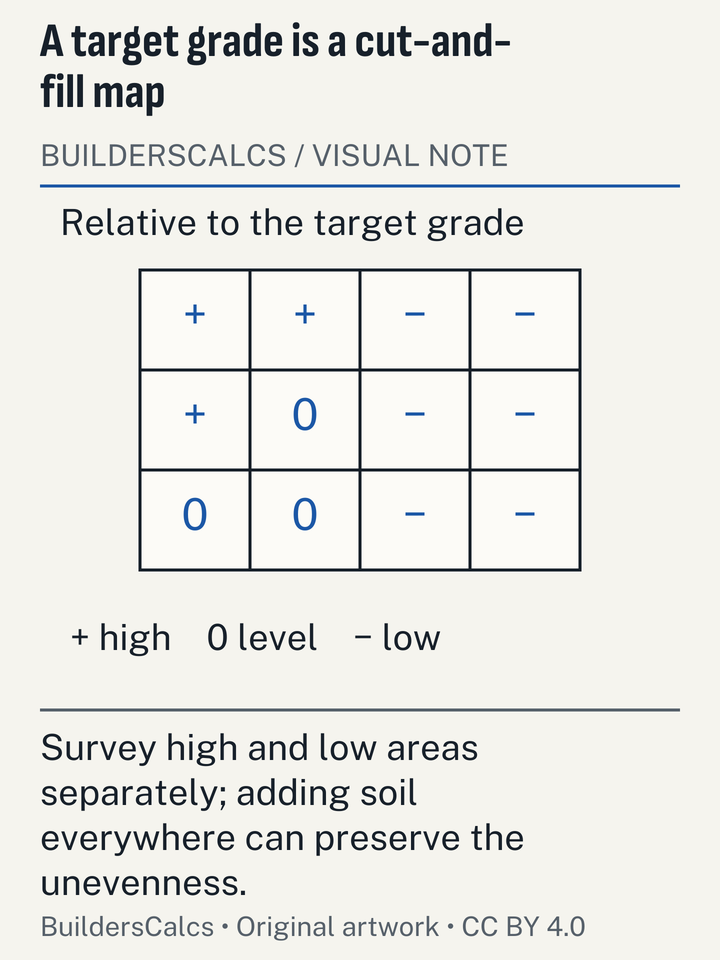
- Spread, firm and re-measure. Spread in layers, firm each one, and check the depth again before final levelling. Top up low spots rather than ordering a percentage extra up front.
How much topsoil per 1,000 square feet?
Use this table to sanity-check a quote. Scale it to your area: a 500 sq ft lawn needs half these figures, a 2,500 sq ft lawn two and a half times. The University of Tennessee rounds the 4 in figure up to 12.5 yd3 per 1,000 sq ft (University of Tennessee Extension (Samples, Sorochan)).
| Depth (in) | Depth (mm) | Cubic yards | Cubic metres |
|---|---|---|---|
| 2 | 51 | 6.17 | 4.72 |
| 4 | 102 | 12.35 | 9.44 |
| 6 | 152 | 18.52 | 14.16 |
| 8 | 203 | 24.69 | 18.88 |
Worked examples: a lawn and a raised bed
A 30 × 50 ft lawn, 4 in of new topsoil
A 1,500 sq ft (139 m²) lawn needs 18.5 cu yd (14.2 m³) of topsoil for a 4 in (100 mm) layer.
- Area: 30 × 50 = 1,500 sq ft.
- Volume: 1,500 × (4 ÷ 12) = 500 cu ft.
- Cubic yards: 500 ÷ 27 = 18.5 cu yd. Cubic metres: 139.4 m² × 0.1016 m = 14.2 m³.
- Check against the table: 1.5 × 12.35 = 18.5 cu yd.
If test holes showed 2 in of decent soil already there, adding 2 in to reach the minimum halves the order to 9.3 cu yd (7.1 m³). Going to the recommended 6 in total with 2 in already present means adding 4 in, which is the full 18.5 cu yd. Either way, loosen the ground underneath before spreading.
An 8 × 4 ft raised bed, 12 in deep
The bed holds 32 cu ft of soil, which is 1.19 cu yd or 0.91 m³ (906 L).
- Volume: 8 × 4 × (12 ÷ 12) = 32 cu ft.
- In 1.5 cu ft bags: 32 ÷ 1.5 = 21.3, so 22 bags.
- In metric, a 2.44 × 1.22 m bed 0.305 m deep is 0.91 m³. Divide the litres by the volume printed on your bag.
At 22 bags, a single small bulk delivery is often easier to handle, but bulk-versus-bag prices vary too much by area to give a break-even point, and we found no source that publishes one. Two or three beds this size and bulk usually wins on handling alone.
Why does dug soil swell, and does topsoil settle?
Soil dug out of the ground takes up more room than it did in place, because digging breaks it into loose clods with air between them. That is why spoil from a hole never fits back in neatly, and why a level-looking delivery of topsoil sinks once firmed.
The WisDOT study behind most US earthwork conversions measured this for 14 natural soils. Loose dry unit weights of 14 natural soils tested for WisDOT ranged 66-106 lb/ft3 (about 0.89-1.43 short tons/yd3 dry, before moisture). (Wisconsin Highway Research Program / WisDOT (Cetin, Bulduk, Likos, Edil)) Clays swelled most when dug; clean sands barely changed.
| Soil type | Bank to loose (%) | Compacted to bank (%) | USCS class |
|---|---|---|---|
| Sands with gravel | 16–23 | 11 | SW-SM, SM |
| Clean sands | 4–8 | 9–10 | SP |
| Silty sands | 2–27 | 1–15 | SM, SP-SM, SC-SM |
| Silts | 27 | 12 | ML |
| Clays | 26–58 | (-5)-9 | CL, CH |
How much does a yard of topsoil weigh?
We could not find a published figure for delivered, screened topsoil from a producer or an extension service, so we do not give one. The closest measured values are the WisDOT dry figures above, about 0.89–1.43 short tons per loose cubic yard before any water, and topsoil is rarely dry. Moist soil weighs more, and a load bought after rain covers the same area but weighs more on the ticket.
This matters for two things: whether a trailer or pickup can carry the load, and comparing a quote by the ton with one by the yard. Ask the yard for the weight of their product per yard or per bulk bag. For volume conversions on any area, the cubic yard calculator handles feet, inches and metric.
Likewise, no extension source gives a settling percentage for topsoil. Order for the depth you want after firming, and keep a little back for low spots rather than adding a fixed percentage.
Why is a few inches of topsoil worth protecting?
Because bare soil disappears faster than most people expect. USDA NRCS's 2022 National Resources Inventory found US cropland lost about 4.75 tons per acre per year to water and wind combined, and that 18% of cultivated cropland lost soil to water faster than its tolerable rate (USDA Natural Resources Conservation Service and Iowa State University CSSM). Those are farm figures, not garden ones, but they show how quickly an unprotected surface goes.
The same inventory counts about 120 million acres of developed land in the US by 2022, 40% of it built in the previous 40 years (USDA Natural Resources Conservation Service and Iowa State University CSSM). Much of today's lawn and garden ground sits on land that was graded within living memory, which is one reason test holes so often find thin soil over subsoil.
In practice: seed, turf or cover new topsoil soon after spreading. A layer of mulch on beds slows wash-off and drying; the guide on coverage per bag at each depth has the depths. And do not build on topsoil: a path or drive should go on firm subsoil, as the guide to gravel for a driveway explains.
What is in a bag of UK topsoil or compost?
Increasingly, less peat. Defra's latest datasheets show peat made up 24.1% of all UK growing media supplied in 2023, and only 16.6% of bagged retail products sold to gardeners (Department for Environment, Food & Rural Affairs (Defra)). In the older industry series, which used a different method, peat was 62.2% in 2011 (Horticultural Trades Association / Defra / AHDB (compiled by Paul Waller Consulting)).
Soil itself is a small part of what is sold in bags. Growing media products used 215,880 m³ of soil or loam in 2023, about 7% of the total (Department for Environment, Food & Rural Affairs (Defra)). Most bagged products are compost-type growing media, which are fine for raised beds and pots but are not a like-for-like substitute for topsoil under a lawn.
The government announced a ban on selling peat to amateur gardeners in England in August 2022, saying bagged retail growing media accounted for 70% of peat sold in the UK; the ban had still not been legislated by late 2026 (Defra (gov.uk) and UK Parliament (House of Commons)). As of 19 October 2026, the UK government said its 2024 and 2025 horticultural peat-use statistics had been delayed and were due by the end of 2026, so 2023 is the latest official year.
For a lawn or a border in the UK, buy screened topsoil by the bulk bag or the cubic metre and check what the supplier says it is made from. We could not confirm UK bag sizes or bulk-bag volumes from a manufacturer, so read the volume off the bag rather than assuming one.
When the depth figures do not apply
- Compacted or waterlogged subsoil. New topsoil on a hard pan holds water in a shallow layer. Loosen or drain the subsoil first; more topsoil does not fix drainage.
- Slopes. Loose soil on a bank washes down before roots hold it. Spread in thinner layers and cover quickly.
- Against the house. Raising ground level against a wall can bridge a damp-proof course or cover weep holes and siding. Keep the finished level below them.
- Over tree roots. Piling soil over an established tree's roots is a different question from lawn depth; ask an arborist.
- Unknown fill. Cheap "topsoil" can be subsoil or demolition fill. Look at a load before it is tipped.
For the other materials a garden project uses, see the yard and garden material tools, including the mulch calculator for what goes on top.
Bottom line
Aim for 4 in of topsoil as the floor and 6 in where you can, measured after firming, over subsoil you have loosened. Probe what is there before you order, buy only the shortfall, and cover it quickly. Raised beds need their full height in soil, and an existing border usually needs a few inches worked in rather than a new layer.
Topsoil depth questions
Is 2 inches of topsoil enough to seed a lawn?
Not on hard subsoil. NMSU and the University of Tennessee set 4 in as the minimum soil depth for a lawn. Two inches is fine as a top-up over soil that is already reasonably deep.
Should new topsoil be mixed into the soil below?
Yes. A distinct layer of new soil over hard ground holds water and stops roots going down. Loosen the existing surface before spreading and work the first layer in.
Does a cubic yard of dug soil fit back into the same hole?
No. Dug soil swells, by up to 58% for clays in the WisDOT measurements, and only part of that comes back out when it is compacted. Expect spare spoil from any hole.
How much peat is in UK bagged growing media now?
In 2023, the latest year Defra has published, peat was 16.6% of bagged retail growing media by volume, against far higher shares a decade earlier. Check the bag if you want peat-free.
Sources (34)
- Alliance Designer Products (Alliance Gator)
- Alliance Reference Guide 2025 - Gator Maxx G2 / Gator Supersand G2 polymeric sand coverage, checked
- American Wood Council
- DCA 6 - Prescriptive Residential Wood Deck Construction Guide (2015 IRC version, (c)2018, incl. Commentary), checked
- Barrette Outdoor Living
- Wood Fence Installation Instructions (BOM-WOODFENCE), hosted by The Home Depot, checked
- Belgard (Oldcastle APG)
- Belgard Technical Resource Guide (BEL25-D-516650), pp. 17 and 27, checked
- CDC / NIOSH
- Revised NIOSH Lifting Equation, checked
- Canadian Centre for Occupational Health and Safety (CCOHS)
- NIOSH Lifting Equation - Assessing Relevant Handling Factors, checked
- Concrete Masonry & Hardscapes Association (CMHA, successor to ICPI)
- Tech Note PAV-TEC-002-22 - Construction of Interlocking Concrete Pavements (formerly ICPI Tech Spec 2), checked
- Defra (gov.uk)
- Sale of horticultural peat to be banned in move to protect England's precious peatlands (press release, 27 Aug 2022), checked
- Department for Environment, Food & Rural Affairs (Defra)
- Annual use of peat and alternatives in the UK horticultural market 2021 to 2023 (growing media production datasheets), checked
- Grange Fencing
- Grange Fencing Brochure 2021, checked
- Horticultural Trades Association / Defra / AHDB (compiled by Paul Waller Consulting)
- UK Growing Media Monitor consolidation 2011 to 2022 (revised May 2024), checked
- Interlocking Concrete Pavement Institute (ICPI)
- Tech Spec 10 - Application Guide for Interlocking Concrete Pavements, checked
- Jacksons Fencing
- Featherboard Panel - Flat Top specification sheet (2019), checked
- How to Dig Post Holes: Expert Tips, checked
- Marshalls plc (UK)
- Drivesys Installation Guidelines, checked
- Driveway Setts Installation Details, checked
- How to lay block paving, checked
- Marshalls Driveways brochure 2020 - Driveline 50 / Standard Block Paving pack data, checked
- Melcourt Industries Ltd (UK)
- Topsoil Blended Loam product page (specification and how to use), checked
- New Mexico State University Cooperative Extension (B. Leinauer)
- Guide H-509 Turfgrass Establishment (rev. Dec 2016), checked
- Paver manufacturer use & care guide (hosted by Lowe's; brand not named on sheet)
- 4x8 Holland Paver - Use & Care Guide, checked
- QUIKRETE Companies
- Setting Posts (QUIKRETE at-home project instructions), checked
- Royal Horticultural Society (UK)
- How to lay turf, checked
- Sakrete (Oldcastle APG)
- Pro Tips: How To Set Posts & Poles, checked
- Scotts Miracle-Gro (label text as shown on Farm and Fleet listing)
- Miracle-Gro All Purpose Garden Soil 1.5 cu ft, checked
- Scotts Premium Topsoil 0.75 cu ft, checked
- The Home Depot (manufacturer not named on document)
- Wood Fence Kits Installation Instructions, checked
- The Quikrete Companies
- Data Sheet - Patio Paver Sands (No. 1150-49, 1150-59), checked
- U.S. OSHA (eCFR)
- 29 CFR 1926.1153 Respirable crystalline silica, Table 1, checked
- UK Parliament (House of Commons)
- Written question 34749: horticultural peat use statistics, answered 19 Oct 2026, checked
- USDA Natural Resources Conservation Service and Iowa State University CSSM
- Summary Report: 2022 National Resources Inventory (September 2025), checked
- University of Tennessee Extension (Samples, Sorochan)
- W160-A Turfgrass Establishment: Preparing to Plant (2007), checked
- Utah State University Extension
- Raised Bed Gardening (Feb 2012), checked
- Wisconsin Highway Research Program / WisDOT (Cetin, Bulduk, Likos, Edil)
- Weight-Volume Relationships and Conversion Factors for Soils and Aggregates of Wisconsin, WHRP G22-05 (Dec 2023), checked
Every number on this page is taken from these documents. How we choose and check sources.