

Gravel for a driveway: depth, layers and how much to order
Work out the finished, compacted depth first, then order loose stone to suit it. A WisDOT study found loose aggregate takes up 27–60% more room than the same stone rolled, so a 12 × 60 ft drive finished at 6 in is 13.3 cu yd (10.2 m³) in place but roughly 17–21 cu yd (13–16 m³) delivered loose, or about 24–26 short tons (21–24 t). No extension service publishes a depth for private gravel drives; the figures below come from Penn State's road spec and paver base minimums.
How do you work out gravel for a driveway, step by step?
Most short orders go wrong at step 4, where the depth you want after rolling gets mixed up with the depth of stone the truck tips.
- Measure the drive. Take the length along the centre line and the width at several points. Split turning bays and flares into rectangles and triangles.
- Set the compacted depth of each layer. A load-bearing base of angular stone, plus an optional thin surface layer.
- Work out the compacted volume. Length (ft) × width (ft) × depth (in) ÷ 12 gives cubic feet; ÷ 27 gives cubic yards. In metric, length (m) × width (m) × depth (mm) ÷ 1,000 gives cubic metres.
- Match the supplier's basis. Sold by loose volume: multiply by the expansion factor for that stone. Sold by weight: use a compacted conversion factor and skip the expansion.
- Round up to a delivery size. No standards body publishes a waste figure for gravel, so round up to the supplier's next increment rather than adding a fixed percentage.
- Spread, crown and roll. Lay the base in lifts your compactor can handle, shaped so water runs off.
How deep should driveway gravel be?
There is no published depth for a private gravel driveway. We looked for one from US extension services, state DOTs and UK producers and found none, but three neighbouring specifications bracket the answer.
- Unpaved roads (US). Penn State's Driving Surface Aggregate for unpaved roads is placed 6-8 in loose and rolled to 4.5-6 in. That surface sits on a prepared road base and carries public traffic, so it is the heavy end (Penn State Center for Dirt and Gravel Roads).
- Base under a paver driveway (US). CMHA and ICPI ask for at least 6 in compacted (150 mm) of aggregate base on well-drained soil (Concrete Masonry & Hardscapes Association (CMHA, successor to ICPI) and Interlocking Concrete Pavement Institute (ICPI)), a sensible floor for a gravel drive's base layer.
- Sub-base under a paved drive (UK). Marshalls says 150 mm of Type 1 should be enough for most domestic driveways (Marshalls plc (UK)).
Colder climates and continually wet or weak soils require thicker bases than these minimums. On frost-prone clay or wet ground, a local contractor's figure beats any general number.
| Use | CMHA minimum | ICPI range | Marshalls (UK) |
|---|---|---|---|
| Patio / walk / pedestrian | 4 in (100 mm) | 4-6 in (100-150 mm) | min 100 mm (blog) |
| Residential driveway | 6 in (150 mm) | 6-8 in (150-200 mm) | 150 mm domestic |
| Residential street | 8-10 in (200-250 mm) | 8-12 in (200-300 mm) | - |
Why does loose gravel shrink when it is compacted?
Loose stone is full of air gaps, and rolling pushes the pieces together, so the same tonnage fills less room. A Wisconsin Highway Research Program study for WisDOT measured this on base aggregates in a stockpile and again compacted.
- Loose (stockpile) dry unit weights of virgin base aggregates measured 90-107 lb/ft3, versus 124-154 lb/ft3 compacted.
- Aggregates take up 27-60% more volume loose than when compacted, so loose volume = compacted volume x 1.27 to 1.60.
- Measured compacted conversion factors for Wisconsin base aggregates were 1.77-1.98 tons per compacted cubic yard (about 2.10-2.35 t/m3).
Road crews see the same thing. Penn State's Driving Surface Aggregate is placed 8 in loose to finish at 6 in compacted, or 6 in loose to 4.5 in, i.e. it loses about a quarter of its depth.
So a cubic yard of loose gravel does not make a cubic yard of driveway. Order 13.3 cu yd of loose stone for the 6 in drive below and, once rolled, it is about 4.5 in deep.
Which factor for which order
- By the loose yard or cubic metre: compacted volume × (1 + expansion ÷ 100), using your material's row in the table.
- By the ton or tonne: compacted volume × a compacted conversion factor, with no expansion added.
- A density with no state given: Vulcan's published densities do not say loose or compacted, and its crusher-run values sit close to WisDOT's compacted ones (Vulcan Materials Company). Ask the quarry which it means.
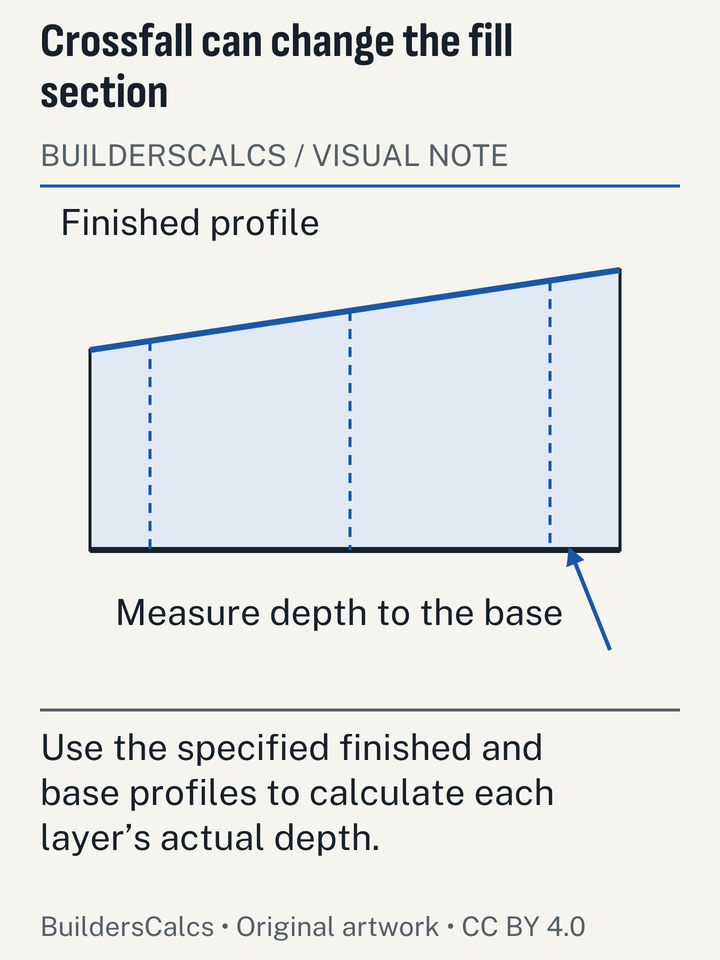
Illustration sources
- Wisconsin Highway Research Program / WisDOT (Cetin, Bulduk, Likos, Edil) — Weight-Volume Relationships and Conversion Factors for Soils and Aggregates of Wisconsin, WHRP G22-05 (Dec 2023)
- Penn State Center for Dirt and Gravel Roads — Technical Bulletin: Driving Surface Aggregate (2025)
- Vulcan Materials Company — Construction Aggregates Calculator (density estimator by geology and product type)
| Material | Tons per compacted cu yd | Extra volume when loose (%) |
|---|---|---|
| Dense graded base 3/4 in | 1.80–1.86 | 36–47 |
| Dense graded base 1 1/4 in | 1.79–1.98 | 34–52 |
| Dense graded base 3 in | 1.78–1.87 | 34–45 |
| Breaker run | 1.82–1.87 | 27–30 |
| Select crushed material | 1.77–1.81 | 27–29 |
| Backfill structure (Grade A or B) | 1.50–1.72 | 35–48 |
| Backfill granular (Grade 1 or 2) | 1.62–1.66 | 38–52 |
| RAP base 1 1/4 in | 1.64–1.71 | 35–46 |
| RCA base 1 1/4 in | 1.65–1.75 | 37–60 |
Worked example: how much gravel for a 12 × 60 ft driveway?
A 12 × 60 ft driveway with a 6 in compacted base needs 13.3 cu yd (10.2 m³) of stone in place, which is 17–21 cu yd (13–16 m³) loose or 24–26 short tons (21–24 t).
- Area: 12 × 60 = 720 sq ft (66.9 m²).
- Compacted volume: 720 × (6 ÷ 12) = 360 cu ft. Divided by 27, that is 13.33 cu yd (10.19 m³).
- Loose, WisDOT range: 360 × 1.27 = 457 cu ft and 360 × 1.60 = 576 cu ft, so 16.9–21.3 cu yd (12.9–16.3 m³).
- Loose, Penn State ratio: 6 ÷ 0.75 = 8 in loose, so 720 × 8 ÷ 12 = 480 cu ft, or 17.8 cu yd (13.6 m³), a 33% expansion inside the WisDOT range.
- Weight: 13.33 × 1.77 = 23.6 and 13.33 × 1.98 = 26.4 short tons (21.4–24.0 t).
As a cross-check, Penn State's crew shortcut for stone placed 8 in loose and rolled to 6 in is width × length × 0.04 tons (Vulcan Materials Company, Wisconsin Highway Research Program / WisDOT (Cetin, Bulduk, Likos, Edil) and others): 12 × 60 × 0.04 = 28.8 short tons (26.1 t). It runs a little high because it assumes road surface stone at about 1.6 tons per loose yard. Two methods within about 10% is normal for aggregate; the quarry's weight for the product it loads is the number to finish on.
The driveway example in each unit
| Basis | US | Metric | Method |
|---|---|---|---|
| Compacted volume in place | 13.3 cu yd | 10.2 m³ | Area × depth |
| Loose volume, low | 16.9 cu yd | 12.9 m³ | × 1.27 (WisDOT low) |
| Loose volume, Penn State ratio | 17.8 cu yd | 13.6 m³ | 8 in loose to 6 in rolled |
| Loose volume, high | 21.3 cu yd | 16.3 m³ | × 1.60 (WisDOT high) |
| Weight | 23.6–26.4 short tons | 21.4–24.0 t | × 1.77–1.98 t per compacted cu yd |
| Weight, road-crew shortcut | 28.8 short tons | 26.1 t | Width × length × 0.04 |
How much does a cubic yard of driveway gravel weigh?
Between about 1.2 and just over 2 short tons, depending on the rock, the grading and whether it is loose or compacted. Clean stone with no fines holds the most air and is lightest; crusher run, with dust filling the gaps, is heaviest. Vulcan's estimator uses 90-102 lb/ft3 for clean coarse aggregate, about 1.22-1.38 short tons per cubic yard (1,442-1,634 kg/m3). Vulcan's estimator uses 130-160 lb/ft3 for crushed stone base / crusher run, about 1.76-2.16 short tons per cubic yard.
The shortcut that a yard of gravel always weighs about 1.4 tons can be out by a third either way. Use the product's own density and note which state it describes.
| Rock | Product | lb per cu ft | Short tons per cu yd | kg per m³ |
|---|---|---|---|---|
| Traprock | Screenings | 124 | 1.67 | 1,986 |
| Traprock | Crushed stone base / crusher run | 160 | 2.16 | 2,563 |
| Traprock | Coarse aggregate (clean stone) | 102 | 1.38 | 1,634 |
| Traprock | Sand | 110 | 1.49 | 1,762 |
| Limestone | Screenings | 113 | 1.53 | 1,810 |
| Limestone | Crushed stone base / crusher run | 138 | 1.86 | 2,211 |
| Limestone | Coarse aggregate (clean stone) | 96 | 1.3 | 1,538 |
| Limestone | Sand | 106 | 1.43 | 1,698 |
| Granite | Screenings | 113 | 1.53 | 1,810 |
| Granite | Crushed stone base / crusher run | 145 | 1.96 | 2,323 |
| Granite | Coarse aggregate (clean stone) | 96 | 1.3 | 1,538 |
| Granite | Sand | 106 | 1.43 | 1,698 |
| Sand & Gravel | Screenings | 112 | 1.51 | 1,794 |
| Sand & Gravel | Crushed stone base / crusher run | 130 | 1.75 | 2,082 |
| Sand & Gravel | Coarse aggregate (clean stone) | 98 | 1.32 | 1,570 |
| Sand & Gravel | Sand | 110 | 1.49 | 1,762 |
| Sandstone | Screenings | 110 | 1.49 | 1,762 |
| Sandstone | Crushed stone base / crusher run | 138 | 1.86 | 2,211 |
| Sandstone | Coarse aggregate (clean stone) | 90 | 1.22 | 1,442 |
| Sandstone | Sand | 100 | 1.35 | 1,602 |
What layers go into a gravel driveway?
A compacted base of angular, well-graded stone carries the load, and an optional thin surface of cleaner stone gives looks and grip. Calculate each layer separately, with its own depth and density.
The base
Crusher run, dense graded base or UK Type 1 locks together when rolled. Spread and compact base in 4-6 in (100-150 mm) lifts with a 7,000 lbf plate compactor; thinner lifts for 5,000 lbf machines. (Concrete Masonry & Hardscapes Association (CMHA, successor to ICPI) and Interlocking Concrete Pavement Institute (ICPI)) In the UK, Marshalls limits each layer to 75 mm max per layer. Penn State specifies at least a 10-ton vibratory roller for road surface stone (Penn State Center for Dirt and Gravel Roads); a hand tamper will not reach that density, so expect a hand-built drive to keep settling.
The surface
Match depth to stone size: Long Rake Spar suggests about 30 mm for 8–14 mm gravel and 50 mm for 14–20 mm, and warns that deeper layers, especially of rounded stone, sink and shift underfoot (Penn State Center for Dirt and Gravel Roads, Long Rake Spar Co. Ltd (UK) and others). Rounded pea gravel rolls under tyres and migrates downhill on a slope. A 50 mm layer of 14–20 mm stone over the 66.9 m² example is 3.3 m³, about 5,620 kg by the table below, or 2 in (4.4 cu yd) over 720 sq ft.
The shape
Standing water is what breaks gravel drives up. Penn State recommends a crown or cross-slope of 1/2 to 3/4 inch per horizontal foot on gravel road surfaces. (Penn State Center for Dirt and Gravel Roads) Build the crown into the base so it survives raking.
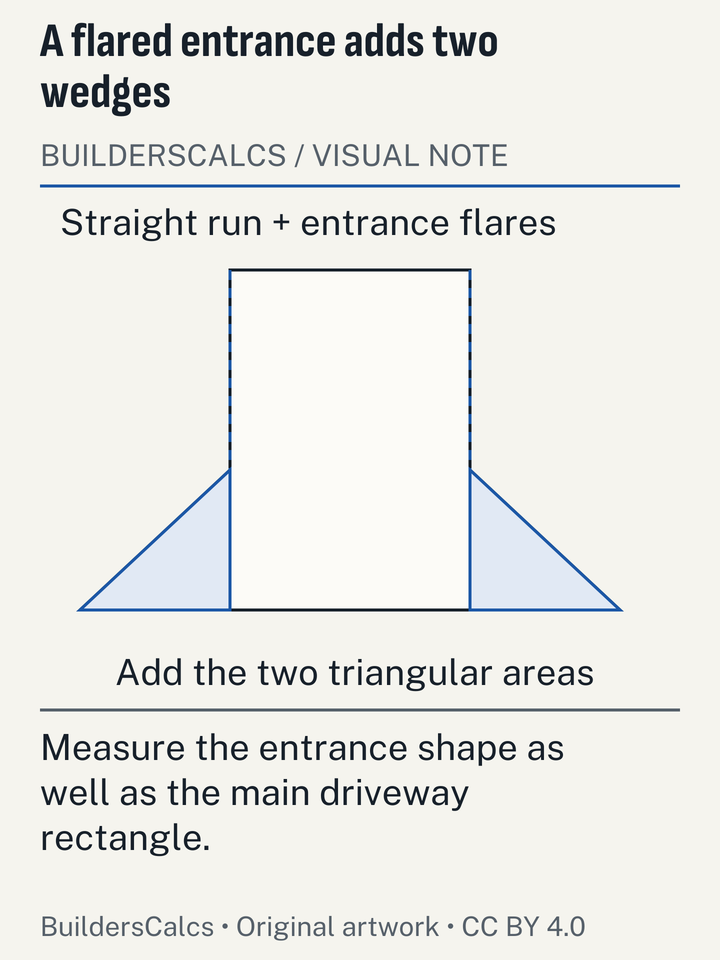
Illustration sources
- Concrete Masonry & Hardscapes Association (CMHA, successor to ICPI) — Tech Note PAV-TEC-002-22 - Construction of Interlocking Concrete Pavements (formerly ICPI Tech Spec 2)
- Interlocking Concrete Pavement Institute (ICPI) — Tech Spec 10 - Application Guide for Interlocking Concrete Pavements
- Marshalls plc (UK) — Drivesys Installation Guidelines
- Marshalls plc (UK) — Driveway Setts Installation Details
- Penn State Center for Dirt and Gravel Roads — Technical Bulletin: Driving Surface Aggregate (2025)
- Long Rake Spar Co. Ltd (UK) — Long Rake Spar Aggregates Brochure - Quantifying your requirements (Suitable Depths; Weight and Bags tables)
| Depth (mm) | kg per 10 m² | 20 kg bags | Bulk bags |
|---|---|---|---|
| 20 | 340 | 17 | 0.43 |
| 30 | 500 | 25 | 0.63 |
| 50 | 840 | 42 | 1.05 |
| 75 | 1,240 | 62 | 1.55 |
How is driveway gravel sold in the UK?
UK merchants sell by the tonne or in bulk bags, and the bulk bag is not a fixed size. Tarmac's Type 1 MOT sub-base is sold in an 850 kg bulk bag. Long Rake Spar's table implies about 800 kg (implied) (Long Rake Spar Co. Ltd (UK)). US yards sell by the short ton or cubic yard, and a short ton is about 10% lighter than a metric tonne.
For the example drive with a 150 mm Type 1 sub-base (10.0 m³ compacted), WisDOT's compacted conversion gives 21–24 t, or 25–28 bags at 850 kg. That factor comes from Wisconsin stone; we found no UK producer density for Type 1, so confirm the bag weight and product with the merchant.
Does recycled aggregate change the quantity?
Slightly. In the WisDOT study, recycled concrete aggregate (RCA) base expanded by up to 60% when loose, the top of the range, so use the RCA row if your supplier offers crushed concrete.
Recycled stone is common. EPA's 2018 estimate, its latest for construction debris, puts US concrete sent to aggregate reuse at 301.2 million US tons (US Environmental Protection Agency (EPA), Office of Resource Conservation and Recovery). The Mineral Products Association estimates 74.7 million tonnes of recycled and secondary aggregates were used in Great Britain in 2024, just under a third of supply (Mineral Products Association (MPA), UK). Virgin stone still dominates: USGS estimates 1.5 billion metric tons of US crushed stone in 2025, mostly for roads (U.S. Geological Survey (USGS), National Minerals Information Center). That is national output across all uses, not driveway demand.
When does the calculation go wrong?
- Soft ground. Stone pressed into mud is stone you paid for and cannot see. Strip topsoil first; the soil depth guide explains why it is the wrong layer to build on.
- A density in the wrong state. A loose density applied to a compacted volume under-orders by a third or more.
- Edges that spread. Where the drive is cut into a bank, the retaining wall calculator sizes the wall; walls over your local code's height limit need an engineer.
- Wet stone. It weighs more per yard. We found no producer correction, so a rainy-day tonnage covers a little less.
- A change to paving. The base idea holds but the surface changes; the pavers or paving slabs needed tool covers blocks, bedding sand and base.
Bottom line: what should you order?
Calculate the compacted volume, then ask the supplier whether they sell by the loose yard or by weight. Loose volume needs the expansion factor; weight needs a compacted conversion factor and nothing else. On firm, well-drained ground, the paver-driveway base minimum is a sensible floor, with a thin surface sized to the stone. For edging, verges and other materials, see the landscape supply calculators, and for any area and depth, the cubic yards from feet and inches converter.
Driveway gravel questions
How many square feet does a ton of driveway base cover?
At WisDOT's 1.77–1.98 tons per compacted cubic yard, one short ton fills about 13.6–15.3 cu ft once rolled: roughly 41–46 sq ft (3.8–4.3 m²) at 4 in deep, or 27–31 sq ft (2.5–2.8 m²) at 6 in.
Why is my gravel driveway thinner than planned after rolling?
The order was probably worked out as if loose stone keeps its volume. Order the loose depth, not the finished depth, or order by weight using a compacted conversion factor.
Can pea gravel be the only layer on a driveway?
It makes a poor base. Rounded stone does not interlock and moves under tyres. Use angular, well-graded stone for the base and keep any rounded stone to a thin top layer.
How do I work out tonnes of gravel from square metres?
Square metres × depth in metres gives cubic metres; multiply by the product's density. Long Rake Spar's table implies about 1,680 kg/m3 (as supplied, loose) for decorative stone, so 20 m² at 50 mm is 1.0 m³, or about 1.7 t.
Sources (26)
- Alliance Designer Products (Alliance Gator)
- Alliance Reference Guide 2025 - Gator Maxx G2 / Gator Supersand G2 polymeric sand coverage, checked
- Belgard (Oldcastle APG)
- Belgard Technical Resource Guide (BEL25-D-516650), pp. 17 and 27, checked
- CDC / NIOSH
- Revised NIOSH Lifting Equation, checked
- Canadian Centre for Occupational Health and Safety (CCOHS)
- NIOSH Lifting Equation - Assessing Relevant Handling Factors, checked
- Concrete Masonry & Hardscapes Association (CMHA, successor to ICPI)
- Tech Note PAV-TEC-002-22 - Construction of Interlocking Concrete Pavements (formerly ICPI Tech Spec 2), checked
- Interlocking Concrete Pavement Institute (ICPI)
- Tech Spec 10 - Application Guide for Interlocking Concrete Pavements, checked
- Long Rake Spar Co. Ltd (UK)
- Long Rake Spar Aggregates Brochure - Quantifying your requirements (Suitable Depths; Weight and Bags tables), checked
- MKM Building Supplies (retailer listing of Tarmac product)
- Tarmac Building Products Type 1 MOT Bulk Bag 850 kg (product listing), checked
- Marshalls plc (UK)
- Drivesys Installation Guidelines, checked
- Driveway Setts Installation Details, checked
- How to lay block paving, checked
- Marshalls Driveways brochure 2020 - Driveline 50 / Standard Block Paving pack data, checked
- Mineral Products Association (MPA), UK
- Profile of the UK Mineral Products Industry, 2025 Edition, checked
- National Institute of Standards and Technology
- Handbook 44 (2026), Appendix C: General Tables of Units of Measurement, checked
- Paver manufacturer use & care guide (hosted by Lowe's; brand not named on sheet)
- 4x8 Holland Paver - Use & Care Guide, checked
- Penn State Center for Dirt and Gravel Roads
- Technical Bulletin: Driving Surface Aggregate (2025), checked
- The Quikrete Companies
- Data Sheet - Patio Paver Sands (No. 1150-49, 1150-59), checked
- Data Sheet - QUIKRETE Sand & Gravel Products (rev. Nov 2020), checked
- Safety Data Sheet C1: Portland Cement Based Concrete Products (rev. Feb-23), checked
- U.S. Geological Survey (USGS), National Minerals Information Center
- Mineral Commodity Summaries 2026: Stone (Crushed), checked
- U.S. OSHA (eCFR)
- 29 CFR 1926.1153 Respirable crystalline silica, Table 1, checked
- UK Parliament (legislation.gov.uk)
- Weights and Measures Act 1985, Schedule 1, checked
- US Environmental Protection Agency (EPA), Office of Resource Conservation and Recovery
- Advancing Sustainable Materials Management: 2018 Fact Sheet, checked
- US Occupational Safety and Health Administration (29 CFR, via Cornell LII)
- 29 CFR 1926.1153 Respirable crystalline silica (construction), checked
- Vulcan Materials Company
- Construction Aggregates Calculator (density estimator by geology and product type), checked
- Wisconsin Highway Research Program / WisDOT (Cetin, Bulduk, Likos, Edil)
- Weight-Volume Relationships and Conversion Factors for Soils and Aggregates of Wisconsin, WHRP G22-05 (Dec 2023), checked
Every number on this page is taken from these documents. How we choose and check sources.