

Waste factors by material: when to add 5%, 10% or 15%
Most published allowances fall between 5% and 15% of the measured quantity, and the right one depends on the material and the layout. Trex suggests 5% extra decking, NRMCA 4–10% on ready-mix concrete, and Fireclay Tile 15% on field tile. Diagonal and herringbone layouts push the figure up: Fireclay says 20% for herringbone tile, and TimberTech 30% for diagonal decking.
How much extra material should you order?
Order the allowance the manufacturer of your product states. Where it states none, use the range published for that material. The table collects every allowance in our fact base, with the organisation that publishes it. Each figure is a percentage added to the net quantity you measured, before rounding up to whole bags, boxes or packs. Use it freely, with a link back to this page.
| Material and layout | Extra to order | Stated by | What it is meant to cover |
|---|---|---|---|
| Ready-mix concrete | 4–10% | National Ready Mixed Concrete Association (CIP 8) | Waste, over-excavation and forms moving under load |
| Clay brick | At least 5% | Brick Industry Association (Technical Note 10) | Breakage and waste |
| Mortar for brick or block | 15–25% | Brick Industry Association (Technical Note 10) | Waste on the net mortar volume |
| Concrete block (8 × 16 in face) | Built into 119 blocks/100 sq ft, against 112.5 net | NCMA (TEK 04-02A) | Waste and breakage |
| Tile, straight or offset | 15% | Fireclay Tile | Cuts and breakage on field tile |
| Tile, herringbone, parquet or specialty shapes | 20% | Fireclay Tile | Extra cuts in patterned layouts |
| Laminate, straight or diagonal | Pergo: add 10% to square footage for standard installs and 15% for diagonal installs. | Pergo (Mohawk) | Cutting and fitting |
| Hardwood, straight or diagonal | Mullican Flooring: add about 5% (5-7% in its worked rule) for standard installs and 10-15% on a diagonal; more for character/builder grades. | Mullican Flooring | Cutting, culling and grade |
| Composite decking, straight | 5% | Trex | Cut-offs |
| Composite decking, straight | 10% | TimberTech (install guide) | Scrap |
| Composite decking, diagonal or patterned | 30% | TimberTech | Angled cuts at every joist end |
| Asphalt shingles | ARMA: most roofs need 2% to 10% extra shingles for trim waste, rising with valleys, dormers, hips and penetrations. | Asphalt Roofing Manufacturers Association | Trim waste |
| Asphalt shingles, typical house | Up to about 5% | Mike Guertin, Fine Homebuilding | Gable fall-off, valley trimmings, damaged shingles |
| Wallpaper | 10% | Graham & Brown | Waste and mistakes |
When should you use 5%, 10% or 15%?
Use about 5% for simple, straight layouts of forgiving materials, 10% as the default for most cut-to-fit flooring and decking, and 15% or more for diagonal work, patterned tile and anything with many cuts. Those three bands are a way of grouping the published figures above. They are not a separate rule, and the maker's own number for your product always comes first.
About 5%
- Brick, where the BIA's minimum is 5%.
- Concrete block, where NCMA's 119 blocks/100 sq ft include 5% over the 112.5 net.
- Hardwood laid straight, where Mullican says 5% to 7%.
- Trex decking laid straight.
- Shingles on a typical house, per Guertin's estimate for fall-off and damage.
About 10%
- Laminate laid straight, where Pergo says 10%.
- Composite decking, per TimberTech's install guide.
- Wallpaper, per Graham & Brown.
- Ready-mix concrete at the top of NRMCA's range, 10%, for a pour over uneven ground.
- Shingles on a cut-up roof, where ARMA's range tops out at 10%.
15% and over
- Laminate laid diagonally, where Pergo says 15%.
- Field tile, per Fireclay, rising to 20% for herringbone.
- Hardwood laid diagonally, at the top of Mullican's range: 15%.
- Mortar, where the BIA range is 15–25%.
- Diagonal or patterned decking, where TimberTech says 30%.
Move up a band when the sources say the job is harder. ARMA's figure rises with valleys, dormers, hips and penetrations. Mullican adds more for character and builder grades. Graham & Brown notes that offset-match wallpaper wastes more per strip than a free or straight match (Graham & Brown).
How do you apply a waste factor?
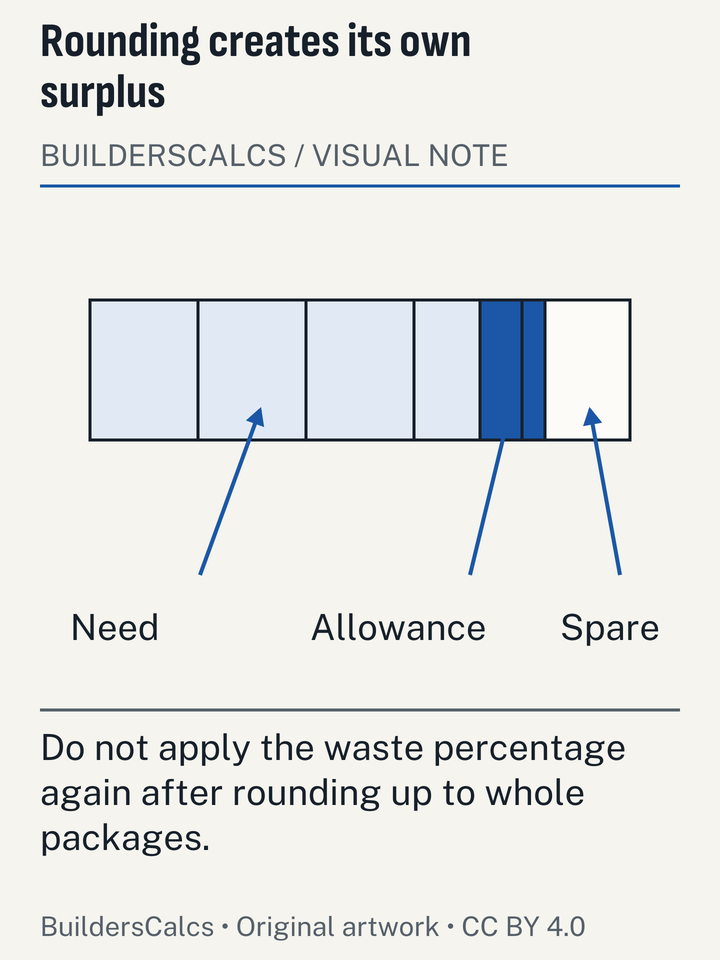
The allowance goes on the measured quantity, and the rounding to whole packs comes last. Done in that order, you never pay for the margin twice.
- Measure the net quantity. Work out the area or volume you are actually covering. For rooms with alcoves, add up the rectangles; a square feet from feet and inches tool handles mixed units.
- Pick the allowance. Use the figure stated for your product. If there is none, use the table above for the material and layout.
- Multiply. Order quantity = net quantity × (1 + allowance ÷ 100). For 10%, multiply by 1.10.
- Divide by the pack coverage. Use the coverage printed on the box or data sheet for the exact product. Coverage differs by product and size, so a generic figure can be wrong.
- Round up once. Flooring is sold in whole packs: divide area plus allowance by pack coverage and round up (Ted Todd (UK wood flooring manufacturer) and Pergo (Mohawk)). Don't add a second margin on top of the rounding.
Worked examples: laminate in feet, tile in metres
A 200 sq ft room in laminate
At Pergo's 10% for a straight lay (Pergo (Mohawk)), 200 × 1.10 = 220 sq ft. Using one published pack size, a Shaw vinyl plank pack of 18.91 sq ft (Shaw Floors), that is 220 ÷ 18.91 = 11.6 packs, so 12 packs covering 226.9 sq ft. In metric, the room is 18.6 m² and each pack 1.76 m².
Laid diagonally at Pergo's 15%, the room needs 230 sq ft, which is 12.2 packs, so 13 packs covering 245.8 sq ft. The change of layout costs one extra pack here. The rounding to whole packs added another 6.9 sq ft in the straight case, about 3.5% of the room, which is why the margin should not be padded a second time.
A 15 m² floor in 60 × 60 cm tile
At Fireclay's 15% for field tile, 15 × 1.15 = 17.25 m² (185.7 sq ft). Marazzi's 60 × 60 cm boxes hold 3 pieces covering 1.08 m² (Marazzi Group (Italy)), so 17.25 ÷ 1.08 = 15.97, which rounds up to 16 boxes, or 17.28 m². The tile and laminate tools do this sum for you: count tiles and boxes, or work out laminate with waste allowance.
Why do diagonal and herringbone layouts need more?
Diagonal and herringbone layouts need more because nearly every piece that meets a wall or edge is cut at an angle, and the offcut from an angled cut is often the wrong shape to start the next row. The published figures show the jump: Pergo goes from 10% to 15% for diagonal laminate, Fireclay from 15% to 20% for herringbone tile, and TimberTech from about 10% to 30% for diagonal decking.
Diagonal decking changes the framing too
Diagonal (45 degree) composite decking needs joists at 12 in on center maximum. (Trex Company and TimberTech (The AZEK Company)) So a diagonal deck can need more joists as well as more boards, and a waste percentage on the boards alone won't capture that. The deck board calculator lets you set the layout.
Herringbone pavers
Herringbone (45 or 90 degree) patterns are recommended where pavers carry vehicles. We have not found a manufacturer or ICPI figure for how much extra a herringbone paver layout uses, only calculator and blog estimates, so we don't give one.
Roofs
Shingle waste depends on the roof shape rather than a layout choice. ARMA ties the extra to valleys, dormers, hips and penetrations, and neither ARMA nor Guertin gives a fixed figure for a gable roof versus a hip roof (Asphalt Roofing Manufacturers Association (ARMA)).
Why order extra material at all?
You order extra because a measured area or volume is never exactly what gets used. Pieces are cut to fit, some break, a few are faulty or spoiled, and concrete spreads into low ground and bulging forms. NRMCA's reasons for its 4–10% are waste, over-excavation and form movement (National Ready Mixed Concrete Association).
A common belief is that ordering exactly the calculated quantity is the thrifty choice. NRMCA's guidance says the opposite for concrete: forms bulge, subgrade is uneven and slabs end up slightly thicker, so the plan volume is a minimum (National Ready Mixed Concrete Association). On a 4 in slab, pouring 1/8 in thicker than planned uses about 3% more concrete. Running short has a price of its own: NRMCA warns that a late short load may mean waiting until after the plant has closed (National Ready Mixed Concrete Association).
Some extra is worth keeping on purpose. Mullican suggests buying 1-2 extra cartons for future repairs. (Mullican Flooring) A spare carton costs little next to an unmatched patch in the middle of a floor. For concrete, see slab, footing and post concrete formulas for how the allowance fits into the volume sum, or go straight to the concrete volume and bag count tool.
Are published waste rates the same as an ordering allowance?
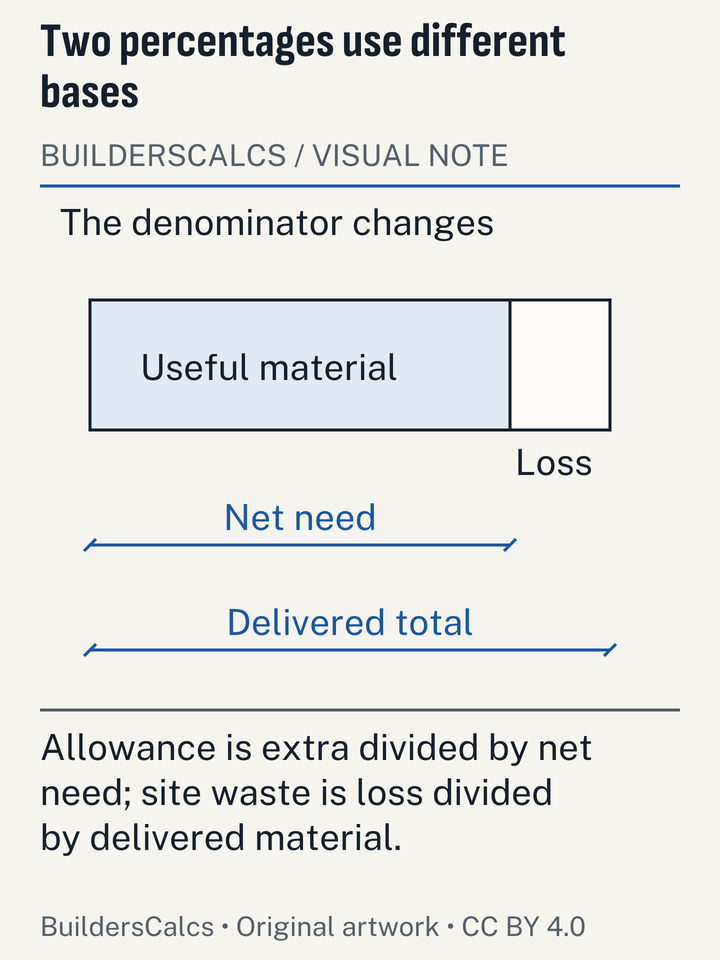
No. Rates such as the RICS defaults measure how much of the material delivered to site ends up wasted. An ordering allowance is how much extra a maker or trade body tells you to buy. RICS's whole life carbon standard (2nd edition, 2023) gives default UK site waste rates for carbon assessments, to be replaced with project data where it exists (Royal Institution of Chartered Surveyors (RICS)). They are useful as a reality check, but they were not written as ordering advice.
Plasterboard shows the difference. The RICS whole life carbon standard (2nd edition, 2023) sets a default UK site waste rate of 4% for plasterboard, 6% for clay brickwork and 6% for tile floor finishes. That 4% is lower than the 10% that Defra's 2010 Plasterboard Sustainability Action Plan reported for one site before changes, and that site halved it to 5% by cutting over-ordering and reusing offcuts. The same plan set a 15% maximum wastage target for the sector (Department for Environment, Food & Rural Affairs (Defra)). The Defra figures date from 2010, and we have not found a newer case study of the same kind. Both figures are real, and they measure different sites and years.
How much do blocks and ready-mix really waste?
Less than older UK benchmarks assumed. A 2023 study for the Mineral Products Association proposed a 5% wastage rate for concrete blocks in housebuilding, replacing the 20% baseline long used in WRAP's Net Waste tool. (Reusefully Ltd for the Mineral Products Association (MPA), Brick Development Association and BRMCA) For concrete, the same study proposed 1–2% for ready-mix on commercial and public projects. That is one study of UK commercial sites, not a national rate, and RICS keeps a 5% default for in-situ concrete (Royal Institution of Chartered Surveyors (RICS)). The table sets the older references and the 2023 proposal side by side.
The low ready-mix figure does not contradict NRMCA's advice to order 4–10% extra. Most of that extra ends up in the slab as extra thickness and filled-out forms, rather than in a skip. The allowance protects the pour, and the wastage rate measures what is thrown away.
| Product | WRAP Net Waste baseline (%) | WRAP good practice (%) | MPA 2023 proposal (%) |
|---|---|---|---|
| Dense concrete blocks | 20 | 5 | 5 |
| Lightweight concrete blocks | 20 | 5 | 5 |
| In-situ / ready-mixed concrete | 5 | 2.5 | 1–2 |
What does over-ordering cost in money and landfill?
Every unit you buy beyond what the job uses is paid for at full price, and much of what isn't returned or reused goes to landfill. The money side depends on your prices. The material cost estimating guide shows how to price the allowance before you commit to it. The landfill side is well measured.
United States
EPA estimates 600 million US tons of construction and demolition debris were generated in the United States in 2018, more than twice the municipal solid waste total; 2018 remains EPA's latest C&D estimate. (US Environmental Protection Agency (EPA), Office of Resource Conservation and Recovery and US Environmental Protection Agency (EPA)) Most of it is not from building new things. Of the 600.3 million tons of US C&D debris in 2018, only 33.0 million tons came from waste during construction and 567.3 million tons from demolition, per EPA. That corrects a common belief that construction sites, rather than demolition, make most of the debris.
Within that construction-phase share, the materials people over-order are prominent. EPA estimates 3.9 million tons of drywall and plaster were wasted during US construction in 2018, more than any other material except concrete (24.2 million tons). EPA estimates 3.4 million tons of wood products were wasted during US construction in 2018, out of 40.8 million tons of wood in all C&D debris. EPA estimates 1.2 million tons of asphalt shingles were wasted during US construction in 2018, against 13.9 million tons from demolition and tear-off.
What happens next differs sharply by material. In 2018, 13.2 million tons of US C&D gypsum drywall went to landfill and only 2.1 million tons to a next use, so roughly 86% was landfilled (EPA). In 2018, 13.0 million tons of US C&D asphalt shingles were landfilled versus 2.1 million tons sent to a next use, about 86% landfilled (EPA). In 2018, 10.8 million tons of US C&D brick and clay tile went to landfill and 1.5 million tons to aggregate, about 88% landfilled (EPA). In 2018, 29.6 million tons of US C&D wood were landfilled while 11.2 million tons went to fuel, mulch or products, about 73% landfilled (EPA). Concrete is the exception. In 2018, 334.0 million tons of US C&D concrete went to a next use (301.2 million tons as aggregate) and 71.2 million tons to landfill, per EPA. Across all materials: EPA estimates 143.8 million tons of US C&D debris (about 24%) were sent to landfill in 2018 and 456.6 million tons went to a next use.
For a single house: EPA's characterization of building-related C&D debris put the weighted average waste from new US residential construction at 4.38 pounds per square foot of floor area (1996 data); no newer national EPA per-square-foot figure has been published. At that rate a 2,000 sq ft (186 m²) home leaves about 8,760 lb (3.97 t) of debris, roughly 21.4 kg per m². Site waste audits of 93 new US dwelling units summarized by EPA ranged from 2.41 to 11.3 pounds of debris per square foot, a spread EPA attributes to house type and builder practice rather than geography. (US EPA (prepared by Franklin Associates), EPA530-R-98-010)
| Material | Wasted during construction | Demolition debris | Total generated | Landfilled | Sent to a next use |
|---|---|---|---|---|---|
| Concrete | 24.2 | 381 | 405.2 | 71.2 | 334 |
| Wood products | 3.4 | 37.4 | 40.8 | 29.6 | 11.2 |
| Drywall and plaster | 3.9 | 11.3 | 15.2 | 13.2 | 2.1 |
| Steel / metal | 0 | 4.7 | 4.7 | 1.1 | 3.6 |
| Brick and clay tile | 0.3 | 12 | 12.3 | 10.8 | 1.5 |
| Asphalt shingles | 1.2 | 13.9 | 15.1 | 13 | 2.1 |
| Asphalt concrete | 0 | 107 | 107 | 4.9 | 102.1 |
| Total | 33 | 567.3 | 600.3 | 143.8 | 456.6 |
How do the UK and EU compare?
England reports a higher recovery rate than the US figures above, although the two are measured differently. England recovered 60.3 million of the 63.3 million tonnes of non-hazardous construction and demolition waste it generated in 2024, a 95.3% recovery rate (Defra, provisional). (Department for Environment, Food & Rural Affairs (Defra)) Construction is still the largest waste stream there. Construction, demolition and excavation generated 118.2 million of England's 178.1 million tonnes of waste in 2024, about 66% of the total (Defra, provisional).
Across the EU, Eurostat's Statistics Explained puts construction at 38.4% of all waste in 2022, the largest share of any activity. Its env_wasgen dataset, revised later, gives 862.2 million tonnes out of 2,225.7 million tonnes, which works out at 38.7% (Eurostat (European Commission)). The two differ because of the revision, and both come from Eurostat. A high recovery rate does not make over-ordering free: recovered material still had to be made, bought and hauled. More figures are on the page about how much building material ends up in landfill.
When does a standard waste factor fail?
- The product has its own figure. Box and pack coverage differs by product and size (Marazzi Group (Italy) and Custom Building Products), and so does the maker's allowance. Use the data sheet for what you are buying.
- The job is small. On a hall floor or a few square feet of backsplash, rounding up to a whole box can add more than any percentage. Work out the boxes before adding a margin.
- The ground is wrong, not the allowance. No allowance covers a sub-base that is an inch low. Fix the levels before you order.
- The grade is rough. Mullican says character and builder grades need more than its standard figure, without putting a number on it.
- The roof is complicated. ARMA's range runs from 2% to 10%. Pick a point in it from the number of valleys, hips and penetrations, and count them first. The roof squares and shingle bundles tool starts from the roof area.
- Mortar. The BIA's 15–25% is a wide range, and it applies to the net mortar volume, not to the bag count. Work out the net volume first, then add the allowance, as the mortar for brick or block joints tool does.
The short version
Start with the maker's figure for your product. Without one, use the material's published range from the table. Use about 5% for straight brick, block, hardwood and Trex decking, 10% for laminate, most composite decking and wallpaper, and 15% or more for diagonal, herringbone and patterned work, up to TimberTech's 30% for diagonal or patterned decking. Apply the allowance before rounding to whole packs, and keep a carton or two for repairs. Every calculator on the site lets you change the percentage. The full list is under all how-to and reference pages.
Waste allowance questions
Is 10% extra enough for tile?
Not according to Fireclay Tile, which recommends 15% extra for field tile and 20% for herringbone, parquet and specialty shapes. For comparison, RICS's default for tile floor finishes actually wasted on UK sites is 6% (Royal Institution of Chartered Surveyors (RICS)), a measure of what is thrown away rather than what to order.
How much extra decking should I buy for a diagonal deck?
TimberTech suggests 30% extra for diagonal or elaborate patterns, against about 10% for a straight lay. Composite boards laid at 45 degrees also need joists at no more than 12 in (305 mm) on centre.
Should I keep leftover flooring?
Yes, a little. Mullican suggests buying 1-2 extra cartons for future repairs. A damaged board can then be replaced with one from the same delivery.
What waste factor do roofers use for shingles?
ARMA puts trim waste at 2% to 10% for most roofs, rising with valleys, dormers, hips and penetrations (Asphalt Roofing Manufacturers Association (ARMA)). Mike Guertin, writing in Fine Homebuilding, puts gable fall-off, valley trimmings and damaged shingles at up to about 5% on a typical house.
How much waste does building a new house create?
EPA's characterisation put the weighted average for new US homes at 4.38 lb per sq ft of floor area, from 1996 data; no newer national EPA figure per square foot has been published. Site audits ranged from 2.41–11.3 lb per sq ft.
Sources (31)
- Asphalt Roofing Manufacturers Association (ARMA)
- Residential Asphalt Roofing Manual - Design and Application Methods, 2014 edition (Ch. 5 Estimating; Ch. 6 Safety), checked
- Brick Industry Association
- Technical Note 10: Dimensioning and Estimating Brick Masonry (Feb 2009), checked
- Concrete Masonry & Hardscapes Association (CMHA, successor to ICPI)
- Tech Note PAV-TEC-002-22 - Construction of Interlocking Concrete Pavements (formerly ICPI Tech Spec 2), checked
- Concrete Masonry & Hardscapes Association (formerly NCMA)
- TEK 04-02A Estimating Concrete Masonry Materials, checked
- Custom Building Products
- Polyblend Sanded / Non-Sanded Grout color card and coverage chart (©2011), checked
- Department for Environment, Food & Rural Affairs (Defra)
- Plasterboard Sustainability Action Plan (PB13439, October 2010), checked
- UK statistics on waste (official statistics release, updated 23 September 2026), checked
- UK statistics on waste release figures and tables dataset 2026, checked
- Eurostat (European Commission)
- Generation of waste by waste category, hazardousness and NACE Rev. 2 activity (env_wasgen), checked
- Waste statistics - Statistics Explained (data extracted September 2024), checked
- Fine Homebuilding (Taunton Press), Mike Guertin
- Don't Fall Short on Shingles: How to Estimate Materials for Roofing Projects (excerpt from Roofing with Asphalt Shingles), checked
- Fireclay Tile
- Tile School: How to Avoid an Add-On Order, checked
- Graham & Brown
- How to measure for wallpaper, checked
- Interlocking Concrete Pavement Institute (ICPI)
- Tech Spec 10 - Application Guide for Interlocking Concrete Pavements, checked
- Marazzi Group (Italy)
- Plaster collection catalogue - formats and packing table, checked
- Mullican Flooring
- How to Calculate the Correct Footage When Purchasing Hardwood Flooring, checked
- National Ready Mixed Concrete Association
- CIP 31 - Ordering Ready Mixed Concrete, checked
- CIP 8 - Discrepancies in Yield (rev. 2016), checked
- Pergo (Mohawk)
- Pergo Installation Essentials Guide (1/4 in expansion version), checked
- Pergo Installation Essentials Guide (rev 012014, 3/8 in expansion version), checked
- Reusefully Ltd for the Mineral Products Association (MPA), Brick Development Association and BRMCA
- Interim findings: wastage rates for blocks and ready mixed concrete (V3, 20 March 2023), checked
- Royal Institution of Chartered Surveyors (RICS)
- Whole life carbon assessment for the built environment, 2nd edition (professional standard, September 2023), checked
- Shaw Floors
- Paragon 7in Plus Floorte PRO direct selling sheet (11.01.2018), checked
- Ted Todd (UK wood flooring manufacturer)
- How to measure a room for wood flooring, checked
- TimberTech (The AZEK Company)
- Decking Installation & Maintenance Guide - TimberTech Composite and Specialty Decking (REV 09/23), checked
- How to Calculate How Much Decking You Need, checked
- Trex Company
- 2024 Trex Decking Installation Guide, checked
- How Many Deck Boards Do I Need?, checked
- US EPA (prepared by Franklin Associates), EPA530-R-98-010
- Characterization of Building-Related Construction and Demolition Debris in the United States, checked
- US Environmental Protection Agency (EPA)
- Construction and Demolition Debris: Material-Specific Data (1960-2018 summary table), checked
- US Environmental Protection Agency (EPA), Office of Resource Conservation and Recovery
- Advancing Sustainable Materials Management: 2018 Fact Sheet, checked
Every number on this page is taken from these documents. How we choose and check sources.