

How to calculate concrete for a slab, footing or post hole
Multiply length by width by thickness, with every measurement in feet, then divide the cubic feet by 27 to get cubic yards. A 10 × 12 ft patio 4 in thick is 40 cu ft, which is 1.48 cu yd (1.13 m³). An 80 lb bag yields 0.6 cu ft (17 L), so that patio takes 67 bags before any allowance, or 74 with the top of NRMCA's 4–10% extra (10%).
How do you calculate concrete, step by step?
Six steps cover any slab, footing, column or post hole. The only things that change from job to job are the shape formula in step 3 and whether you finish with bags or a ready-mix order.
- Measure the pour. Take length and width in feet (or metres) and thickness or depth in inches (or millimetres). Split an L-shaped or irregular area into rectangles and work each one separately.
- Put every measurement in the same unit. Divide inches by 12 to get feet, so 4 in becomes 0.33 ft. In metric, divide millimetres by 1,000, so 100 mm becomes 0.1 m.
- Multiply for volume. For a slab or footing, length × width × thickness gives cubic feet (or cubic metres). For a round column or post hole, use π × radius² × depth.
- Convert to the unit you buy in. Divide cubic feet by 27 for cubic yards, or multiply cubic feet by 0.02831685 for cubic metres.
- Add an allowance. NRMCA advises ordering 4–10% more than the plan volume. Multiply by 1.04 for the low end (4%) or 1.10 for the high end (10%).
- Turn volume into bags or a truck order. Divide by the yield printed on the bag and round up to a whole bag. For ready-mix, round up to the increment your supplier sells in.
What is the formula for concrete volume?
Concrete volume is length × width × thickness for any flat or rectangular pour, and π × radius² × depth for anything round. Sakrete's data sheets give the slab version as length (ft) × width (ft) × thickness (in) ÷ 12, which is the same thing with the inch conversion built in (The Quikrete Companies and SAKRETE of North America).
The five shapes most home projects need:
- Slab, patio, path or pad:
length_ft × width_ft × (thickness_in ÷ 12) - Continuous wall footing:
length_ft × (width_in ÷ 12) × (depth_in ÷ 12) - Round column or tube form:
π × (diameter_in ÷ 24)² × height_ft - Post hole: the cylinder above, minus the post's cross-section × the fill depth
- Solid steps on grade:
width_ft × (rise_in ÷ 12) × (run_in ÷ 12) × n × (n + 1) ÷ 2, where n is the number of steps
The ÷ 24 in the cylinder formula is not a typo. It halves the diameter to get the radius and converts inches to feet in one move. Once you have cubic feet, volume in cubic yards or cubic metres is one division away.
The most common mistake is putting inches straight into the formula. A slab entered as 10 × 12 × 4 comes out at 480, which is twelve times too big, because the 4 is inches and the other two numbers are feet (SAKRETE of North America and National Institute of Standards and Technology). Convert first. The table below does the conversion for the thicknesses people pour most.
| Thickness (in) | In feet | In millimetres |
|---|---|---|
| 2 | 0.1667 | 50.8 |
| 3 | 0.25 | 76.2 |
| 3.5 | 0.2917 | 88.9 |
| 4 | 0.3333 | 101.6 |
| 5 | 0.4167 | 127 |
| 6 | 0.5 | 152.4 |
| 8 | 0.6667 | 203.2 |
| 10 | 0.8333 | 254 |
| 12 | 1 | 304.8 |
Worked example 1: how much concrete does a 10 × 12 ft patio need?
A 10 × 12 ft patio poured 4 in thick needs 40 cu ft of concrete, which is 1.48 cu yd or 1.13 m³ before any allowance. Quikrete gives 4 in as the typical patio thickness (The Quikrete Companies and SAKRETE of North America).
The working
- Thickness in feet: 4 ÷ 12 = 0.333 ft.
- Volume: 10 × 12 × 0.333 = 40 cu ft.
- Cubic yards: 40 ÷ 27 = 1.48 cu yd.
- Cubic metres: 40 × 0.0283 = 1.13 m³.
- With the 10% top of NRMCA's range: 40 × 1.10 = 44 cu ft (1.63 cu yd, 1.25 m³).
In bags
At 0.6 cu ft (17 L) per 80 lb bag, 44 ÷ 0.6 = 73.3, so buy 74 bags. With 60 lb bags at 0.45 cu ft (12.7 L), 44 ÷ 0.45 = 97.8, so 98 bags. That is about 5,900 lb (2.7 t) of dry mix to lift, mix and place by hand.
UK bags are smaller. A Blue Circle bag makes about 0.01 m³ and a Hanson MaxiPack20 about 0.009 m³ (Tarmac (Blue Circle)). For 1.25 m³ that is 125 Blue Circle bags or 139 Hanson bags. When the bag count runs into three figures, compare it with a small ready-mix delivery, covered further down.
Check the thickness before you order
A slab poured just 1/8 in thicker than planned on a 4 in base uses about 3% more concrete, according to NRMCA (National Ready Mixed Concrete Association). On this patio that is a little over 1 cu ft, or two more 80 lb bags. Screed the sub-base flat and set the forms to the exact height, and the allowance will cover spillage instead of a dip in the ground.
Worked example 2: how much concrete does a wall footing take?
A 40 ft footing 16 in wide and 8 in deep takes 35.6 cu ft of concrete: 1.32 cu yd or 1.01 m³ before the allowance. Those dimensions come from Quikrete's rule of thumb for an 8 in block wall, which makes the footer twice as wide as the wall and as deep as the wall is wide (The Quikrete Companies).
The working
- Width in feet: 16 ÷ 12 = 1.333 ft. Depth in feet: 8 ÷ 12 = 0.667 ft.
- Volume: 40 × 1.333 × 0.667 = 35.6 cu ft.
- Cubic yards: 35.6 ÷ 27 = 1.32 cu yd. Cubic metres: 35.6 × 0.0283 = 1.01 m³.
- With 10% extra: 39.1 cu ft, or 1.45 cu yd (1.11 m³).
- In 80 lb bags: 39.1 ÷ 0.6 = 65.2, so 66 bags.
Compare it with the code minimum
The IRC sets the smallest allowed footing at 12 in wide x 6 in deep (International Code Council / California Building Standards Commission via GoCodebook and MyBuildingPermit.com (Washington municipal permitting consortium)). The same 40 ft run at that minimum is 40 × 1 × 0.5 = 20 cu ft (0.74 cu yd, 0.57 m³), a little over half the rule-of-thumb volume. The minimum is a floor, not a design. Required width grows with the load and the soil, the bottom must sit 12 in below undisturbed ground and below the frost line, and your building department has the final word.
If the footing carries a block wall, the CMU blocks per wall count is the next number to work out.
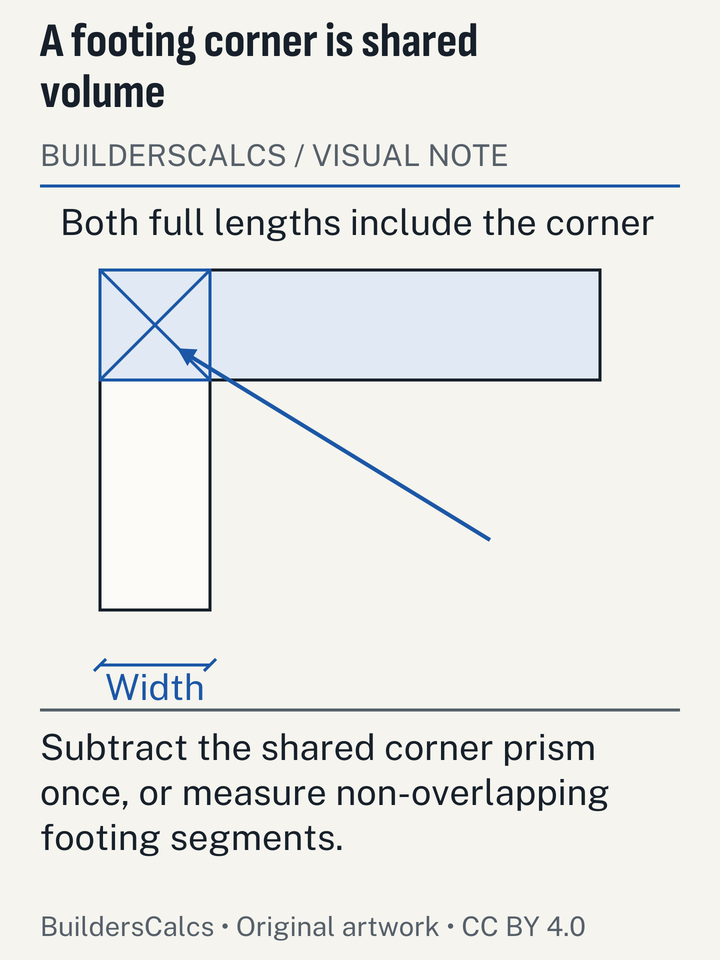
Illustration sources
- The Quikrete Companies — Project guide: Footers for Walls
- National Ready Mixed Concrete Association — CIP 8 - Discrepancies in Yield (rev. 2016)
- National Ready Mixed Concrete Association — CIP 31 - Ordering Ready Mixed Concrete
- International Code Council / California Building Standards Commission via GoCodebook — 2025 California Residential Code Section R403 Footings
- MyBuildingPermit.com (Washington municipal permitting consortium) — Inspection Checklist: Residential Footing and Foundation (2021 IRC with WA amendments, Sept 2024)
Worked example 3: how much concrete does a fence post hole take?
A 4x4 fence post set in a 10.5 in hole with 28 in of concrete takes about 1.2 cu ft (34 L) per hole once the post is subtracted. Ten posts need about 12 cu ft, which is 33 bags of 50 lb fast-setting mix or 21 bags of 80 lb standard mix.
Sizing the hole first
- Diameter: Quikrete and Sakrete say to dig 3x post width (The Quikrete Companies and SAKRETE of North America). A 4x4 actually measures 3.5 in square (NIST / American Lumber Standard Committee and USDA Forest Service, Forest Products Laboratory), so the hole is 10.5 in across. Sakrete Canada instead allows 2 in each side (King Packaged Materials / Sika Canada (SAKRETE Canada)), which gives an 8 in hole. Both are published methods, and the narrower hole uses less concrete.
- Depth: bury about 1/3 post length on a base of 4–6 in of gravel. An 8 ft post is buried 32 in.
- Fill height: Quikrete stops the concrete 3–4 in below the top and finishes with soil, so the concrete column here is 32 − 4 = 28 in, or 2.33 ft.
The working
- Hole area: radius 5.25 in = 0.4375 ft, so π × 0.4375² = 0.601 sq ft.
- Post area: 3.5 × 3.5 = 12.25 sq in = 0.085 sq ft.
- Net area: 0.601 − 0.085 = 0.516 sq ft.
- Concrete per hole: 0.516 × 2.33 = 1.20 cu ft (34 L).
- Ten holes: 12.05 cu ft. In 50 lb fast-setting bags at 0.375 cu ft (10.6 L): 12.05 ÷ 0.375 = 32.1, so 33 bags. In 80 lb bags: 20.1, so 21 bags.
Multiply the unrounded per-hole volume by the number of posts and round up once at the end. Rounding up at every hole would put 4 bags in each, 40 in all, and leave seven unopened. As a cross-check, Sakrete's post-setting chart lists 3 bags of 50 lb Fast Setting mix for an average 10 in (254 mm) hole 30 in (762 mm) deep. (SAKRETE of North America) That is in line with the 3.2 bags worked out here.
The post takes up about 14% of the hole in this example. Skip the subtraction and you overbuy by the same share. The post hole calculator subtracts the post for you and includes the UK Postcrete bag chart.
The three examples side by side
| Pour | Net volume | Cubic yards | Cubic metres | With 10% extra | 80 lb bags (with extra) |
|---|---|---|---|---|---|
| Patio, 10 × 12 ft × 4 in | 40.0 cu ft | 1.48 | 1.13 | 44.0 cu ft | 74 |
| Footing, 40 ft × 16 in × 8 in | 35.6 cu ft | 1.32 | 1.01 | 39.1 cu ft | 66 |
| Ten 4x4 posts, 10.5 in holes, 28 in fill | 12.0 cu ft | 0.45 | 0.34 | not added | 21 |
How many bags is that, and when is ready-mix the better buy?
About 45 bags of 80 lb concrete make one cubic yard, before any allowance (The Quikrete Companies, SAKRETE of North America and others). The table shows the US bag sizes, their yields and the count per cubic yard and cubic metre.
| Product | Bag (lb) | Bag (kg) | Yield (cu ft) | Yield (L) | Bags per cu yd | Bags per m³ |
|---|---|---|---|---|---|---|
| Quikrete Concrete Mix 1101 | 40 | 18.1 | 0.3 | 8.5 | 90 | 117.7 |
| Quikrete Concrete Mix 1101 | 50 | 22.6 | 0.375 | 10.6 | 72 | 94.2 |
| Quikrete Concrete Mix 1101 | 60 | 27.2 | 0.45 | 12.7 | 60 | 78.5 |
| Quikrete Concrete Mix 1101 | 80 | 36.2 | 0.6 | 17 | 45 | 58.9 |
| Quikrete Concrete Mix 1101 (regional) | 90 | 40.8 | 0.675 | 19.1 | 40 | 52.3 |
| Sakrete High Strength Concrete Mix | 40 | 18.1 | 0.3 | 8.5 | 90 | 117.7 |
| Sakrete High Strength Concrete Mix | 60 | 27.2 | 0.45 | 12.7 | 60 | 78.5 |
| Sakrete High Strength Concrete Mix | 80 | 36.2 | 0.6 | 17 | 45 | 58.9 |
| Sakrete High Strength Concrete Mix | 90 | 40.8 | 0.68 | 19.3 | 39.7 | 51.9 |
| Quikrete Fast-Setting Concrete Mix 1004 | 50 | 22.6 | 0.375 | 10.6 | 72 | 94.2 |
| Quikrete Fast-Setting Concrete Mix 1004 | 60 | 27.2 | 0.45 | 12.7 | 60 | 78.5 |
| Sakrete Fast Setting Concrete Mix | 50 | 22.6 | 0.38 | 10.8 | 71.1 | 92.9 |
| Sakrete Rapid Post (Canada) | 66 | 30 | 0.5 | 14 | 54 | 70.6 |
Bag maths for ready-mix orders
Bags make sense for post holes, steps and small pads. Each 80 lb bag needs 1 cu ft of mixer drum space (The Quikrete Companies), and every bag is mixed, carried and placed by hand. Ready-mix is sold by the volume of fresh concrete that comes off the truck (National Ready Mixed Concrete Association), which is why the cubic-yard figure from the formula is the number to give the plant.
Most US cement ends up in ready-mix. USGS estimates that 70–75% of US cement sales in 2025 went to ready-mixed concrete producers, and NRMCA's production model assumes 75% (U.S. Geological Survey (USGS), National Minerals Information Center and National Ready Mixed Concrete Association (NRMCA)). That is cement tonnage across all construction, not a measure of what homeowners choose, but it shows where the industry's quality control sits.
Minimum loads and short-load fees are set by each supplier, so ask for them when you get a price. NRMCA says truck mixer capacity varies between 8 and 12 cu yd (5 to 9 m³). (National Ready Mixed Concrete Association) As one example of published terms, One US producer, Cemstone, charges a part-load fee on any load of 6¼ cu yd (4.8 m³) or less; the fee amount is not published. (Cemstone) In the UK, Heidelberg Materials UK delivers ready-mix in 6 and 8 m³ trucks, free on full loads, and charges for part loads. (Heidelberg Materials UK) For the full comparison of the two, see cement, sand and gravel proportions and the bagged-versus-ready-mix section on that page.
How much of the allowance is really wasted?
Less than you might expect. A 2023 study for the UK Mineral Products Association proposed a wastage rate of 1–2% for ready-mixed concrete on commercial and public projects, below the 5% that the old WRAP baseline assumed (Reusefully Ltd for the Mineral Products Association (MPA), Brick Development Association and BRMCA). That is one study of UK commercial sites, not a national rate. It also measures something different from NRMCA's ordering advice. Most of the extra you order ends up in the slab as extra thickness, bulged forms and low spots, rather than in a skip. The waste percentage by job guide compares allowances across materials.
Why does the concrete come up short?
Concrete usually runs short because the pour is bigger than the plan, not because the plant short-delivered. NRMCA's guidance on yield discrepancies lists thicker-than-planned slabs, forms that bulge under the weight, uneven subgrade and spillage as the usual causes. It quotes the ASTM C94 note that these are not the producer's responsibility (National Ready Mixed Concrete Association).
- The sub-base is low. Every 1/8 in of extra depth on a 4 in slab adds about 3%.
- Forms move. Stake and brace them so the sides stay straight when full.
- Hardened concrete is a little smaller than fresh. Concrete in place can be 2% less in volume than what was delivered (National Ready Mixed Concrete Association). Measuring the cured slab to check a delivery will always read slightly low.
- The last load is guessed. Near the end of the pour, re-measure what is left and adjust the last 2 or 3 loads to avoid a short load. That beats waiting for a top-up after the plant has closed (National Ready Mixed Concrete Association).
A common belief is that you should order exactly the calculated volume and the supplier will make up any difference. The figure on the ticket is fresh volume. Anything lost to the ground or the forms is yours to cover, which is the reason for the 4–10% allowance.
When does this method not apply?
The formula gives you the volume. It does not tell you how thick, how wide or how strong the concrete must be, and on structural work that decision belongs to the code and to an engineer.
- House slabs and footings. The IRC minimum for a slab-on-ground floor is 3.5 in (89 mm), not the 4 in many people assume (International Code Council / California Building Standards Commission via GoCodebook and UpCodes (Colorado DFPC Residential Code 2021, based on 2021 IRC)). Footing widths by load and soil come from IRC Table R403.1(1) and its companions. For a light-frame house on weak soil they grow well past the minimum; IRC Table R403.1(1) assumes a 32 ft (9.75 m) wide building; wider buildings add 2 in of footing width and 1 in of depth per 4 ft. (International Code Council and International Code Council / California Building Standards Commission via GoCodebook) Use the numbers on your approved plans.
- Driveways. Quikrete's 4 in figure is for cars only; trucks and heavy vehicles need more (The Quikrete Companies).
- Thin toppings. Standard and fast-setting bag mixes are meant for pours of 2 in (50 mm) or more. A thinner layer needs a different product.
- Rebar and mesh. The volume formula says nothing about reinforcement. Where a slab has it, the steel must be supported so it stays in the slab, around mid-depth, during the pour; bars lying on the ground under the slab do nothing (The Quikrete Companies and International Code Council / California Building Standards Commission via GoCodebook).
- Weight, not volume. Density varies by mix. Quikrete lists its bagged mix at 140 lb/ft³ (2,242.5 kg/m³), while NRMCA's ready-mix example uses 151 lb/ft³ (2,430 kg/m³). Use density to estimate a load on a trailer, never to work out volume.
- Odd shapes. Curves, tapers and thickened slab edges need splitting into simple shapes. Add each piece separately rather than averaging the depth by eye.
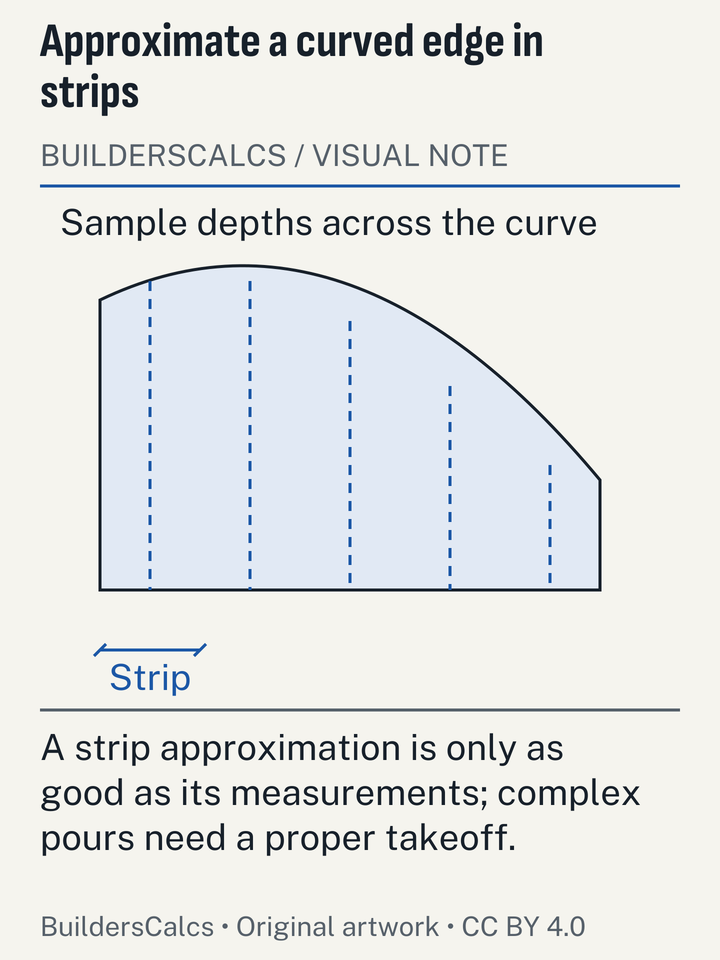
Illustration sources
- International Code Council / California Building Standards Commission via GoCodebook — 2025 California Residential Code (based on 2024 IRC): Sections R402, R403, R506
- UpCodes (Colorado DFPC Residential Code 2021, based on 2021 IRC) — R506.1 Concrete floors on ground
- International Code Council / California Building Standards Commission via GoCodebook — 2025 California Residential Code Section R403 Footings
- International Code Council — 2021 International Residential Code, Chapter 4 Foundations (public access)
- The Quikrete Companies — Project guide: Concrete Driveways and Curbs
- The Quikrete Companies — QUIKRETE Concrete Mix No. 1101 Data Sheet (revised Oct 2022)
- SAKRETE of North America — SAKRETE Fast Setting Concrete Mix technical data sheet, hosted by Home Depot
- The Quikrete Companies — Project guide: Concrete Sidewalks and Small Slabs
- National Ready Mixed Concrete Association — CIP 8 - Discrepancies in Yield (rev. 2016)
By hand or with the calculator?
Work it by hand once, so you know where each number comes from, then let the concrete calculator handle the repeats and the unit switching. It applies the same formulas, the same bag yields and the same NRMCA allowance shown here. The concrete calculator collection also has tools for blocks, mortar and post holes.
For context on the bigger picture, see how much concrete is produced each year in the US, UK and EU.
Concrete maths questions
Why do you divide by 27 to get cubic yards?
A cubic yard is a cube 3 ft on each side, and 3 × 3 × 3 = 27, so one cubic yard holds 27 cu ft/yd³. In metric, one cubic yard is about 0.7645549 m³ and one cubic metre is about 1.307951 cu yd.
How do I work out concrete for a round column or tube form?
Use π × radius² × height with everything in feet. A 12 in tube form 4 ft tall is π × 0.5² × 4 = 3.14 cu ft (0.089 m³). At 0.6 cu ft per 80 lb bag that is 5.2, so buy 6 bags.
How do I calculate concrete for solid steps?
Each step is a block as wide as the stair, one riser high per step counted from the top, and one tread deep. Three steps 4 ft wide with 7 in risers and 11 in treads give 4 × (7 ÷ 12) × (11 ÷ 12) × 6 = 12.8 cu ft (0.36 m³). The 6 is 3 × 4 ÷ 2. Add any top landing as a separate slab. The riser and tread pairing comes from Quikrete's step proportion chart (The Quikrete Companies).
Do I subtract the post when working out post hole concrete?
Yes. In the 10.5 in hole worked above, a 4x4 fills about 14% of the hole, so leaving it in the sum overstates the concrete by the same share. As Quikrete's own example puts it: Two 50 lb bags of Quikrete Fast-Setting Concrete set a 3 in square post in a 9 in (225 mm) hole 30 in (0.75 m) deep. (The Quikrete Companies)
Should the allowance go on before or after converting to bags?
Before. Multiply the volume by the allowance first, then divide by the bag yield and round up once. Rounding up and then adding a percentage on top orders more than the allowance you meant to apply.
Sources (34)
- Cemstone
- Ready Mixed Concrete Customer Service Guidelines 2026, checked
- Hanson (Heidelberg Materials UK)
- Instant Concrete technical data sheet, checked
- Multipurpose Concrete technical data sheet (updated August 2020), checked
- Health and Safety Executive (UK)
- Construction hazardous substances: Cement, checked
- Heidelberg Materials UK
- Ready-mixed concrete pricing guide, checked
- International Code Council
- 2021 International Residential Code, Chapter 4 Foundations (public access), checked
- International Code Council / California Building Standards Commission via GoCodebook
- 2025 California Residential Code (based on 2024 IRC): Sections R402, R403, R506, checked
- 2025 California Residential Code Section R403 Footings, checked
- King Packaged Materials / Sika Canada (SAKRETE Canada)
- SAKRETE Rapid Post product data sheet, checked
- MyBuildingPermit.com (Washington municipal permitting consortium)
- Inspection Checklist: Residential Footing and Foundation (2021 IRC with WA amendments, Sept 2024), checked
- NIST / American Lumber Standard Committee
- Voluntary Product Standard PS 20-20, American Softwood Lumber Standard, checked
- National Institute of Standards and Technology
- NIST Guide to the SI (SP 811), Appendix B.9 conversion factors, checked
- National Ready Mixed Concrete Association
- CIP 31 - Ordering Ready Mixed Concrete, checked
- CIP 8 - Discrepancies in Yield (rev. 2016), checked
- National Ready Mixed Concrete Association (NRMCA)
- U.S. Ready Mixed Concrete Production industry fact sheet, 2025 edition (monthly sheet and 2024 production by state), checked
- Reusefully Ltd for the Mineral Products Association (MPA), Brick Development Association and BRMCA
- Interim findings: wastage rates for blocks and ready mixed concrete (V3, 20 March 2023), checked
- SAKRETE of North America
- SAKRETE Fast Setting Concrete Mix technical data sheet, hosted by Home Depot, checked
- SAKRETE High Strength Concrete Mix technical data sheet (REV 7-10), hosted by Home Depot, checked
- Tarmac (Blue Circle)
- High Strength Concrete (40N) product data sheet (June 2014), hosted by Wickes, checked
- Multi-Purpose Concrete product data sheet (March 2014), hosted by Wickes, checked
- POSTCRETE product data sheet (April 2014), hosted by Wickes, checked
- The Quikrete Companies
- Project guide: Concrete Driveways and Curbs, checked
- Project guide: Concrete Patios, checked
- Project guide: Concrete Sidewalks and Small Slabs, checked
- Project guide: Concrete Steps and Ramps, checked
- Project guide: Footers for Walls, checked
- Project guide: Setting Posts, checked
- QUIKRETE Concrete Mix No. 1101 Data Sheet (revised Oct 2022), checked
- QUIKRETE Fast-Setting Concrete Mix No. 1004 Data Sheet, checked
- Safety Data Sheet C1: Portland Cement Based Concrete Products (rev. Feb-23), checked
- U.S. Geological Survey (USGS), National Minerals Information Center
- Mineral Commodity Summaries 2026: Cement, checked
- US Occupational Safety and Health Administration (29 CFR, via Cornell LII)
- 29 CFR 1926.1153 Respirable crystalline silica (construction), checked
- USDA Forest Service, Forest Products Laboratory
- Wood Handbook (FPL-GTR-282), Chapter 6: Commercial Lumber, Round Timbers, and Ties, checked
- UpCodes (Colorado DFPC Residential Code 2021, based on 2021 IRC)
- R506.1 Concrete floors on ground, checked
Every number on this page is taken from these documents. How we choose and check sources.