

Mortar calculator
Enter how many bricks or blocks you are laying, pick the mortar you plan to buy, and this calculator returns the bags, tubs or site-mix batches, with sand and lime where you mix your own. The quick rule from the bag: One 80 lb bag of Quikrete Mortar Mix (Type N) lays up to 37 standard bricks or 13 standard 8 x 8 x 16 blocks. Add the Brick Industry Association's waste allowance and 1,000 bricks need 32 of those bags. Sakrete and NCMA print higher yields per bag, so the count depends on the product you choose.
Mortar calculator
v1 · US and metricEnter how many bricks or blocks you are laying and how you will get your mortar: bagged mix, masonry cement and sand, or cement, lime and sand mixed on site.
Result
Enter your measurements and press Calculate.
Formula and assumptions
Bags = count × (1 + extra %) ÷ units laid per bag, rounded up; metric:Bags or tubs = count × (1 + extra %) ÷ units laid per bag or tub, rounded upMasonry cement: bags = count × (1 + extra %) ÷ (units per batch ÷ 8); sand = bags × 250 lb; metric:Masonry cement: bags = count × (1 + extra %) ÷ (units per batch ÷ 8); sand = bags × 113 kgSite mix: batches = count × (1 + extra %) ÷ units per batch; each batch is 1 cu ft cement plus the lime and sand for the type; metric:Site mix: batches = count × (1 + extra %) ÷ units per batch; each batch is 28.3 L cement plus the lime and sand for the type- Bag yields are the makers' own figures: One 80 lb bag of Quikrete Mortar Mix (Type N) lays up to 37 standard bricks or 13 standard 8 x 8 x 16 blocks. One 80 lb bag of Sakrete Type N Mortar Mix lays about 40 standard bricks or 15 8 in blocks with 3/8 in joints.
- NCMA estimates one 80 lb bag of preblended mortar lays about 16 conventional blocks or 50 brick-sized units.
- Masonry cement and site-mix batches follow NCMA TEK 04-02A (Concrete Masonry & Hardscapes Association (formerly NCMA)). NCMA: about 1 ton (2,000 lb) of masonry sand per 8 bags of masonry cement; add 1/2 ton for waste if using more than 3 tons.
- A 70 lb bag of masonry cement mixed with sand lays about 46 blocks or 144 bricks (Quikrete) or about 30 hollow blocks (NCMA). We use the NCMA figure because it also gives the sand.
- UK: A 10 kg tub of Tarmac ready-to-use Mortar Mix lays about 12 bricks or six 100 mm blocks. Canada: A 30 kg (66 lb) bag of Sakrete Mortar Mix Type N (Canada) lays about 33 bricks with a 10 mm joint.
- Bag, tub and batch counts are rounded up.
How many bags of mortar do I need for 1,000 bricks?
With Quikrete's 80 lb Mortar Mix, 1,000 bricks need 32 bags with the default extra, which is the low end of the Brick Industry Association's waste range. That is the result the calculator shows when it loads. The working: 1,000 × 1.15 = 1,150 bricks' worth of mortar, divided by the 37 bricks one bag lays, is 31.1, rounded up to 32.
The same 1,150 divided by Sakrete's 40 bricks/bag gives 29 bags of its 80 lb Type N mix. NCMA's estimate for any preblended 80 lb bag is 50 units/bag, which gives 23 bags. That spread is the main reason to choose the product in the calculator rather than rely on one rule of thumb: the yields are each maker's own figures, and they do not agree.
For metric users the default is 500 bricks laid from Tarmac's 10 kg ready-to-use tubs. A 10 kg tub of Tarmac ready-to-use Mortar Mix lays about 12 bricks. With the default extra that is 48 tubs, which is why tubs suit repairs and short garden walls rather than a house extension.
Enter the count before any breakage allowance. If you used the brick calculator or the cinder block count tool, take the "before extra" figure, not the number to buy, so the spare units do not inflate the mortar.
How is mortar quantity calculated?
Mortar is counted from the number of units each bag or batch will lay, not from the volume of the joints. Makers and trade bodies publish those yields because joint volume is hard to measure and most of the loss happens on the board and the ground. The calculator follows three routes depending on the mortar you pick.
- Bagged mortar mix or tubs: units × (1 + extra ÷ 100) ÷ units laid per bag, rounded up.
- Masonry cement and sand: NCMA's batch of 8 bags (70 lb each) of masonry cement and 2,000 lb (907 kg) of sand lays 1,000 units/batch or 240 blocks/batch. The calculator divides that by eight to get units per bag, rounds the bag count up, then adds an eighth of the batch's sand per bag.
- Portland cement, hydrated lime and sand: each NCMA batch starts from 1 cu ft of cement, with the lime and sand set by the mortar type. Units ÷ units per batch gives the batches, and each ingredient is batches × its amount per batch.
Worked example: Type S site mix for 1,000 bricks
With no extra, 1,000 bricks ÷ the 225 units/batch a Type S batch lays = 4.44 batches. Cement: 4.44 × 1 = 4.44 cu ft (126 L). Lime: 4.44 × 0.5 = 2.22 cu ft (63 L). Sand: 4.44 × 4.5 = 20 cu ft (566 L). The amounts are loose volumes, measured by the bucket or box, not weights.
Worked example: masonry cement for 500 bricks
One 70 lb bag of masonry cement lays 1,000 ÷ 8 = 125 bricks in NCMA's batch. So 500 bricks need 4 bags, and 4 × 250 lb = 1,000 lb of masonry sand, half a short ton. Quikrete's own figure for the same bag is higher. A 70 lb bag of masonry cement mixed with sand lays about 46 blocks or 144 bricks (Quikrete) or about 30 hollow blocks (NCMA). The calculator uses NCMA's because it states the sand too, and its lower yield is the safer side to be on.
| Job | Mortar chosen | Extra | Result | Also needed |
|---|---|---|---|---|
| 1,000 bricks | Quikrete Mortar Mix, 80 lb | 15% | 32 bags | Water only |
| 200 blocks | Sakrete Type N, 80 lb | 15% | 16 bags | Water only |
| 1,000 bricks | Type S cement-lime site mix | 0% | 4.44 batches | 4.44 cu ft cement, 2.22 cu ft lime, 20 cu ft sand |
| 500 bricks | Masonry cement, 70 lb | 0% | 4 bags | 1,000 lb (0.5 ton) masonry sand |
| 120 bricks (UK) | Tarmac ready-to-use, 10 kg tub | 0% | 10 tubs | Nothing; the tub is ready to use |
How many bricks or blocks does each mortar product lay?
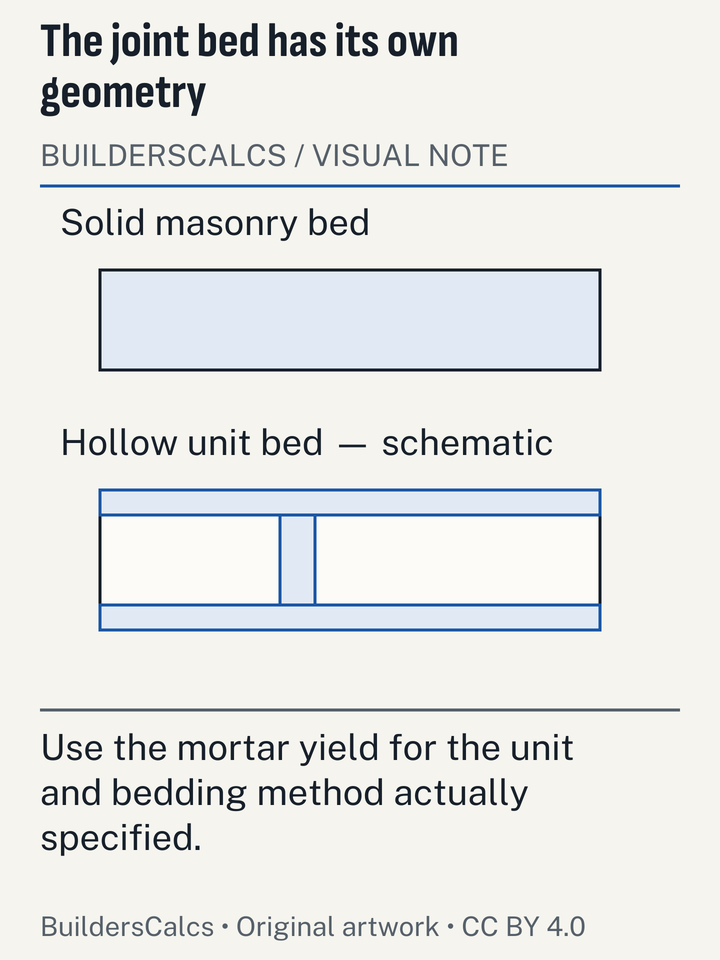
An 80 lb bag of pre-sanded Type N mortar lays between 37 bricks/bag and 50 units/bag, depending on whose figure you use. The table sets each yield the calculator uses beside its source. Blocks use far more mortar per unit than bricks, because each block has a much larger bed and head joint, so a bag lays far fewer blocks than bricks.
A common mix-up is to treat a bag of mortar mix and a bag of masonry cement as the same thing. Mortar mix already contains its sand; you add only water. Masonry cement is the binder alone and must be mixed with several times its volume of sand. Quikrete mixes 1 part masonry cement with 2 1/4 to 3 parts masonry sand for mortar. That is why one bag of masonry cement lays several times as many bricks as one bag of mortar mix, and why the calculator lists sand only for the masonry cement and site-mix routes.
| Product | Bricks | Blocks | Source |
|---|---|---|---|
| Quikrete Mortar Mix (Type N), 80 lb | 37 bricks/bag | 13 blocks/bag | (The Quikrete Companies) |
| Sakrete Type N Mortar Mix, 80 lb | 40 bricks/bag | 15 blocks/bag | (SAKRETE of North America) |
| Sakrete Type N Mortar Mix, 60 lb | 30 bricks/bag | 11 blocks/bag | (SAKRETE of North America) |
| Any preblended mortar, 80 lb (NCMA) | 50 units/bag | 16 blocks/bag | (Concrete Masonry & Hardscapes Association (formerly NCMA)) |
| Tarmac ready-to-use mortar, 10 kg tub (UK) | 12 bricks/tub | 6 blocks/tub (100 mm blocks) | (Tarmac) |
| Sakrete Mortar Mix Type N, 30 kg (Canada) | 33 bricks | Not published | (King Packaged Materials / Sika Canada (SAKRETE Canada)) |
| Mortar and batch | Conventional blocks laid | Brick-sized units laid |
|---|---|---|
| Masonry cement: 8 x 70 lb bags + 1 ton sand | 240 | 1,000 |
| Preblended mortar: one 80 lb bag | 16 | 50 |
| Preblended mortar: one 3,000 lb bag | 420 | 1,550 |
| Portland cement-lime Type M: 1 ft³ PC, 1/4 ft³ lime, 3 3/4 ft³ sand | 38 | 187 |
| Portland cement-lime Type S: 1 ft³ PC, 1/2 ft³ lime, 4 1/2 ft³ sand | 46 | 225 |
| Portland cement-lime Type N: 1 ft³ PC, 1 ft³ lime, 6 ft³ sand | 62 | 300 |
| Portland cement-lime Type O: 1 ft³ PC, 2 ft³ lime, 9 ft³ sand | 93 | 450 |
| Mortar/masonry cement Type N or O: 1 ft³ Type N cement, 3 ft³ sand | 31 | 150 |
Which mortar type should I choose: M, S, N or O?
Type N is the default for most above-ground walls, and Type S for work at or below ground. ASTM C270's selection guide recommends Type N for above-grade load-bearing walls, inside and out, and Type S for foundations, retaining walls, paving and patios. The letters set a minimum strength, which ASTM C270 lists as 2,500 psi (17.2 MPa) for Type M, 1,800 psi (12.4 MPa) for S, 750 psi (5.2 MPa) for N and 350 psi (2.4 MPa) for O (Concrete Masonry & Hardscapes Association (formerly NCMA) and The Quikrete Companies).
Stronger is not automatically better. NCMA and Quikrete both point readers to the selection guide in ASTM C270 rather than to the strongest type. Use the type the guide, your drawings or your local code calls for.
The type affects the calculator in two ways. In site-mix mode it sets the lime and sand per batch, so Type O, with the most lime and sand, lays the most units per batch of cement. With a bagged product, the bag is one type only: if you choose Type S while a Type N bag is selected, the calculator keeps the count but adds a note telling you to buy a Type S product and check its own yield. For concrete mixes and mortar proportions on one page, see which concrete mix for which job.
| Location | Wall or element | Recommended type | Alternatives |
|---|---|---|---|
| Exterior, above grade | Load-bearing wall | N | S or M |
| Exterior, above grade | Non-load-bearing wall | O | N or S |
| Exterior, above grade | Parapet wall | N | S |
| Exterior, at or below grade | Foundation and retaining walls, manholes, sewers, pavements, walks, patios | S | M or N |
| Interior | Load-bearing wall | N | S or M |
| Interior | Non-bearing partition | O | N |
How much extra mortar should I allow?
The Brick Industry Association's rule is to add 15 to 25 percent to net mortar. Add 15-25% to net mortar quantities for waste. The calculator starts at the low end and lets you raise it. Mortar waste runs higher than brick waste because it is lost in ways that do not show up in a count: it dries on the board, drops from the trowel, and gets scraped off the face when joints are struck.
Choose the higher end for hot, windy days, when mortar stiffens on the board before it is used; for first-time bricklayers; and for walls with lots of cuts and short runs. Keep the low end for long straight runs laid by someone practised. The bag yields from Quikrete and Sakrete describe ideal laying, so they make no allowance of their own. The NCMA batch tables are different: the masonry cement figures already include waste, which is one reason they sit lower than the maker's. To compare mortar with other materials, see the waste percentage by job guide.
Hydrated lime has become notably dearer, which is worth knowing before you choose the site-mix route on cost. The US Geological Survey's Mineral Commodity Summaries 2026 put the average US plant value of hydrated lime at 280 USD per metric ton in 2025, well above its 2021 level. That is a producer value, not a store price, but it shows the direction.
What changes for UK and metric mortar?
In the UK, mortar is named by designation or strength class rather than by letter. UK mortar designations (i) to (iv) correspond to strength classes M12, M6, M4 and M2. Designation (iii), class M4, the usual general-purpose UK mortar, is 1:1:5-6 cement:lime:sand by volume. The table gives the full set of proportions. The calculator's site-mix route uses NCMA's US batches, not these, so for a UK site mix use the proportions below and the per-tonne yield instead.
MPA says 1 tonne of cement:lime:sand mortar lays about 1,000 bricks or 600 blocks of 450 x 225 x 100 mm. For tubs, the calculator uses Tarmac's figure. We found no printed brick or block count for any UK 20 kg or 25 kg bag of dry mortar from Tarmac, Blue Circle or Hanson, so those bags are not offered. Blue Circle does print a water figure: Blue Circle Quality Assured Mortar takes about 4 litres of water per 20 kg bag.
Sand is the bulk of any mortar, and supply has tightened. Great Britain sales of sand and gravel fell to 40.97 million tonnes in 2025 from 53.77 million in 2021, with 17.09 million tonnes sold as sand for concreting, per DBT Table 4b. Brick use has moved the other way in the latest year. Great Britain brick deliveries were 1,481 million bricks in 2025, up from 1,401 million in 2024 but below 2,050 million in 2018, per DBT Table 9c.
In metric mode the calculator's sand figure for masonry cement is shown in kilograms, and site-mix volumes are shown in litres beside cubic feet.
| Designation | Cement : lime : sand | Cement : premixed lime-sand | Cement : sand with plasticiser | Strength class | Exposure |
|---|---|---|---|---|---|
| (i) | 1:1/4:3 | 1:3 | 1:3 | M12 | Severe |
| (ii) | 1:1/2:4-4 1/2 | 1:4 1/2 | 1:3 to 1:4 | M6 | Severe |
| (iii) | 1:1:5-6 | 1:6 | 1:5 to 1:6 | M4 | Moderate |
| (iv) | 1:2:8-9 | 1:9 | 1:7 to 1:8 | M2 | Passive |
When is the mortar result wrong or not enough?
The calculator counts mortar for the bed and head joints of a single skin of ordinary bricks or blocks. These cases need more:
- Collar joints. In a double-skin wall with the gap between skins filled solid, the filled joint needs its own mortar. BIA's table below gives that volume per 100 sq ft; it is not in the bag yields.
- Header bonds. English, Flemish and garden-wall bonds use more bricks and more mortar than running bond. Count the bricks with the bond in mind first, then enter that count.
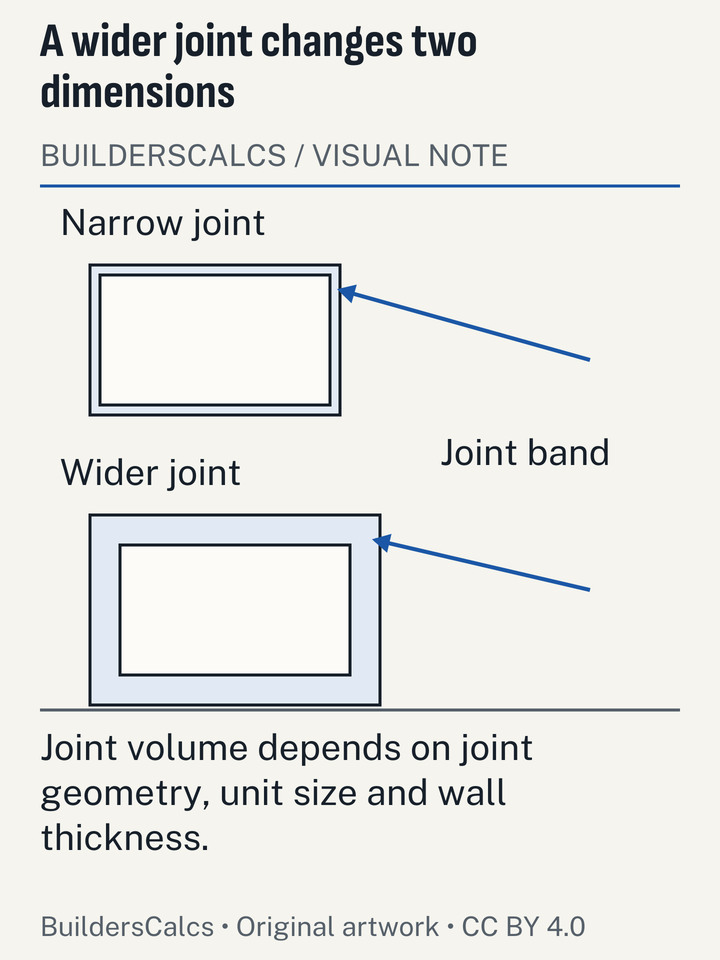
- Joints wider than usual. Bag yields assume normal joints. With 3/8 in joints, 1,000 modular bricks take about 8.1 cu ft (0.23 m³) of mortar before waste; 10.3 cu ft at 1/2 in joints. Wider joints use more per brick, so raise the extra if your joints are wide.
- Large or unusual units. Yields are for standard bricks and conventional 8 in blocks, or UK 100 mm blocks for the tub. Jumbo bricks, thick blocks and stone need their own figures.
- Parging, pointing and render. Coating or repointing a wall is not laying it. Those jobs need area-based coverage from the product's data sheet.
One cubic foot (or m³) of loose, damp sand yields about one cubic foot (or m³) of mortar. That is a handy cross-check: if a site mix result seems off, the sand volume should be close to the mortar volume your joints need.
| Collar joint width (in) | Mortar (cu ft per 100 sq ft) | Mortar (m³ per 10 m²) |
|---|---|---|
| 1/4 | 2.08 | 0.064 |
| 3/8 | 3.13 | 0.095 |
| 1/2 | 4.17 | 0.13 |
| 3/4 | 6.25 | 0.19 |
Which calculator do I need next?
Mortar is the second step: the unit count comes first. The brick calculator uses BIA's per-area figures for eight US brick sizes plus the UK standard brick, and the cinder block count tool covers US and UK blockwork with core grout. If you would rather check the arithmetic yourself, the guide to calculating bricks by hand sets it out step by step.
The full set of concrete and masonry calculators sits on one category page. For the bigger picture on cement and lime, see the cement production and consumption data.
Mortar calculator questions
How much water does a 20 kg bag of UK mortar need?
Blue Circle Quality Assured Mortar takes about 4 litres of water per 20 kg bag. Add it gradually and stop when the mix holds its shape on the trowel; the calculator counts bags only, not water.
Is mortar mix the same as masonry cement?
No. Mortar mix has the sand already in the bag, so you add water only. Masonry cement is the binder alone and needs sand added on site. A 70 lb bag of masonry cement mixed with sand lays about 46 blocks or 144 bricks (Quikrete) or about 30 hollow blocks (NCMA).
Can I use Type N mortar below ground?
ASTM C270's guide recommends Type S for foundations, retaining walls, paving and patios, with Type M or N as alternatives. Most bagged mortar on the shelf is Type N, so buy a Type S product for below-grade work unless your drawings say otherwise.
Why does the calculator show no result for blocks with the 30 kg Canadian bag?
Because the maker gives a brick figure only. A 30 kg (66 lb) bag of Sakrete Mortar Mix Type N (Canada) lays about 33 bricks with a 10 mm joint. Rather than guess a block yield, the calculator asks you to pick another product for blocks.
What is the BIA rule of eight bags per 1,000 bricks?
Masons' rough rule: eight bags of masonry cement lay 1,000 modular bricks (waste included, BIA calls it very rough). It applies to masonry cement mixed with sand, not to pre-sanded mortar mix, and BIA itself calls it very rough. The calculator uses NCMA's batch figures for masonry cement instead.
Put this mortar calculator on your site
Sources (20)
- Brick Industry Association
- Technical Note 10: Dimensioning and Estimating Brick Masonry (Feb 2009), checked
- Concrete Masonry & Hardscapes Association (formerly NCMA)
- TEK 04-02A Estimating Concrete Masonry Materials, checked
- TEK 09-01A Mortars for Concrete Masonry (ASTM C270 tables), checked
- Department for Business and Trade (DBT), UK (data from ONS, DBT and Mineral Products Association)
- Monthly Bulletin of Building Materials and Components, September 2026 (Bulletin 617), data tables, checked
- Hanson UK (Heidelberg Materials)
- General Purpose Cement - Technical Data Sheet, checked
- Health and Safety Executive (UK)
- Construction hazardous substances: Cement, checked
- King Packaged Materials / Sika Canada (SAKRETE Canada)
- SAKRETE Mortar Mix, Type N product data sheet, checked
- Mason Contractors Association of America
- Choosing the Best Mortar for Your Project (reproduces ASTM C270 Table X1.1), checked
- Mineral Products Association (MPA Mortar)
- Data sheet 01: Factory produced lime:sand mortar for masonry (Issue 10, October 2023), checked
- National Institute of Standards and Technology
- Handbook 44 (2026), Appendix C: General Tables of Units of Measurement, checked
- Special Publication 811 (2008), Guide for the Use of the International System of Units (SI), Appendix B.8, checked
- SAKRETE of North America
- SAKRETE Type N Mortar Mix technical data sheet (REV 7-10), hosted by Home Depot, checked
- Tarmac
- Ready-to-use Mortar Mix product data sheet (10 kg tub), hosted by Wickes, checked
- Tarmac (Blue Circle)
- Quality Assured Mortar product data sheet (August 2018), hosted by MKM, checked
- The Quikrete Companies
- QUIKRETE Masonry Cement (Type N) Data Sheet, checked
- QUIKRETE Masonry Cement (Type S) Data Sheet, checked
- QUIKRETE Mortar Mix No. 1102 Data Sheet, checked
- Safety Data Sheet C1: Portland Cement Based Concrete Products (rev. Feb-23), checked
- U.S. Geological Survey (USGS), National Minerals Information Center
- Mineral Commodity Summaries 2026: Lime, checked
- UK Parliament (legislation.gov.uk)
- Weights and Measures Act 1985, Schedule 1, checked
Every number on this page is taken from these documents. How we choose and check sources.