

Deck board calculator
Enter the deck's length and depth, the board and the joist spacing, and this deck board calculator returns the rows of boards, the boards to buy at your length, the joists and the screws or clip boxes. A 16 × 12 ft deck in 5/4×6 wood boards (5.5 in (140 mm) wide with a 0.125 in gap) takes 26 rows, or 29 boards 16 ft long once 10% extra is added, on 13 joists at 16 in centres.
Deck board calculator
v1 · US and metricEnter the deck size, the board you plan to use and the joist spacing. The result gives the rows of boards, the number of boards at your chosen length, the joists, and the screws, clips or fastener boxes, with the DCA 6 joist span for your framing shown for reference.
Result
Enter your measurements and press Calculate.
Formula and assumptions
Rows = deck depth (in) ÷ (board width + gap), rounded up; decking length = rows × deck length; metric:Rows = deck depth (mm) ÷ (board width + gap), rounded up; decking length = rows × deck lengthDecking length = deck area ÷ (board width + gap)Boards = decking length × (1 + waste) ÷ board length, rounded up; joists = deck length ÷ spacing, rounded up, + 1Face screws = board crossings of joists × 2; CAMO screws = area ÷ 100 × 350; clip boxes = area ÷ box coverage; metric:Face screws = board crossings of joists × 2; CAMO screws = area (sq ft) ÷ 100 × 350; clip boxes = area ÷ box coverage- Board sizes: A 5/4x6 wood deck board is about 1 in thick and 5-1/2 in wide (dry, dressed). Trex Signature, Transcend and Enhance boards measure 0.94 in x 5.5 in (24 x 140 mm). TimberTech Composite Prime/Prime+ boards are 0.94 in thick and 5.36 in wide.
- Gaps: DCA 6 says to space wood deck boards about 1/8 in apart. Trex boards need a 3/16 in (5 mm) side-to-side gap at any temperature. TimberTech boards need a 1/8 to 3/16 in side gap. The TimberTech count uses the wider gap.
- Joist spacing: Composite decking needs joists at 16 in on center maximum for residential straight-lay decks. Diagonal (45 degree) composite decking needs joists at 12 in on center maximum. Each length of decking must bear on at least three joists.
- Fasteners: Fasten each deck board to every joist with two 8d threaded nails or two #8 screws. CAMO sells EDGE screws as 350 per 100 sq ft (9.29 m2) of decking. A Trex Hideaway Universal Fastener box covers 50 sq ft; the bucket covers 500 sq ft. A TimberTech CONCEALoc box covers 100 sq ft; the bulk bucket covers 1,000 sq ft.
- Board joints must land on a joist, so a deck longer than one board needs staggered butt joints; the waste allowance covers the offcuts.
- The joist span shown comes from DCA 6 Table 2 (40 psf (1.92 kN/m2) live load, 10 psf (0.48 kN/m2) dead load, No. 2 grade, wet service). It is a reference value, not an approval of your framing. DCA 6 does not cover decks carrying large concentrated loads such as hot tubs. Your local building department has the final say.
- Joists, beams, posts, ledgers and footings are not sized here.
How many deck boards do I need for a 16 × 12 deck?
A 16 ft by 12 ft deck laid with 5/4×6 wood boards needs 26 rows of boards and 416 lineal feet of decking before waste. Bought as 16 ft boards with the calculator's default allowance, that is 29 boards. The framing under it, at 16 in on centre, is 13 joists, and face-screwing every board at every joist uses 676 screws. Those are the figures the tool shows when it first opens, so you can compare them with the step list printed under the result.
The same deck in metric, 4.8 m by 3.6 m with boards 4.8 m long, also comes to 26 rows, 29 boards and 13 joists. If you switch the fastening to CAMO EDGE screws, the count drops slightly to 652, because CAMO sizes its packs by deck area rather than by joist crossings.
Two measurements drive everything, and they are easy to swap. Deck length is the side the boards run along, which on most attached decks is the house wall. Deck depth is the distance out from the ledger to the outer rim, across the boards. Rows come from the depth; joists are spaced out along the length. Enter them the wrong way round and the board count changes, since a 12 ft run of 16 ft boards wastes a third of every board.
Pick the board length you can actually buy and carry. Radius-edged wood decking is commonly 8 to 16 ft long. Trex 1x6 boards come in 12, 16 and 20 ft lengths (some lines 16/20 only). When the deck is longer than one board, the calculator still divides lineal footage by board length, so plan butt joints that land on a joist and stagger them from row to row.
How does the calculator count boards, joists and fasteners?
It works in four steps: rows, decking length, boards, then joists and fasteners. Each step uses the board's actual face width plus the side gap the board maker prints, never the nominal size on the label.
- Rows (straight layout): deck depth ÷ (board width + gap), rounded up. A part row still needs a whole board, often ripped to width.
- Decking length: rows × deck length for a straight deck. For boards at 45°, the calculator skips rows and divides the deck area by (board width + gap), which gives the same coverage as long diagonal pieces laid edge to edge.
- Boards: decking length × (1 + waste %) ÷ board length, rounded up.
- Joists: deck length ÷ joist spacing, rounded up, plus one for the closing end.
- Face screws: rows × joists × 2 for a straight deck. Fasten each deck board to every joist with two 8d threaded nails or two #8 screws. On a diagonal, each piece crosses a joist every spacing × √2, so the crossings are decking length ÷ (spacing × 1.414), times two.
- CAMO screws and clip boxes: deck area ÷ 100 sq ft × the CAMO rate, or deck area ÷ the area one box of clips covers, rounded up.
Worked example: a Trex deck with hidden clips
Take a 20 ft by 14 ft deck in Trex boards, bought 20 ft long, fastened with Hideaway clips and with Trex's own allowance of 5%. One board plus its gap is 5.5 + 0.1875 = 5.6875 in. The depth is 168 in, and 168 ÷ 5.6875 = 29.5, so 30 rows. Thirty rows of 20 ft is 600 lineal ft; adding 5% makes 630 ft, and 630 ÷ 20 = 31.5, so 32 boards. Joists at 16 in: 240 ÷ 16 = 15, plus one, is 16 joists. The deck covers 280 sq ft, and at 50 sq ft per box that is 5.6, rounded up to 6 boxes of clips. The deck framing and board takeoff guide walks through a full deck the same way, including beams and posts.
| Deck | Board and length | Rows | Boards to buy | Joists | Fasteners |
|---|---|---|---|---|---|
| 16 × 12 ft, straight | 5/4×6 wood, 16 ft | 26 | 29 | 13 | 676 face screws |
| 4.8 × 3.6 m, straight | 5/4×6 wood, 4.8 m | 26 | 29 | 13 | 652 CAMO EDGE screws |
| 20 × 14 ft, straight, 5% extra | Trex, 20 ft | 30 | 32 | 16 | 6 boxes of Hideaway clips |
| 16 × 12 ft, diagonal, 30% extra | Trex, 16 ft | n/a (405.1 lineal ft) | 33 | 13 (warning: 12 in needed) | Face screws |
| 16 × 12 ft, straight, 0% extra | Other: 3.5 in board, 1/4 in gap | 39 | 39 | 13 | Face screws |
What size are deck boards, and how wide is the gap?
Most deck boards are close to 5.5 in (140 mm) wide, but the exact width and gap differ by board, and the row count depends on both. The 5/4×6 label misleads many first-time builders: the numbers are nominal sizes, not the board's real thickness and width. A 5/4x6 wood deck board is about 1 in thick and 5-1/2 in wide (dry, dressed). (NIST / American Lumber Standard Committee and USDA Forest Service, Forest Products Laboratory) A 2×6 laid flat is the same width but thicker. A 2x6 used as decking is 1-1/2 in by 5-1/2 in dry.
The board makers disagree on gaps, so the calculator uses each one's own figure. Trex boards need a 3/16 in (5 mm) side-to-side gap at any temperature. TimberTech boards need a 1/8 to 3/16 in side gap. For TimberTech the calculator takes the wider end of that range, which gives slightly fewer rows; if you gap tighter you may need one more. DCA 6 says to space wood deck boards about 1/8 in apart. Gaps at the ends of boards follow separate rules. Trex end-to-end gap is 1/8 in when installed above 40 F (4.5 C). Trex end-to-end gap is 3/16 in when installed below 40 F.
If your board is not listed, choose Other and type its actual face width and the side gap from its installation guide. Measure a board from the stack with a tape rather than trusting the product name.
| Board | Actual size | Side gap | Common lengths |
|---|---|---|---|
| Wood 5/4×6 | 1 x 5-1/2 in (25 x 140 mm) | 0.125 in (3 mm) (DCA 6) | 8 to 16 ft (2.4 to 4.9 m) |
| Wood 2×6 | 1-1/2 x 5-1/2 in (38 x 140 mm) | 0.125 in (3 mm) (DCA 6) | 8 to 16 ft (2.4 to 4.9 m) |
| Trex Signature, Transcend, Enhance | 0.94 x 5.5 in (24 x 140 mm) | 0.1875 in (5 mm) | 12, 16, 20 ft (3.65, 4.87, 6.09 m) |
| TimberTech Composite Prime, Prime+ | 0.94 x 5.36 in (24 x 136 mm) | 0.125 to 0.1875 in (3 to 5 mm) | Not stated in our sources |
How far apart should deck joists be for composite boards?
Standard composite deck boards need joists no more than 16 in apart on a straight residential deck, and 12 in apart when the boards run diagonally. Composite decking needs joists at 16 in on center maximum for residential straight-lay decks. Diagonal (45 degree) composite decking needs joists at 12 in on center maximum. Commercial composite decks need joists at 12 in on center.
A common belief is that composite can go on the same wide spacing as 2× wood decking. It cannot. The only exception in our sources is a thicker profile: Trex 2x6 boards may span 24 in on residential decks. If you choose Trex or TimberTech and pick a spacing wider than the maker allows, the calculator still counts the joists but adds a warning, as in the diagonal row of the table above. Skew the boards further than 45° and the limit tightens again. Trex: at a 30 degree board angle the maximum joist span is half the chart value.
Every board also needs enough support along its length. Each length of decking must bear on at least three joists. At 16 in spacing that means no board shorter than 32 in, and the calculator flags a board length that is too short for the spacing chosen. Under DCA 6, decking may run from perpendicular to the joists up to 45 degrees.
What does the DCA 6 joist span in the result mean?
The span line is the longest clear distance a joist of your chosen size, species and spacing may cross in the American Wood Council's DCA 6 deck guide. It is shown for reference and is never an approval of your framing. The figures come from one publication, DCA 6 Table 2, and we found no second independent source for them. DCA 6 span tables assume a 40 psf live load and a 10 psf dead load. The table is for No. 2 grade lumber in wet service conditions (American Wood Council).
For the default deck, a Southern Pine 2×8 at 16 in centres, the table value is 142 in, or 11 ft 10 in. If you type a longer span into the optional box, as in a 14 ft span on the same joists, the calculator shows a note telling you the span exceeds the table value and suggesting a deeper joist, closer spacing or another beam. A span under the table value produces no note, and that silence is not a sign-off. DCA 6 limits joist span to 18 ft 0 in for its footing design.
DCA 6 says its span format was taken into the 2018 IRC, but we could not read the ICC text to confirm the numbers match, and the edition your area has adopted, with any local amendments, governs. DCA 6 does not cover decks carrying large concentrated loads such as hot tubs. Joist cantilevers have their own limit. A joist may cantilever past the beam by the tabulated overhang or one quarter of the joist span, whichever is less.
| Species group | Joist | Max span at 12 in o.c. (in) | At 16 in o.c. (in) | At 24 in o.c. (in) |
|---|---|---|---|---|
| Southern Pine | 2x6 | 119 | 108 | 91 |
| Southern Pine | 2x8 | 157 | 142 | 116 |
| Southern Pine | 2x10 | 194 | 168 | 137 |
| Southern Pine | 2x12 | 216 | 198 | 162 |
| Douglas Fir-Larch, Hem-Fir, Spruce-Pine-Fir | 2x6 | 114 | 100 | 82 |
| Douglas Fir-Larch, Hem-Fir, Spruce-Pine-Fir | 2x8 | 150 | 133 | 109 |
| Douglas Fir-Larch, Hem-Fir, Spruce-Pine-Fir | 2x10 | 188 | 163 | 133 |
| Douglas Fir-Larch, Hem-Fir, Spruce-Pine-Fir | 2x12 | 216 | 189 | 154 |
| Redwood, Western Cedars, Ponderosa Pine, Red Pine | 2x6 | 106 | 96 | 82 |
| Redwood, Western Cedars, Ponderosa Pine, Red Pine | 2x8 | 140 | 127 | 104 |
| Redwood, Western Cedars, Ponderosa Pine, Red Pine | 2x10 | 179 | 156 | 127 |
| Redwood, Western Cedars, Ponderosa Pine, Red Pine | 2x12 | 209 | 181 | 148 |
How much extra decking should I buy?
Buy 5% to 10% extra for a straight deck and about 30% for a diagonal or patterned one. Who says so matters, because the two big composite makers differ. Trex suggests ordering 5% extra decking. TimberTech's install guide suggests about 10% extra for scrap. TimberTech suggests 30% extra for diagonal or elaborate patterns. The calculator defaults to the TimberTech figure and warns when a diagonal layout is set below the diagonal allowance.
The higher figure suits most wood decks too, since end checks and bowed boards get cut away. In the UK, the Royal Institution of Chartered Surveyors uses a similar default for measured waste. RICS (2023) gives a default site waste rate of 10% for timber floor boards and aggregate, against 2% for structural timber frames and 1% for glass. That is a site-waste benchmark for building projects rather than an ordering rule for a garden deck, but it points the same way.
TimberTech also publishes a shortcut that skips rows: divide the deck area by the area one board covers. Its two documents give slightly different divisors, shown below. The calculator counts rows instead, which handles part rows and gaps exactly. For the general picture across materials, see the waste factor table.
Offcuts add up nationally. EPA estimates 3.4 million tons of wood products were wasted during US construction in 2018, out of 40.8 million tons of wood in all C&D debris. Ordering to a sensible allowance, and laying out joints so short ends get reused on the next row, keeps your share of that small.
| Board length (ft) | Sq ft per board, install guide | Sq ft per board, web article |
|---|---|---|
| 12 | 5.5 | 5.4 |
| 16 | 7.3 | 7.2 |
| 20 | 9.1 | 9 |
How many screws or hidden clips does a deck need?
Face-screwed boards take two screws at every joist, so a straight 16 × 12 ft deck on 16 in joists uses 676. Face-fastened boards take two screws at every joist. The calculator multiplies rows by joists by two and does not add spares, so buy the next pack size up.
Edge screws and hidden clips are counted by area instead, using the coverage printed by each maker. CAMO sells EDGE screws as 350 per 100 sq ft (9.29 m2) of decking. A Trex Hideaway Universal Fastener box covers 50 sq ft; the bucket covers 500 sq ft. A TimberTech CONCEALoc box covers 100 sq ft; the bulk bucket covers 1,000 sq ft. The clip makers state coverage per box but not the number of clips inside, so the result is in boxes. Starter clips for the first row and the picture-frame border are bought separately.
Fastener material is a code issue on treated lumber, not a matter of looks. Fasteners in preservative-treated wood must be hot-dip galvanized, stainless steel, silicon bronze or copper; stainless 304/316 within 300 ft of salt water.
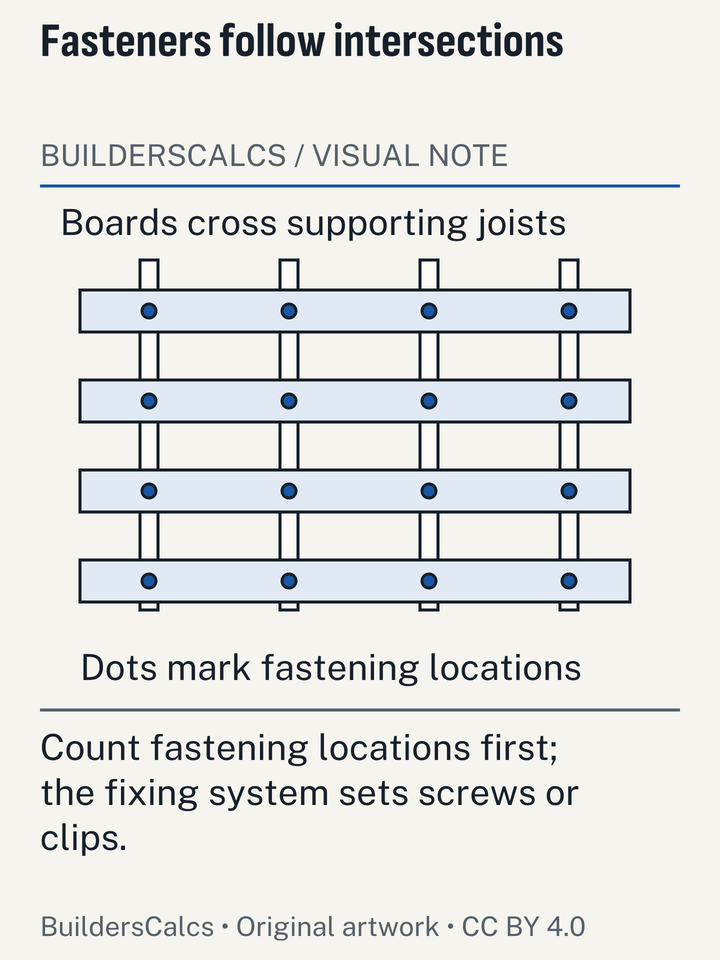
Illustration sources
- Trex Company — 2024 Trex Decking Installation Guide
- TimberTech (The AZEK Company) — Decking Installation & Maintenance Guide - TimberTech Composite and Specialty Decking (REV 09/23)
- American Wood Council — DCA 6 - Prescriptive Residential Wood Deck Construction Guide (2015 IRC version, (c)2018, incl. Commentary)
- CAMO Fasteners (National Nail Corp.) — CAMO Product Catalog 2025
What changes when I use metric units?
The method stays the same; only the units on screen change. In metric mode, the deck and board lengths are in metres and board widths and gaps are in millimetres, and the result gives the deck area in square metres. The board presets keep their published sizes, shown in millimetres: 24 x 140 mm for Trex and 24 x 136 mm for TimberTech. Joist spacings are offered as 305, 406 and 610 mm, the metric equivalents of the US centres.
CAMO's rate is converted, not changed. 37.7 screws per m2 is the same coverage, which is why the metric example deck comes to 652 screws. The clip boxes are converted the same way.
Our fact base has no checked UK or EU composite board sizes or UK deck span guidance, so those products and rules are not modelled. A UK builder using a softwood board from a merchant should choose Other and enter the board's actual width and the gap from the supplier's instructions. Leave the DCA 6 span line aside: it is a US guide built on US lumber grades. Our US and metric conversion reference lists the conversions the calculator uses.
How many people are injured on decks and porches?
Deck falls are counted together with porches and balconies in US hospital data. An estimated 151,403 people (95% CI 121,876–180,930) were treated in US hospital emergency departments in 2025 for injuries involving porches, balconies, open-side floors or floor openings (code 1817), per our analysis of CPSC NEISS data. NEISS has no deck-only code, so read that as an upper bound for decks rather than a deck count. Most of these injuries happen at home: 70.7% of porch, balcony and open-side floor injuries treated in US emergency departments in 2025 happened at home (107,089 of the national estimate, 95% CI 81,804–132,373), per our analysis of CPSC NEISS 2025 data. The 2024 estimate was almost the same. An estimated 151,222 people (95% CI 122,428–180,016) were treated in US hospital emergency departments in 2024 for injuries involving porches, balconies, open-side floors or floor openings (code 1817, the NEISS code covering decks), per our analysis of CPSC NEISS data. CPSC publishes the same figure, 151,222, in its 2024 NEISS Data Highlights. Year-to-year comparisons that reach back before 2024 need care. CPSC's 2024 NEISS estimates come from a redesigned sample of 100 hospitals, of which 77 reported, while 2023 estimates used the older 96-hospital sample, so 2023-to-2024 changes are not clean trends (the all-product estimate jumps from 12.74 million to 15.07 million).
Decks remain a routine build. About 180,000 of the 1,005,000 new US single-family homes completed in 2025 (roughly 18%) were built with a deck, alone or with a patio or porch, per the Census Bureau. Owners add them to existing homes too. About 1.93 million US homeowners added a porch, deck, patio or terrace in 2023, spending about $16.0 billion in total (Harvard JCHS Table A-1, 2023 AHS). The breakdown of these and other home-project injury groups is on our page of how many people are hurt falling off ladders and on other jobs.
When is the result wrong or not enough?
The calculator assumes one rectangular deck surface with every board running the same way. These jobs need more thought:
- Picture-frame borders and breaker boards. A border row around the edge, or a board across the middle to split long runs, adds lineal footage and often blocking. Count the border separately and add it.
- L-shaped or multi-level decks. Split the plan into rectangles and run each one. Joists are counted per rectangle, which may double-count a shared joist.
- Doubled joists and blocking. Joists doubled at board splices, around stairs or under a border are not in the count.
- Stairs. Treads, risers and stringers are a separate takeoff. The stair calculator lays out the steps.
- Beams, posts and footings. None of these are sized or counted here. The concrete per fence post tool works out the bags for post holes, but the footing size itself should come from DCA 6 or your local code.
- Heavy loads. Hot tubs, planters full of soil and outdoor kitchens fall outside DCA 6 and need an engineered design.
- Overhang at the rim. Trex decking may overhang the rim by at most 3/4 in. The calculator does not add length for overhangs.
Prices are not included. Lumber moves too fast for a stored figure to stay right. US producer prices for softwood lumber rose 14.2% in the year to September 2026 but were still 50.4% below the May 2021 peak and only 3.0% above the 2020 average (BLS PPI). Take the board count to your supplier for a current quote.
As an Amazon Associate I earn from qualifying purchases. Links to Amazon below can earn us a commission at no cost to you. Affiliate disclosure.
Fasteners and tools for laying deck boards
These items match the fastening options in the calculator and were chosen from the makers' published specifications; we have not used or measured them. Links go to Amazon; read how affiliate links work here.
-
CAMO (National Nail) Edge

CAMO Edge Deck Screws
The screws behind the calculator's CAMO EDGE option, driven at an angle through the board edge so no heads show on top. 1-7/8 in. (47.6 mm) screw for boards 3/4-1 in. thick. 2-3/8 in. (60.3 mm) screw for boards 1-1-1/2 in. thick. Sold in PROTECH coated and 316 stainless steel versions. Packs of 350, 700 and 1,750 screws.
Check price on Amazon Opens Amazon in a new tab -
CAMO (National Nail) MARKSMAN Edge

CAMO MARKSMAN Edge Tool
The guide that holds the angle for CAMO EDGE screws; the maker says the screws are installed with it. Used only with CAMO Edge deck screws. For decking other than treated lumber, cedar or softwood, the maker says to add secondary spacers.
Check price on Amazon Opens Amazon in a new tab -
FastenMaster FMTED-212-350

FastenMaster TrapEase Composite Deck Screws, 2-1/2 in., 350 pc
A colour-matched face screw for composite boards if you choose face fastening. Offered in 2-1/2 in. and 3 in. lengths. A 350-piece bucket covers about 100 sq ft. SKUs take a color code suffix, e.g. FMTED-212-350GY for gray.
Check price on Amazon Opens Amazon in a new tab
Which calculator do I need after the deck boards?
Most decks need three more takeoffs. Set the posts first: the bags of concrete per post hole result tells you how much mix each footing hole takes. If the deck sits more than a step above the yard, run the stair calculator next for the riser count, tread depth and stringer length. And if you want a drawing of the frame to work from, the reusable stair and deck diagrams are free to use with credit.
Fence, stair and post tools are grouped on the outdoor build calculators page, which also explains which one to use for each part of a project.
Deck board calculator questions
Should I measure deck length along the house or out from it?
Measure along the direction the boards will run and enter that as the deck length; enter the other side as the depth. On most attached decks the boards run parallel to the house, so the length is along the wall. If you plan boards running out from the house, swap the two figures.
Why does the calculator give more boards than deck area divided by board area?
Because it counts whole rows and adds the waste allowance. A part row at the edge still needs a full-length board, and every row is rounded up before boards are counted. The area shortcut assumes every inch of every board is used, which only happens on paper.
Can I mix 12, 16 and 20 ft boards on one deck?
Yes, but the calculator counts one length at a time. Run it once for the length that fits most rows, then work out any rows that need a different length by hand: rows × deck length ÷ board length. Every joint has to land on a joist, so plan the mix on paper first.
Do hidden deck clips cost me any board coverage?
No. The clips sit in the gap the board maker already requires, so the row count is the same as for face screws. What changes is the fastener line, which becomes boxes of clips sized by the deck area each box covers.
Does a span under the DCA 6 figure mean my deck passes inspection?
No. The span is a single reference value for one joist size, species and spacing. Inspection also covers the ledger, beams, posts, footings, guards, stairs and fasteners, none of which this calculator checks. Your building department decides whether the deck passes.
Put this deck calculator on your own site
Sources (24)
- American Wood Council
- DCA 6 - Prescriptive Residential Wood Deck Construction Guide (2015 IRC version, (c)2018, incl. Commentary), checked
- CAMO Fasteners
- Edge - CAMO Fasteners, checked
- MARKSMAN Edge Tool - CAMO Fasteners, checked
- CAMO Fasteners (National Nail Corp.)
- CAMO Product Catalog 2025, checked
- City of Gilroy Building Division
- Residential Stairways, Handrails and Guards handout - California Residential Code R311.7 and R312 (rev. 03/03/2025), checked
- FastenMaster
- TrapEase: Composite, PVC & Capstock Deck Screws | FastenMaster, checked
- Joint Center for Housing Studies of Harvard University
- Improving America's Housing 2025, checked
- NIST / American Lumber Standard Committee
- Voluntary Product Standard PS 20-20, American Softwood Lumber Standard, checked
- National Institute of Standards and Technology
- Handbook 44 (2026), Appendix C: General Tables of Units of Measurement, checked
- Special Publication 811 (2008), Guide for the Use of the International System of Units (SI), Appendix B.8, checked
- Royal Institution of Chartered Surveyors (RICS)
- Whole life carbon assessment for the built environment, 2nd edition (professional standard, September 2023), checked
- TimberTech (The AZEK Company)
- Decking Installation & Maintenance Guide - TimberTech Composite and Specialty Decking (REV 09/23), checked
- How to Calculate How Much Decking You Need, checked
- Trex Company
- 2024 Trex Decking Installation Guide, checked
- How Many Deck Boards Do I Need?, checked
- UK Parliament (legislation.gov.uk)
- Weights and Measures Act 1985, Schedule 1, checked
- US Bureau of Labor Statistics
- Producer Price Index by commodity (series WPU0811, WPU083, WPU137, WPU1322, WPU1333, WPU1321, WPU1342, WPU1344, WPU1361, WPU1392, WPU0621, WPU1231, WPU1232, WPUIP2321001), checked
- US Census Bureau
- Characteristics of New Housing 2025: Presence of Outdoor Features in New Single-Family Houses Completed, checked
- US Consumer Product Safety Commission
- NEISS Data Highlights – Calendar Year 2023, checked
- NEISS Data Highlights – Calendar Year 2024, checked
- NEISS annual data files 2015–2025 (neiss<year>.xlsx, NEISS_FMT code sheet), checked
- US Consumer Product Safety Commission (Federal Register)
- Agency Information Collection Activities; NEISS — FR Doc. 2021-23302, Docket CPSC-2009-0102, checked
- US Environmental Protection Agency (EPA), Office of Resource Conservation and Recovery
- Advancing Sustainable Materials Management: 2018 Fact Sheet, checked
- USDA Forest Service, Forest Products Laboratory
- Wood Handbook (FPL-GTR-282), Chapter 6: Commercial Lumber, Round Timbers, and Ties, checked
Every number on this page is taken from these documents. How we choose and check sources.