

Tile calculator
Give this tile calculator the floor or wall size, the tile size and the grout joint, and it returns the tiles and boxes to buy plus the thinset and grout. The rule behind it: divide the area by the space one tile fills including its joint, round up, then add extra for cuts. Fireclay Tile puts that extra at 15% for a straight or offset lay. A 12 × 10 ft floor in 12 × 12 in tile needs 118 tiles before extra and 136 with it.
Tile calculator
v1 · US and metricEnter the area, tile size, joint width and layout. The result gives tiles and boxes to buy with extra for cuts, plus thinset by trowel notch and grout by weight.
Result
Enter your measurements and press Calculate.
Formula and assumptions
Tiles = area (sq ft) ÷ ((tile length + joint) × (tile width + joint) ÷ 144), rounded up; metric:Tiles = area (m²) ÷ ((tile length + joint) × (tile width + joint) ÷ 1,000,000), rounded upTiles to buy = tiles × (1 + extra % ÷ 100), rounded up; boxes = area × (1 + extra % ÷ 100) ÷ coverage per box, rounded upThinset (lb) = area ÷ coverage per 50 lb bag × 50; metric:Thinset (kg) = area ÷ coverage per 22.7 kg bag × 22.7Grout (kg/m²) = (A + B) ÷ (A × B) × C × D × 1.6, with tile length A, width B, thickness C and joint D in mm- Each tile plus one joint occupies (length + joint) × (width + joint). Nominal sizes are used; the coverage on the box is the better figure when you have it.
- Default extra by layout: Fireclay Tile recommends ordering 15% extra for field tile such as subway tile. Fireclay Tile recommends 20% extra for herringbone, parquet or specialty shapes. Artistic Tile advises adding 25-30% overage when tile is laid on a diagonal. The diagonal default takes the low end, 25%.
- Daltile recommends buying about 10% more tile than the measured area needs. Type a lower figure in Extra to order if you are confident in the layout.
- Thinset uses the lowest coverage the makers publish for each notch, so the bag count is not short: The lowest coverage the three US brands give for a 1/4 x 1/4 in (6 x 6 mm) square notch is 75 sq ft (6.97 m2) per 50 lb bag (MAPEI Ultraflex 2).
- Custom states mortar contact must be at least 80% in dry areas and 95% in wet areas and exteriors.
- Grout uses MAPEI's consumption formula with its factor of 1.6. Other grouts differ; the maker's chart for your product is the better figure.
- Thinset and grout are worked out on the area before extra. Rough or uneven tiles use more.
How many tiles do I need for a 12 × 10 ft floor?
A 12 ft by 10 ft floor is 120 sq ft. In 12 × 12 in tile with a 1/8 in joint, that floor takes 118 tiles to cover and 136 to buy once the 15% straight-lay allowance is added. Those are the figures the calculator shows when it first opens, along with 80 lb of thinset (two 50 lb bags) and 7.8 lb of grout, which is one 25 lb bag.
The metric default is a 3.6 m by 3 m room, 10.8 m², in 60 × 60 cm porcelain with a 3 mm joint. It needs 30 tiles to cover and 35 to buy. With Marazzi's 60 × 60 cm box picked from the box list, that is 12 boxes, plus 35.2 kg of thinset and 1.7 kg of grout.
Measure before you choose a tile. For a floor, take the length and width wall to wall and include the doorway if the tile runs into it. For a wall, enter the wall's width as the length and the height you plan to tile as the width. If the room is not a rectangle, switch the first box to I know the area and type the total in square feet or square metres. The measuring a room for tile guide shows how to split an L-shaped floor or a tub surround into pieces and add them up.
How does the calculator turn square feet into tiles?
It divides the area by the footprint of one tile plus one grout joint, then rounds up. A tile laid with a joint takes up more than its face: each one owns a strip of grout along one side and one end. So the footprint is (tile length + joint) × (tile width + joint). In US mode that product is in square inches, and dividing by 144 turns it into square feet. In metric mode the sizes are in millimetres, and dividing by 1,000,000 gives square metres.
The calculator then works in this order:
- Tiles to cover: area ÷ footprint per tile, rounded up to a whole tile.
- Tiles to buy: that count × (1 + extra % ÷ 100), rounded up again.
- Boxes: area × (1 + extra % ÷ 100) ÷ the coverage per box, rounded up. Boxes come from the area, not the tile count, because the coverage printed on a carton already reflects the real tile size.
- Thinset: area ÷ the coverage per bag for your trowel notch × the bag weight that coverage was stated for.
- Grout: MAPEI's consumption formula, (A + B) ÷ (A × B) × C × D × 1.6, gives kilograms per square metre from tile length A, width B, thickness C and joint D, all in millimetres.
Worked example: the default floor
Area: 12 ft × 10 ft = 120 sq ft. Footprint: (12 + 0.125) × (12 + 0.125) = 147.02 sq in, ÷ 144 = 1.0209 sq ft. Tiles to cover: 120 ÷ 1.0209 = 117.5, rounded up to 118. With 15% extra: 118 × 1.15 = 135.7, rounded up to 136 tiles.
Thinset with a 1/4 × 1/4 in square notch: the lowest published coverage is 75 sq ft per 50 lb bag (6.97 m2 per 22.7 kg bag), so 120 ÷ 75 × 50 = 80 lb, which is two 50 lb bags. Grout: the tile is 304.8 mm square and 9.5 mm thick with a 3.2 mm joint, which MAPEI's formula turns into 0.318 kg per m². Over 11.148 m² that is 3.54 kg, or 7.8 lb.
Had you ignored the joint, you would divide 120 by a flat 1 sq ft and get 120 tiles before extra rather than 118. With small tiles the joint matters far more: 60 sq ft of 3 × 6 in subway tile is 480 tiles at face size but 452 once a 1/8 in joint is counted.
| Job | Inputs | Extra | Tiles to buy | Boxes, thinset and grout |
|---|---|---|---|---|
| Floor (US default) | 12 × 10 ft, 12 × 12 in tile, 1/8 in joint, straight | 15% | 136 (118 before extra) | 80 lb thinset; 7.8 lb grout |
| Floor (metric default) | 3.6 × 3 m, 60 × 60 cm tile, 3 mm joint, Marazzi box | 15% | 35 (30 before extra) | 12 boxes; 35.2 kg thinset; 1.7 kg grout |
| Diagonal floor (US) | 12 × 10 ft, 12 × 12 in tile, 45° | Low end of 25–30% | 148 (118 before extra) | As the default floor |
| Herringbone (US) | 12 × 10 ft, 12 × 24 in custom tile | 20% | 72 (60 before extra) | 5.9 lb grout |
| Daltile carton preset (US) | 12 × 10 ft, 12 × 24 in tile, straight | 15% | 69 (60 before extra) | 10 cartons at 15.20 sq ft |
| Large floor (US) | 200 sq ft, 12 × 12 in tile, 1/4 × 3/8 in notch | 15% | 226 | 181.8 lb thinset (4 × 50 lb bags) |
How do I calculate tile for a shower?
Add up each wall to be tiled as its own rectangle, then enter the total with I know the area. A tub alcove with a 5 ft back wall and two 2.5 ft end walls, all tiled 6 ft high, is 30 + 15 + 15 = 60 sq ft. In 3 × 6 in subway tile, 5/16 in thick, set in an offset pattern with a 1/8 in joint, the calculator gives 452 tiles to cover and 520 to buy, about 40 lb of thinset and 9.8 lb of grout.
Measure each wall separately because showers are rarely square. Leave out the tub itself and the opening, but keep the area above a window or niche if it gets tiled. A recessed niche adds its back and four returns, so measure those too and add them to the total. Run the shower floor as a separate entry, since it is usually a different, smaller tile with a different joint, and its own extra.
Wet areas change how the tile is set, not how many tiles you buy. Custom states mortar contact must be at least 80% in dry areas and 95% in wet areas and exteriors. That means back-buttering larger tiles or using a bigger notch, which uses more thinset than the dry-area figure. If the thinset bag lists a separate coverage for wet areas or for back-buttering, use that figure and expect to open more bags than the calculator shows.
How much extra tile should I buy?
Plan on 15% extra for a straight or offset grid and more for patterns, according to Fireclay Tile. The calculator picks the extra from the layout you choose, and a number typed in Extra to order replaces it. Tile makers do not agree on one figure, and no Tile Council of North America waste percentage could be found, so the table names who says what.
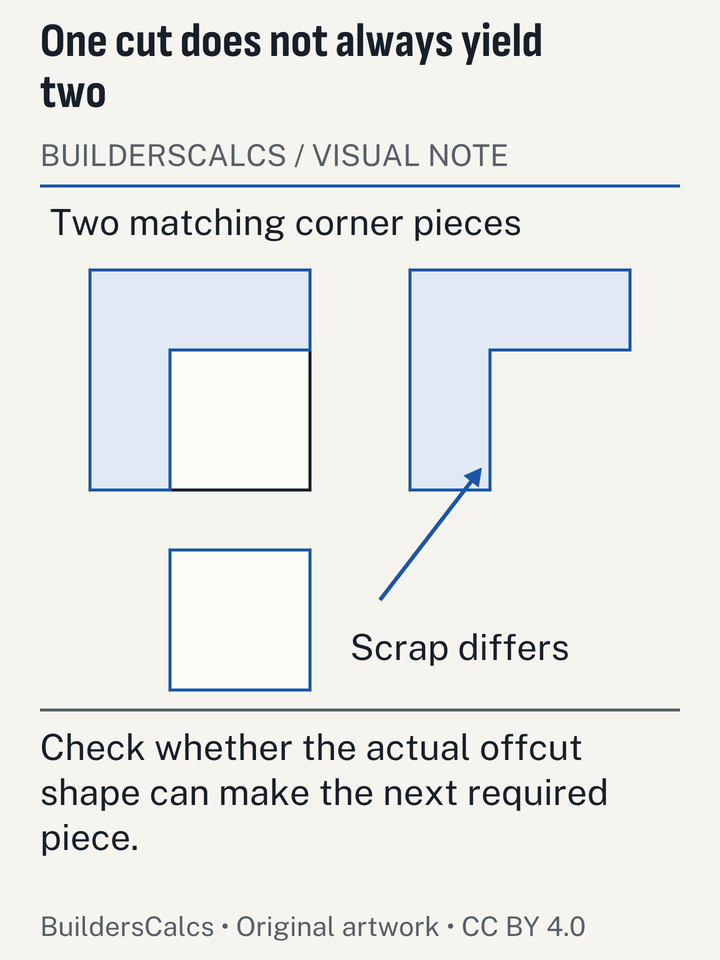
The extra covers cuts at every wall, tiles that crack while you cut them, and some to keep. A diagonal layout cuts a triangle off every tile that meets a wall, which is why it carries the biggest allowance. Herringbone and parquet patterns waste less than diagonal but more than a grid, because the zigzag ends must be trimmed along each edge.
A common belief is that a skilled tiler needs almost no extra. The cut pieces are lost whoever makes them: a 12 in tile trimmed to 4 in at a wall leaves an 8 in offcut that rarely fits anywhere else. Daltile recommends buying about 10% more tile than the measured area needs. That is Daltile's general advice, and it sits below Fireclay's figure. Type 10 into the extra box if you prefer it for a simple room with few cuts.
Measured site waste is lower than these ordering figures. The RICS whole life carbon standard (2nd edition, 2023) sets a default UK site waste rate of 4% for plasterboard, 6% for clay brickwork and 6% for tile floor finishes. The tile figure there is a default for carbon accounting on UK building projects, where tilers work from drawings and leftover stock can move to the next job. It is not a sign that a homeowner tiling one bathroom can order that little over. Our waste allowance by material page sets tile against drywall, brick and wood.
| Layout | Extra the calculator uses | Who states it |
|---|---|---|
| Straight grid | 15% | Fireclay Tile (field tile) |
| Offset or running bond | 15% | Fireclay Tile (field tile) |
| Herringbone, parquet or other pattern | 20% | Fireclay Tile |
| Diagonal (45°) | Low end of 25–30% | Artistic Tile |
| Any layout, general advice | 10% (type it in to use it) | Daltile |
How much thinset and grout does a tile floor need?
For thinset, the trowel notch decides the answer. Across three US brands, a 1/4 × 1/4 in square notch covers 75–100 sq ft per 50 lb, while a 1/4 × 3/8 in notch covers only 55–70 sq ft per 50 lb. Custom VersaBond covers 42-47 sq ft (3.9-4.4 m2) per 50 lb bag with a 1/2 x 1/2 in (12 x 12 mm) square notch; 42 is the low end. For each notch the calculator takes the lowest figure any of those brands publishes, so the bag count leans long rather than short. Bigger tiles need a deeper notch to reach full contact, so check the thinset bag's chart for your tile size before you pick a notch.
Many people assume any bag of thinset covers about the same area. The table shows otherwise: the same brand covers less than half the floor with a 1/2 in notch that it covers with a 1/4 in one (Custom Building Products, LATICRETE International and others).
| Thinset | Trowel notch | Sq ft per bag (low) | Sq ft per bag (high) | m² per bag (low) | m² per bag (high) | Source |
|---|---|---|---|---|---|---|
| Custom VersaBond | 1/4 x 1/4 x 1/4 in square | 90 | 100 | 8.4 | 9.3 | Custom Building Products |
| Custom VersaBond | 1/4 x 3/8 x 1/4 in square | 60 | 67 | 5.6 | 6.2 | Custom Building Products |
| Custom VersaBond | 1/2 x 1/2 x 1/2 in square | 42 | 47 | 3.9 | 4.4 | Custom Building Products |
| LATICRETE 253 Gold | 1/4 x 1/4 in (6 x 6 mm) | 80 | 95 | 7.4 | 8.8 | LATICRETE International |
| LATICRETE 253 Gold | 1/4 x 3/8 in (6 x 9 mm) | 60 | 70 | 5.6 | 6.5 | LATICRETE International |
| MAPEI Ultraflex 2 | 1/4 x 1/4 x 1/4 in (6 x 6 x 6 mm) | 75 | 90 | 6.97 | 8.36 | MAPEI Corporation |
| MAPEI Ultraflex 2 | 1/4 x 3/8 x 1/4 in (6 x 10 x 6 mm) | 55 | 65 | 5.11 | 6.04 | MAPEI Corporation |
Why does the grout estimate change so much with tile size?
Grout fills the joints, and small tiles have far more joint per square foot than large ones. The MAPEI formula captures that with its first term, (A + B) ÷ (A × B), which grows as the tile shrinks. The joint width and the tile's thickness multiply the result, since a deeper or wider joint holds more grout. That is why the default 12 × 12 in floor needs 7.8 lb of grout while the 60 sq ft subway-tile shower above, half the area, needs 9.8 lb.
The calculator uses MAPEI's factor of 1.6 for every grout. Other products weigh differently, so Custom Building Products publishes its own chart in square feet per bag instead of a formula. For a sanded grout, find your tile and joint in the chart below and divide your area by the figure shown to get bags. Custom Polyblend Plus Sanded grout is for joints 1/8 to 1/2 in (3.1-12.7 mm); unsanded for joints up to 1/8 in.
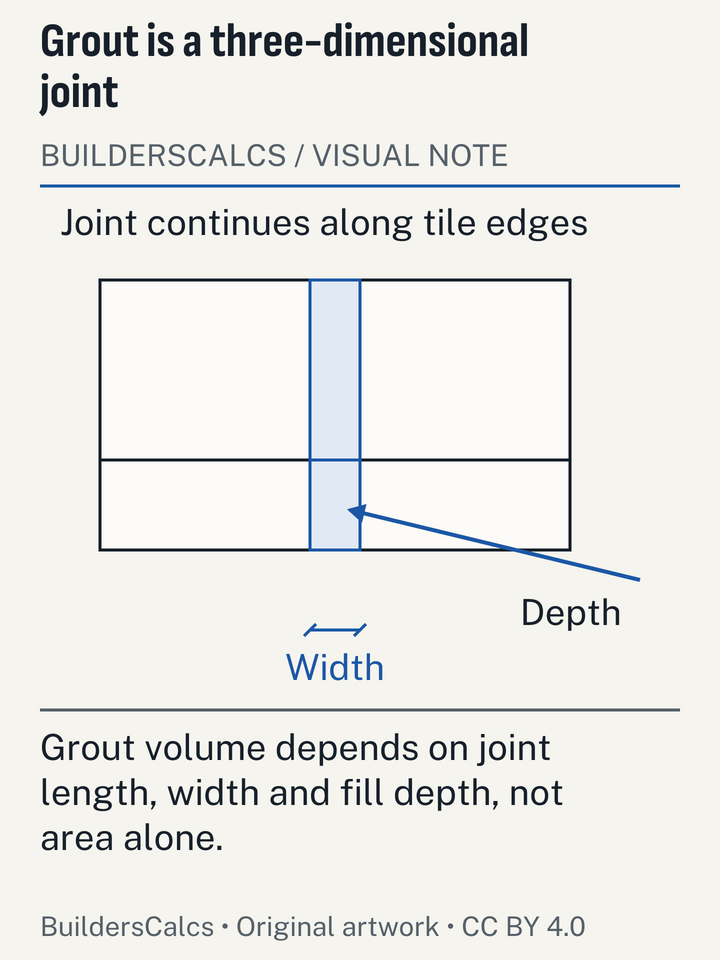
Illustration sources
| Tile (in, L × W × thickness) | 1/8 in joint | 3/16 in joint | 1/4 in joint | 3/8 in joint | 1/2 in joint |
|---|---|---|---|---|---|
| 1 x 1 x 1/4 | 63 | 40 | 25 | 23 | 20 |
| 2 x 2 x 1/4 | 88 | 73 | 50 | 40 | 33 |
| 3 x 3 x 1/4 | 150 | 103 | 80 | 55 | 45 |
| 4-1/4 x 4-1/4 x 1/4 | 210 | 143 | 110 | 75 | 60 |
| 6 x 6 x 1/4 | 263 | 178 | 136 | 93 | 70 |
| 8 x 8 x 3/8 | 230 | 155 | 113 | 75 | 50 |
| 12 x 12 x 3/8 | 345 | 230 | 175 | 118 | 90 |
| 16 x 16 x 3/8 | 458 | 305 | 225 | 144 | 94 |
| 20 x 20 x 3/8 | 567 | 381 | 280 | 189 | 142 |
| 24 x 24 x 3/8 | 685 | 458 | 325 | 225 | 150 |
Why don't the tile count and the box count match?
Because tile is sold by nominal size and the box states real coverage. Daltile San Michele 12 x 24 in porcelain (actual 11-5/8 x 23-7/16 in) ships 8 pieces, 15.20 sq ft (1.41 m2), per carton. Eight nominal 12 × 24 in tiles would be 16 sq ft, so a buyer who counts tiles at their nominal size and divides by eight comes up a box short on a large floor. The calculator avoids that by working out boxes from the area and the carton coverage, not from the tile count. Box coverage differs by product and size, so use the coverage printed on the box or data sheet.
The box list holds a few presets taken from manufacturer data sheets: two Daltile San Michele cartons for US mode and three Marazzi Plaster boxes for metric. For anything else, choose Use the coverage I enter below and type the square feet or square metres printed on the carton label. Leave the box blank and the calculator skips the box count but still gives tiles, thinset and grout. The standard tile sizes chart lists the common inch sizes with the metric sizes they match.
What changes for metric, UK and European tile?
The metric mode swaps the tile list for European porcelain formats and the result into square metres and kilograms. Common European porcelain formats include 30x60, 60x60, 75x75 and 60x120 cm (Marazzi, Mapei tables). The calculator lists 30 × 60, 60 × 60, 75 × 75 and 60 × 120 cm, and a custom size covers mosaic sheets and anything else. Joints are entered in millimetres, so a 3 mm joint is the metric counterpart of 1/8 in.
Thinset coverage is published mostly by US makers per 50 lb bag, so the metric result counts bags of 22.7 kg. UK adhesives are sold in other sizes and quoted per square metre instead. UK weberset plus uses about 3.0 kg/m2 with a 6 x 6 mm notched trowel, 4.5 kg/m2 for a 3 mm solid bed. That is a little below what the calculator gives for a 6 × 6 mm notch, so the calculator's figure leans long. UK bags are often a different weight from the US basis, so type the weight of your bag in the Thinset bag size box. The default grout bag in metric mode is 23 kg, MAPEI's Ultracolor Plus pack.
UK tile formats and box sizes were not researched separately from the European ones, so the metric presets are Italian Marazzi boxes. For a UK product, use the coverage on its box.
When is the tile count wrong or not enough?
The calculator handles flat rectangles and known areas in a single tile size. It warns you in three cases and leaves several others to you:
- Joints that are too narrow. ANSI A108.02 4.3.8: no grout joint may be narrower than 1/16 in (1.6 mm). Enter anything narrower and the result carries a note.
- Long tiles in running bond. ANSI: running-bond layouts of tile with any side over 15 in need joints averaging at least 1/8 in (3 mm) for rectified tile. For calibrated tile the figure is larger. ANSI: running-bond layouts of tile with any side over 15 in need joints averaging at least 3/16 in (5 mm) for calibrated tile. The calculator flags a narrower joint with any tile over 15 in.
- Herringbone with square tiles. The pattern needs rectangular tiles, so the calculator warns you if you pick both.
- Trim and edge pieces. Bullnose, cove base and pencil liners are sold by the piece or the linear foot. Measure the runs and count them separately.
- Mixed sizes and borders. Run each tile size as its own area. A border or a feature strip has its own count and its own extra.
- Uneven floors. A dished or wavy subfloor takes more thinset than the bag chart allows, and large tiles show every dip. Level the floor first or plan on extra adhesive.
- Mosaic sheets. Enter the sheet as a custom tile with the joint between sheets, or use the sheet coverage on the box. The grout estimate for a mosaic should come from the grout maker's chart for the individual chip size.
Nominal sizes also have a limit of their own. ANSI A108.02: the joint must be at least 3 times the actual facial-size variation of the tile supplied (1/16 in variation means 3/16 in joint). If the tile you buy varies more than usual, a wider joint is required, which slightly lowers the tile count and raises the grout.
How much tile does the US buy each year?
US ceramic tile consumption was 2.57 billion sq ft in 2025, down 4.9% from 2.70 billion in 2024, with imports making up 72.4% of volume (TCNA, March 2026). That figure counts all ceramic and porcelain tile sold in the country, commercial jobs included, not just home bathrooms. It does show how much of what you buy is likely to be imported, which is one reason box sizes and actual tile dimensions vary so much from one product line to the next.
As an Amazon Associate I earn from qualifying purchases. Links to Amazon below can earn us a commission at no cost to you. Affiliate disclosure.
Tools for setting the tiles you just counted
With the count done, these are the small tools the job uses, chosen from the makers' published specifications. We have not handled or measured them. Links go to Amazon; read how affiliate links work here.
-
RUBI 02923 (bag of 200)

T-spacers 1/8" (3mm)
Match these to the joint you entered in the calculator. Spacers set a 1/8-inch (3 mm) joint. Reference 02923 is a bag of 200.
Check price on Amazon Opens Amazon in a new tab -
RUBI 03914 (1/16 in clips)
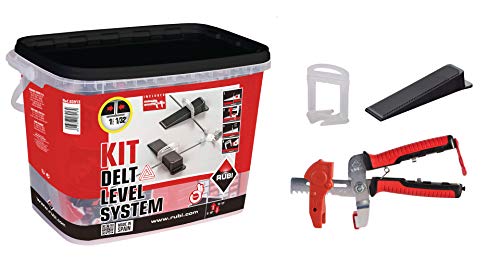
DELTA LEVEL SYSTEM KIT V4
Clips and wedges that hold neighbouring tile edges flush while the thinset cures, useful for the larger formats. Reference 03914 uses 1/16-inch clips. Clips suit tile 1/8 to 1/2 inch thick. The joint is narrower than the 1/8 in default, so set the calculator's joint to match.
Check price on Amazon Opens Amazon in a new tab -
RUBI TS-66 MAX (ref. 18922 orange / 18974 grey)

TS-66 MAX Tile Cutter
A score-and-snap cutter for the straight cuts at each wall. The TS-66 MAX has a 25-inch cutting length. It cuts tile diagonally up to 18-1/8 x 18-1/8 inches. Rated cutting height range is 1/4 to 5/8 inch. It does not cut notches or curves.
Check price on Amazon Opens Amazon in a new tab -
RUBI 65971

SUPERPRO Plastic Handle Grout Float
For pressing grout into the joints and cleaning the face. Rubi rates it for joints up to 1/8 inch wide. Wider joints call for one of the other versions Rubi sells. Sold as standard (65971), solid rubber (65972) and TERMOFLEX (65973) versions.
Check price on Amazon Opens Amazon in a new tab
Which calculator do I need next?
Tiling one room often leads into the next floor. For the rooms that get a floating floor, the laminate flooring calculator counts packs with Pergo's extra, and the vinyl flooring calculator handles plank boxes and sheet off the roll. Not sure tile is the right choice? See flooring types compared for how each one is sold and how much extra it needs.
The rest of the floor covering calculators sit on the flooring hub, and the free PDF reference charts put the size and coverage tables on paper for the job.
Tile calculator questions
Can I use the tile calculator for a kitchen backsplash?
Yes. Enter the length of the counter run as the length and the height from worktop to cabinet as the width, or add several runs together and use I know the area. Subtract a window but not the outlets, which are cut around. Backsplash tile is usually small, so the grout figure will be higher per square foot than on a floor.
Why does the tile calculator round up twice?
The first rounding turns the covered area into whole tiles, and the second rounds the count after extra is added. Nobody can buy part of a tile. The box count is rounded up separately from the area, so it can leave you with a few more tiles than the tile count asks for.
Can I type my own waste percentage instead of the layout figure?
Yes. Any number in Extra to order replaces the layout default, and zero gives the bare count. Fireclay, Artistic Tile and Daltile each give a different figure, so set the one your tile supplier or installer prefers.
Is the grout estimate for sanded or unsanded grout?
The weight comes from MAPEI's formula, which models the joint volume, so it applies to both. Choose by joint width rather than by the estimate. Custom Polyblend Plus Sanded grout is for joints 1/8 to 1/2 in (3.1-12.7 mm); unsanded for joints up to 1/8 in. Epoxy and urethane grouts weigh differently; use the maker's own chart for those.
How do I count tile for a room with a closet or a bay?
Treat each part as its own rectangle, multiply length by width for each, and add them. Enter the total with I know the area. If the room is a straight lay with many short walls, consider raising the extra, since every extra wall adds a row of cuts.
Add this tile calculator to your site
Sources (25)
- Artistic Tile
- Advice: ordering tile and overage, checked
- Ceramic Tile Education Foundation (CTEF)
- ANSI Standards: A Tile Installer's Best Friend (quotes ANSI A108.02 4.3.8), checked
- Custom Building Products
- Polyblend Plus Sanded Grout technical data sheet (published 3/22/2023), checked
- Polyblend Sanded / Non-Sanded Grout color card and coverage chart (©2011), checked
- VersaBond Professional Tile Mortar product page - coverage table, checked
- Daltile
- San Michele sales sheet (sizes table), checked
- Tile & Stone FAQs (What is Attic Stock?), checked
- Fireclay Tile
- Tile School: How to Avoid an Add-On Order, checked
- LATICRETE International
- 253 GOLD sell sheet DS-167.6-EN-SP-0726 (©2026), checked
- MAPEI Corporation
- Ultraflex 2 technical data sheet (version Aug. 5, 2013), checked
- MAPEI S.p.A.
- Ultracolor Plus technical data sheet (GB) - consumption table and formula, checked
- Marazzi Group (Italy)
- Plaster collection catalogue - formats and packing table, checked
- National Institute of Standards and Technology
- Handbook 44 (2026), Appendix C: General Tables of Units of Measurement, checked
- Special Publication 811 (2008), Guide for the Use of the International System of Units (SI), Appendix B.8, checked
- RUBI
- DELTA LEVEL SYSTEM KIT V4, checked
- SUPERPRO plastic handle grout float, checked
- T-spacers 1/8" (3mm), checked
- TS-MAX Tile Cutters, checked
- Royal Institution of Chartered Surveyors (RICS)
- Whole life carbon assessment for the built environment, 2nd edition (professional standard, September 2023), checked
- Saint-Gobain Weber (UK)
- weberset plus tile adhesive - NBS Source product data, checked
- The Quikrete Companies
- Safety Data Sheet C1: Portland Cement Based Concrete Products (rev. Feb-23), checked
- Tile Council of North America (TCNA)
- 2025 U.S. Ceramic Tile Market Update (press release, 31 March 2026), checked
- TileLetter (National Tile Contractors Association)
- About Grout Joint Width, checked
- UK Parliament (legislation.gov.uk)
- Weights and Measures Act 1985, Schedule 1, checked
- US Occupational Safety and Health Administration (29 CFR, via Cornell LII)
- 29 CFR 1926.1153 Respirable crystalline silica (construction), checked
Every number on this page is taken from these documents. How we choose and check sources.