

Concrete block calculator
Type the wall length and height, take off doors and windows, and this calculator gives the number of concrete blocks to buy, the mortar to lay them and, for US walls, the grout to fill every core. The working rule for US walls: 8 x 16 in blocks need 1.125 blocks per sq ft of wall (112.5 per 100 sq ft) before waste. The block width does not change that count. UK blocks are counted from their face size plus a 10 mm joint.
Concrete block calculator
v1 · US and metricEnter the wall size and take off any openings. The result gives the blocks to buy, the mortar and, for US block walls, the grout to fill the cores.
Result
Enter your measurements and press Calculate.
Formula and assumptions
Net wall area = length × height − openingsUS blocks = net area (sq ft) × 1.125; metric:UK blocks per m² = 1,000,000 ÷ ((440 + joint) × (215 + joint))Blocks to buy = blocks × (1 + extra %), rounded upGrout (cu ft) = net area ÷ 100 × NCMA grout volume for the block width; metric:Mortar tubs = blocks ÷ blocks per tub, rounded up- 8 x 16 in blocks need 1.125 blocks per sq ft of wall (112.5 per 100 sq ft) before waste. Block count per wall area depends only on face size, so the same count applies to 6, 8, 10 or 12 in wide blocks.
- UK blocks: Standard UK building blocks have a 440 mm long face. Standard UK building blocks have a 215 mm high face.
- Mortar for US walls uses NCMA estimates an 80 lb bag of preblended mortar lays about 16 conventional blocks. UK walls use A 10 kg tub of Tarmac ready-to-use Mortar Mix lays about six 100 mm blocks.
- Solid-grouting an 8 in block wall (every cell, 8 in spacing) takes about 36.1 cu ft of grout per 100 sq ft (about 1.34 yd³), including 3% waste. An 80 lb (36.3 kg) bag of preblended grout yields about 0.66 cu ft (0.019 m³).
- NCMA does not recommend grouting conventional 4 in units because the cells are too small to fill and consolidate.
- Block and bag counts are rounded up.
How many blocks for a 20 ft wall 8 ft high?
A 20 ft by 8 ft wall of standard US block needs 180 blocks before any extra, and 189 to buy once the default allowance is added. Those are the figures the calculator shows when it loads in US units. The same wall takes 12 bags of 80 lb preblended mortar, counted from the blocks before extra. If you tick the grout option, a third line shows the grout for filling every core.
The metric default is a 10 m by 2 m wall of UK blocks with 10 mm joints. It needs 198 blocks before extra, 208 to buy, and 33 of Tarmac's 10 kg ready-to-use mortar tubs if the blocks are 100 mm thick.
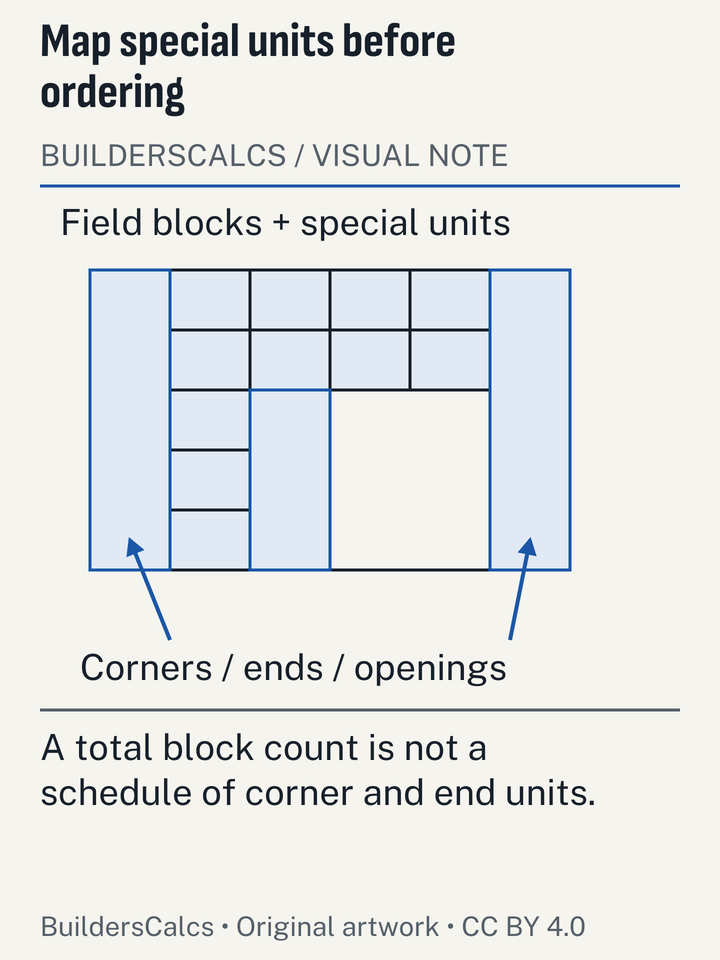
Measure the wall on the face you will build, not along a footing that may run long. For a wall that turns a corner, add the lengths of each run measured on the outside face, then enter the total as one length. The calculator does not count corner or end blocks separately, which is fine for a rough order but worth checking against the block yard's list for a wall with many returns.
Openings go in as one total area. Add width times height for each door and window, then type the sum. A 3 ft by 7 ft door is 21 sq ft; two 4 ft by 3 ft windows add 24 sq ft more. The calculator subtracts that from the gross wall area before it counts anything.
How is the number of concrete blocks calculated?
Block count is net wall area multiplied by the blocks needed per unit of area. For US walls that multiplier is 1.125 blocks/sq ft, and it comes from the face of one block. A conventional block with an 8 x 16 in nominal face covers 8/9 sq ft (0.083 m²) of wall. Divide one square foot by that face and you get the per-square-foot figure (Concrete Masonry & Hardscapes Association (formerly NCMA)).
The calculator runs the steps in this order:
- Net area: length × height, minus the openings you entered.
- Blocks: US walls multiply net square feet by 1.125. UK walls divide 1,000,000 by (face length + joint) × (face height + joint), all in millimetres, which gives blocks per square metre, then multiply by the net area.
- Extra: blocks × (1 + extra ÷ 100), rounded up to a whole block.
- Mortar: blocks before extra divided by the blocks one bag or tub lays, rounded up.
- Grout, if chosen: net square feet ÷ 100 × NCMA's grout volume for that block width, then divided by one bag's yield and rounded up.
Joint width only matters for UK blocks. A US 8 × 16 in block is a nominal size that already includes its share of joint, so the joint box is ignored in US mode.
Worked example: US wall with solid-grouted cores
Take a 10 ft by 10 ft wall of 8 in wide block, every core grouted, no extra. Area: 100 sq ft. Blocks: 100 × 1.125 = 112.5, rounded up to 113. Grout: 100 ÷ 100 × 36.1 = 36.1 cu ft, which is 1.34 cu yd. Bags: 36.1 ÷ 0.66 = 54.7, so 55 bags of 80 lb grout.
Worked example: UK wall at 10 mm joints
With a 440 mm by 215 mm face and 10 mm joints, each block takes up 450 × 225 mm of wall. One million square millimetres divided by 101,250 gives 9.877 blocks per m². A 10 m by 2 m wall is 20 m², so 197.5 blocks, which the calculator shows as 198 before extra and 208 with the default allowance. Take 2 m² off for a door and set the extra to zero and the count drops to 178.
| Wall | Inputs | Extra | Blocks to buy | Mortar and grout |
|---|---|---|---|---|
| US block wall | 20 ft × 8 ft, no openings | 5% | 189 (180 before extra) | 12 × 80 lb preblended mortar |
| US wall with openings | 20 ft × 8 ft, less 20 sq ft | 5% | 166 | Mortar falls with the block count |
| US 8 in block, solid grouted | 10 ft × 10 ft | 0% | 113 | 36.1 cu ft grout (1.34 cu yd), 55 × 80 lb bags |
| US 12 in block, solid grouted | 20 ft × 8 ft | 5% | 189 | 94.24 cu ft grout (3.49 cu yd), 143 × 80 lb bags |
| UK 100 mm blockwork | 10 m × 2 m, 10 mm joints | 5% | 208 (198 before extra) | 33 × 10 kg ready-to-use tubs |
| UK wall with a door | 10 m × 2 m, less 2 m² | 0% | 178 | Mortar falls with the block count |
What size is a standard concrete block?
A standard US concrete block is sold as 8 × 8 × 16 in, but that is its nominal size, not what a tape measure reads. A nominal 8 x 8 x 16 in block actually measures 7 5/8 x 7 5/8 x 15 5/8 in, leaving room for a 3/8 in joint. ASTM C90 allows block dimensions to vary 1/8 in from the specified size. Many first-time builders measure a block, divide the wall by the real face size and then add a joint on top, which double-counts the mortar and gives too few blocks. The nominal face is the one to divide by, and the calculator already does that.
Block count per wall area depends only on face size, so the same count applies to 6, 8, 10 or 12 in wide blocks. Width changes how much the wall weighs, how much grout fills it and how much mortar sits on the face shells, but not the number of blocks per square foot. Metric descriptions of the same block vary. Quikrete describes the standard 8 x 8 x 16 in block as 200 x 200 x 405 mm.
UK blocks are a different shape. Forterra's Thermalite specification tables give a 440 mm by 215 mm face, and the calculator uses that for every UK block whatever its thickness or density. We found the face size only in that one manufacturer's tables, so check the face printed on the delivery note if you buy another make.
| Constant | Figure | Source |
|---|---|---|
| US block face | A conventional block with an 8 x 16 in nominal face covers 8/9 sq ft (0.083 m²) of wall. | (Concrete Masonry & Hardscapes Association (formerly NCMA)) |
| US blocks per area, no waste | Without waste, 8 x 16 in blocks need 112.5 blocks per 100 sq ft (9.29 m²) of wall. | (Concrete Masonry & Hardscapes Association (formerly NCMA)) |
| US blocks per area, with waste | NCMA estimates 119 blocks per 100 sq ft (9.29 m²) of wall, including about 5% for waste and breakage. | (Concrete Masonry & Hardscapes Association (formerly NCMA)) |
| Real size of a nominal 8 × 8 × 16 | A nominal 8 x 8 x 16 in block actually measures 7 5/8 x 7 5/8 x 15 5/8 in, leaving room for a 3/8 in joint. | (Angelus Block Co.) |
| UK block face length | Standard UK building blocks have a 440 mm long face. | (Forterra) |
| UK block face height | Standard UK building blocks have a 215 mm high face. | (Forterra) |
| UK joint | UK brickwork is set out with 10 mm mortar joints. | (Designing Buildings Ltd (industry wiki)) |
| US mortar per bag | NCMA estimates an 80 lb bag of preblended mortar lays about 16 conventional blocks. | (Concrete Masonry & Hardscapes Association (formerly NCMA)) |
| UK mortar per tub | A 10 kg tub of Tarmac ready-to-use Mortar Mix lays about six 100 mm blocks. | (Tarmac) |
| Grout per bag | An 80 lb (36.3 kg) bag of preblended grout yields about 0.66 cu ft (0.019 m³). | (Concrete Masonry & Hardscapes Association (formerly NCMA)) |
How much grout fills the cores of a block wall?
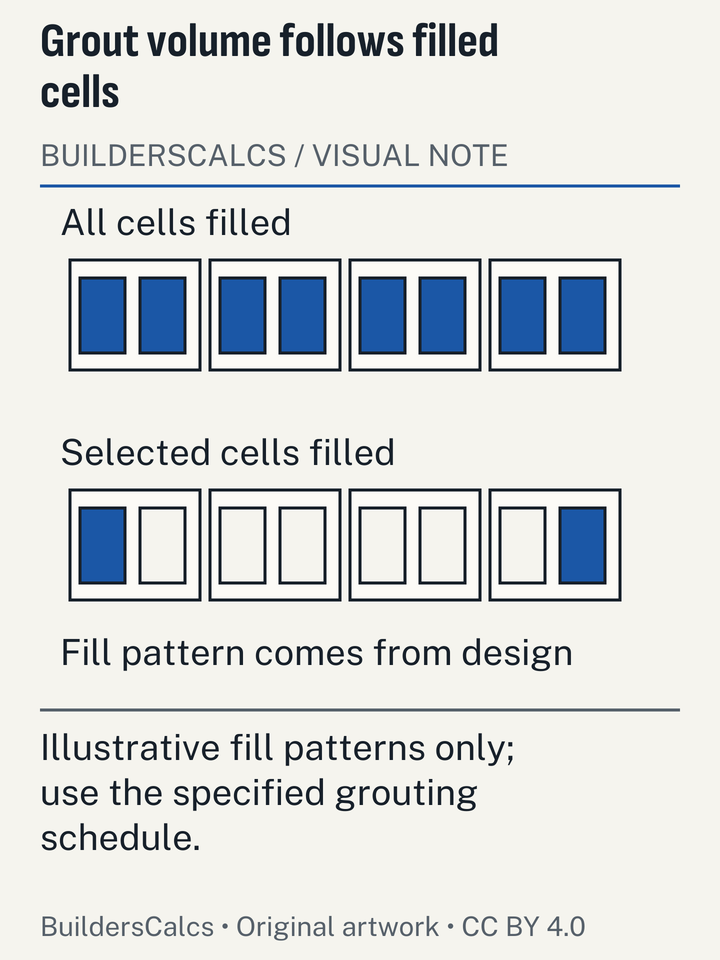
Solid grouting an 8 in wall takes about 36.1 cu ft/100 sq ft per 100 sq ft. Solid-grouting an 8 in block wall (every cell, 8 in spacing) takes about 36.1 cu ft of grout per 100 sq ft (about 1.34 yd³), including 3% waste. The figures for other widths come from the same NCMA estimating note: 25.6 cu ft/100 sq ft for 6 in block, 47 cu ft/100 sq ft for 10 in and 58.9 cu ft/100 sq ft for 12 in (Concrete Masonry & Hardscapes Association (formerly NCMA)).
Grout is not mortar. Mortar goes in the bed and head joints; grout is a more fluid mix poured into the hollow cells, usually around reinforcing bars. The calculator keeps them as separate lines for that reason. One 80 lb bag of preblended grout fills about 2.7 cores of 8 in block.
Most reinforced walls are not grouted solid. Engineers and local codes often call for grout only in the cells that hold vertical bars, at a set spacing. The calculator's grout option covers the solid case only. For partial grouting, read the volume for your bar spacing and block width from the table below, multiply by your wall area in hundreds of square feet, and divide by the bag yield. NCMA does not recommend grouting conventional 4 in units because the cells are too small to fill and consolidate.
| Grouted cell spacing (in) | Spacing (mm) | 6 in wall | 8 in wall | 10 in wall | 12 in wall |
|---|---|---|---|---|---|
| 8 | 203 | 25.6 | 36.1 | 47 | 58.9 |
| 16 | 406 | 12.8 | 18.1 | 23.5 | 29.5 |
| 24 | 610 | 8.6 | 12.1 | 15.7 | 19.7 |
| 32 | 813 | 6.4 | 9.1 | 11.8 | 14.8 |
| 40 | 1,016 | 5.2 | 7.3 | 9.4 | 11.8 |
| 48 | 1,219 | 4.3 | 6.1 | 7.9 | 9.9 |
| 56 | 1,422 | 3.7 | 5.2 | 6.8 | 8.5 |
| 64 | 1,626 | 3.2 | 4.6 | 5.9 | 7.4 |
| 72 | 1,829 | 2.9 | 4.1 | 5.3 | 6.6 |
| 80 | 2,032 | 2.6 | 3.7 | 4.7 | 5.9 |
| 88 | 2,235 | 2.4 | 3.3 | 4.3 | 5.4 |
| 96 | 2,438 | 2.2 | 3.1 | 4 | 5 |
| 104 | 2,642 | 2 | 2.8 | 3.7 | 4.6 |
| 112 | 2,845 | 1.9 | 2.6 | 3.4 | 4.3 |
| 120 | 3,048 | 1.8 | 2.5 | 3.2 | 4 |
How much extra block should I order?
The calculator adds 5% by default, the allowance NCMA builds into its own estimate. NCMA estimates 119 blocks per 100 sq ft (9.29 m²) of wall, including about 5% for waste and breakage. That covers chipped corners, cut blocks at openings and the odd unit that breaks in handling.
A UK figure points the same way. A 2023 study for the Mineral Products Association proposed a 5% wastage rate for concrete blocks in housebuilding, replacing the 20% baseline long used in WRAP's Net Waste tool. The 2023 rate describes measured site waste on professional housebuilding, not an ordering rule for a garden wall, but it suggests the older WRAP baseline overstated what a careful site loses. Use the default for a straight wall and raise it for a wall with many corners, piers or cuts around windows. The choosing a waste allowance guide sets the block figure beside brick, tile and timber.
Mortar is counted from the blocks before extra, so the spare blocks do not inflate the mortar order. Mortar has its own waste allowance; the mortar for brick or block joints calculator applies it and lets you switch between bagged, masonry cement and site-mixed mortar.
What changes for UK and metric blockwork?
In metric mode the calculator switches to UK blocks, millimetre joints and ready-to-use mortar tubs. Lengths are in metres, joints in millimetres and openings in square metres. The joint box matters here, because the UK count is worked out from the block face plus the joint rather than from a published per-area figure. A thicker joint means slightly fewer blocks per square metre.
Mortar uses Tarmac's tub figure. A 10 kg tub of Tarmac ready-to-use Mortar Mix lays about 12 bricks or six 100 mm blocks. Bigger jobs are usually laid from bagged or silo mortar, and the trade body gives a per-tonne yield for that. MPA says 1 tonne of cement:lime:sand mortar lays about 1,000 bricks or 600 blocks of 450 x 225 x 100 mm. No UK maker we found prints a block count for a 20 kg or 25 kg mortar bag, so the calculator does not offer one.
Core grouting is a US practice. NCMA's grout tables describe hollow units with open cells, and we found no UK source for filling block cores, so the grout option appears only in US mode. The block types also differ: Great Britain's market splits between dense, lightweight and aerated blocks. Great Britain concrete block deliveries were 54.2 million square meters in 2025 (dense 18.4, lightweight 13.8, aerated 22.1), down from 73.4 million in 2021, per DBT Table 11c. The face size the calculator uses applies to all three.
When is the block count wrong or not enough?
The calculator handles a flat, single-wythe wall of one block type. These cases fall outside it:
- Corners, ends and piers. Corner, end and pilaster units are special shapes. The area method counts them as ordinary blocks, so ask the yard to split your total into stretchers, corners and half blocks.
- Bond beams and lintels. U-shaped units over openings and along the top are a separate line on the order.
- Partial grouting. The grout option fills every core. Use the NCMA table above when only some cells are grouted.
- Walls on a slope or with steps. Measure each stepped section as its own rectangle and add the areas.
- The footing. A block wall needs a footing, and the concrete for it is a separate figure. The concrete volume and bag count calculator has a footing mode.
- Reinforcement and design. The calculator counts materials; it does not say how much steel a wall needs, how tall it may be or whether it can carry a load. Basement, foundation and load-bearing walls follow your local code or an engineer's drawings.
- Retaining walls. A mortared block wall holding back soil is a structural wall. Dry-stacked garden walls use different units, which the segmental wall block count calculator covers.
Rounding is always up. If you split a wall into parts and run each separately, each part rounds up, so the sum can come out a block or two higher than one run of the whole wall.
Which calculator do I need next?
Take the block count to the mortar for brick or block joints calculator if you want to compare a different bag brand or mix your own from cement, lime and sand. If the wall will carry a brick skin or a brick-faced section, the bricks per wall calculator counts those using Brick Industry Association figures. For the method behind brick and block counts in metric, including gables and openings, read the bricks per square metre method guide.
The other block, mix and bag tools sit together under all concrete tools. National production and delivery figures for blocks, cement and ready-mix are collected on the concrete and cement statistics page.
Concrete block calculator questions
Does this work for cinder blocks?
Yes, if the block has the usual nominal 8 × 16 in face. The count depends only on face size, so the calculator gives the same number whatever the block is made from or called locally. Check the face of the block you are buying; if it differs, the per-square-foot figure changes.
How many concrete blocks are in 100 square feet of wall?
Without waste, 8 x 16 in blocks need 112.5 blocks per 100 sq ft (9.29 m²) of wall. NCMA estimates 119 blocks per 100 sq ft (9.29 m²) of wall, including about 5% for waste and breakage. Doors and windows come off the area first.
Why is there no joint setting for US blocks?
Because the US block size already includes the joint. A nominal 8 x 8 x 16 in block actually measures 7 5/8 x 7 5/8 x 15 5/8 in, leaving room for a 3/8 in joint. Dividing the wall by the nominal face therefore counts each block with its share of mortar. UK blocks are listed by their real face size, so the joint has to be added.
How many 80 lb bags of grout does one core take?
One 80 lb bag of preblended grout fills about 2.7 cores of 8 in block. Wider blocks hold more, so fewer cores are filled per bag. The calculator works from wall area rather than cores, using NCMA's volume per 100 sq ft.
Can I grout the cores of 4 in blocks?
NCMA does not recommend grouting conventional 4 in units because the cells are too small to fill and consolidate. The grout option therefore starts at 6 in block.
Put this block calculator on your site
Sources (21)
- Angelus Block Co.
- CMU Basics: Dimensions and Sizes, checked
- Brick Industry Association
- Technical Note 10: Dimensioning and Estimating Brick Masonry (Feb 2009), checked
- Concrete Masonry & Hardscapes Association (formerly NCMA)
- TEK 04-02A Estimating Concrete Masonry Materials, checked
- Department for Business and Trade (DBT), UK (data from ONS, DBT and Mineral Products Association)
- Monthly Bulletin of Building Materials and Components, September 2026 (Bulletin 617), data tables, checked
- Designing Buildings Ltd (industry wiki)
- Brick sizes, checked
- Forterra
- Thermalite Aircrete Block Guide (brochure), pp. 7-11 specification tables, checked
- Health and Safety Executive (UK)
- Construction hazardous substances: Cement, checked
- Mineral Products Association (MPA Mortar)
- Data sheet 01: Factory produced lime:sand mortar for masonry (Issue 10, October 2023), checked
- National Institute of Standards and Technology
- Handbook 44 (2026), Appendix C: General Tables of Units of Measurement, checked
- Special Publication 811 (2008), Guide for the Use of the International System of Units (SI), Appendix B.8, checked
- Occupational Safety and Health Administration (OSHA), Federal Register (GovInfo)
- Occupational Exposure to Respirable Crystalline Silica; Final Rule, 81 FR 16286 (March 25, 2016), checked
- Office of the Federal Register / OSHA (eCFR)
- 29 CFR 1926.1153 Respirable crystalline silica (construction), including Table 1, checked
- Reusefully Ltd for the Mineral Products Association (MPA), Brick Development Association and BRMCA
- Interim findings: wastage rates for blocks and ready mixed concrete (V3, 20 March 2023), checked
- Tarmac
- Ready-to-use Mortar Mix product data sheet (10 kg tub), hosted by Wickes, checked
- Tarmac (Blue Circle)
- Multi-Purpose Concrete product data sheet (March 2014), hosted by Wickes, checked
- POSTCRETE product data sheet (April 2014), hosted by Wickes, checked
- The Quikrete Companies
- QUIKRETE Concrete Mix No. 1101 Data Sheet (revised Oct 2022), checked
- QUIKRETE Mortar Mix No. 1102 Data Sheet, checked
- Safety Data Sheet C1: Portland Cement Based Concrete Products (rev. Feb-23), checked
- UK Parliament (legislation.gov.uk)
- Weights and Measures Act 1985, Schedule 1, checked
- US Occupational Safety and Health Administration (29 CFR, via Cornell LII)
- 29 CFR 1926.1153 Respirable crystalline silica (construction), checked
Every number on this page is taken from these documents. How we choose and check sources.