

Concrete and mortar mix ratios: which mix for which job
House concrete is chosen by strength, not by a site recipe: the IRC calls for 2,500-3,500 psi depending on exposure, and an 80 lb bag of Quikrete Concrete Mix reaches about 4,000 psi (27.5 MPa) at 28 days. Mortar is the mix you proportion yourself. ASTM C270 puts the sand at 2 1/4 to 3 x cementitious volume, and Type N mortar must reach at least 750 psi (5.2 MPa).
What mix does house concrete need?
US house concrete needs a minimum compressive strength of 2,500 psi where it is sheltered and up to 3,500 psi where it faces severe weather, per IRC Table R402.2 (Pennsylvania Housing Research Center, Penn State and International Code Council / California Building Standards Commission via GoCodebook). The code sets the strength. It does not set a ratio of cement to sand to stone, because the same strength can be reached with different proportions of different materials. The supplier or bag manufacturer does that proportioning and states the strength the result reaches.
In metric terms, 2,500 psi is about 17.2 MPa, 3,000 psi about 20.7 MPa and 3,500 psi about 24.1 MPa, using 1 psi = 0.006895 MPa.
| Where the concrete goes | Negligible weathering (psi) | Moderate (psi) | Severe (psi) |
|---|---|---|---|
| Basement walls, foundations, other concrete not exposed to weather | 2,500 | 2,500 | 2,500 |
| Basement slabs and interior slabs on grade (not garage floors) | 2,500 | 2,500 | 2,500 |
| Basement, foundation and exterior walls and other vertical work exposed to weather | 2,500 | 3,000 | 3,000 |
| Porches, carport slabs and steps exposed to weather, and garage floor slabs | 2,500 | 3,000 | 3,500 |
How to read the strength table
Pick the row for where the concrete goes, then the column for your climate's weathering potential. Garage floors, porches, carport slabs and exposed steps are the demanding row: IRC Table R402.2: 2,500 psi for basement and interior slabs; garage floors, porches and exposed steps need 3,000 psi (moderate) or 3,500 psi (severe weathering).
Strength is only half the requirement. Where weathering is moderate or severe, exposed concrete must be air-entrained at 5-7% air. Air content is something you specify when you order ready-mix. If you are using bags for exposed work in a cold climate, check whether the product's data sheet says it is air-entrained before you buy.
A common belief is that any bagged mix will do for a garage floor. In a severe-weathering area, the IRC calls for 3,500 psi and 5-7% air (International Code Council / California Building Standards Commission via GoCodebook, Pennsylvania Housing Research Center, Penn State and others), and those two numbers decide the product.
What is the concrete mix ratio for mixing by hand?
For concrete you batch yourself, three current sources agree on 1:2:3. The general-purpose site mix is 1 part cement, 2 parts sand and 3 parts coarse aggregate (gravel or 4/20 mm stone), measured by volume. (US Army (Headquarters, Department of the Army), The Quikrete Companies and others) The US Army's concrete and masonry manual calls it the simple way to batch by volume. The unit doesn't matter, whether shovels, buckets or wheelbarrow loads, as long as every part uses the same measure. Quikrete prints the same ratio on its portland cement data sheet, and Hanson does on its UK general purpose cement sheet.
In the UK, sand and gravel are often bought together as all-in ballast. Hanson gives 1 part cement to 4 parts combined sand-and-gravel ballast for general-purpose concrete. (Hanson UK (Heidelberg Materials)) Older US guidance used a range of mixes. USDA's 1922 farm bulletin calls 1:2:4 the standard mix, used for reinforced concrete and watertight work. The same bulletin lists a richer 1:1.5:3 and a leaner 1:3:5 (US Department of Agriculture). Treat those as history. The three current sources all use 1:2:3 for general work.
None of these sources gives a strength for a volume ratio. Where your plans or the IRC table above call for a strength, buy a bagged mix or a ready-mix order that states it, rather than relying on a site recipe.
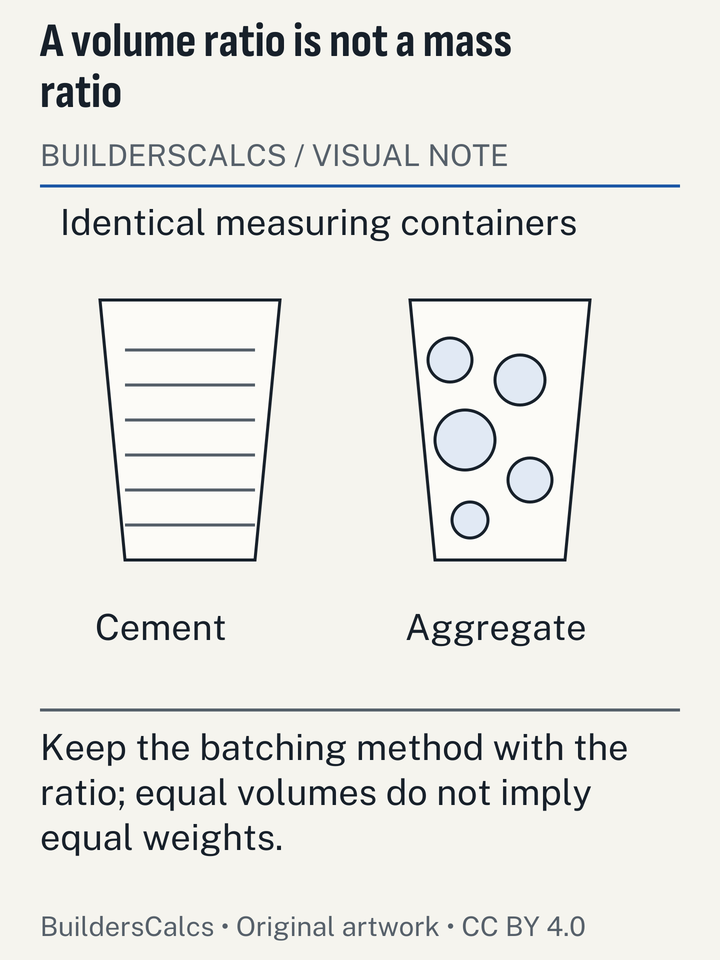
Illustration sources
- US Army (Headquarters, Department of the Army) — FM 5-428 Concrete and Masonry (1998)
- The Quikrete Companies — QUIKRETE Portland Cement data sheet (1124/1125)
- Hanson UK (Heidelberg Materials) — General Purpose Cement - Technical Data Sheet
- US Department of Agriculture — Farmers' Bulletin 1279: Plain Concrete for Farm Use (T. A. H. Miller, 1922)
| Mix | Cement (parts) | Sand (parts) | Coarse aggregate (parts) | Used for | Source |
|---|---|---|---|---|---|
| General purpose | 1 | 2 | 3 | General site concrete; the US Army's simple batch method | US Army (Headquarters, Department of the Army); The Quikrete Companies; Hanson UK (Heidelberg Materials) |
| UK ballast mix | 1 | 4 parts combined ballast | (in the ballast) | General purpose concrete with all-in ballast | Hanson UK (Heidelberg Materials) |
| Rich (USDA, 1922) | 1 | 1.5 | 3 | High stress, exceptional watertightness, abrasion | US Department of Agriculture |
| Standard (USDA, 1922) | 1 | 2 | 4 | Reinforced concrete and watertight work | US Department of Agriculture |
| Medium (USDA, 1922) | 1 | 3 | 5 | Plain concrete of moderate strength | US Department of Agriculture |
How much water goes into hand-mixed concrete?
Water is the part of a hand mix most often overdone. Quikrete tells users to add only the least water that gives a workable mix, because extra water weakens the concrete. (The Quikrete Companies and US Army (Headquarters, Department of the Army)) A 94 lb sack of cement needs about 2.5 US gal (9.5 L) of water just to hydrate; more is added only for workability. The Army manual puts the water in economical mixes at a minimum of 4 US gal per 94 lb sack (15.1 L per 42.6 kg sack) and a maximum of 7 US gal per 94 lb sack (26.5 L per 42.6 kg sack) (US Army (Headquarters, Department of the Army)). USDA's 1922 bulletin gives 4 to 5 US gal (15-19 L) of water per sack of cement as a very rough figure for general work.
Concrete that has to hold water needs less. For watertight concrete exposed to fresh water, the Corps of Engineers limit cited in the Army manual is 5.5 US gal (20.8 L) per sack, a water-cement ratio of 0.48. For concrete exposed to saltwater the same limit is 5 US gal (18.9 L) per sack, a water-cement ratio of 0.44. (US Army (Headquarters, Department of the Army))
The ratio of water to cement by weight, not the sand and gravel ratio, is what mainly sets strength. The table gives the Army manual's highest water-cement ratio for each specified strength. A lower ratio gives a stronger mix, and air-entrained concrete needs a lower ratio for the same strength. For ordering cement, Quikrete says five to six 94 lb bags of its portland cement, with sand and gravel, typically make 1 cu yd (0.76 m³) of concrete. (The Quikrete Companies)
| Specified 28-day strength (psi) | Strength (MPa) | Max. w/c, non-air-entrained | Max. w/c, air-entrained |
|---|---|---|---|
| 2,500 | 17.2 | 0.67 | 0.54 |
| 3,000 | 20.7 | 0.58 | 0.46 |
| 3,500 | 24.1 | 0.51 | 0.4 |
| 4,000 | 27.6 | 0.44 | 0.35 |
| 4,500 | 31 | 0.38 | not given |
Which bagged concrete fits which job?
Bagged concrete is already proportioned. The bag tells you what strength it reaches and what jobs it is sold for, so the choice comes down to strength, setting speed and the thickness you are pouring.
| Product | Stated strength | Region | Made for |
|---|---|---|---|
| Quikrete Concrete Mix (1101) | 4,000 psi (27.5 MPa) at 28 days | US | Slabs, footings, steps and posts at least 2 in (50 mm) thick |
| Sakrete High Strength Concrete Mix | 4,000 psi (27 MPa) at 28 days | US | General slabs, footings and setting posts |
| Quikrete and Sakrete fast-setting mixes | Not used here: chosen for set time | US | Posts, poured dry into the hole; sets in 20–40 min |
| Blue Circle High Strength Concrete | 40 N/mm² at 28 days | UK | Bases and slabs needing a higher strength |
| SAKRET Premium-Beton | C30/37 (EN 206-1) | EU (DE) | Layers at least 40 mm thick |
| Blue Circle Postcrete | No strength stated | UK | domestic posts; gates under 1.0 m wide; sets in 5–10 min |
What does the bag strength mean for your job?
Both US general-purpose mixes in the table state about 4,000 psi (27-27.5 MPa) at 28 days, which is above every row of the IRC strength table. Strength alone is rarely what rules a bagged mix out. Thickness, air entrainment and the sheer number of bags are the usual limits.
UK products are not one strength. Blue Circle High Strength Concrete typically reaches 40 N/mm² at 28 days; Hanson Multipurpose about 25 N/mm². Pick the high-strength product where the job states a strength, and remember that Postcrete is not meant for general concreting or wherever a specified strength is needed (Tarmac (Blue Circle)).
The cement inside the bag has changed in recent years. Blended cement made up 63% of US cement shipments in the first nine months of 2025, and about 95% of that blended cement was portland-limestone cement (Type IL), per USGS MCS 2026. (U.S. Geological Survey (USGS), National Minerals Information Center) So a data sheet that lists Type IL cement is describing the mainstream US product, not a cut-price substitute.
To turn a bag choice into a count, the slab, footing and post concrete formulas guide works three pours by hand, and the concrete needed for a slab tool does the same sum in either unit system.
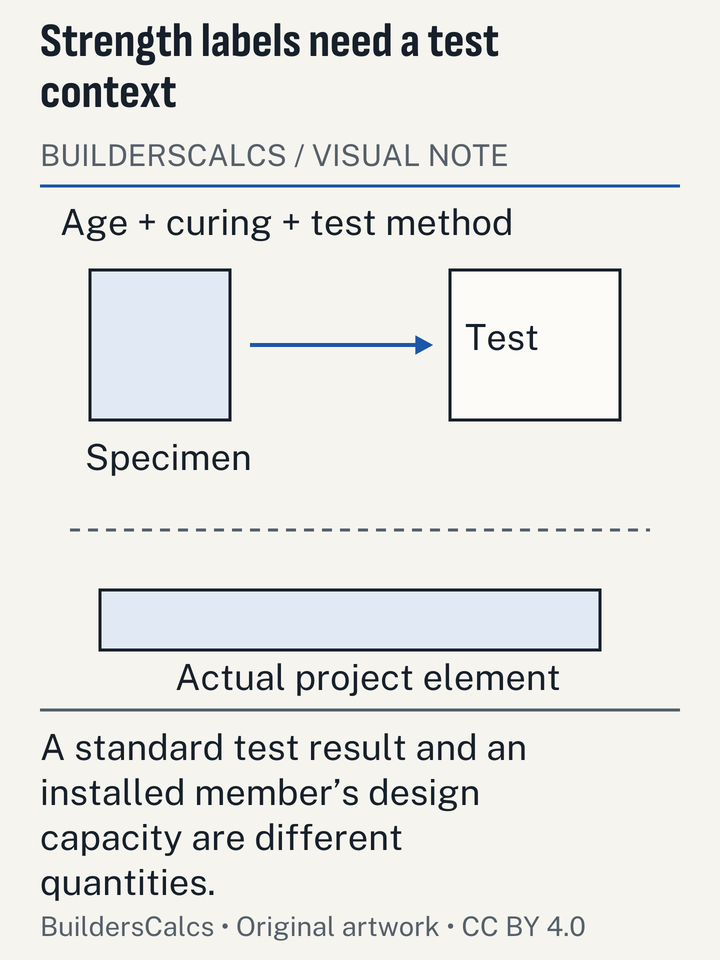
Illustration sources
- Hanson (Heidelberg Materials UK) — Multipurpose Concrete technical data sheet (updated August 2020)
- Tarmac (Blue Circle) — High Strength Concrete (40N) product data sheet (June 2014), hosted by Wickes
- Tarmac (Blue Circle) — POSTCRETE product data sheet (April 2014), hosted by Wickes
- U.S. Geological Survey (USGS), National Minerals Information Center — Mineral Commodity Summaries 2026: Cement
What are the mortar mix ratios?
ASTM C270 mortar is 1 part portland cement to a quarter up to two and a half parts hydrated lime, depending on the type, with sand at 2 1/4 to 3 x cementitious volume (Concrete Masonry & Hardscapes Association (formerly NCMA)). Those are volume proportions of damp, loose sand. The table gives the cement-lime proportions for each type, as reproduced in NCMA TEK 09-01A.
| Mortar type | Portland cement (parts) | Hydrated lime (parts) | Sand |
|---|---|---|---|
| M | 1 | 1/4 | 2 1/4-3 x (cement + lime) |
| S | 1 | over 1/4 to 1/2 | 2 1/4-3 x (cement + lime) |
| N | 1 | over 1/2 to 1 1/4 | 2 1/4-3 x (cement + lime) |
| O | 1 | over 1 1/4 to 2 1/2 | 2 1/4-3 x (cement + lime) |
Mixing mortar from masonry cement
Masonry cement already contains its own lime or plasticiser, so the ratio is simpler: Quikrete mixes 1 part masonry cement with 2 1/4 to 3 parts masonry sand for mortar. (The Quikrete Companies and Concrete Masonry & Hardscapes Association (formerly NCMA)) Under C270's proportion rules, Type N or Type O mortar is 1 part Type N masonry cement plus sand. Type S is half a part portland cement with 1 part Type N masonry cement, or 1 part Type S masonry cement. Type M is 1 part portland cement with 1 part Type N masonry cement, or 1 part Type M masonry cement (Concrete Masonry & Hardscapes Association (formerly NCMA)).
How much sand to buy
One cubic foot (or m³) of loose, damp sand yields about one cubic foot (or m³) of mortar. (Brick Industry Association) That makes sand the easy part of the estimate: work out the mortar volume and you have the sand volume. By weight, NCMA's rule is about 1 ton sand per 8 bags, with an extra half ton for waste on orders over 3 tons (Concrete Masonry & Hardscapes Association (formerly NCMA)).
Preblended mortar mix skips all of this. It is cement, lime and sand in one bag, and you only add water. A common mix-up is to treat a bag of mortar mix and a bag of masonry cement as the same. Quikrete's 80 lb mortar mix lays up to 37 bricks or 13 blocks, while masonry cement goes much further once sand is added: A 70 lb bag of masonry cement mixed with sand lays about 46 blocks or 144 bricks (Quikrete) or about 30 hollow blocks (NCMA). (The Quikrete Companies and Concrete Masonry & Hardscapes Association (formerly NCMA))
How strong is each mortar type?
ASTM C270 sets four minimum 28-day strengths: Type M 2,500 psi (17.2 MPa), Type S 1,800 psi (12.4 MPa), Type N 750 psi (5.2 MPa) and Type O 350 psi (2.4 MPa) (Concrete Masonry & Hardscapes Association (formerly NCMA) and The Quikrete Companies). These are laboratory minimums for mortar made under the property specification, not a measure of what a site-mixed batch will reach. The table adds the water-retention and air-content limits that apply to each cement system.
| Cement system | Type | Min. 28-day strength (psi) | Min. 28-day strength (MPa) | Min. water retention (%) | Max. air content (%) |
|---|---|---|---|---|---|
| Cement-lime | M | 2,500 | 17.2 | 75 | 12 |
| Cement-lime | S | 1,800 | 12.4 | 75 | 12 |
| Cement-lime | N | 750 | 5.2 | 75 | 14 |
| Cement-lime | O | 350 | 2.4 | 75 | 14 |
| Mortar cement | M | 2,500 | 17.2 | 75 | 12 |
| Mortar cement | S | 1,800 | 12.4 | 75 | 12 |
| Mortar cement | N | 750 | 5.2 | 75 | 14 |
| Mortar cement | O | 350 | 2.4 | 75 | 14 |
| Masonry cement | M | 2,500 | 17.2 | 75 | 18 |
| Masonry cement | S | 1,800 | 12.4 | 75 | 18 |
| Masonry cement | N | 750 | 5.2 | 75 | 20 |
| Masonry cement | O | 350 | 2.4 | 75 | 20 |
Which mortar type should you use?
Use the type your plans, the brick or block maker, or ASTM C270's Appendix X1 calls for, and don't default to the strongest. NCMA and Quikrete both point to Appendix X1 for matching the type to the job. They do not treat Type M as the safe choice for everything (Concrete Masonry & Hardscapes Association (formerly NCMA) and The Quikrete Companies). Strength is a minimum, not a target. ASTM C270's selection guide recommends Type N for above-grade load-bearing walls, inside and out, and Type S for foundations, retaining walls, paving and patios. (Mason Contractors Association of America) On the shelf, Quikrete Mortar Mix and Sakrete Mortar Mix are both Type N products.
Two jobs that look like mortar work are not. Filling the cores of a reinforced block wall takes grout, which NCMA treats as a separate material with its own estimating tables (Concrete Masonry & Hardscapes Association (formerly NCMA)). Setting a fence post takes post mix or concrete, not mortar.
When you have the type, the bags of mortar mix calculator turns a brick or block count into bags. Published yields differ by maker. One 80 lb bag of Sakrete Type N Mortar Mix lays about 40 standard bricks or 15 8 in blocks with 3/8 in joints. NCMA's estimate for an 80 lb preblended bag is 16 CMU or 50 brick-size units (Concrete Masonry & Hardscapes Association (formerly NCMA)).
| Location | Part of the building | Recommended type | Alternative |
|---|---|---|---|
| Exterior, above grade | Load-bearing wall | N | S or M |
| Exterior, above grade | Non-load-bearing wall | O | N or S |
| Exterior, above grade | Parapet wall | N | S |
| Exterior, at or below grade | Foundation and retaining walls, manholes, sewers, pavements, walks, patios | S | M or N |
| Interior | Load-bearing wall | N | S or M |
| Interior | Non-bearing partition | O | N |
Bagged or ready-mix: which should you use?
Bags suit small, spread-out or hard-to-reach pours. Ready-mix suits anything measured in whole cubic yards. The table sets the two side by side on the points that decide most jobs.
| What to weigh | Bagged concrete | Ready-mix |
|---|---|---|
| How much per unit | 0.6 cu ft (17 L) per 80 lb bag; about 45 bags per cubic yard | Sold by fresh volume in cubic yards or cubic metres |
| Mixing | By hand or in a mixer with 1 cu ft of drum per 80 lb bag; 6-9 pt (2.8-4.3 L) of water per 80 lb bag | Mixed at the plant and delivered ready to place |
| Strength | Fixed by the product, for example 4,000 psi (27.5 MPa) | Ordered to the strength and air content the job needs |
| Thinnest pour | 2 in (50 mm) for standard and fast-setting mixes | Set by the mix ordered |
| Allowance | Round up to whole bags; spare bags keep | NRMCA: order 4–10% over plan volume |
| Minimum order | One bag | Set by each supplier. One US producer charges a part-load fee at 6.25 cu yd (4.8 m³) or less |
Where the bag count tips the decision
The decision usually comes down to bag count. One cubic yard is 45 bags of 80 lb mix, about 3,600 lb (1.6 t) of dry material, and every bag has to be lifted, opened, mixed and placed before the previous batch starts to set. A post hole or a set of steps is a handful of bags. A patio or a garage slab is a truck.
- Choose bags for post holes, small pads, step repairs and pours spread over days, or where a truck can't reach.
- Choose ready-mix when the slab must be placed in one go, when the job calls for air entrainment or a strength the bags don't state, or when the bag count runs into the dozens.
- Either way, work out the volume first. The post hole calculator handles fence and deck posts, and the concrete and masonry calculators cover slabs, blocks and mortar.
In Great Britain ready-mix carries most of the cement. Imports supplied a record 32% of UK domestic cement sales and 58% of domestic cement sales went into ready-mixed concrete in 2024, per the MPA Profile 2025. (Mineral Products Association (MPA), UK)
Where do the cement, sand and gravel come from?
Most of what goes into a mix is sand and stone. USGS estimates the US produced 870 million metric tons of construction sand and gravel in 2025, and 42% of it was used as aggregate in portland cement concrete (U.S. Geological Survey (USGS), National Minerals Information Center). The cement is a far smaller tonnage: US portland, blended and masonry cement production was an estimated 84 million metric tons in 2025 from 97 plants in 34 states and Puerto Rico, down from 91 million in 2021 (USGS MCS 2026).
In Europe, EU27 cement production was 160.8 million tonnes in 2024 (down 0.2%) while EU27 consumption fell to 148.1 million tonnes, per Cement Europe's 2025 Activity Report. (Cement Europe (formerly CEMBUREAU, the European Cement Association))
Cement is the ingredient that carries the carbon, because making clinker releases CO2 from the limestone itself as well as from the kiln fuel. Global process CO2 from cement clinker production was about 1.5 billion tonnes in 2024, plus about 0.9 billion tonnes from fuel burned for kiln heat, per CICERO's Global Carbon Project cement dataset (Oct 2025). (CICERO Center for International Climate Research (Robbie M. Andrew), via Zenodo) Process CO2 from US cement production was 37.2 million metric tons CO2e in 2024, 8% below 2023 and 11% above 1990, per the University of Maryland's continuation of the US GHG inventory (2026). More figures are on the concrete and cement statistics page.
How do UK and EU mixes differ?
UK and EU products state strength in different units and come in smaller bags. UK bag strengths are given in N/mm², which is the same as MPa: Blue Circle's high-strength bag at 40 N/mm², for example. German SAKRET Premium-Beton is sold as a strength class, C30/37, under EN 206-1 and DIN 1045-2 (SAKRET Trockenbaustoffe Europa).
Yields differ too. A bag of Blue Circle ready-to-use concrete makes about 0.01 m³, so roughly 100 bags per m³. That is about 0.35 cu ft, or roughly 60% of what a US 80 lb bag makes. For mortar, Blue Circle's Quality Assured Mortar needs water at about 4 L per 20 kg bag. Do not mix Blue Circle mortar below 3 °C when the temperature is falling or below 1 °C when rising. (Tarmac (Blue Circle))
UK mortar is specified by designation or strength class rather than by US type. UK mortar designations (i) to (iv) correspond to strength classes M12, M6, M4 and M2. Designation (iii), class M4, the usual general-purpose UK mortar, is 1:1:5-6 cement:lime:sand by volume. (Mineral Products Association (MPA Mortar) and Hanson UK (Heidelberg Materials)) The table gives each designation as a cement:lime:sand mix, as cement added to factory-made lime:sand, and as cement and building sand with a plasticiser. MPA says 1 tonne of cement:lime:sand mortar lays about 1,000 bricks or 600 blocks of 450 x 225 x 100 mm.
| Designation | Cement:lime:sand | Cement : factory lime:sand | Cement : building sand (plasticised) | Class | Exposure |
|---|---|---|---|---|---|
| (i) | 1:1/4:3 | 1:3 | 1:3 | M12 | Severe |
| (ii) | 1:1/2:4-4 1/2 | 1:4 1/2 | 1:3 to 1:4 | M6 | Severe |
| (iii) | 1:1:5-6 | 1:6 | 1:5 to 1:6 | M4 | Moderate |
| (iv) | 1:2:8-9 | 1:9 | 1:7 to 1:8 | M2 | Passive |
When does the mix choice go wrong?
- Too thin. Standard bag mixes are made for 2 in (50 mm) and up, and SAKRET Premium-Beton for 40 mm and up. A skim coat over old concrete needs a topping or repair product.
- Exposed concrete without air. Where the IRC calls for 5-7% air, a high strength figure does not replace it; the mix needs both.
- Mortar that is too strong. A higher type is not automatically better. Follow the specified type rather than upgrading by habit.
- Mortar used as grout. Block cores that carry rebar need grout, not leftover mortar.
- Post mix used as general concrete. Postcrete's maker limits it to domestic posts and small gates.
- Cold weather. Don't mix mortar when it is too cold for the product, and protect fresh joints from rain and frost.
- Too much water. Quikrete gives a starting and a maximum water quantity for each bag size. Stay inside that range.
| Bag (lb) | Start with (pints) | Start with (L) | Maximum (pints) | Maximum (L) |
|---|---|---|---|---|
| 40 | 3 | 1.4 | 4.5 | 2.1 |
| 50 | 3.5 | 1.7 | 5.5 | 2.6 |
| 60 | 4 | 1.9 | 7 | 3.3 |
| 80 | 6 | 2.8 | 9 | 4.3 |
| 90 | 7 | 3.3 | 10 | 4.7 |
What to buy: the short version
For a US patio, path, footing or post, a general-purpose bag mix at about 4,000 psi clears the IRC's strength minimums. For a garage floor or exposed steps in a cold climate, also check air entrainment, or order ready-mix specified for it. For brick and block, buy the mortar type your plans or the masonry maker name (the common preblended bags from Quikrete and Sakrete are Type N), and buy grout for any reinforced cores. In the UK, look for the N/mm² figure on the bag and use high-strength concrete where a strength is stated.
Mix and strength questions
Should I use 1:2:3 or 1:2:4 for hand-mixed concrete?
Use 1:2:3 for general work. The US Army manual, Quikrete and Hanson all give it (US Army (Headquarters, Department of the Army), The Quikrete Companies and others). 1:2:4 comes from a 1922 USDA bulletin that called it the standard mix for reinforced and watertight work (US Department of Agriculture). Neither ratio comes with a stated strength.
Is 4,000 psi bagged concrete strong enough for a garage floor?
On strength, yes: the IRC's highest residential minimum is 3,500 psi, for garage floors and exposed slabs in severe weathering areas. In moderate or severe weathering the concrete must also be air-entrained at 5–7%, so confirm that on the product's data sheet or order ready-mix with air.
Is Type S mortar stronger than Type N?
Yes. ASTM C270 sets a minimum of 1,800 psi (12.4 MPa) for Type S and 750 psi (5.2 MPa) for Type N. Stronger is not the same as better, so use the type the job specifies.
How much sand goes with a bag of masonry cement?
Quikrete mixes 1 part masonry cement with 2 1/4 to 3 parts masonry sand for mortar. By weight, NCMA's ordering rule is 1 ton sand per 8 bags, which is about 907 kg of sand per 8 bags.
Can I fill concrete block cores with mortar?
Not for reinforced cores. NCMA estimates grout separately from mortar. An 80 lb (36.3 kg) bag of preblended grout yields about 0.66 cu ft (0.019 m³).
Does a UK bag of concrete make as much as a US bag?
No. A Blue Circle bag makes about 0.01 m³, so roughly 100 bags per cubic metre, while a US 80 lb bag makes 0.6 cu ft (17 L).
Sources (38)
- Brick Industry Association
- Technical Note 10: Dimensioning and Estimating Brick Masonry (Feb 2009), checked
- CICERO Center for International Climate Research (Robbie M. Andrew), via Zenodo
- Global CO2 emissions from cement production, version 251007 (GCP-CEM.csv, 1880-2024), checked
- Cement Europe (formerly CEMBUREAU, the European Cement Association)
- Cement Europe Activity Report 2025, checked
- Cemstone
- Ready Mixed Concrete Customer Service Guidelines 2026, checked
- Center for Global Sustainability, University of Maryland (Hedger, Camobreco, Desai, Steller)
- Greenhouse Gas Inventory and Analysis for the United States: 1990-2024, Chapter 4 Industrial Processes and Product Use (doi:10.13016/g1xw-qftw), checked
- Concrete Masonry & Hardscapes Association (formerly NCMA)
- TEK 04-02A Estimating Concrete Masonry Materials, checked
- TEK 09-01A Mortars for Concrete Masonry (ASTM C270 tables), checked
- Hanson (Heidelberg Materials UK)
- Multipurpose Concrete technical data sheet (updated August 2020), checked
- Hanson UK (Heidelberg Materials)
- General Purpose Cement - Technical Data Sheet, checked
- Health and Safety Executive (UK)
- Construction hazardous substances: Cement, checked
- International Code Council / California Building Standards Commission via GoCodebook
- 2025 California Residential Code Section R402 Materials (Table R402.2), checked
- Mason Contractors Association of America
- Choosing the Best Mortar for Your Project (reproduces ASTM C270 Table X1.1), checked
- Mineral Products Association (MPA Mortar)
- Data sheet 01: Factory produced lime:sand mortar for masonry (Issue 10, October 2023), checked
- Mineral Products Association (MPA), UK
- Profile of the UK Mineral Products Industry, 2025 Edition, checked
- MyBuildingPermit.com (Washington municipal permitting consortium)
- Inspection Checklist: Residential Footing and Foundation (2021 IRC with WA amendments, Sept 2024), checked
- National Ready Mixed Concrete Association
- CIP 31 - Ordering Ready Mixed Concrete, checked
- CIP 8 - Discrepancies in Yield (rev. 2016), checked
- Pennsylvania Housing Research Center, Penn State
- Residential Concrete 101 webinar handout (Dec 2016), reproducing IRC Table R402.2, checked
- SAKRET Trockenbaustoffe Europa
- Technisches Merkblatt SAKRET Premium-Beton (Stand 02.12.2025), checked
- SAKRETE of North America
- SAKRETE Fast Setting Concrete Mix technical data sheet, hosted by Home Depot, checked
- SAKRETE High Strength Concrete Mix technical data sheet (REV 7-10), hosted by Home Depot, checked
- SAKRETE Type N Mortar Mix technical data sheet (REV 7-10), hosted by Home Depot, checked
- Tarmac (Blue Circle)
- High Strength Concrete (40N) product data sheet (June 2014), hosted by Wickes, checked
- Multi-Purpose Concrete product data sheet (March 2014), hosted by Wickes, checked
- POSTCRETE product data sheet (April 2014), hosted by Wickes, checked
- Quality Assured Mortar product data sheet (August 2018), hosted by MKM, checked
- The Quikrete Companies
- QUIKRETE Concrete Mix No. 1101 Data Sheet (revised Oct 2022), checked
- QUIKRETE Fast-Setting Concrete Mix No. 1004 Data Sheet, checked
- QUIKRETE Masonry Cement (Type N) Data Sheet, checked
- QUIKRETE Masonry Cement (Type S) Data Sheet, checked
- QUIKRETE Mortar Mix No. 1102 Data Sheet, checked
- QUIKRETE Portland Cement data sheet (1124/1125), checked
- Safety Data Sheet C1: Portland Cement Based Concrete Products (rev. Feb-23), checked
- U.S. Geological Survey (USGS), National Minerals Information Center
- Mineral Commodity Summaries 2026 (full volume; Sand and Gravel (Construction) chapter), checked
- Mineral Commodity Summaries 2026: Cement, checked
- US Army (Headquarters, Department of the Army)
- FM 5-428 Concrete and Masonry (1998), checked
- US Department of Agriculture
- Farmers' Bulletin 1279: Plain Concrete for Farm Use (T. A. H. Miller, 1922), checked
- US Occupational Safety and Health Administration (29 CFR, via Cornell LII)
- 29 CFR 1926.1153 Respirable crystalline silica (construction), checked
Every number on this page is taken from these documents. How we choose and check sources.