

Post hole concrete calculator
Enter the post size, the hole diameter and depth, and how many posts you are setting. The calculator returns the concrete per hole, the bags for every post and the gravel for the base. It fills only the ring around the post, between the gravel and the soil cap. A 4 × 4 post in a 12 in hole 36 in deep takes about 4.2 bags of 50 lb fast-setting mix. The sizing rules it checks against come from Quikrete and Sakrete: Dig the post hole about three times the width (diameter) of the post.
Post hole concrete calculator
v1 · US and metricEnter the post size, the hole size and how many posts you are setting. The result gives the concrete per hole and the total bags of fast-setting or standard mix.
Result
Enter your measurements and press Calculate.
Formula and assumptions
Concrete depth = hole depth − gravel − top gapConcrete per hole (cu in) = (π × (hole ÷ 2)² − post area) × concrete depth; ÷ 1,728 for cu ft; metric:Concrete per hole (mm³) = (π × (hole ÷ 2)² − post area) × concrete depth; ÷ 1,000,000,000 for m³Total bags = concrete per hole × posts × (1 + extra %) ÷ bag yield, rounded up- The concrete fills the ring between the post and the hole wall, from the top of the gravel to the soil cap. Put 4-6 in (100-150 mm) of compacted gravel in the bottom of the hole for drainage.
- Fast-setting yields: Quikrete 0.375 cu ft (10.6 L) per 50 lb bag; A 50 lb bag of Sakrete Fast Setting Concrete Mix yields about 0.38 cu ft (10.8 L). A 30 kg (66 lb) bag of Sakrete Rapid Post yields about 0.014 m³ (1/2 cu ft).
- Two 50 lb bags of Quikrete Fast-Setting Concrete set a 3 in square post in a 9 in (225 mm) hole 30 in (0.75 m) deep. Sakrete's post-setting chart lists 3 bags of 50 lb Fast Setting mix for an average 10 in (254 mm) hole 30 in (762 mm) deep. The calculator reproduces both.
- Posts carrying structures such as decks should go at least 6 in (150 mm) below the frost line.
- Postcrete is for domestic fence, decking, washing-line and small gate posts (gates under 1 m wide), not general concreting or where a specified strength is needed. Its yield per bag is not published, so it is not offered here.
- The total is rounded up once for all posts, so part-bags left from one hole are used in the next.
How many bags of concrete per fence post?
For a 4 × 4 post in a 12 in hole 36 in deep, with gravel in the bottom and a soil cap on top, plan on about 4.2 bags of 50 lb fast-setting mix per hole. Ten such posts take 43 bags, because the calculator rounds up once for the whole job rather than per hole. Each hole holds 1.576 cu ft (0.045 m³) of concrete. Those are the numbers the calculator shows when it opens in US units, using the actual width of a 4 × 4, which is 3 1/2 in, not 4.
Smaller holes take far less. Quikrete's own example is a 3 in square post in a 9 in hole 30 in deep, which it says takes two 50 lb bags. Enter those sizes and the calculator gives 1.77 bags, rounded up to 2. Sakrete's chart for a 4 × 4 in a 10 in hole 30 in deep lists 3 bags of its 50 lb mix; the calculator gives 2.12, so 3 bags, and notes that a 10 in hole is just under three times the post's width. Matching both makers' published examples is the check that the method is right.
The default also puts gravel in each hole. For ten 12 in holes with the default gravel depth, the gravel line shows 3.93 cu ft in all, which is a few bags of pea gravel or crushed stone rather than a bulk delivery.
How is post hole concrete calculated?
Concrete per hole is the area of the hole minus the area of the post, multiplied by the depth of concrete. The post takes up space the concrete cannot, so leaving it out over-orders, especially with large posts in narrow holes.
- Depth of concrete: hole depth − gravel − top gap for soil.
- Ring area: π × (hole diameter ÷ 2)², minus the post: width × width for a square post, or π × (diameter ÷ 2)² for a round one.
- Volume per hole: ring area × depth of concrete. In inches, divide cubic inches by 1,728 to get cubic feet; in millimetres, divide by 1,000,000,000 to get cubic metres.
- Bags per hole: volume ÷ one bag's yield.
- Bags for the job: bags per hole × number of posts × (1 + extra ÷ 100), rounded up once.
Worked example: the default fence
Depth of concrete: 36 − 6 − 3 = 27 in. Hole area: π × 6² = 113.10 sq in. Post: 3.5 × 3.5 = 12.25 sq in. Ring: 100.85 sq in. Volume: 100.85 × 27 = 2,723 cu in, ÷ 1,728 = 1.576 cu ft. Bags: 1.576 ÷ 0.375 = 4.20 per hole. Ten posts: 42.0, rounded up to 43 bags.
Worked example: metric round posts
Four 100 mm round posts in 300 mm holes 900 mm deep, with 150 mm of gravel and a 75 mm soil cap, leave 675 mm of concrete. The ring is π × 150² − π × 50² = 62,832 mm², so each hole holds 0.0424 m³. With UK 20 kg ready-to-use bags at 0.009 m³ each, that is 4.71 bags per hole and 19 bags for all four. The calculating concrete by hand guide shows the same cylinder method for slabs and footings.
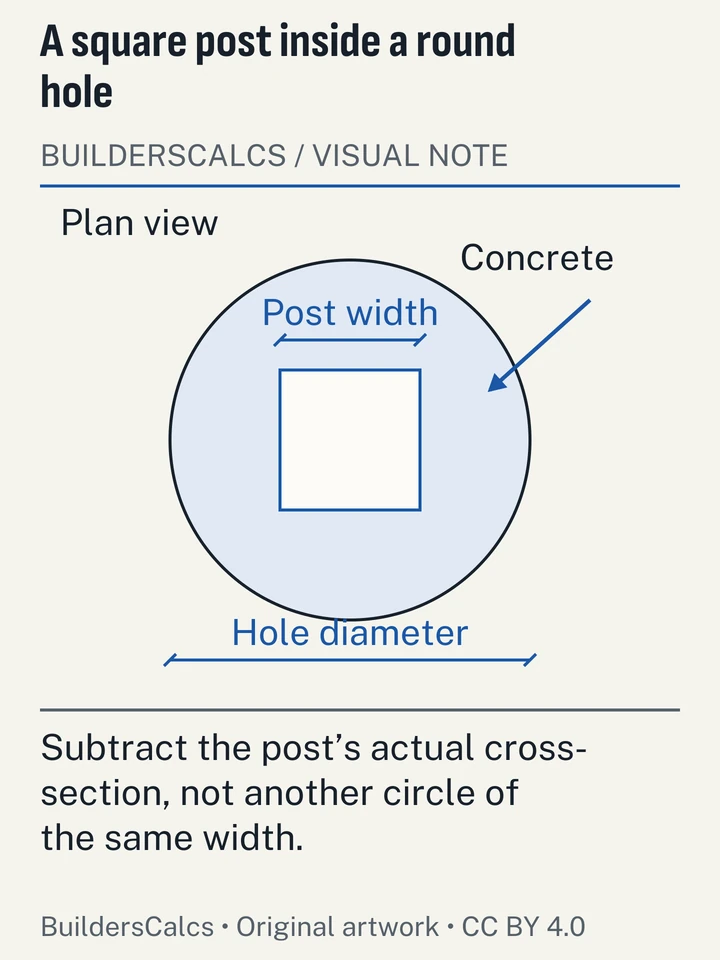
Illustration sources
- NIST — Handbook 44 (2026), Appendix C: General Tables of Units of Measurement
- UK Parliament (legislation.gov.uk) — Weights and Measures Act 1985, Schedule 1
- The Quikrete Companies — QUIKRETE Concrete Mix No. 1101 Data Sheet (revised Oct 2022)
- The Quikrete Companies — QUIKRETE Fast-Setting Concrete Mix No. 1004 Data Sheet
- Hanson (Heidelberg Materials UK) — Instant Concrete technical data sheet
- Hanson (Heidelberg Materials UK) — Multipurpose Concrete technical data sheet (updated August 2020)
| Job | Post and hole | Mix | Bags per hole | Bags to buy |
|---|---|---|---|---|
| Quikrete's example, 1 post | 3 in square, 9 in hole, 30 in deep | Quikrete Fast-Setting 50 lb | 1.77 | 2 |
| Sakrete's chart, 1 post | 4 × 4, 10 in hole, 30 in deep | Sakrete Fast Setting 50 lb | 2.12 | 3 |
| Ten fence posts | 4 × 4, 12 in hole, 36 in deep | Quikrete Fast-Setting 50 lb | 4.20 | 43 |
| Four round posts (metric) | 100 mm, 300 mm hole, 900 mm deep | UK 20 kg ready-to-use | 4.71 | 19 |
| One 6 × 6 post | 5 1/2 in, 12 in hole, 30 in deep | Quikrete Fast-Setting 50 lb | 2.68 | 3, with a hole-size note |
| Mix | Yield per bag | Source |
|---|---|---|
| Quikrete Fast-Setting, 50 lb | 0.375 cu ft (10.6 L) | (The Quikrete Companies) |
| Quikrete Fast-Setting, 60 lb | A 60 lb bag of Quikrete Fast-Setting Concrete Mix yields about 0.45 cu ft (12.7 L). | (The Quikrete Companies) |
| Sakrete Fast Setting, 50 lb | A 50 lb bag of Sakrete Fast Setting Concrete Mix yields about 0.38 cu ft (10.8 L). | (SAKRETE of North America) |
| Sakrete Rapid Post, 30 kg (Canada) | A 30 kg (66 lb) bag of Sakrete Rapid Post yields about 0.014 m³ (1/2 cu ft). | (King Packaged Materials / Sika Canada (SAKRETE Canada)) |
| Standard concrete mix, 80 lb | 0.6 cu ft (17 L) | (The Quikrete Companies and SAKRETE of North America) |
| UK ready-to-use concrete, 20 kg | A Hanson MaxiPack20 bag of Multipurpose or Instant Concrete makes about 0.009 m³. | (Hanson (Heidelberg Materials UK)) |
How big and how deep should a post hole be?
Dig the hole about three times as wide as the post and deep enough to bury a third of the post's length, plus a gravel base. Bury about one third of the post's overall length, plus a gravel base. Put 4-6 in (100-150 mm) of compacted gravel in the bottom of the hole for drainage. For a 4 × 4, which is 3.5 in (89 mm) across, three times the width is about 10 1/2 in, so a 10 or 12 in auger fits. A 6 × 6 is 5.5 in (140 mm), which calls for a hole of about 16 1/2 in.
Not every maker agrees on width. Sakrete Canada's Rapid Post sizing allows 2 in (50 mm) of clearance on each side of the post. That gives an 8 in hole for a 4 × 4, which is much tighter than the three-times rule. The calculator warns only when a hole is narrower than three times the post, because that is the rule both Quikrete and Sakrete print in the US.
Depth has a second limit where the ground freezes. Where ground freezes, post holes go below the frost line (check local code). Many people assume a third of the post is always enough; in a cold climate the frost line can be deeper than that. Posts that hold up a structure need more again. Posts carrying structures such as decks should go at least 6 in (150 mm) below the frost line. Your building department can tell you the local frost depth.
If you enter the post's height above ground, the calculator checks the depth for you. A post with a third of its length buried has twice as much above ground as below, so it divides the height above ground by two and compares that with the hole depth less the gravel. A 6 ft fence post above ground needs about 36 in in the ground; a 30 in hole with 6 in of gravel falls short, and the calculator says so.
| Hole depth (in) | Hole depth (mm) | 50 lb bags per post |
|---|---|---|
| 12 | 305 | 1.25 |
| 18 | 457 | 2 |
| 24 | 610 | 2.5 |
| 30 | 762 | 3 |
Should I use fast-setting or standard concrete for posts?
Fast-setting mix is quicker and simpler for fence and mailbox posts; standard mix suits posts where you have time to brace and wait. Quikrete and Sakrete fast-setting concrete sets in about 20-40 minutes. Wait 4 hours before hanging heavy loads such as a basketball backboard on a fast-set post (longer below 72 °F). With standard concrete mix, wait 24 hours before putting strain on the post.
The two are placed differently. Fast-setting mix goes into the hole dry and water is added on top. Quikrete says roughly 1 gallon of water per 50 lb bag of fast-setting mix in the hole, depending on soil. A common mistake is to mix it in a barrow first, which wastes most of its short working time. Makers also differ on order: Quikrete adds water after the dry mix, while Sakrete Fast Setting and Postcrete fill the hole a third full of water first, so follow the bag you buy. Standard mix is mixed first and shovelled in like any concrete.
Deep holes need the dry mix placed in stages. For holes deeper than 2.5 ft, place and soak the dry mix in lifts of 2.5 ft or less. The calculator adds a note when a hole is deeper than that and you have chosen a fast-setting mix.
Bag size changes the count, not the concrete. A 50 lb bag yields less than an 80 lb bag, so the same hole takes more bags, but each is lighter to carry to the far end of a fence line.
How much extra concrete should I order for posts?
The calculator's default is no extra, because with none it already matches the makers' own examples. Two 50 lb bags of Quikrete Fast-Setting Concrete set a 3 in square post in a 9 in (225 mm) hole 30 in (0.75 m) deep. Sakrete's post-setting chart lists 3 bags of 50 lb Fast Setting mix for an average 10 in (254 mm) hole 30 in (762 mm) deep. Neither maker adds an allowance to those figures, and we found no maker that states one for post holes.
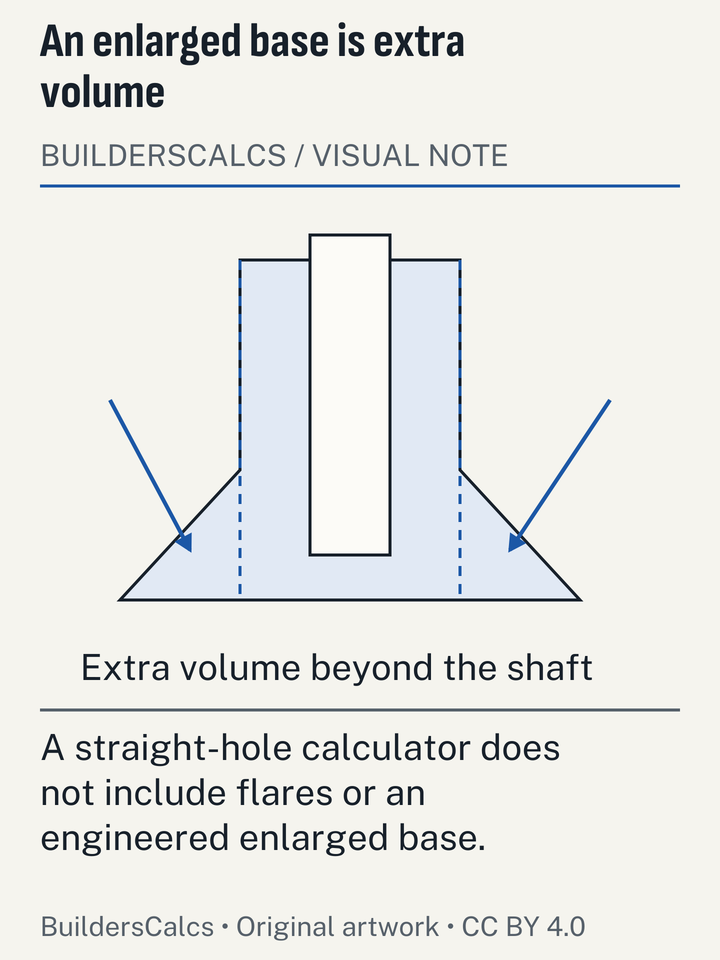
Add some when the holes will not be clean cylinders. Holes dug by hand in stony ground end up wider than the digger blade, and holes that bell out at the bottom hold more than the formula assumes. The total is rounded up once for the whole job, so part-bags left from one hole go in the next.
What changes for UK and metric post holes?
In metric mode, sizes are in millimetres, the default post is 100 mm and the default mix is UK 20 kg ready-to-use concrete at Hanson's yield. UK fencing guidance sets a minimum depth rather than a fraction. UK guidance: set posts at least 600 mm deep; a 1.8 m fence needs a 2.4 m post.
The UK's best-known post mix is Blue Circle Postcrete. Blue Circle Postcrete sets in about 5-10 minutes. Postcrete is for domestic fence, decking, washing-line and small gate posts (gates under 1 m wide), not general concreting or where a specified strength is needed. Tarmac prints bags per post by hole size rather than a yield per bag, so the calculator cannot divide a volume by it and does not offer it. Use Tarmac's own chart for Postcrete, or choose the 20 kg ready-to-use concrete here.
Garden posts are a tiny part of UK concrete use; housebuilding as a whole takes a large share. UK housebuilding accounted for 29% of ready-mixed concrete demand and 23% of aggregates demand in 2024, per the MPA Profile 2025. More national figures are on our cement production and consumption data page.
When is the result wrong or not enough?
The calculator assumes a straight-sided round hole and a post set in the middle of it. Results will be off in these cases:
- Belled or ragged holes. Measure the widest point and enter that, or add extra.
- Tool size versus hole size. A finished hole is not always the size of the auger or digger that made it. Measure one before you buy for a long fence.
- Deck footings. A deck post usually sits on a poured footing, not in a concrete-filled hole. Footing size depends on load and soil, and the concrete calculator has a round column mode for pier tubes.
- Gate and corner posts. These take more load and are often set deeper and in wider holes. Run them as a separate entry.
- Posts set in gravel or soil only. Some fence posts are set without concrete. The gravel line still applies, but the bag count does not.
For how deck posts meet their footings below grade, the deck framing section in our free construction diagrams shows the ledger, joists, beam, posts and footings in one drawing.
As an Amazon Associate I earn from qualifying purchases. Links to Amazon below can earn us a commission at no cost to you. Affiliate disclosure.
Tools for digging and setting posts
These are items the job uses, chosen from the manufacturers' published specifications. We have not handled or measured them. Links go to Amazon; see how affiliate links work here.
-
True Temper 2704200
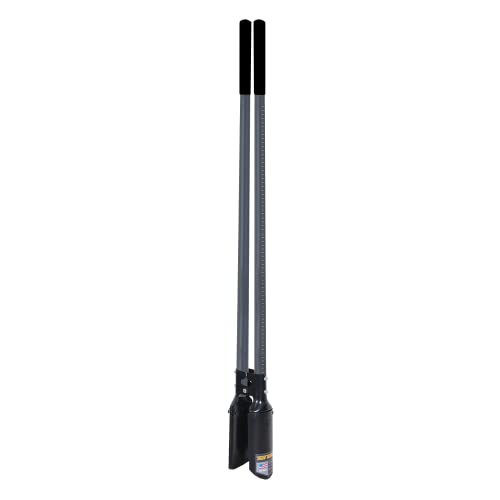
Post Hole Diggers with Ruler and Cushion End Grips on Fiberglass Handles
A two-handled clamshell digger for holes in soil. Handles are 48-inch fiberglass. A ruler on the handle helps check hole depth. The maker does not state a maximum hole diameter, so check it opens wide enough for your hole size.
Check price on Amazon Opens Amazon in a new tab -
Swanson Tool Co. PL001M

Post Level
Holds on the post while the concrete sets so you can keep it plumb. Reads plumb on two perpendicular faces at once; rotate to check the third axis. Strip magnets hold it on steel posts; an elastic strap holds it on wood, vinyl or composite.
Check price on Amazon Opens Amazon in a new tab -
QUIKRETE No. 1101

QUIKRETE Concrete Mix
The standard mix option in this calculator, for posts you can brace and leave. An 80 lb bag yields approximately 0.60 cubic feet of concrete. Wait 24 hours before putting strain on a post set with this mix.
Check price on Amazon Opens Amazon in a new tab
Which calculator do I need next?
A post count usually comes from the fence or deck plan. The fence calculator works out posts, rails and panels from the length of the run, so you can bring its post count here. Once posts are set for a deck, the calculator for decking boards and screws handles the surface. All the outdoor build tools are grouped under deck, stair and post tools.
Post hole calculator questions
How long before I can hang a gate on a fast-set post?
Wait 4 hours before hanging heavy loads such as a basketball backboard on a fast-set post (longer below 72 °F). With standard concrete mix, wait a full day before loading the post. Brace the post plumb until then.
Do I mix fast-setting concrete before pouring it in the hole?
No. Quikrete, Sakrete and Postcrete are all poured into the hole dry and wetted there, and Postcrete says not to pre-mix it at all. Check whether your bag wants the water added before or after the mix.
Why does the calculator warn about deep holes?
For holes deeper than 2.5 ft, place and soak the dry mix in lifts of 2.5 ft or less. Water poured on a deep column of dry mix may not soak to the bottom, so the warning reminds you to fill in stages.
How much gravel goes under each post?
Put 4-6 in (100-150 mm) of compacted gravel in the bottom of the hole for drainage. The calculator lists the gravel volume for all holes, worked out from the full hole diameter because the post sits on the gravel rather than in it.
Why can't I pick Postcrete in the calculator?
Tarmac does not publish a volume per bag for Postcrete, only bags per post for set hole sizes, so there is nothing for the calculator to divide by. Use Tarmac's chart for Postcrete, or pick the 20 kg ready-to-use concrete option.
Put this post hole calculator on your site
Sources (30)
- AMES Companies (Home by AMES)
- True Temper Post Hole Diggers with Ruler and Cushion End Grips on Fiberglass Handles (2704200), checked
- American Wood Council
- DCA 6 - Prescriptive Residential Wood Deck Construction Guide (2015 IRC version, (c)2018, incl. Commentary), checked
- Barrette Outdoor Living
- Wood Fence Installation Instructions (BOM-WOODFENCE), hosted by The Home Depot, checked
- City of Gilroy Building Division
- Residential Stairways, Handrails and Guards handout - California Residential Code R311.7 and R312 (rev. 03/03/2025), checked
- Grange Fencing
- Grange Fencing Brochure 2021, checked
- Hanson (Heidelberg Materials UK)
- Instant Concrete technical data sheet, checked
- Multipurpose Concrete technical data sheet (updated August 2020), checked
- Jacksons Fencing
- Featherboard Panel - Flat Top specification sheet (2019), checked
- How to Dig Post Holes: Expert Tips, checked
- King Packaged Materials / Sika Canada (SAKRETE Canada)
- SAKRETE Rapid Post product data sheet, checked
- Mineral Products Association (MPA), UK
- Profile of the UK Mineral Products Industry, 2025 Edition, checked
- NIST / American Lumber Standard Committee
- Voluntary Product Standard PS 20-20, American Softwood Lumber Standard, checked
- National Institute of Standards and Technology
- Handbook 44 (2026), Appendix C: General Tables of Units of Measurement, checked
- Special Publication 811 (2008), Guide for the Use of the International System of Units (SI), Appendix B.8, checked
- QUIKRETE
- Concrete Mix No. 1101 data sheet (rev. Oct 2022), checked
- QUIKRETE Companies
- Setting Posts (QUIKRETE at-home project instructions), checked
- SAKRETE of North America
- SAKRETE Fast Setting Concrete Mix technical data sheet, hosted by Home Depot, checked
- SAKRETE High Strength Concrete Mix technical data sheet (REV 7-10), hosted by Home Depot, checked
- Sakrete (Oldcastle APG)
- Pro Tips: How To Set Posts & Poles, checked
- Swanson Tool Co.
- Post Level PL001M, checked
- Tarmac (Blue Circle)
- POSTCRETE product data sheet (April 2014), hosted by Wickes, checked
- The Home Depot (manufacturer not named on document)
- Wood Fence Kits Installation Instructions, checked
- The Quikrete Companies
- Project guide: Setting Posts, checked
- QUIKRETE Concrete Mix No. 1101 Data Sheet (revised Oct 2022), checked
- QUIKRETE Fast-Setting Concrete Mix No. 1004 Data Sheet, checked
- Safety Data Sheet C1: Portland Cement Based Concrete Products (rev. Feb-23), checked
- TimberTech (The AZEK Company)
- Decking Installation & Maintenance Guide - TimberTech Composite and Specialty Decking (REV 09/23), checked
- Trex Company
- 2024 Trex Decking Installation Guide, checked
- UK Parliament (legislation.gov.uk)
- Weights and Measures Act 1985, Schedule 1, checked
- USDA Forest Service, Forest Products Laboratory
- Wood Handbook (FPL-GTR-282), Chapter 6: Commercial Lumber, Round Timbers, and Ties, checked
Every number on this page is taken from these documents. How we choose and check sources.