

Paving calculator
Enter the area and pick a paver, and this paving calculator counts the pavers and sizes everything under and between them. A 4 × 8 in Holland paver lays at 4.8 units/sq ft, so a 12 × 10 ft patio takes 576 before any cut allowance; a 200 × 100 mm block lays at 50 blocks/m2. Below the pavers go at least 4 in compacted (100 mm) of base for foot traffic, or 6 in compacted (150 mm) for a driveway, topped with 1 in uncompacted (25 mm) of bedding sand.
Paving calculator
v1 · US and metricEnter the patio, path or driveway size and pick a paver. The result gives the paver count, the compacted base, the bedding sand, joint sand and the length of edging.
Result
Enter your measurements and press Calculate.
Formula and assumptions
Pavers = area (sq ft) × pavers per sq ft × (1 + extra %), rounded up; metric:Pavers = area (m²) × pavers per m² × (1 + extra %), rounded upOther size: pavers per sq ft = 144 ÷ ((length + joint) × (width + joint)), all in inches; metric:Other size: pavers per m² = 1,000,000 ÷ ((length + joint) × (width + joint)), all in mmBase (cu ft) = area × base depth (in) ÷ 12; bedding sand = area × 1 in ÷ 12; metric:Sub-base (m³) = area × depth (mm) ÷ 1,000; laying course = area × 50 mm ÷ 1,000- Base depths are the minimums for well-drained soil: CMHA/ICPI: sidewalks, patios and pedestrian areas need at least 4 in (100 mm) of compacted aggregate base over well-drained soil. CMHA/ICPI: residential driveways on well-drained soil need at least 6 in (150 mm) of base; ICPI's application guide gives 6-8 in. UK figures follow Marshalls: 100 mm for paths and patios and 150 mm for driveways.
- Colder climates and continually wet or weak soils require thicker bases than these minimums.
- Bedding sand is screeded to a nominal 1 in (25 mm), uncompacted; it must not be used to fill dips in the base. The UK figure uses Marshalls' block-paving guide spreads a 50 mm layer of damp sharp sand as the laying course.
- Base weight uses Wisconsin dense-graded and crushed base aggregates weighed 1.77-1.98 short tons per compacted cubic yard in WisDOT-funded tests.
- Joint sand bags use the low end of A 50 lb bag of Gator Maxx G2 polymeric sand fills 65-85 sq ft of paving with narrow (1/8-3/8 in) joints.
- Edge restraint is the full perimeter of a rectangle. Leave out sides that sit against a wall or kerb.
How many pavers do I need for a 12 × 10 ft patio?
A 12 ft by 10 ft patio is 120 sq ft, and at the Holland rate of 4.8 units/sq ft it takes 576 pavers with no allowance for cuts. That is the figure the calculator shows when it first loads. The same result lists 1.48 cu yd (40 cu ft) of compacted base, which weighs about 2.62 to 2.93 tons, 0.37 cu yd (10 cu ft) of bedding sand, 2 bags of polymeric joint sand and 44 ft of edge restraint.
The metric default is a 4 m by 3 m patio of 200 × 100 mm blocks: 12 m² and 600 blocks, on 1.2 m³ of sub-base (about 2.52 to 2.82 tonnes) and 0.6 m³ of sharp sand, with 2 bags of joint sand and 14 m of edging.
Measure the finished paved area, not the dug area. For anything that is not a rectangle, switch to I know the area, type the total, and enter only the edges that are not against a wall, step or kerb. Then choose what the paving carries: a patio or path takes the pedestrian base, a residential driveway the deeper one. The paver count stays the same; the stone order does not.
How does the calculator count pavers, base and sand?
Pavers are the area multiplied by the number of pavers per unit of area, then multiplied by any extra you add, then rounded up to whole pavers. For the two listed pavers, the per-area rate is the one their makers publish. For any other size, the calculator works the rate out from the paver's laying size plus one joint in each direction:
- US, other size: pavers per sq ft = 144 ÷ ((length + joint) × (width + joint)), all in inches.
- Metric, other size: pavers per m² = 1,000,000 ÷ ((length + joint) × (width + joint)), all in millimetres.
- Base and bedding sand: area × depth, as sq ft × inches ÷ 12 for cubic feet (÷ 27 for cubic yards), or m² × mm ÷ 1,000 for m³.
- Base weight: cubic yards × 1.77–1.98 short ton/yd3 (compacted in place) (Wisconsin Highway Research Program / WisDOT (Cetin, Bulduk, Likos, Edil)), converted to tonnes per m³ in metric mode.
- Joint sand and edging: area ÷ the low end of the bag coverage, rounded up; edging is the rectangle's perimeter or the length you enter.
Worked example: 6 in square pavers on 100 sq ft
Pick Other size, enter 6 by 6 in and leave the joint at its default, the narrowest joint the trade guides allow. The rate is 144 ÷ (6.0625 × 6.0625) = 3.918 pavers per sq ft. Over 100 sq ft that is 391.8 pavers; with 5% extra, 391.8 × 1.05 = 411.4, rounded up to 412.
The metric version shows why joints matter. Enter 200 × 100 mm with 3 mm joints over 10 m² and the formula gives 1,000,000 ÷ (203 × 103) = 47.8 blocks per m², or 479 blocks. The pack-based figure for the listed 200 × 100 mm block gives 500 for the same area. When a maker publishes pieces per m² or per sq ft for its own product, choose that figure over the formula.
| Job | Inputs | Extra | Pavers | Base and sand |
|---|---|---|---|---|
| Patio (US) | 12 × 10 ft, Holland pavers | 0% | 576 | 1.48 cu yd base (2.62-2.93 tons); 0.37 cu yd sand |
| Patio (metric) | 4 × 3 m, 200 × 100 mm blocks | 0% | 600 | 1.2 m³ sub-base (2.52-2.82 tonnes); 0.6 m³ sand |
| Driveway (US) | 200 sq ft, Holland pavers | 10% | 1,056 | 3.7 cu yd base at 6 in (6.56-7.33 tons) |
| Square pavers (US) | 100 sq ft, 6 × 6 in, narrowest joint | 5% | 412 | Same base and sand rules as the patio |
| Blocks with joints (metric) | 10 m², 200 × 100 mm, 3 mm joints | 0% | 479 | Same base and sand rules as the patio |
How deep should the base and bedding sand be?
For a patio or path, the US trade minimum is 4 in compacted (100 mm) of compacted aggregate base, and for a residential driveway it is 6 in compacted (150 mm) (Concrete Masonry & Hardscapes Association (CMHA, successor to ICPI) and Interlocking Concrete Pavement Institute (ICPI)). Those minimums assume well-drained soil. Colder climates and continually wet or weak soils require thicker bases than these minimums. That warning comes from CMHA's technical note alone and names no extra depth, so the calculator keeps the minimum. Spread and compact base in 4-6 in (100-150 mm) lifts with a 7,000 lbf plate compactor; thinner lifts for 5,000 lbf machines.
The guides disagree on patio bases. Quikrete's DIY sheet is thinner than the trade figure: Quikrete's paver-sand sheet says spread 1-2 in of base sand over 2-4 in of compacted gravel. The calculator follows CMHA and ICPI instead.
Many people think extra bedding sand can make up for a lumpy base. It cannot. Bedding sand is screeded to a nominal 1 in (25 mm), uncompacted; it must not be used to fill dips in the base. A dip in the base shows through as a dip in the pavers, so fix the base, then screed the sand. Use concrete sand (ASTM C33); not mason sand, limestone screenings or stone dust.
| Use | CMHA minimum | ICPI range | UK (Marshalls) |
|---|---|---|---|
| Patio / walk / pedestrian | 4 in (100 mm) | 4-6 in (100-150 mm) | min 100 mm (blog) |
| Residential driveway | 6 in (150 mm) | 6-8 in (150-200 mm) | 150 mm domestic |
| Residential street | 8-10 in (200-250 mm) | 8-12 in (200-300 mm) | - |
Why is the base given in tons as well as cubic yards?
Because yards usually sell base stone by weight, while the hole you dig is a volume. The calculator converts the compacted volume with WisDOT-funded test figures. Wisconsin dense-graded and crushed base aggregates weighed 1.77-1.98 short tons per compacted cubic yard in WisDOT-funded tests. It shows a range because the tested materials differed.
The cubic yards in the result are compacted cubic yards. Stone in a truck or a heap is loose and takes more room. Loose aggregate takes up 27-60% more room than the same aggregate compacted, so loose volume is compacted volume x 1.27 to 1.60. If your supplier sells base by the loose yard, multiply by that expansion before ordering. If you buy by the ton, the tonnage already allows for compaction.
Rock type changes the weight too. The tons of gravel for your area calculator lists densities by stone, and the driveway gravel depth and layers guide covers loose and compacted depths in more detail.
Which paver sizes and joint widths does the calculator use?
Two pavers are built in, one per unit system, and each rate comes from a single published source, so check the label of the paver you buy. A 4x8 Holland paver (actual 7.75 x 3.88 in, 4 lb) lays at 4.8 units per square foot. That sheet is hosted by a retailer and does not name the brand. Marshalls Driveline 50 (200 x 100 x 50 mm) comes 488 blocks per pack covering 9.76 m2, i.e. 50 blocks per m2.
For any other paver, enter its actual laying size rather than the nominal size. Joints between concrete pavers should be consistent and between 1/16 and 3/16 in (2-5 mm). A joint outside that range brings up a warning.
| Paver | Pieces per area | Source |
|---|---|---|
| 4 x 8 in Holland (actual 3.88 x 7.75 in) | 4.8 per sq ft | Paver manufacturer use & care guide (hosted by Lowe's; brand not named on sheet) |
| 200 x 100 mm block (Marshalls Driveline 50) | 50 per m2 (4.65 per sq ft) | Marshalls plc (UK) |
How many bags of polymeric sand fill the joints?
The calculator divides the paved area by the low end of the narrow-joint coverage and rounds up. A 50 lb bag of Gator Maxx G2 polymeric sand fills 65-85 sq ft of paving with narrow (1/8-3/8 in) joints. The low end is deliberate, because running a bag short means a second trip with the sand half swept in. Metric mode uses 6–7.4 m2 per 22.7 kg bag.
Wide joints take far more sand, as the table shows, and the calculator does not switch columns for you. For tumbled pavers or wide gaps, use the wide figures and work out the bags by hand. No sourced coverage exists for UK polymeric sands, so metric results use the converted US figure.
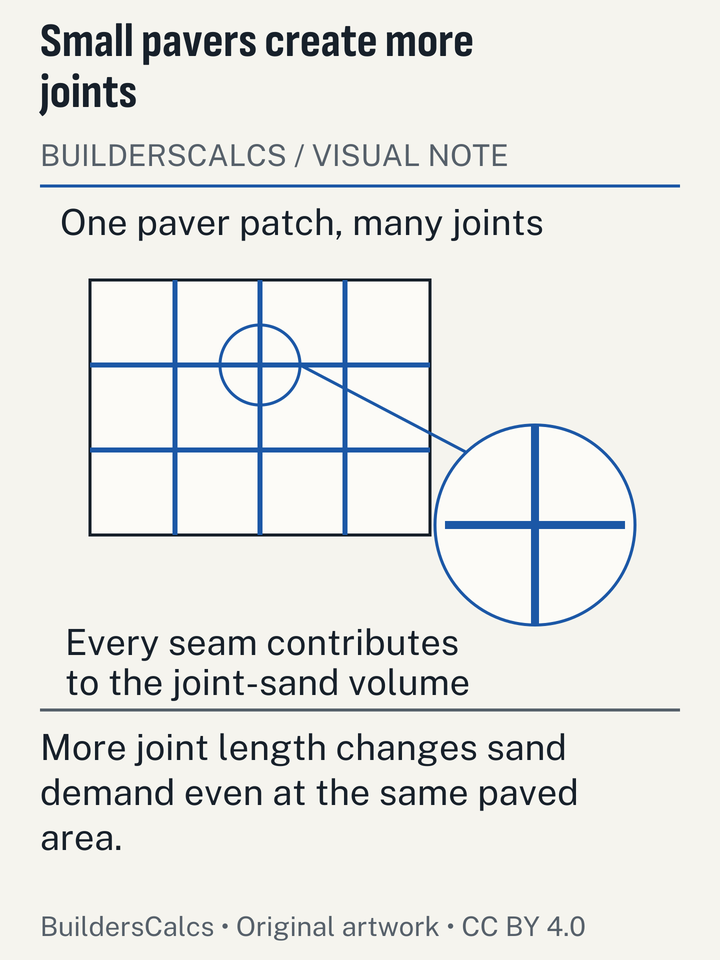
| Product | Narrow joints, 1/8-3/8 in | Wide joints, 3/4-1 1/4 in |
|---|---|---|
| Gator Maxx G2 (Beige, Slate Grey, Ivory) | 65-85 sq ft (6-7.4 m2) | 22-42 sq ft (2-3.9 m2) |
| Gator Maxx G2 Black Diamond | 58-76 sq ft (5.5-6.5 m2) | 20-38 sq ft (1.8-3.5 m2) |
| Gator Supersand G2 (Beige, Slate Grey) | 65-85 sq ft (6-7.4 m2) | 22-42 sq ft (2-3.9 m2) |
How many extra pavers should I buy for cuts?
The calculator starts at 0% extra because we found no trade-association figure for paver cutting waste. CMHA, ICPI and the manufacturers we checked publish base depths, joint widths and laying rates, but none of them states a cut allowance by pattern; the only percentages we found came from other calculators and blogs, which is not a source we can repeat. Zero is a starting point, not a recommendation.
Add your own allowance in the extra box. You will need more for patterns and shapes that create many cut pieces: herringbone, curved edges, circles, and paving that wraps around drains, posts and steps. Herringbone (45 or 90 degree) patterns are recommended where pavers carry vehicles. That pattern locks together well under cars, but every edge then needs angled cuts. A plain running bond against two straight walls needs the fewest. Buying a few spare pavers from the same batch also covers later repairs, since colour can vary between production runs.
The why you order extra material guide sets paving next to the materials where a published allowance does exist. Extra is applied only to the pavers; the base, sand and edging follow the area exactly.
Illustration sources
What changes for UK block paving?
Metric mode follows Marshalls' guidance for UK block paving. The sub-base is Type 1 aggregate: Marshalls says to lay at least 100 mm under block paving, which metric mode uses for patios and paths, and driveway mode switches to the domestic driveway figure. Marshalls: for most domestic driveways a 150 mm Type 1 sub-base (40 mm to dust) should be sufficient; its how-to says at least 100 mm. Marshalls says place sub-base in layers no thicker than 75 mm (or twice the maximum aggregate size), compacting each.
The laying course is thicker than the US bedding layer. Metric mode uses Marshalls' block-paving guide spreads a 50 mm layer of damp sharp sand as the laying course. Marshalls' two guides differ slightly: Marshalls' block-paving guide uses a 50 mm layer of damp sharp sand; its Drivesys guide targets 30 mm compacted, never over 40 mm.
Next to a house, height matters as much as depth. Finished paving next to a house should be at least 150 mm below the damp-proof course (Marshalls). Tonnages are in metric tonnes, which is how UK merchants sell Type 1. The weight uses the same WisDOT conversion as US mode, because no UK producer's compacted figure was available.
When is the paving result wrong or not enough?
The calculator handles a flat rectangle or a known area of one paver. These jobs fall outside it:
- Patio slabs and porcelain. Large slabs on a mortar bed are not modelled; we found no maker's slabs-per-m² table or mortar-bed depth.
- Weak, wet or frost-prone ground. The base depths are minimums for well-drained soil. How much more clay or deep frost needs is a site decision.
- Raised patios. Paving above the garden on one side needs a wall to hold the fill; the retaining wall blocks and base gravel calculator covers it.
- Mixed sizes. Multi-piece patterns use sizes in fixed shares. Run each size as its own area.
- Partial edges. In rectangle mode the edging is the whole perimeter; subtract sides against a wall or kerb.
- Heavier traffic. The driveway base is for cars on a home drive. Pavers 2-3/8 in (60 mm) thick suit pedestrian areas and residential driveways; streets need at least 3-1/8 in (80 mm).
How many new homes come with a patio?
Most of them, in US Census Bureau figures for homes finished in 2025. About 625,000 of 1,005,000 new US single-family homes completed in 2025 (roughly 62%) included a patio, versus 180,000 with a deck and 84,000 with no patio, porch or deck (Census Bureau). The survey does not record what the patios are made of, so slabs count alongside pavers.
What else does a paving job need?
Most of the material under a paved area is stone, so the gravel calculator is the natural next step if you want a base other than the default, or a weight for a different rock. For a paved drive, read about gravel for a driveway before you dig, since it covers the layers and compaction this page only summarises. Choosing between pavers and a poured slab? The concrete needed for a slab calculator gives the volume and bag count for the same footprint.
The rest of the landscaping calculators cover the soil, mulch and fencing around a new patio.
Paving calculator questions
Does the paver count include the joints between pavers?
Yes. The two built-in rates are the makers' own laying rates, which already allow for joints, and the Other size formula adds one joint width to the length and width of each paver before dividing. Enter the paver's actual size, not its nominal size, or the count comes out low.
Is the base figure loose stone or compacted stone?
Compacted. The depth you enter for a patio or driveway is the finished depth after compaction, and the tonnage uses compacted test weights. If you buy base by the loose cubic yard, add the loose-to-compacted expansion: Loose aggregate takes up 27-60% more room than the same aggregate compacted, so loose volume is compacted volume x 1.27 to 1.60.
Why is the default extra for pavers set to zero?
Because no trade association or manufacturer we checked publishes a cut allowance for pavers by pattern, and we only use published figures. Type your own allowance into the extra box: more for herringbone, curves and many edges, less for a straight running bond between two walls.
Does edge restraint go on every side of the patio?
Only on open edges. A side that is held by a house wall, a kerb or an existing slab is already restrained. In rectangle mode the calculator gives the full perimeter, so subtract those sides; in area mode, enter only the open edges.
Put this paving calculator on your site
Sources (21)
- Alliance Designer Products (Alliance Gator)
- Alliance Reference Guide 2025 - Gator Maxx G2 / Gator Supersand G2 polymeric sand coverage, checked
- Belgard (Oldcastle APG)
- Belgard Technical Resource Guide (BEL25-D-516650), pp. 17 and 27, checked
- CDC / NIOSH
- Revised NIOSH Lifting Equation, checked
- Canadian Centre for Occupational Health and Safety (CCOHS)
- NIOSH Lifting Equation - Assessing Relevant Handling Factors, checked
- Concrete Masonry & Hardscapes Association (CMHA, successor to ICPI)
- Tech Note PAV-TEC-002-22 - Construction of Interlocking Concrete Pavements (formerly ICPI Tech Spec 2), checked
- Interlocking Concrete Pavement Institute (ICPI)
- Tech Spec 10 - Application Guide for Interlocking Concrete Pavements, checked
- Marshalls plc (UK)
- Drivesys Installation Guidelines, checked
- Driveway Setts Installation Details, checked
- How to lay block paving, checked
- Marshalls Driveways brochure 2020 - Driveline 50 / Standard Block Paving pack data, checked
- National Institute of Standards and Technology
- Handbook 44 (2026), Appendix C: General Tables of Units of Measurement, checked
- Special Publication 811 (2008), Guide for the Use of the International System of Units (SI), Appendix B.8, checked
- Occupational Safety and Health Administration (OSHA), Federal Register (GovInfo)
- Occupational Exposure to Respirable Crystalline Silica; Final Rule, 81 FR 16286 (March 25, 2016), checked
- Office of the Federal Register / OSHA (eCFR)
- 29 CFR 1926.1153 Respirable crystalline silica (construction), including Table 1, checked
- Paver manufacturer use & care guide (hosted by Lowe's; brand not named on sheet)
- 4x8 Holland Paver - Use & Care Guide, checked
- Penn State Center for Dirt and Gravel Roads
- Technical Bulletin: Driving Surface Aggregate (2025), checked
- The Quikrete Companies
- Data Sheet - Patio Paver Sands (No. 1150-49, 1150-59), checked
- U.S. OSHA (eCFR)
- 29 CFR 1926.1153 Respirable crystalline silica, Table 1, checked
- UK Parliament (legislation.gov.uk)
- Weights and Measures Act 1985, Schedule 1, checked
- US Census Bureau
- Characteristics of New Housing 2025: Presence of Outdoor Features in New Single-Family Houses Completed, checked
- Wisconsin Highway Research Program / WisDOT (Cetin, Bulduk, Likos, Edil)
- Weight-Volume Relationships and Conversion Factors for Soils and Aggregates of Wisconsin, WHRP G22-05 (Dec 2023), checked
Every number on this page is taken from these documents. How we choose and check sources.