

Carpet calculator
Carpet is cut from the full width of a roll, so you pay for more than the floor you cover. Most US carpet comes 12 ft wide, and installers add 3 in (7.62 cm) at every wall. A 12 × 10 ft room has 13.33 square yards of floor, yet it takes 16.67 square yards of carpet: one drop 12.5 ft long off a 12 ft roll. The calculator lays the drops both ways and shows the cheaper one, with seams and pad.
Carpet calculator
v1 · US and metricEnter the room and the roll width. Carpet is cut from the full width of the roll, so the calculator lays out the drops both ways, picks the one that buys less, and gives square yards or square metres, seams and pad.
Result
Enter your measurements and press Calculate.
Formula and assumptions
Drops = (room width + 2 × trim) ÷ roll width, rounded up; each drop = room length + 2 × trimCarpet (sq yd) = drops × drop length (ft) × roll width (ft) ÷ 9; both directions are tried and the smaller is shown; metric:Carpet (m²) = drops × drop length (m) × roll width (m); both directions are tried and the smaller is shownPad (sq yd) = room length × width ÷ 9; metric:Pad (m²) = room length × width- Shaw: most carpet is made in 12 ft (3.66 m) rolls; 15 ft (4.57 m) rolls are also available. UK carpet makers sell broadloom in 4 m (13 ft 1 in) widths.
- CRI 105: cut carpet to the seaming diagram with at least 3 in (7.6 cm) extra at each wall for trimming, plus any pattern-match allowance.
- CRI 105: adjacent pieces of the same broadloom must have the same pile direction unless specified. Offcuts are therefore not used to fill gaps.
- Masland: run seams lengthwise in major areas, parallel to traffic paths. CRI 105: plan seams away from areas of pivoting traffic.
- Pad is trimmed to the tack strip, so it follows the room area rather than the carpet bought.
- Pattern repeats need extra length that depends on the carpet; add it to the trim allowance.
How much carpet do I need for a 12 × 10 room?
A 12 × 10 ft room needs 16.67 square yards of carpet (150 sq ft) on a 12 ft roll, plus 13.33 square yards of pad. Those are the figures the calculator shows when it opens. The carpet runs across the 10 ft width in a single piece: 10 ft plus the trim at both walls fits inside the 12 ft roll, so there is no seam, and the piece is cut 12.5 ft long to cover the 12 ft length with trim at each end.
The metric default is a 3.6 × 3 m room on a 4 m roll. Here the calculator turns the layout round, because the 3.6 m side plus trim still fits inside 4 m. One drop 3.15 m long covers the room, so you buy 12.61 m² for a 10.8 m² floor. Laid the other way it would need 15.01 m², which the steps under the result show for comparison.
Measure for carpet, not for the floor plan
Take each dimension wall to wall at the longest point, and carry it into a doorway as far as the threshold strip, because the carpet has to reach there. Measure both ends of each wall and use the larger figure. If a closet or bay opens off the room, measure it as part of the main rectangle when the carpet will run into it in one piece; otherwise treat it as a separate area. The L-shaped room flooring measurement guide shows how to sketch the room before you type anything in.
How does the calculator work out carpet from a roll?
It counts how many full-width strips, called drops, cover the room, then multiplies the drops by their length and by the roll width. Broadloom comes off the roll in one fixed width, so the shop sells you that full width for every drop, even where the room is narrower. Here is what the calculator does, in order:
- Drops across the room: (room width + 2 × trim) ÷ roll width, rounded up to a whole drop.
- Length of each drop: room length + 2 × trim.
- Carpet bought: drops × drop length × roll width. In US mode the square feet are divided by 9 to give square yards. One square yard is 0.83612736 m2 (9 sq ft).
- Both directions: the room is laid out with the drops running along the length and again across the width, and the smaller purchase is shown.
- Seams: one fewer than the number of drops.
- Pad: room length × room width, with no trim, converted to square yards in US mode.
Worked example: a 20 × 15 ft living room
On a 12 ft roll, try the drops running along the 20 ft length first. The width to cover is 15 ft + 0.5 ft of trim = 15.5 ft, which is more than one 12 ft drop, so it takes 2 drops, each 20.5 ft long: 2 × 20.5 × 12 = 492 sq ft, or 54.67 sq yd. Now turn them. The width to cover is 20.5 ft, still 2 drops, but each is only 15.5 ft long: 2 × 15.5 × 12 = 372 sq ft, or 41.33 sq yd. The calculator keeps the second layout. It takes 31 ft off the roll, has 1 seam, and the pad is 300 sq ft ÷ 9 = 33.33 sq yd.
The floor is 33.33 sq yd either way; the carpet you buy depends on how the drops fall.
| Room | Roll | Drops and length | Seams | Carpet to buy | Floor area |
|---|---|---|---|---|---|
| 12 × 10 ft | 12 ft | 1 drop, 12.5 ft | 0 | 16.67 sq yd | 13.33 sq yd |
| 20 × 15 ft | 12 ft | 2 drops of 15.5 ft (31 ft) | 1 | 41.33 sq yd | 33.33 sq yd |
| 20 × 15 ft | 15 ft | 2 drops of 15.5 ft (31 ft) | 1 | 51.67 sq yd | 33.33 sq yd |
| 3.6 × 3 m | 4 m | 1 drop, 3.15 m | 0 | 12.61 m² | 10.8 m² |
| 4.8 × 4.2 m | 5 m | 1 drop, 4.35 m | 0 | 21.76 m² | 20.16 m² |
Why can a wider roll mean buying more carpet?
A wider roll only helps when the room, plus its trim, fits inside it. The 20 × 15 ft room above looks made for a 15 ft roll, but the trim makes the piece 15.5 ft wide, which no longer fits. The calculator still needs 2 drops, and because each drop is now 15 ft wide instead of 12 ft, the purchase rises to 51.67 sq yd, about 10 sq yd more than on the narrower roll. A room up to 14.5 ft wide would fit a single 15 ft drop with no seam; one a few inches wider gains nothing from the wide roll.
So check both widths whenever the room is close to a roll size. Shaw: most carpet is made in 12 ft (3.66 m) rolls; 15 ft (4.57 m) rolls are also available. Not every style is made in both widths.
The metric example works the other way. A 4.8 × 4.2 m room on a 5 m roll fits in one 4.35 m drop because 4.8 m plus trim stays under 5 m. You buy 21.76 m² for 20.16 m² of floor and there is no seam at all.
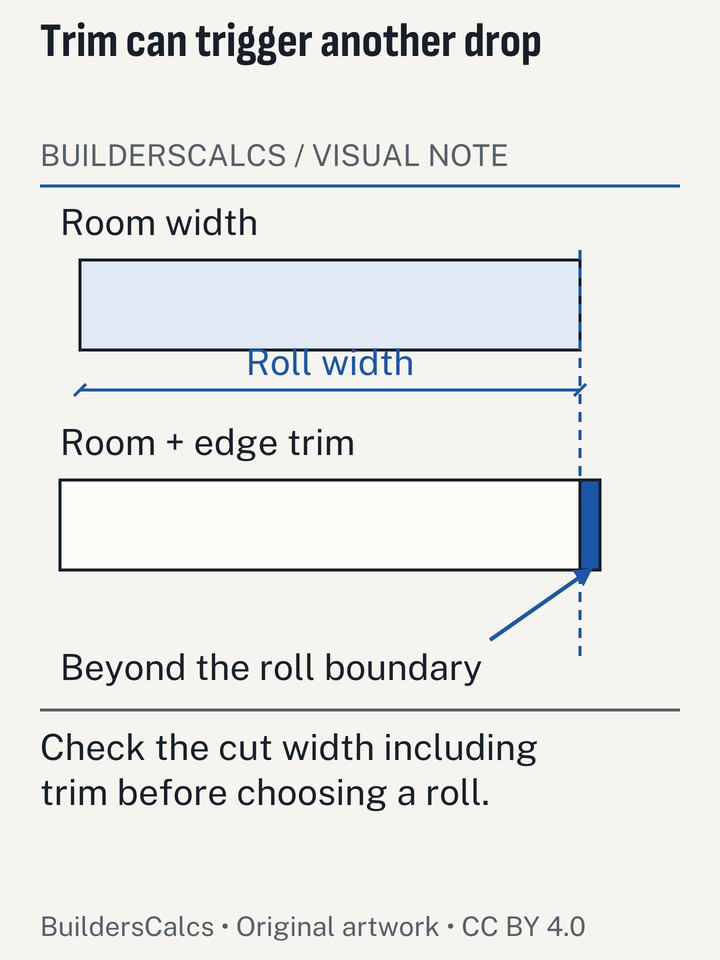
Illustration sources
What roll widths and allowances does the calculator use?
These are the published figures behind the result. Each sentence names who states it.
| Item | Published figure | Used in the result |
|---|---|---|
| US standard roll | Most carpet is made in 12 ft (3.66 m) wide rolls. | Yes, US default |
| US wide roll | Some carpet is also made in 15 ft (4.57 m) wide rolls. | Yes, option |
| UK and EU roll | UK carpet makers sell broadloom in 4 m (13 ft 1 in) widths. | Yes, metric default |
| UK and EU wide roll | UK carpet makers also sell broadloom in 5 m (16 ft 5 in) widths. | Yes, option |
| Trim at each wall | CRI 105: cut carpet to the seaming diagram with at least 3 in (7.6 cm) extra at each wall for trimming, plus any pattern-match allowance. | Yes, editable |
| Pile direction | CRI 105: adjacent pieces of the same broadloom must have the same pile direction unless specified. | Yes, offcuts are not reused |
| Cushion thickness | CRI 105: residential separate cushion should not exceed 7/16 in (11 mm) thick. | No, choose the pad to suit |
| Acclimation | Carpet and materials should acclimate at least 24 hours before installation. | No |
How much extra carpet should I add for waste?
Usually none on top of the result, because the extra is already in the layout. The calculator adds trim at every wall and charges you the full roll width for every drop, and those two things are where carpet waste comes from. We found no percentage allowance for carpet published by CRI or by the carpet makers whose instructions we used, so the calculator does not apply one. Adding a 10% figure borrowed from hard flooring would double-count.
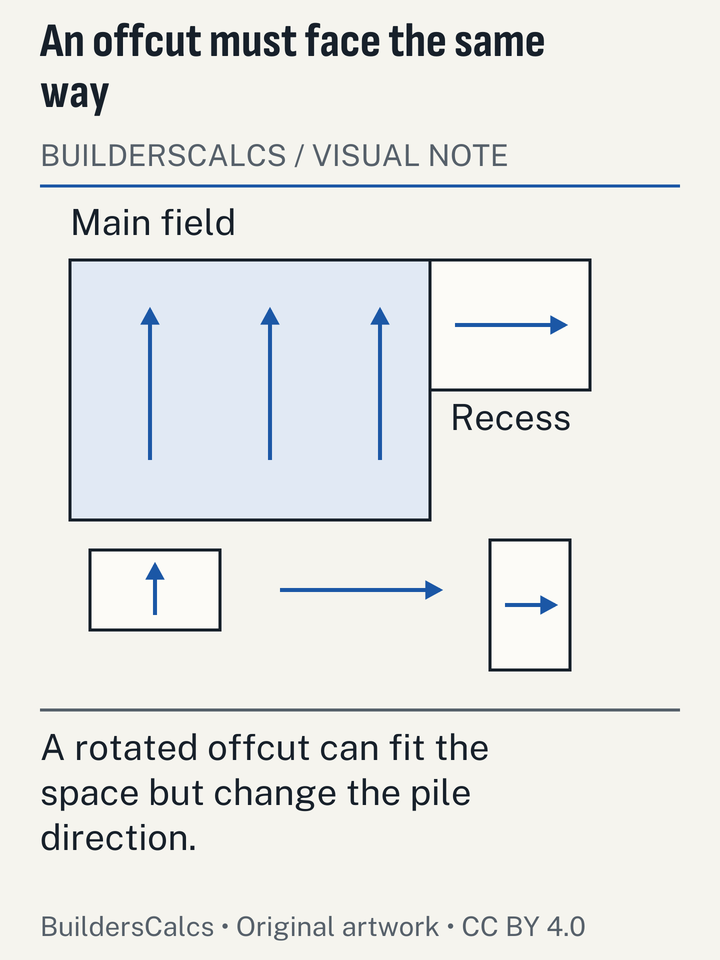
The biggest misconception is that carpet needed equals floor area. It does not, and the gap can be large: the 12 × 10 ft room buys about a quarter more carpet than its floor area. The reason goes beyond the roll width. CRI 105: adjacent pieces of the same broadloom must have the same pile direction unless specified. An offcut from the side of a drop has its pile running the right way only if it is turned to match, and most offcuts are the wrong shape to fill a gap that way, so the calculator treats them as waste rather than as stock for the next room.
There are two cases where you should add length yourself:
- Patterned carpet. Each drop must be cut so the pattern lines up across the seam. CRI 105 mentions a pattern-match allowance but gives no formula we could verify, so add the repeat length shown on the sample to the trim figure.
- Uneven walls. If a room is out of square by more than the trim, raise the trim so each drop still reaches the far wall.
For the allowances on tile, plank and sheet goods, see the waste allowances by material explainer.
Where should the seams go?
Along the main traffic path and away from turning points. Masland: run seams lengthwise in major areas, parallel to traffic paths. CRI 105: plan seams away from areas of pivoting traffic. The calculator shows the seam count for the cheapest layout, and when that layout has a seam it adds a note to the result as a reminder.
Sometimes the cheapest layout puts the seam where nobody wants it, such as across a doorway or down the middle of a hallway where everyone walks. Then check the second layout in the steps under the result: turning the drops may cost a few square yards more but move the join to the edge of the room. Ask the fitter to confirm the seaming plan before you order, because they cut from it.
Pad has its own rule. Masland: install cushion so its seams run perpendicular to carpet seams. That way the joins in the two layers never sit on top of each other.
How much carpet pad do I need?
The pad covers the floor area only, so a 12 × 10 ft room needs 13.33 sq yd, and a 3.6 × 3 m room needs 10.8 m². Installers trim the pad to the tack strip at the edge of the room, so none of the wall trim allowance applies to it. In the calculator, set Carpet pad to No if you are reusing pad, fitting carpet with an integral backing, or buying pad separately.
Divide the area by the coverage printed on the pad you choose and round up. On thickness, a deeper pad is not automatically better. CRI 105: residential separate cushion should not exceed 7/16 in (11 mm) thick. Read the carpet maker's installation sheet as well, since the cushion it calls for is the one to buy.
Should I buy carpet in square yards or square metres?
Use whichever unit your supplier quotes; the calculator gives both. In US mode the result leads with square yards and shows square feet in brackets. In metric mode it gives square metres. One square yard is 0.83612736 m2 (9 sq ft).
Roll widths are the bigger difference between the markets. UK carpet makers sell broadloom in 4 m (13 ft 1 in) widths. UK carpet makers also sell broadloom in 5 m (16 ft 5 in) widths. These are not conversions of the US 12 ft and 15 ft widths, so a room that fits a single drop in one market may need a seam in the other. You can mix systems if you need to: the roll list includes both US and UK sizes in either unit mode, and the calculator converts the width before laying out the drops. To check a quote given in the other unit, the construction unit conversions page has the full set.
When is the carpet result wrong or not enough?
The calculator handles one rectangle on one roll. These common jobs fall outside it:
- L-shaped and open-plan rooms. Split the floor into rectangles and run each. Where two parts can share a drop, the real purchase may be lower than the sum, and where seams must line up with doorways it may be higher.
- Stairs. Each tread and riser is covered by pieces cut to suit the staircase, which has no simple room area. Measure the stairs separately and ask the fitter for the length off the roll.
- Patterned or striped carpet. Add the pattern repeat to the trim, as described above.
- Carpet tiles. These are sold by the box, not by the roll, so the drop method does not apply. Use the area in square feet or square metres and the box coverage instead.
For the floor area alone, of any shape, including circles and triangles, the square footage calculator does the arithmetic with feet and inches.
What happens to carpet when it is taken up?
Most of it is buried. Of 3.37 million tons of carpets and rugs entering US municipal waste in 2018, 2.46 million tons were landfilled and 310,000 tons recycled, EPA's latest national Facts and Figures data. 2018 is the most recent year EPA has published for carpet, and the count covers all carpets and rugs in US municipal waste.
Recycling is growing where a state requires it. California's carpet stewardship program recycled 38.5% of post-consumer carpet in 2024, a record, from 194.6 million lb discarded, while 117.9 million lb still went to landfill (CARE 2024 Annual Report). That rate is for California's stewardship program only, not a national figure. The same report shows how much less carpet that state is buying: Carpet sales in California were 53.1 million square yards in 2024, down 21% from 67.3 million in 2021 and from 80.6 million in 2019 (CARE 2024 Annual Report).
Carpet weight matters when you plan the haul. The average US broadloom and carpet tile weighed 4.14 lb per square yard in the first half of 2024 and 4.22 lb in the second half, up from 4.00 lb in 2022-23, per CARE's annual industry survey. Multiply the square yards you are taking up by that figure to estimate the load for a trailer or a skip, then add the old pad, which is not included in it. It is an industry average, so a heavy wool carpet will weigh more.
Which calculator do I need next?
If the carpet is only part of the job, the estimate flooring square footage hub lists every floor covering we calculate, with the figures each one needs. For a kitchen or hall that will get a hard floor instead, the LVP quantity calculator counts plank cartons and also handles sheet vinyl, which comes off a roll like carpet. For wood, the hardwood boxes and board footage calculator adds the allowance hardwood makers publish.
Still deciding? The flooring types compared page sets carpet against the hard floors, room by room.
Carpet calculator questions
Does a 13 ft wide room need a carpet seam?
On a 12 ft roll, yes: 13 ft plus the trim at both walls needs two drops and one seam. On a 15 ft roll it fits in one drop, since 13.5 ft is under 15 ft. In the UK a 4 m roll is also wide enough, because UK carpet makers sell broadloom in 4 m (13 ft 1 in) widths. Enter the room and switch the roll to compare.
Which way should carpet drops run in a room?
The calculator picks the direction that buys less carpet, then shows the other one in its steps. Where the two are close, choose the layout that keeps seams along the main walkway and out of doorways, and keep every drop's pile running the same way.
Can I use the leftover strip from the roll in a closet?
Only if it is big enough and can be laid with its pile running the same way as the carpet next to it. A side offcut from a 12 ft roll is often long but narrow, which suits a closet or a step better than a gap in the main room. The calculator does not count offcuts, so any you can use are a bonus.
Why does the calculator add trim at each wall?
Because the carpet has to be trimmed to the wall on site, and the installation standard asks for that margin. CRI 105: cut carpet to the seaming diagram with at least 3 in (7.6 cm) extra at each wall for trimming, plus any pattern-match allowance. Set the trim to zero only if you want the bare floor dimensions.
Use this carpet calculator on your site
Sources (10)
- Abingdon Flooring
- Knightsbridge Berber range page, checked
- Brockway Carpets
- Dimensions Plain 40 (Flint) product specification, checked
- Carpet America Recovery Effort (CARE), filed with CalRecycle
- California Carpet Stewardship Program 2024 Annual Report, checked
- Masland Carpets
- Stretch over Cushion installation instructions, checked
- National Institute of Standards and Technology
- Handbook 44 (2026), Appendix C: General Tables of Units of Measurement, checked
- Special Publication 811 (2008), Guide for the Use of the International System of Units (SI), Appendix B.8, checked
- Shaw Floors
- Carpet - Plan and Install (FAQ), checked
- The Carpet and Rug Institute (CRI)
- CRI 105 Standard for Installation of Residential Carpet, checked
- UK Parliament (legislation.gov.uk)
- Weights and Measures Act 1985, Schedule 1, checked
- US Environmental Protection Agency (EPA)
- Advancing Sustainable Materials Management: Facts and Figures 2018 Tables and Figures, checked
Every number on this page is taken from these documents. How we choose and check sources.