

Hardwood flooring calculator
Enter the room and the coverage on the carton, and this hardwood flooring calculator gives the cartons to buy for solid or engineered wood, any spares, underlayment rolls and the expansion space at the walls. Mullican Flooring's allowance is 5–7% for a straight lay and 10–15% on a diagonal; the calculator uses the top of each range. A 12 × 10 ft room in Bruce Dundee oak needs 128.4 sq ft with extra, which is 6 cartons.
Hardwood flooring calculator
v1 · US and metricEnter the room, the board direction and the coverage printed on the carton. The result gives cartons with the maker's extra for cuts, any spares, underlayment rolls and the expansion space to leave.
Result
Enter your measurements and press Calculate.
Formula and assumptions
Cartons = area × (1 + extra % ÷ 100) ÷ coverage per carton, rounded up, plus any spare cartonsUnderlayment rolls = area ÷ coverage per roll, rounded up- Mullican Flooring: add about 5% (5-7% in its worked rule) for standard installs and 10-15% on a diagonal; more for character/builder grades. The calculator uses the top of each range: 7% straight and 15% diagonal.
- Mullican suggests buying 1-2 extra cartons for future repairs.
- Carton presets: Bruce Dundee solid oak (3/4 x 3-1/4 in) covers 22 sq ft (2.04 m2) per carton. Bruce unfinished solid strip D35 (3/4 x 3-1/4 in) covers 18.5 sq ft (1.72 m2) per carton. Kährs Oak Nouveau engineered boards (15 x 187 x 2420 mm) come 2.72 m2 (29.3 sq ft) to a pack.
- NWFA (2007): leave about 3/4 in expansion space at walls and vertical obstructions for nail-down solid flooring. Engineered and floating floors follow the maker's own figure.
- Aquabar B hardwood underlayment comes in 500 sq ft (36 in x 167 ft) and 1,000 sq ft (36 in x 334 ft) rolls.
How much hardwood flooring do I need for a 12 × 10 room?
Six cartons of Bruce Dundee solid oak, which come to 132 sq ft of boards. The room is 120 sq ft; with 7% extra it is 128.4 sq ft, and 128.4 ÷ 22 sq ft per carton = 5.84, rounded up to 6. That is the result the calculator opens with. Lay the boards on a diagonal and the extra rises to 15%, which makes 138 sq ft and 7 cartons.
In metric mode the default is a 3.6 m by 3 m room, 10.8 m², in Kährs Oak Nouveau engineered boards. With the same 7% that is 11.56 m², and at 2.72 m² per pack the room takes 5 packs, holding 13.6 m².
Measure the floor the boards will actually cover. Hardwood often runs through a doorway into a hall or closet, and those strips belong in the total. Include doorways, alcoves, bay windows and any adjoining area getting the same floor. For an L-shaped room or an open plan, add the rectangles and enter the sum with I know the area. Our floor measuring guide covers bays, angled walls and the rest.
How does the calculator work out cartons?
Cartons = area × (1 + extra % ÷ 100) ÷ coverage per carton, rounded up, then plus any spare cartons you ask for. Wood flooring is sold in cartons or packs with a stated coverage, and that coverage depends on the board width and the lengths packed, so it is different for every product line. The calculator holds three presets from manufacturer data and accepts any other figure from the label.
Worked example: Bruce Dundee, straight lay, one spare
12 ft × 10 ft = 120 sq ft. Add 7%: 120 × 1.07 = 128.4 sq ft. Bruce Dundee solid oak (3/4 x 3-1/4 in) covers 22 sq ft (2.04 m2) per carton. 128.4 ÷ 22 = 5.84, rounded up to 6 cartons for the floor. With one spare carton for repairs, the order is 7 cartons, or 154 sq ft. A roll of Aquabar B covers 500 sq ft per roll, so one roll does the room.
Worked example: a 500 sq ft floor in Bruce D35
500 × 1.07 = 535 sq ft. Bruce unfinished solid strip D35 (3/4 x 3-1/4 in) covers 18.5 sq ft (1.72 m2) per carton. 535 ÷ 18.5 = 28.9, rounded up to 29 cartons, which hold 536.5 sq ft. Both Bruce products use the same board size, but the D35 carton holds less, so the same floor needs more cartons. That is why the carton figure matters more than the board size printed on the box end.
| Floor | Carton | Extra | Area with extra | Cartons |
|---|---|---|---|---|
| 12 × 10 ft (US default) | Bruce Dundee, 22 sq ft | 7% | 128.4 sq ft | 6 (132 sq ft) |
| 12 × 10 ft, diagonal | Bruce Dundee, 22 sq ft | 15% | 138 sq ft | 7 (154 sq ft) |
| 12 × 10 ft, two spares | Bruce Dundee, 22 sq ft | 7% | 128.4 sq ft | 8 (6 for the floor, 2 spare) |
| 500 sq ft | Bruce D35, 18.5 sq ft | 7% | 535 sq ft | 29 (536.5 sq ft) |
| 3.6 × 3 m (metric default) | Kährs Oak Nouveau, 2.72 m² | 7% | 11.56 m² | 5 (13.6 m²) |
| 12 × 10 ft, RICS timber-board figure typed in | Bruce Dundee, 22 sq ft | 10% | 132 sq ft | 6 |
How much extra hardwood should I buy?
Mullican Flooring adds 5–7% for a standard install and 10–15% on a diagonal, with more for character and builder grades (Mullican Flooring). The calculator takes the top of each range, since running short on a wood floor is worse than having a few boards left: a later carton may come from a different production run and may not match. Mullican's own text gives the lower figure for a standard floor, so if your room is a simple rectangle you can type 5 into Extra to order.
Sources disagree. Ted Todd, a UK wood flooring maker, uses a higher figure than Mullican in its worked example, and no NWFA waste percentage was found in the guidelines retrieved. The UK carbon-accounting default is higher too. RICS (2023) gives a default site waste rate of 10% for timber floor boards and aggregate, against 2% for structural timber frames and 1% for glass. That RICS figure is meant for estimating waste on whole building projects, not for one room, but it shows that the professional default for timber boards sits above Mullican's straight-lay figure.
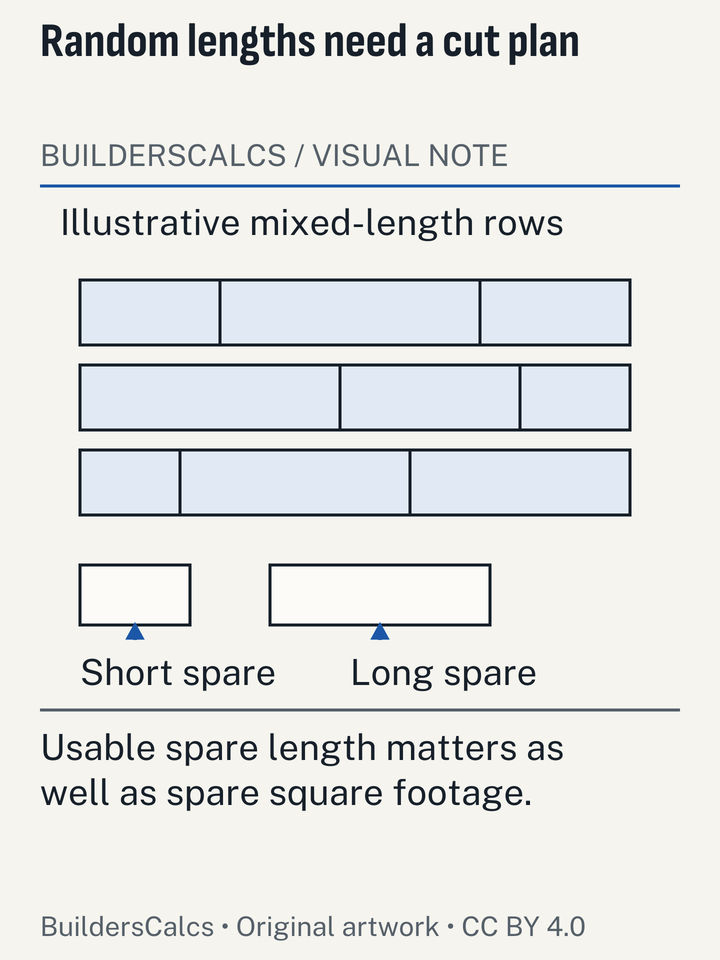
A frequent assumption is that hardwood needs the same allowance as laminate. Pergo asks 10% for laminate; Mullican asks less for wood. A likely reason is the boards: solid strip flooring is packed in random lengths, so a short offcut can often start the next row. Character grades are the exception, since boards with large knots or splits get cut out. Mullican does not put a number on that, and no source quantified the extra for random-length boards, so raise the figure yourself for a rustic grade.
| Layout or grade | Extra (%) | Who says so |
|---|---|---|
| standard | 5 (5-7) | Mullican Flooring |
| diagonal | 10–15 | Mullican Flooring |
| character / builder grade | higher than standard (not quantified) | Mullican Flooring |
Why keep spare cartons of hardwood?
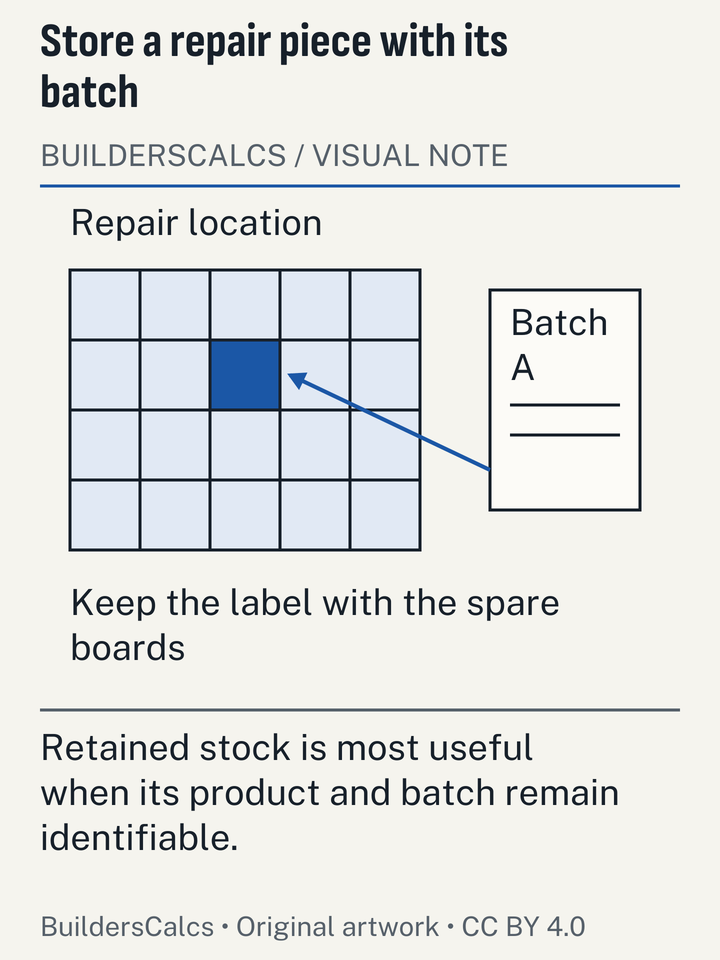
For repairs years later. Mullican suggests buying 1-2 extra cartons to keep for future repairs. A gouged or water-stained board can be cut out and replaced, but only with a board that matches in species, grade, width, finish and colour, and the same product bought later can differ in tone. The Extra cartons to keep box adds spares after the floor's own count is rounded, so they are separate from the waste allowance rather than hidden inside it. It starts at zero; set it to one or two.
Store the spares flat, in the house, not in a damp garage or shed, so they stay at the same moisture content as the installed floor.
| What | Figure | Who states it |
|---|---|---|
| Extra, straight lay (default) | 7% | Mullican Flooring |
| Extra, diagonal lay (default) | 15% | Mullican Flooring |
| Spare cartons | 1–2 cartons | Mullican Flooring |
| Bruce Dundee solid oak carton | 22 sq ft per carton | Bruce (AHF Products) |
| Bruce D35 unfinished strip carton | 18.5 sq ft per carton | Bruce (AHF Products) |
| Kährs Oak Nouveau pack | 2.72 m2 per pack | Kährs |
| Aquabar B underlayment roll | 500 sq ft per roll | Fortifiber |
| Expansion space, solid nail-down | 0.75 in | NWFA (2007 guidelines) |
Does solid or engineered wood change the count?
Not the count, only the details around it. The carton sum is the same for both: area, extra, carton coverage. What changes is the coverage per carton, because engineered boards are often wider and longer and come in metric packs, and the gap you leave at the walls.
For solid wood that is nailed down, the result gives NWFA's expansion space. NWFA (2007): leave about 3/4 in expansion space at walls and vertical obstructions for nail-down solid flooring. Those are the 2007 guidelines, the edition that could be retrieved, so check the current NWFA guidance and the board maker's instructions before you set spacers. For engineered flooring, whether glued, nailed or floating, the calculator tells you to follow the maker's figure, since engineered products set their own.
Underlayment follows the same split. Solid boards nailed over a wood subfloor can go over a hardwood underlayment such as Aquabar B; a floating engineered floor uses the underlayment its maker names. Choose None or not needed if the boards are glued straight to the subfloor.
When can I install hardwood after it is delivered?
When the wood and the subfloor are close enough in moisture content, not after a set number of days. NWFA: some manufacturers do not require acclimation; follow the flooring maker's instructions and MC readings, not a fixed day count. The common belief that every wood floor must sit for a fixed time before installing is what the NWFA guidance corrects. The guidelines set the moisture targets instead:
- NWFA: solid strip flooring (under 3 in wide) should be within 4% moisture content of the subfloor.
- NWFA: solid flooring 3 in or wider should be within 2% moisture content of the subfloor.
- NWFA: run permanent heating/air conditioning at least 5 days before installation where codes allow.
- NWFA: check moisture on about 40 boards per 1,000 sq ft delivered.
For a floor the size of the default room, that sampling rule means checking a handful of boards from different cartons rather than one. A pin-type or pinless moisture meter does the job; read the subfloor too. All four figures come from the NWFA's 2007 guidelines, the edition retrieved for this page.
What changes for metric, UK and European wood floors?
Units and packs. In metric mode, enter the room in metres; the result is in square metres, the carton preset is the Kährs pack, and the expansion space converts to 19 mm. European engineered boards are sized in millimetres and sold by the pack in square metres. Kährs Oak Nouveau engineered boards (15 x 187 x 2420 mm) come 2.72 m2 (29.3 sq ft) to a pack. For another brand, choose Other flooring and type the m² per pack.
UK makers measure in metres throughout. Record every dimension in one unit (Ted Todd uses metres) so areas add correctly. Ted Todd's worked example also uses a larger allowance than Mullican's US figure, in line with the RICS default of 10% for timber boards, so a UK fitter quoting that much is not padding the order. Type 10 into the extra box to match.
Underlayment is the one preset sold only in US units, as a 500 sq ft roll. In metric mode the calculator converts it to square metres; for a European underlay, choose Other underlayment and enter its m² per roll.
When is the carton count wrong or not enough?
- Patterns. Herringbone, chevron and parquet use different products and much more cutting than the straight and diagonal lays Mullican's figures cover. Use the pattern maker's figure.
- Borders and inlays. A picture-frame border or a feature strip has its own cuts at every corner. Count it separately.
- Stairs. Treads, risers and stair nosing are sold by the piece. Count them by the step.
- Character and rustic grades. More boards get culled for defects; Mullican says to allow more without a figure, so raise the extra.
- Reducers, thresholds and trim. These are bought by the length and are not in the result.
- Subfloor work. Sheathing, levelling and moisture barriers over concrete are separate jobs with their own quantities.
The rounding can also mislead on small jobs. A closet of 20 sq ft still needs a whole carton, and the result will show far more extra than the percentage suggests. That is the carton size, not a mistake.
How much wood goes to waste on US building sites?
A great deal. EPA estimates 3.4 million tons of wood products were wasted during US construction in 2018, out of 40.8 million tons of wood in all C&D debris. Those are EPA's latest national figures of their kind, and they cover all wood products on construction and demolition sites, from framing to flooring, not floors alone. They are a reminder that a waste allowance is real material, and that a good measurement keeps it from growing.
Floors are a common project. About 5.47 million US homeowners reported carpeting, flooring, paneling or ceiling-tile projects in 2023, totalling about $25.0 billion (Harvard JCHS Table A-1, 2023 AHS). The Harvard category groups wood floors with carpet, paneling and ceiling tile, so it is not a hardwood count. For wider figures on C&D debris figures by material, see our statistics page.
Which calculator do I need next?
Hardwood rarely runs through every room. For a wood-look floor in a basement or a rental, the laminate calculator gives laminate packs needed with Pergo's allowance. Bedrooms off the same hall may get carpet; the carpet calculator handles roll widths and seams. To weigh wood against the other options first, read the floor material comparison.
The full set is on the flooring calculator hub, and our waste allowances by material guide puts the wood figures beside tile, laminate and carpet.
Hardwood flooring calculator questions
Do I need more hardwood than laminate for the same room?
Usually a little less extra, but it depends on the carton. Mullican's straight-lay allowance is lower than Pergo's for laminate, so the area with extra is smaller. The number of cartons then depends on how much each one holds, which differs between products.
Are the spare cartons part of the waste allowance?
No. The calculator rounds the floor's cartons first, with the extra included, then adds the spares on top. That keeps the spares sealed for repairs instead of being opened to finish the last row.
Does engineered hardwood use the same waste percentage as solid?
The calculator applies Mullican's figures to both, because the cutting is similar for straight and diagonal lays. Some engineered makers publish their own allowance; if yours does, type it into Extra to order.
How many boards should I check with a moisture meter?
NWFA: check moisture on about 40 boards per 1,000 sq ft delivered. Spread the readings across several cartons, and read the subfloor in several places as well. Those figures are from the NWFA's 2007 guidelines.
Can I use the hardwood calculator for a parquet or herringbone floor?
Only for a rough area. The extra figures cover straight and diagonal lays, and pattern blocks are sold with their own coverage and waste advice. Enter the area, type the pattern maker's extra and use the coverage from its pack.
Embed the hardwood calculator
Sources (15)
- Bruce (AHF Products)
- Dundee Timeless Appeal CB3250LG solid hardwood specifications, checked
- Unfinished Solid D35 product dimensions, checked
- Fortifiber (spec sheet hosted by Roberts/QEP)
- Aquabar B Hardwood Floor & Tile Underlayment spec sheet, checked
- Joint Center for Housing Studies of Harvard University
- Improving America's Housing 2025, checked
- Kährs
- Oak Nouveau Gray product page, checked
- Mullican Flooring
- How to Calculate the Correct Footage When Purchasing Hardwood Flooring, checked
- National Institute of Standards and Technology
- Handbook 44 (2026), Appendix C: General Tables of Units of Measurement, checked
- Special Publication 811 (2008), Guide for the Use of the International System of Units (SI), Appendix B.8, checked
- National Wood Flooring Association (NWFA)
- NWFA Installation Guidelines (copyright 2007, revised March 2007 / April 2008), checked
- Pergo (Mohawk)
- Pergo Installation Essentials Guide (1/4 in expansion version), checked
- Pergo Installation Essentials Guide (rev 012014, 3/8 in expansion version), checked
- Royal Institution of Chartered Surveyors (RICS)
- Whole life carbon assessment for the built environment, 2nd edition (professional standard, September 2023), checked
- Ted Todd (UK wood flooring manufacturer)
- How to measure a room for wood flooring, checked
- UK Parliament (legislation.gov.uk)
- Weights and Measures Act 1985, Schedule 1, checked
- US Environmental Protection Agency (EPA), Office of Resource Conservation and Recovery
- Advancing Sustainable Materials Management: 2018 Fact Sheet, checked
Every number on this page is taken from these documents. How we choose and check sources.