

Vinyl flooring calculator
This vinyl flooring calculator works two ways. For plank or tile (LVP, LVT), it adds Daltile's 10% for cuts and divides by the box coverage. For sheet vinyl, it works out how many widths of the roll cover the room and how many feet or metres to cut. A 12 × 10 ft room takes 7 cartons of Shaw's Paragon plank, or a 10 ft length off a 12 ft roll with no seam.
Vinyl flooring calculator
v1 · US and metricChoose plank (LVP or LVT) or sheet vinyl and enter the room. Planks give boxes with the maker's extra for cuts; sheet gives the length to cut from the roll, the area bought and the seams.
Result
Enter your measurements and press Calculate.
Formula and assumptions
- Plank or tile (LVP, LVT) in boxes:
Boxes = length × width × (1 + extra % ÷ 100) ÷ coverage per box, rounded up - Sheet vinyl off a roll:
Drops = room width ÷ roll width, rounded up; length off the roll = drops × (room length + trim); both directions are tried and the smaller one is shown - Daltile's ProSeries LVP guide adds 10% to the square footage for cuts on a standard install. Daltile's ProSeries LVP guide adds 15% to the square footage for a diagonal install.
- Shaw Floorte PRO Paragon 7 in Plus LVP (7 x 48 in) covers 18.91 sq ft (1.757 m2) per carton.
- Roll widths: US sheet vinyl is commonly made in 12 ft (3.66 m) wide rolls; Mannington lists single rolls 6-12 ft wide. Tarkett makes sheet vinyl in 4 m wide rolls (about 22 m long).
- Sheet is sold by the full roll width, so the area bought is larger than the room. Offcuts are not reused to fill gaps, because pieces should run the same way off the roll.
- One square yard is 0.83612736 m², or 9 square feet.
How many boxes of vinyl plank do I need for a 12 × 10 room?
Seven boxes, if the plank is Shaw Floorte PRO Paragon 7 in Plus. The room is 120 sq ft. Daltile's allowance for a straight lay takes it to 132 sq ft, and each Paragon carton covers 18.91 sq ft, so 132 ÷ 18.91 = 6.98, which rounds up to 7. Those seven cartons hold 132.37 sq ft. On a diagonal the same room needs 8.
In metric mode no box preset is chosen at first, so the result stops at 11.88 m² to buy for a 3.6 m by 3 m room. Type the coverage from the label to get boxes: with 2.2 m² per box, that is 6 boxes holding 13.2 m².
Vinyl plank and vinyl tile go through the same sum. Both come in boxes with a printed coverage, and neither cares about a grout joint, so leave the mode on Plank or tile for either. The only difference that matters is the coverage on the box. Measure wall to wall at the longest and widest points, include doorways and closets that get the same floor, and use the measuring irregular rooms for flooring guide for anything that is not a rectangle.
How is vinyl plank flooring calculated?
Boxes = length × width × (1 + extra % ÷ 100) ÷ coverage per box, rounded up. The extra comes from the plank direction: 10% for planks parallel to a wall and 15% for a diagonal, both from Daltile's ProSeries LVP guide (Daltile). Type any other figure in Extra to order and it replaces the default.
Worked example: Shaw Paragon, straight
12 ft × 10 ft = 120 sq ft. Add 10%: 120 × 1.10 = 132 sq ft. Shaw Floorte PRO Paragon 7 in Plus LVP (7 x 48 in) covers 18.91 sq ft (1.757 m2) per carton. 132 ÷ 18.91 = 6.98, rounded up to 7 cartons, or 132.37 sq ft of plank delivered.
That result is close to the line. A room only a little larger would tip it to 8 cartons, so check your measurements before you order the exact count, and consider one more box if a wall is out of square.
How much sheet vinyl do I need?
Enough full widths of the roll to span the room, each one as long as the room plus any trim. Sheet vinyl is sold by length off a roll of fixed width, so the room's area alone does not tell you what to buy. The calculator divides the room's width by the roll width and rounds up to get the number of drops (the pieces laid side by side), then multiplies by the length of each drop.
- Drops = room width ÷ roll width, rounded up.
- Length off the roll = drops × (room length + trim allowance).
- Sheet bought = length off the roll × roll width.
- Seams = drops − 1.
It then repeats the sum with the room turned 90 degrees and shows whichever direction buys less, with the other one listed in the steps for comparison.
Worked example: 12 × 10 ft room, 12 ft roll
Run the drops along the 10 ft side: 12 ft ÷ 12 ft roll = 1 drop, 10 ft long. That is 10 ft off the roll, 120 sq ft of sheet, or 13.33 sq yd, and no seam. Turned the other way, a 12 ft drop off the same roll would buy 144 sq ft, so the calculator picks the first layout.
Worked example: 20 × 15 ft room, 6 in trim
Now the room is wider than the roll in both directions. Along the 15 ft side, 20 ft ÷ 12 ft = 1.67, so 2 drops of 15.5 ft each: 31 ft off the roll, 372 sq ft (41.33 sq yd), one seam. The other direction would need 2 drops of 20.5 ft, which is 492 sq ft. The room is 300 sq ft, so even the better layout buys noticeably more sheet than the floor area. That is the cost of a fixed roll width.
| Job | Inputs | Result | Bought | Seams |
|---|---|---|---|---|
| LVP, US default | 12 × 10 ft, Shaw Paragon cartons, straight | 7 boxes | 132.37 sq ft | None |
| LVP, diagonal | 12 × 10 ft, Shaw Paragon cartons | 8 boxes | 138 sq ft needed with extra | None |
| LVP, metric | 3.6 × 3 m, 2.2 m² boxes | 6 boxes | 13.2 m² | None |
| Sheet, US | 12 × 10 ft, 12 ft roll, no trim | 10 ft off the roll | 120 sq ft (13.33 sq yd) | 0 |
| Sheet, US | 20 × 15 ft, 12 ft roll, 6 in trim | 31 ft off the roll | 372 sq ft (41.33 sq yd) | 1 |
| Sheet, metric | 3.6 × 3 m, 4 m roll | 3 m off the roll | 12 m² | 0 |
| Sheet, metric | 5 × 4 m, 3 m roll | 8 m off the roll | 24 m² | 1 |
Which roll width should I pick?
Pick the widest roll the product comes in that spans your room in one piece, because every extra drop adds a seam and an offcut. US sheet vinyl is commonly made in 12 ft (3.66 m) wide rolls; Mannington lists single rolls 6-12 ft wide. In Europe, Tarkett makes three widths, listed below. The calculator's Other width box takes any figure, so a 6 ft roll or a 2.5 m one works too.
The 3.6 by 3 m metric example shows why width matters. On a 4 m roll the room is one piece with no seam, 12 m² bought. On a 3 m roll the room still fits in one drop if it runs the right way, but a 2 m roll would need two drops and a seam whichever way you turn it.
| Roll | Width | Where | Who states it |
|---|---|---|---|
| US standard | 12 ft | US | Armstrong, Mannington |
| Tarkett 2 m | 2 m | Europe | Tarkett |
| Tarkett 3 m | 3 m | Europe | Tarkett |
| Tarkett 4 m | 4 m | Europe | Tarkett |
Why is the sheet bought bigger than the room?
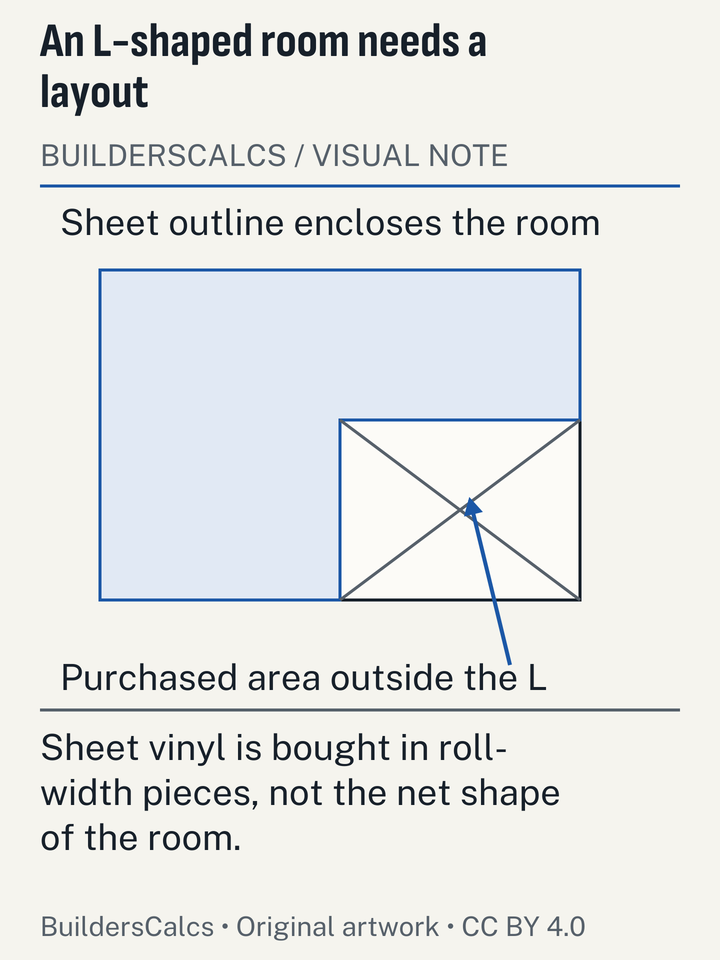
Because the roll width rarely matches the room. A 10 ft wide room on a 12 ft roll leaves a 2 ft strip along one side that is cut away, and the calculator counts it because you pay for it. That strip is the sheet equivalent of a waste percentage, which is why sheet mode has no Extra to order box. The overage is set by geometry, not by a rule of thumb.
A common shortcut is to take the room's square footage, add a plank-style percentage, and order that much. It fails as soon as the room is wider than the roll. In the 20 × 15 ft example the room is 300 sq ft, and no ordinary allowance on top of that reaches the 372 sq ft the two drops actually need. The calculator also does not count offcuts towards filling a gap. Pieces should run the same way off the roll so the surface pattern and sheen match, and a sideways offcut can show.
The trim allowance adds a little to every drop so the edges can be scribed to walls that are never quite straight. No sheet vinyl maker's figure could be verified, so it starts at zero. Add what your installer or the product sheet asks for; it is entered per drop, in inches or centimetres.
How much extra vinyl plank should I order?
Daltile's figures are 10% for a straight lay and 15% on a diagonal, and those are the defaults. Pergo gives the same pair for its laminate, so for a click-together plank the two makers agree. The extra covers the end cut in every row, the strip ripped along the last wall, and notches around door casings and pipes.
Planks with a strong grain or a visible pattern can push that up, because you may skip a plank to avoid repeating the same print next to itself. That is a judgment call rather than a published rule, so raise the extra yourself if the product has few distinct plank faces. Our waste percentage by job guide puts vinyl beside tile, wood and carpet.
What changes for metric, UK and European vinyl?
The sums stay the same; the units and the rolls change. In metric mode, enter the room in metres. Plank results come out in square metres, and you type the m² per box from the label because the only box preset is a US carton. Sheet results come out in metres off the roll and square metres bought, and the roll list adds Tarkett's 2, 3 and 4 m widths.
US sheet vinyl is often priced by the square yard, so the US result shows square yards next to square feet. One square yard is 0.83612736 m2 (9 sq ft). European shops may price sheet by the square metre or by the running metre off a given width. When you compare quotes, multiply a running-metre price by the roll width to get a price per square metre.
In the UK, sheet vinyl is often loosely called lino, although true linoleum is a different material. The calculation for either is the same: widths of the roll, length of each piece, then seams.
When is the result wrong or not enough?
- Rooms that are not rectangles. There is no area-only mode here because sheet vinyl depends on the room's shape. For plank, run each rectangle and add the boxes, or total the area and use the laminate with waste allowance calculator's area box with your vinyl's coverage, since the box sum is the same. For sheet, plan each drop on a sketch.
- Patterned sheet. A tile-effect or wood-effect sheet must line up across the seam, which uses more than the plain-roll result. There is no pattern repeat input, so add the repeat to the trim allowance.
- Glue-down plank and sheet. Adhesive is not counted. No verified spread rate for vinyl adhesive was available, so use the coverage on the adhesive pail for your trowel.
- Underlayment. Some vinyl planks have a backing attached. If yours needs a separate one, count rolls from its label.
- Stairs and transitions. Stair nosings and threshold strips are bought by the piece or the length and are not in the result.
How many US homes replace their flooring?
About 5.47 million US homeowners reported carpeting, flooring, paneling or ceiling-tile projects in 2023, totalling about $25.0 billion (Harvard JCHS Table A-1, 2023 AHS). The category covers every kind of floor, carpet and ceiling-tile job reported in the Harvard survey, so it says nothing about vinyl's share. It does put the scale in view: a floor estimate like this one is a job millions of households take on in a single year.
Which calculator do I need next?
Vinyl often shares a house with other floors. For rooms getting click-lock laminate, use the laminate calculator linked above. For a bathroom where tile is still on the table, the tile calculator will count tiles and boxes with thinset and grout. Carpet is the other floor sold off a roll; the carpet roll length and seams tool plans its drops the same way.
If you are still deciding, laminate vs vinyl vs hardwood sets out how each floor is sold and fitted. The rest of the floor covering calculators are on the flooring hub.
Vinyl flooring calculator questions
Is LVT counted differently from LVP?
No. Both are sold in boxes with a printed coverage, so the calculator treats them the same: area plus extra, divided by the coverage per box. Use the LVT box's coverage and the same plank mode.
Why does the sheet vinyl result try the room both ways?
Because the direction changes what you buy. A 12 × 10 ft room on a 12 ft roll is one 10 ft drop one way and one 12 ft drop the other. The calculator works out both and shows the smaller, with the other in the steps in case you prefer the seam or the pattern to run that way.
How do I turn sheet vinyl square feet into square yards?
Divide by 9. The US sheet result already shows both, for example 120 sq ft as 13.33 sq yd. One square yard is 0.83612736 m2 (9 sq ft).
Can I fill the end of a room with an offcut of sheet vinyl?
You can, but the calculator does not count on it. A piece turned sideways can look different in the light, and a short infill adds a seam. If you plan to use offcuts, the length off the roll may come down; work it out on a sketch first.
Embed this vinyl calculator
Sources (9)
- Armstrong Flooring
- How to Choose the Best Vinyl Sheet Floor, checked
- Daltile
- ProSeries Luxury Vinyl Flooring Installation & Care Guide, checked
- Joint Center for Housing Studies of Harvard University
- Improving America's Housing 2025, checked
- Mannington Mills
- Ultimate Guide to Sheet Vinyl, checked
- National Institute of Standards and Technology
- Handbook 44 (2026), Appendix C: General Tables of Units of Measurement, checked
- Special Publication 811 (2008), Guide for the Use of the International System of Units (SI), Appendix B.8, checked
- Shaw Floors
- Paragon 7in Plus Floorte PRO direct selling sheet (11.01.2018), checked
- Tarkett
- Vinyl Collection 2017 brochure (logistics information), checked
- UK Parliament (legislation.gov.uk)
- Weights and Measures Act 1985, Schedule 1, checked
Every number on this page is taken from these documents. How we choose and check sources.