

Tile sizes: US nominal inches and European metric formats
US tile is sold in nominal inch sizes: US tile is sold in nominal inch sizes; Custom's coverage chart lists 1x1 to 24x24 in. European porcelain is sold in centimetre formats: Common European porcelain formats include 30x60, 60x60, 75x75 and 60x120 cm (Marazzi, Mapei tables). The name on the box is not always the exact face size, so order from the coverage printed on the box. Once any side is over 15 in, ANSI's large-tile joint rules apply.
What are the standard tile sizes in the US?
The chart below is Custom Building Products' list, the most complete US size list in our sources. Small sizes up to about 2 × 2 in are usually mosaics, sold on mesh sheets. Sizes from 12 × 12 in up are the usual floor tiles. The table gives each size as Custom lists it, with the metric figure it prints beside it.
| Nominal size (in) | Length (in) | Width (in) | Metric size as listed (mm) |
|---|---|---|---|
| 1 x 1 | 1 | 1 | 25 x 25 |
| 2 x 2 | 2 | 2 | 50 x 50 |
| 3 x 3 | 3 | 3 | 75 x 75 |
| 4-1/4 x 4-1/4 | 4.25 | 4.25 | 100 x 100 |
| 6 x 6 | 6 | 6 | 150 x 150 |
| 8 x 8 | 8 | 8 | 200 x 200 |
| 12 x 12 | 12 | 12 | 300 x 300 |
| 16 x 16 | 16 | 16 | 400 x 400 |
| 20 x 20 | 20 | 20 | 500 x 500 |
| 24 x 24 | 24 | 24 | 600 x 600 |
Are the metric sizes in that table exact conversions?
No, and this catches people out. One inch is exactly 2.54 cm. So a true 12 in tile would be 304.8 mm, and a 4-1/4 in tile would be about 108 mm. Custom lists them as 300 mm and 100 mm. Those are the nearest round metric sizes, a soft conversion, not the same tile. When you set a US tile and a European tile side by side, or plan a layout from a metric drawing, convert from the actual size and don't assume the listed metric figure is exact. The construction unit conversions page has the exact factors.
What tile formats are common in Europe?
Marazzi and MAPEI tables show the same core set of formats, from 30 × 60 cm to 60 × 120 cm, plus 30 × 30 cm mosaic sheets (Marazzi Group (Italy) and MAPEI S.p.A.). These are porcelain formats, named in centimetres, and the box states both the number of pieces and the area. The Marazzi boxes below show how few pieces of large tile fit in one box, and how heavy each box gets.
We have not separately researched UK tile formats or box sizes. Much UK floor tile is sold in the same centimetre formats as the rest of Europe, but check the data sheet for the exact product before you count.
| Format (cm) | Pieces per box | m² per box | kg per box | Thickness (mm) |
|---|---|---|---|---|
| 75x75 | 2 | 1.13 | 24.98 | 10 |
| 60x60 | 3 | 1.08 | 21.01 | 9.5 |
| 30x60 | 6 | 1.08 | 21.07 | 9.5 |
| 60x60 (20 mm outdoor) | 2 | 0.72 | 33.53 | 20 |
Is a 12 × 12 tile really 12 inches?
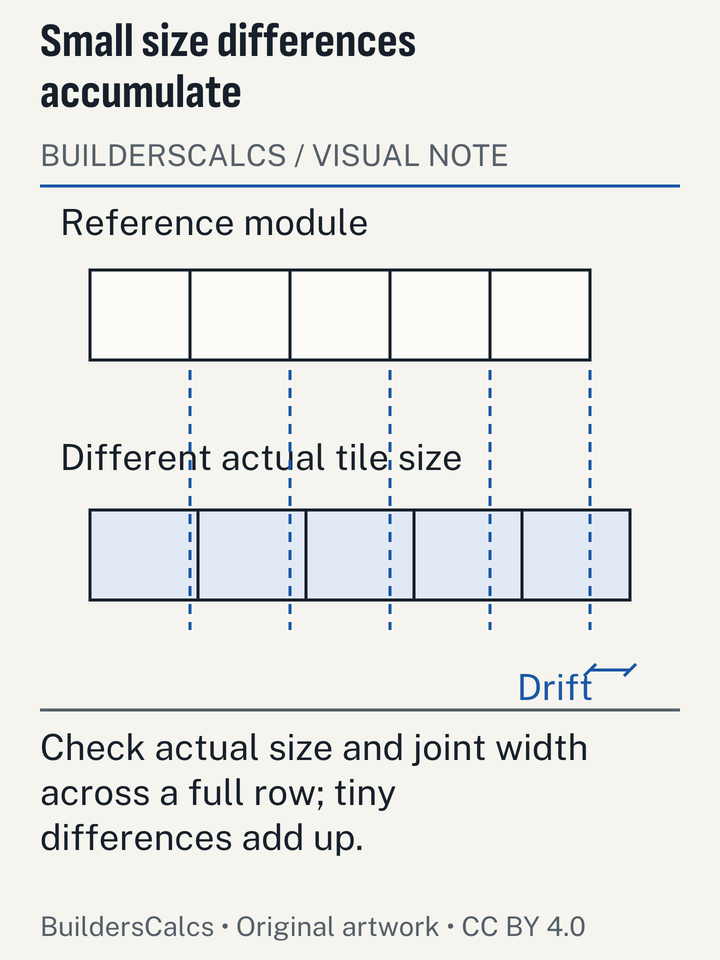
Not always. US tile is named by nominal size, and the actual face is often slightly smaller so that the tile plus its joint fits the nominal module. Box coverage differs by product and size, so use the coverage printed on the box or data sheet. That is the reliable figure, because the maker works it out from the real face size. A common belief is that a 12 × 24 tile covers exactly 2 sq ft. Custom and Marazzi both point to the box instead (Marazzi Group (Italy) and Custom Building Products).
The same applies to joints. The size on the box never includes the grout joint. The joint is added when you lay the tile out, which is why the tiles needed for a floor or shower wall tool asks for both.
How many tiles cover a square metre or a square foot?
Divide the area by the tile's face plus one joint in each direction. For a 60 × 60 cm tile with a 3 mm joint, each tile takes up 0.603 × 0.603 m, or 0.364 m², so one square metre needs 2.75 tiles before any allowance. Without the joint you would get 2.78, a small difference on one metre but a visible one across a large floor.
Box coverage works from the face alone: Marazzi's three-piece box of the same format is rated at 1.08 m², the face area alone (Marazzi Group (Italy)). So the box count from printed coverage is slightly cautious, which is the right direction to err. In feet, the same 60 × 60 cm tile is about 3.9 sq ft, so a 100 sq ft floor needs about 26 tiles net, or 9 boxes of three. Add the overage, then round up to whole boxes. On small tile the joint matters far more, because there are many more joints per square foot, which is why tile calculators always ask for joint width.
When does a tile count as large format, and what changes?
ANSI's large-tile joint rule applies to tiles with any side greater than 15 in (381 mm). Above that size, minimum joint widths depend on whether the tile is rectified (ground to exact size) or calibrated (sorted by size), because bigger tiles show size variation more. Three ANSI A108.02 rules apply to every tile.
| Rule | What ANSI requires | Applies to |
|---|---|---|
| Absolute minimum joint | ANSI A108.02 4.3.8: no grout joint may be narrower than 1/16 in (1.6 mm). | All tile |
| Joint against size variation | ANSI A108.02: the joint must be at least 3 times the actual facial-size variation of the tile supplied (1/16 in variation means 3/16 in joint). | All tile |
| Large tile in running bond | For running-bond layouts with any side over 15 in, ANSI requires on average at least 1/8 in joints for rectified and 3/16 in for calibrated tile. | Any side over 15 in |
How does tile size change grout and thinset?
Smaller tile needs far more grout per square foot, because a floor of small tile is mostly joints. Custom's Polyblend chart shows it plainly: with a 1/8 in joint, a 25 lb bag of sanded grout covers about five times more area of 12 × 12 in tile than of 1 × 1 in mosaic (Custom Building Products). Wider joints cut coverage further. Sanded grout is for joints from 1/8 to 1/2 in, unsanded for narrower ones (Custom Building Products).
Thinset depends on the trowel rather than the tile, but larger tile usually needs a deeper notch to get full contact. Custom states mortar contact must be at least 80% in dry areas and 95% in wet areas and exteriors. So a move to big tile cuts grout but can raise thinset at the same time. The tile layout and cut planning guide covers the layout side.
| Tile (in, L × W × thickness) | Sanded, 1/8 in joint | Sanded, 3/16 in | Sanded, 1/4 in | Non-sanded, 1/16 in | Non-sanded, 1/8 in |
|---|---|---|---|---|---|
| 1 x 1 x 1/4 | 63 | 40 | 25 | 44 | 20 |
| 2 x 2 x 1/4 | 88 | 73 | 50 | 85 | 40 |
| 3 x 3 x 1/4 | 150 | 103 | 80 | 126 | 60 |
| 4-1/4 x 4-1/4 x 1/4 | 210 | 143 | 110 | 149 | 78 |
| 6 x 6 x 1/4 | 263 | 178 | 136 | 250 | 120 |
| 8 x 8 x 3/8 | 230 | 155 | 113 | 220 | 110 |
| 12 x 12 x 3/8 | 345 | 230 | 175 | 331 | 171 |
| 16 x 16 x 3/8 | 458 | 305 | 225 | 370 | 185 |
| 20 x 20 x 3/8 | 567 | 381 | 280 | 453 | 227 |
| 24 x 24 x 3/8 | 685 | 458 | 325 | 659 | 330 |
| Tile (mm, L × W × thickness) | 2 mm joint | 3 mm | 5 mm | 8 mm | 10 mm |
|---|---|---|---|---|---|
| 75x150x6 | 0.4 | 0.6 | 1 | 1.5 | 1.9 |
| 100x100x7 | 0.4 | 0.7 | 1.1 | 1.8 | 2.2 |
| 150x150x6 | 0.3 | 0.4 | 0.6 | 1 | 1.3 |
| 200x200x7 | 0.2 | 0.3 | 0.6 | 0.9 | 1.1 |
| 300x300x10 | 0.2 | 0.3 | 0.5 | 0.9 | 1.1 |
| 300x600x10 | 0.2 | 0.2 | 0.4 | 0.6 | 0.8 |
| 600x600x10 | 0.1 | 0.2 | 0.3 | 0.4 | 0.5 |
| 150x900x9 | 0.2 | 0.3 | 0.6 | 0.9 | 1.1 |
| 750x750x10 | 0.1 | 0.1 | 0.2 | 0.3 | 0.4 |
How much tile does the US use?
Less each year since 2021. The Tile Council of North America's March 2026 market report gives the national total. US ceramic tile consumption was 2.57 billion sq ft in 2025, down 4.9% from 2.70 billion in 2024, with imports making up 72.4% of volume (TCNA, March 2026). TCNA does not split that total by size in the data we hold, so we can't say which formats sell most.
Prices have moved less than for most materials. US producer prices for ceramic and clay floor and wall tile were 14.8% higher in September 2026 (preliminary) than in January 2020, up 0.8% on a year earlier and 2.7% below the November 2023 peak (BLS PPI WPU1344). That compares with far larger rises for paint, drywall and insulation over the same period.
| Year | US shipments | Imports | Exports | Consumption | Change (%) |
|---|---|---|---|---|---|
| 2025 | 747,952 | 1,859,671 | 40,251 | 2,567,372 | -4.9 |
| 2024 | 810,991 | 1,930,509 | 41,094 | 2,700,407 | -5.1 |
| 2023 | 898,353 | 1,999,520 | 51,032 | 2,846,840 | -7.3 |
| 2022 | 939,966 | 2,182,363 | 50,754 | 3,071,575 | -1.3 |
| 2021 | 918,264 | 2,233,142 | 37,986 | 3,113,421 | 9.9 |
How do you use this table on a real job?
- Counting tiles: work from box coverage, not nominal size. Divide your area plus allowance by the area per box and round up.
- Mixing US and European tile: compare actual sizes in millimetres, not the listed equivalents.
- Wet areas: the higher mortar contact rule applies whatever the size.
- Choosing between tile and plank: the page on flooring types compared sets out what each floor needs you to calculate, and the vinyl plank boxes or sheet rolls tool covers the vinyl alternative.
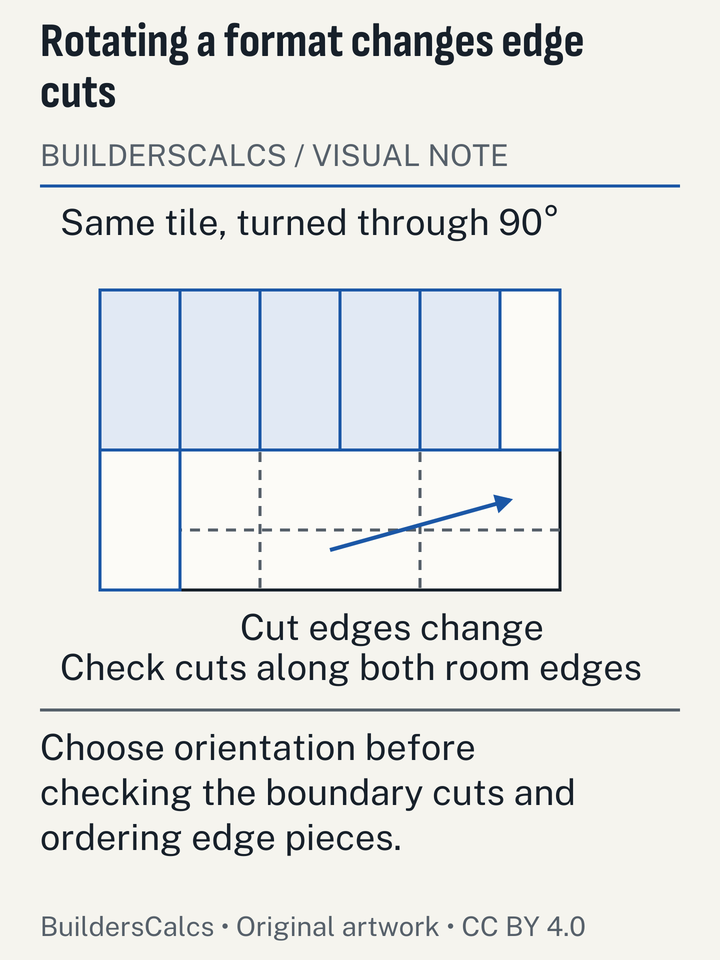
For the room area itself, estimate flooring square footage first, then add the overage from the waste factor table.
When does this reference not apply?
- Your product's sheet says otherwise. Box contents differ by maker and line, even at the same nominal size.
- UK-specific formats. We hold no UK tile or box data, so use the merchant's data sheet.
- Patterned layouts. Herringbone and specialty shapes need a larger allowance, which Fireclay puts at 20%.
- Tile thicker than the chart rows. Grout charts are set for a given thickness; thicker tile has deeper joints and uses more.
Summary
US sizes are nominal inches; European formats are centimetres. Neither name is a guaranteed face size, so count from the box. Above 15 in on any side, ANSI's large-tile joint rules apply, and every size change moves your grout and thinset quantities as well as your tile count.
Tile size questions
Is 4-1/4 in tile the same as 100 mm tile?
No. A true 4-1/4 in tile is about 108 mm, while Custom's chart lists it as 100 mm, the nearest round metric size. Check the actual dimensions before mixing the two in one layout.
How many 60 × 60 cm tiles come in a box?
It depends on the product and thickness. Marazzi packs its 9.5 mm 60 × 60 cm Plaster tile three to a box covering 1.08 m², and its 20 mm outdoor version two to a box (Marazzi Group (Italy)).
Does the size on a tile box include the grout joint?
No. The size describes the tile, and the joint is added in the layout. That is why tile calculators ask for joint width as well as tile size.
What joint width does a large rectified tile need?
In running bond with any side over 15 in, ANSI requires an average of at least 1/8 in for rectified tile and 3/16 in for calibrated tile (Ceramic Tile Education Foundation (CTEF) and TileLetter (National Tile Contractors Association)).
Sources (12)
- Ceramic Tile Education Foundation (CTEF)
- ANSI Standards: A Tile Installer's Best Friend (quotes ANSI A108.02 4.3.8), checked
- Custom Building Products
- Polyblend Plus Sanded Grout technical data sheet (published 3/22/2023), checked
- Polyblend Sanded / Non-Sanded Grout color card and coverage chart (©2011), checked
- VersaBond Professional Tile Mortar product page - coverage table, checked
- Fireclay Tile
- Tile School: How to Avoid an Add-On Order, checked
- MAPEI S.p.A.
- Ultracolor Plus technical data sheet (GB) - consumption table and formula, checked
- Marazzi Group (Italy)
- Plaster collection catalogue - formats and packing table, checked
- National Institute of Standards and Technology
- Handbook 44 (2026), Appendix C: General Tables of Units of Measurement, checked
- Special Publication 811 (2008), Guide for the Use of the International System of Units (SI), Appendix B.8, checked
- Tile Council of North America (TCNA)
- 2025 U.S. Ceramic Tile Market Update (press release, 31 March 2026), checked
- TileLetter (National Tile Contractors Association)
- About Grout Joint Width, checked
- US Bureau of Labor Statistics
- Producer Price Index monthly data, series WPUIP2311001, WPUIP2321001, WPU0811, WPU083, WPU0831, PCU321219321219, WPU137, WPU13710102, WPU1333, WPU1322, WPU1331, WPU13314101, WPU1342, WPU1321, WPU1361, WPU1392, WPU13920105, WPU062101, WPU1344, WPU1017, WPU1074051 (Jan 2020-September 2026), checked
Every number on this page is taken from these documents. How we choose and check sources.