

Brick calculator
Enter the wall length and height, subtract doors and windows, choose a brick, and this brick calculator returns the bricks to buy and, for US sizes, the mortar volume. For the most common US brick: A single-wythe wall of US modular brick with 3/8 in joints needs about 6.75 bricks per sq ft (675 per 100 sq ft; 727 per 10 m²), before waste. A UK half-brick wall takes about 60 bricks/m² by the trade rule, slightly fewer by strict geometry. Every count is for running bond and is rounded up.
Brick calculator
v1 · US and metricEnter the wall size, take off doors and windows, and pick a brick. The result gives the number of bricks to buy and, for US brick sizes, the mortar volume.
Result
Enter your measurements and press Calculate.
Formula and assumptions
Net wall area = length × height − openingsUS sizes: bricks = net area (sq ft) × BIA count per 100 sq ft ÷ 100 × skinsUK and other sizes: bricks per sq ft = 144 ÷ ((length + joint) × (height + joint)), in inches; metric:UK and other sizes: bricks per m² = 1,000,000 ÷ ((length + joint) × (height + joint)), in mmBricks to buy = bricks × (1 + extra %), rounded up- US counts and mortar volumes come from the Brick Industry Association's Technical Note 10 (Brick Industry Association). A single-wythe wall of US modular brick with 3/8 in joints needs about 6.75 bricks per sq ft (675 per 100 sq ft; 727 per 10 m²), before waste.
- A UK brick is 215 x 102.5 x 65 mm (L x W x H). With 10 mm joints a UK brick occupies a co-ordinating size of 225 x 112.5 x 75 mm. That works out at just under 60 bricks/m² for a half-brick wall.
- Counts are for running (stretcher) bond. Bonds with headers, such as English or Flemish bond, use more bricks.
- Mortar volumes are before waste. Add 15-25% to net mortar quantities for waste.
- Brick counts are rounded up to whole bricks.
How many bricks do I need for a 20 × 8 ft wall?
A 20 ft by 8 ft single-skin wall of US modular brick needs 1,080 bricks before extra and 1,134 to buy with the default allowance. It also takes about 8.8 cu ft (0.249 m³) of mortar before mortar waste. Those are the figures on screen when the calculator first opens in US units.
Take off one standard 3 by 7 ft door, which is 21 sq ft, and the order drops to 986 bricks. Build the same wall two skins thick and it doubles to 2,268.
In metric units the starting wall is 5 m by 2 m of UK standard brick with 10 mm joints. It needs 593 bricks before extra and 623 to buy.
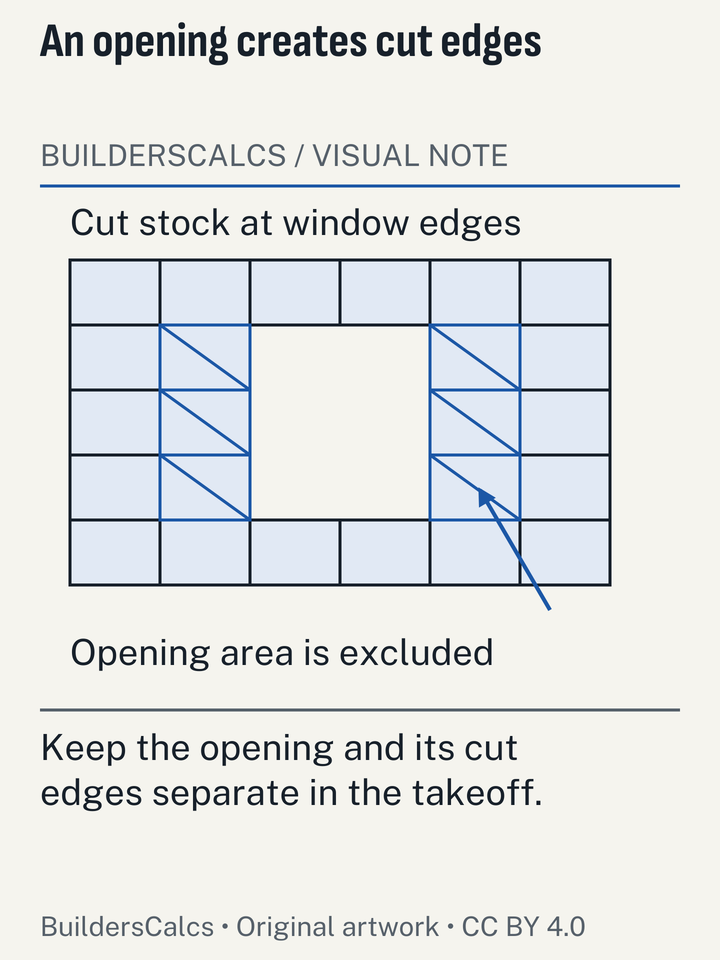
Measure the face of the wall you will build. For a garden wall, that is its length times its height above the footing. For a house wall, measure each elevation between corners, then add the areas or enter the total length. Openings go in as one combined area: work out width times height for each window and door, add them up and enter the sum. The calculator takes that off before it counts anything, so a wall with large windows can need far fewer bricks than its outline suggests.
How does the brick calculator work out the count?
For US sizes, the calculator multiplies net wall area by the Brick Industry Association's published count per 100 sq ft. For UK bricks and any size you type in, it works out bricks per unit area from the brick face plus one joint.
- Net area: length × height − openings.
- US sizes: net sq ft × BIA count per 100 sq ft ÷ 100 × number of skins.
- UK and other sizes: bricks per m² = 1,000,000 ÷ ((length + joint) × (height + joint)) in millimetres; in US units, 144 ÷ ((length + joint) × (height + joint)) in inches gives bricks per sq ft.
- Extra: bricks × (1 + extra ÷ 100), rounded up to a whole brick.
- Mortar (US sizes): net sq ft × BIA mortar volume per 100 sq ft at the nearer of the two joint widths BIA publishes.
Why not use geometry for US bricks too? Because BIA's figures and pure geometry differ slightly, and BIA's are the published standard. For modular brick the gap is small: BIA tabulates 6.75 bricks/sq ft (72.7 bricks/m²), while dividing by the brick's face plus a joint gives a little more, because the modular coursing is set so three courses make 8 in rather than adding the joint separately. The calculator uses BIA's figure.
Worked example: Norman brick with 1/2 in joints
A 10 ft by 10 ft wall is 100 sq ft. BIA lists 450 bricks/100 sq ft for Norman brick, so with no extra the wall needs 450 bricks. At 1/2 in joints the mortar is 100 × 6.5 ÷ 100 = 6.5 cu ft (0.184 m³) before waste. The longer Norman face is why the count is a third lower than for modular brick on the same wall.
Worked example: UK brick at 10 mm joints
With 10 mm joints a UK brick occupies a co-ordinating size of 225 x 112.5 x 75 mm. One square metre is 1,000,000 mm², and each brick with its joint covers 225 × 75 = 16,875 mm², so 59.26 bricks fit in a square metre. The 5 m by 2 m wall is 10 m², which gives 592.6, shown as 593 before extra and 623 with the default allowance.
For a brick not on the list, choose Other size and type its real length and height. A 240 × 71 mm brick at 10 mm joints covers 250 × 81 mm, so 49.38 per m². A 2 m by 2 m wall then needs 197.5 bricks, or 208 to buy with the default extra.
| Wall | Brick and joint | Extra | Bricks to buy | Mortar before waste |
|---|---|---|---|---|
| 20 ft × 8 ft, one skin | US modular, 3/8 in | 5% | 1,134 (1,080 before extra) | 8.8 cu ft (0.249 m³) |
| 20 ft × 8 ft less a 21 sq ft door | US modular, 3/8 in | 5% | 986 | Falls with the area |
| 20 ft × 8 ft, two skins | US modular, 3/8 in | 5% | 2,268 | Doubles |
| 10 ft × 10 ft | US Norman, 1/2 in | 0% | 450 | 6.5 cu ft (0.184 m³) |
| 5 m × 2 m, half-brick wall | UK 215 × 65 mm, 10 mm | 5% | 623 (593 before extra) | Not calculated for UK sizes |
| 2 m × 2 m | Other size, 240 × 71 mm, 10 mm | 5% | 208 | Not calculated for other sizes |
How many bricks per square foot for each US brick size?
It ranges from 300 bricks/100 sq ft for utility brick to 675 bricks/100 sq ft for modular, before waste. The tables below are BIA's own, and the calculator reads its US counts and mortar volumes straight from them (Brick Industry Association).
US brick names cause a lot of wrong orders. A modular brick and a standard brick are not the same size. A US modular brick is nominally 4 x 2 2/3 x 8 in (102 x 68 x 203 mm), sized so three courses equal 8 in. The standard, or non-modular, brick is specified by its actual size rather than a nominal one, and BIA gives it a different count: 655 bricks/100 sq ft against 675 for modular at the same joint. Nominal masonry size equals the unit's specified size plus one mortar joint. So check the size printed on the pallet or the supplier's sheet before you pick an option.
Joint width does not change the BIA brick counts, because a modular brick gets smaller as the joint gets bigger to keep the same coursing. With a 3/8 in joint, a modular brick's specified size is 3 5/8 x 2 1/4 x 7 5/8 in (92 x 57 x 194 mm); with a 1/2 in joint it is 3 1/2 x 2 1/4 x 7 1/2 in. The mortar volume does change, which is why the calculator chooses BIA's 3/8 in or 1/2 in mortar column from your joint entry.
| Brick | Nominal W × H × L (in) | Joint (in) | Bricks per 100 sq ft | Bricks per 10 m² | Mortar cu ft per 100 sq ft | Mortar m³ per 10 m² |
|---|---|---|---|---|---|---|
| Modular | 4 x 2 2/3 x 8 | 3/8 | 675 | 727 | 5.5 | 0.168 |
| Modular | 4 x 2 2/3 x 8 | 1/2 | 675 | 727 | 6.9 | 0.21 |
| Engineer Modular | 4 x 3 1/5 x 8 | 3/8 | 563 | 605 | 4.8 | 0.146 |
| Engineer Modular | 4 x 3 1/5 x 8 | 1/2 | 563 | 605 | 6.1 | 0.186 |
| Closure Modular | 4 x 4 x 8 | 3/8 | 450 | 484 | 4.1 | 0.125 |
| Closure Modular | 4 x 4 x 8 | 1/2 | 450 | 484 | 5.2 | 0.158 |
| Roman | 4 x 2 x 12 | 3/8 | 600 | 646 | 6.4 | 0.195 |
| Roman | 4 x 2 x 12 | 1/2 | 600 | 646 | 8.2 | 0.25 |
| Norman | 4 x 2 2/3 x 12 | 3/8 | 450 | 484 | 5.1 | 0.155 |
| Norman | 4 x 2 2/3 x 12 | 1/2 | 450 | 484 | 6.5 | 0.198 |
| Engineer Norman | 4 x 3 1/5 x 12 | 3/8 | 375 | 404 | 4.4 | 0.134 |
| Engineer Norman | 4 x 3 1/5 x 12 | 1/2 | 375 | 404 | 5.6 | 0.171 |
| Utility | 4 x 4 x 12 | 3/8 | 300 | 323 | 3.7 | 0.113 |
| Utility | 4 x 4 x 12 | 1/2 | 300 | 323 | 4.7 | 0.143 |
| Brick | Actual W × H × L (in) | Joint (in) | Bricks per 100 sq ft | Bricks per 10 m² | Mortar cu ft per 100 sq ft |
|---|---|---|---|---|---|
| Standard | 3 5/8 x 2 1/4 x 8 | 3/8 | 655 | 705 | 9.5 |
| Standard | 3 1/2 x 2 1/4 x 8 | 1/2 | 655 | 705 | 11 |
| Queen | 2 3/4 x 2 3/4 x 7 5/8 | 3/8 | 550 | 592 | 6.7 |
| Queen | 3 x 2 3/4 x 8 | 1/2 | 550 | 592 | 7.4 |
| King | 2 3/4 x 2 5/8 x 9 5/8 | 3/8 | 455 | 490 | 6.5 |
| King | 3 x 2 3/4 x 9 3/4 | 1/2 | 455 | 490 | 7.3 |
| Engineer Standard | 3 5/8 x 2 13/16 x 8 | 3/8 | 539 | 581 | 8.2 |
| Engineer Standard | 3 1/2 x 2 3/4 x 8 | 1/2 | 539 | 581 | 9.7 |
| Closure Standard | 3 5/8 x 3 5/8 x 8 | 3/8 | 430 | 463 | 7 |
| Closure Standard | 3 1/2 x 3 1/2 x 8 | 1/2 | 430 | 463 | 8.5 |
Do bond patterns change how many bricks I need?
Yes. Any bond with header bricks laid end-on through the wall uses more brick than running bond, and the calculator counts running bond only. BIA publishes the increase as a fraction to add. English bond, with a full header course every second course, adds half again; Flemish bond, with headers and stretchers alternating along every course, adds a third. BIA's Technical Note 10 lists the fractions for common, cross and garden-wall bonds too, for brick and for mortar (Brick Industry Association).
To use them, run the calculator for the wall face, take the "before extra" count, multiply it by one plus the bond's fraction, then add your breakage allowance. Mortar rises by a smaller fraction: a sixth for English bond and a ninth for Flemish. Stack bond and running bond need no correction.
How much extra brick should I buy?
The calculator adds 5% by default, which is BIA's floor rather than a target. Add at least 5% to net brick quantities for breakage and waste. Raise it for walls with many openings, corners or decorative courses, where more bricks are cut.
A UK benchmark sits just above that. The RICS whole life carbon standard (2nd edition, 2023) sets a default UK site waste rate of 4% for plasterboard, 6% for clay brickwork and 6% for tile floor finishes. The RICS figure is a default site waste rate for carbon accounting on whole buildings, not an ordering rule, but it is a useful check that the default is not generous. Spare bricks also matter for later repairs, because a brick from another batch rarely matches in colour.
Over-ordering has a cost beyond the invoice. In 2018, 10.8 million tons of US C&D brick and clay tile went to landfill and 1.5 million tons to aggregate, about 88% landfilled (EPA). That is the EPA's latest published breakdown for the material. The waste allowance by material guide compares the brick allowance with tile, timber and plasterboard.
What changes for UK and metric bricks?
In metric mode the calculator uses the UK standard brick and 10 mm joints. The standard UK brick is 215 x 102.5 x 65 mm. UK brickwork is set out with 10 mm mortar joints. The trade rule of 60 bricks/m² for a half-brick wall comes from a single industry source, while geometry gives 59.26. The calculator uses the geometry, so its count is a fraction lower than the rule, then rounds up.
A half-brick wall is one brick thick on its narrow edge, which is one skin in the calculator. A cavity wall's outer leaf is one skin; a one-brick garden wall built as two skins is two. We found no published UK count per square metre for one-brick walls in English or Flemish bond, so for those use the BIA bond fractions above as an approximation and check with your supplier.
The calculator gives no mortar figure for UK bricks, because the UK sources we found publish mortar per tonne or per tub rather than per square metre. Take the brick count to the bags of mortar mix calculator, which has Tarmac's tub yield and the MPA per-tonne figure. European formats such as German NF bricks are not on the list; enter them as Other size. Our imperial-to-metric chart has the conversion factors if your plans mix units.
UK brick demand recovered a little in the latest year. Great Britain brick deliveries were 1,481 million bricks in 2025, up from 1,401 million in 2024 but below 2,050 million in 2018, per DBT Table 9c.
How common is brick on new US homes?
Less common than it was. Brick was the primary exterior wall on 16% of new US single-family homes completed in 2025, down from 20% in 2023 and 35% in 1973 (Census Bureau, Characteristics of New Housing). Vinyl siding and stucco were each the primary exterior wall material on 26% of new US single-family homes completed in 2025, ahead of fiber cement (23%) and brick (16%), per the Census Bureau. The figures describe the main exterior wall material on new single-family homes, not garden walls, repairs or partial brick fronts, which make up much of what this calculator is used for.
When is the brick count wrong or not enough?
The calculator handles flat rectangular walls in running bond. Watch for these:
- Gables and sloping tops. A triangle is half its base times its height. Work it out and add it to the length × height of the rectangular part, or follow the brick quantity for gables and openings guide.
- Arches, soldier courses and sills. Bricks set on end or on edge cover less face per brick. Count them separately and add them.
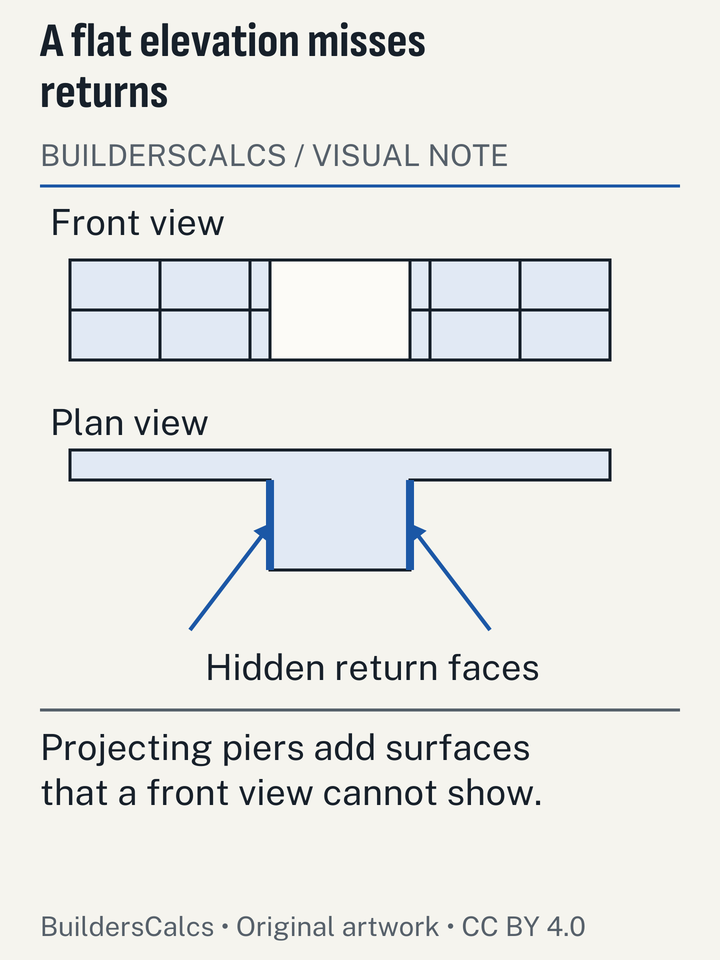
- Piers and returns. Corners and piers add bricks that a face area does not show. Add a few for each corner, or count piers as short walls of their own.
- Unusual joints. BIA's tables cover 3/8 in and 1/2 in joints. Outside that range the calculator uses the nearer column and adds a note, because both the count and the mortar would change.
- Ties, lintels and cavity trays. Wall ties, lintels, damp-proof course and weep vents are not counted.
- Structure. The calculator counts bricks; it does not decide how tall or long a wall can be, what footing it needs or whether it can carry a load. Retaining and load-bearing walls follow code or an engineer.
Which calculator do I need next?
Once you have the brick count, the bags of mortar mix calculator turns it into bags, tubs or a cement, lime and sand order. If part of the job is blockwork, such as an inner leaf or a garden wall backing, the CMU blocks per wall calculator counts US or UK blocks with their mortar. Painting or plastering the inside of the same wall? The calculators for interior walls cover drywall, paint and wallpaper.
Brick calculator questions
Is a US modular brick the same as a standard brick?
No. A modular brick's nominal size includes its joint; a standard brick is specified by its actual, non-modular size. BIA lists 675 bricks/100 sq ft modular bricks against 655 bricks/100 sq ft standard ones, and standard brick takes noticeably more mortar per wall.
How many bricks for a double-skin wall?
Twice the single-skin count. Set the number of skins to 2 and the calculator doubles the bricks and the mortar. If the gap between skins is filled solid with mortar, add the collar joint mortar from BIA's table on the mortar calculator page.
Why is there no mortar figure for UK bricks?
Because we found no published UK figure for mortar per square metre or per 1,000 bricks, and the calculator does not estimate one. Use the mortar calculator, which works from Tarmac's tub yield and the MPA's per-tonne yield.
Can I use the brick calculator for a brick veneer on a house?
Yes. A veneer is a single skin, so enter each wall's length and height, add up the window and door areas, and leave skins at 1. Ties, flashing and lintels are not counted.
What does the warning about joint width mean?
BIA publishes counts and mortar volumes at 3/8 in and 1/2 in joints only. If you type a joint far from either, the calculator uses the nearer set of figures and warns you, because a very thin or very thick joint changes both the count and the mortar.
Put this brick calculator on your site
Sources (19)
- Angelus Block Co.
- CMU Basics: Dimensions and Sizes, checked
- Brick Industry Association
- Technical Note 10: Dimensioning and Estimating Brick Masonry (Feb 2009), checked
- Department for Business and Trade (DBT), UK (data from ONS, DBT and Mineral Products Association)
- Monthly Bulletin of Building Materials and Components, September 2026 (Bulletin 617), data tables, checked
- Designing Buildings Ltd (industry wiki)
- Brick sizes, checked
- Forterra
- Commons 65mm brick datasheet, checked
- Health and Safety Executive (UK)
- Construction hazardous substances: Cement, checked
- National Institute of Standards and Technology
- Handbook 44 (2026), Appendix C: General Tables of Units of Measurement, checked
- Special Publication 811 (2008), Guide for the Use of the International System of Units (SI), Appendix B.8, checked
- Occupational Safety and Health Administration (OSHA), Federal Register (GovInfo)
- Occupational Exposure to Respirable Crystalline Silica; Final Rule, 81 FR 16286 (March 25, 2016), checked
- Office of the Federal Register / OSHA (eCFR)
- 29 CFR 1926.1153 Respirable crystalline silica (construction), including Table 1, checked
- Royal Institution of Chartered Surveyors (RICS)
- Whole life carbon assessment for the built environment, 2nd edition (professional standard, September 2023), checked
- Tarmac (Blue Circle)
- Multi-Purpose Concrete product data sheet (March 2014), hosted by Wickes, checked
- POSTCRETE product data sheet (April 2014), hosted by Wickes, checked
- The Quikrete Companies
- QUIKRETE Concrete Mix No. 1101 Data Sheet (revised Oct 2022), checked
- Safety Data Sheet C1: Portland Cement Based Concrete Products (rev. Feb-23), checked
- UK Parliament (legislation.gov.uk)
- Weights and Measures Act 1985, Schedule 1, checked
- US Census Bureau
- Characteristics of New Housing 2025: Primary Type of Exterior Wall Material of New Single-Family Houses Completed, checked
- US Environmental Protection Agency (EPA), Office of Resource Conservation and Recovery
- Advancing Sustainable Materials Management: 2018 Fact Sheet, checked
- US Occupational Safety and Health Administration (29 CFR, via Cornell LII)
- 29 CFR 1926.1153 Respirable crystalline silica (construction), checked
Every number on this page is taken from these documents. How we choose and check sources.