

How to calculate brick quantity for any wall shape
Multiply the net wall area, after taking out doors and windows, by the bricks per unit area for your brick and joint, then add at least 5% for breakage. US modular brick with 3/8 in joints needs 6.75 bricks/sq ft (72.7 bricks/m²), per the Brick Industry Association. A standard UK brick needs about 60 bricks/m² in a half-brick wall. A 184 sq ft (17.1 m²) US wall therefore takes 1,242 bricks, or 1,305 with the allowance.
How do you work out how many bricks you need?
The Brick Industry Association calls this the wall-area method in its Technical Note 10. It works for any wall that can be split into rectangles.
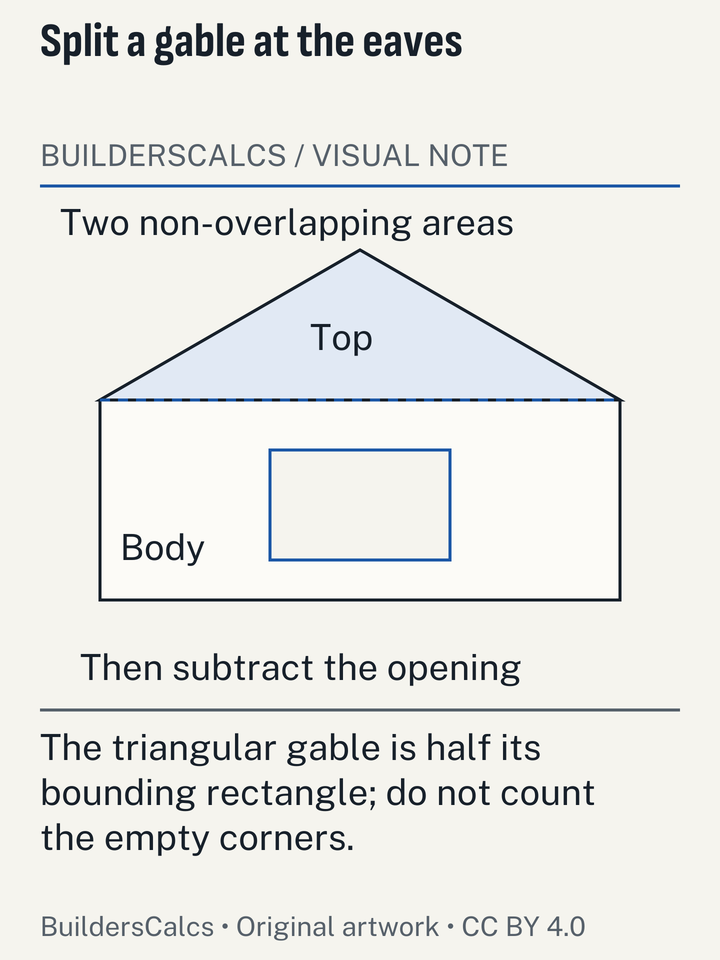
- Measure the gross wall area. Length × height for each rectangle of wall. Split gables, steps and returns into rectangles and triangles and add them.
- Take out the openings. Subtract width × height for every door, window and vent. The result is the net area.
- Find the bricks per unit area. Read it from the BIA table below for US sizes, or use the UK figure. It depends on the brick's face size and the joint, not its depth.
- Apply any bond correction. Bonds with headers use more brick per square foot of face. Multiply the net count by (1 + the BIA factor).
- Multiply by the number of leaves. A double-wythe wall or a cavity wall with brick both sides needs the count twice.
- Add the allowance and round up. The BIA says at least 5% for breakage and waste. Round up to whole bricks, then to whole packs or cubes.
How many bricks per square foot or square metre?
A US modular brick with 3/8 in joints takes 6.75 bricks/sq ft (72.7 bricks/m²), and larger faces take fewer. The figures are BIA's, from Technical Note 10 (February 2009, the current edition), for a single wythe in running or stack bond before waste (Brick Industry Association). The joint width barely changes the brick count, because the modular sizes shrink the brick to keep the coursing, but it does change the mortar.
| Brick | Joint (in) | Bricks per 100 sq ft | Bricks per 10 m² | Mortar per 100 sq ft (cu ft) |
|---|---|---|---|---|
| Modular | 3/8 | 675 | 727 | 5.5 |
| Modular | 1/2 | 675 | 727 | 6.9 |
| Engineer Modular | 3/8 | 563 | 605 | 4.8 |
| Engineer Modular | 1/2 | 563 | 605 | 6.1 |
| Closure Modular | 3/8 | 450 | 484 | 4.1 |
| Closure Modular | 1/2 | 450 | 484 | 5.2 |
| Roman | 3/8 | 600 | 646 | 6.4 |
| Roman | 1/2 | 600 | 646 | 8.2 |
| Norman | 3/8 | 450 | 484 | 5.1 |
| Norman | 1/2 | 450 | 484 | 6.5 |
| Engineer Norman | 3/8 | 375 | 404 | 4.4 |
| Engineer Norman | 1/2 | 375 | 404 | 5.6 |
| Utility | 3/8 | 300 | 323 | 3.7 |
| Utility | 1/2 | 300 | 323 | 4.7 |
Why 6.75 bricks per square foot and not 7?
Because a modular brick and its joint fill a nominal 8 × 2⅔ in rectangle, which is 21⅓ sq in, and 144 ÷ 21⅓ = 6.75. A US modular brick is nominally 4 x 2 2/3 x 8 in (102 x 68 x 203 mm), sized so three courses equal 8 in. Nominal masonry size equals the unit's specified size plus one mortar joint.
The general formula is bricks per unit area = 1 ÷ ((brick length + joint) × (brick height + joint)). Working it from the specified size, (7⅝ + ⅜) × (2¼ + ⅜) = 21 sq in, gives 6.86 per sq ft. BIA publishes 6.75 because three courses are designed to rise exactly 8 in; use the published figure (Brick Industry Association).
The same formula covers a brick no table lists. For a UK brick, 1 ÷ (0.225 × 0.075) = 59.26 per m². The trade figure of 60 bricks/m² rounds that up; we found it only on an industry wiki, not from the Brick Development Association, so treat it as a rule of thumb (Designing Buildings Ltd (industry wiki)).
A common mistake: treating all US bricks as one size
A modular brick and an older non-modular standard brick do not give the same count. BIA lists 675 modular against 655 standard bricks per 100 sq ft at 3/8 in joints. Check the size on the quote before you multiply.
Worked example 1: a US brick veneer wall
A wall 24 ft long and 9 ft high has a 4 × 3 ft window and a 3 ft × 6 ft 8 in door. Gross area is 216 sq ft. The openings take 12 + 20 = 32 sq ft, so the net area is 184 sq ft (17.1 m²).
Bricks
184 × 6.75 = 1,242 modular bricks. With BIA's minimum 5%, 1,242 × 1.05 = 1,304.1, so 1,305 bricks. In the metric version of BIA's table, 17.1 m² × 72.7 per m² gives the same 1,243 before rounding.
Mortar
At 5.5 cu ft per 100 sq ft for 3/8 in joints, 184 sq ft needs 10.1 cu ft (0.29 m³) of mortar before waste. BIA adds 15–25%, which brings it to 11.6 to 12.7 cu ft (Brick Industry Association). Checked by the brick count instead: With 3/8 in joints, 1,000 modular bricks take about 8.1 cu ft (0.23 m³) of mortar before waste; 10.3 cu ft at 1/2 in joints. So 1.242 × 8.1 = 10.1 cu ft, the same answer.
Bags
The answer depends on what you buy. One 80 lb bag of Quikrete Mortar Mix (Type N) lays up to 37 standard bricks or 13 standard 8 x 8 x 16 blocks. That is 1,305 ÷ 37 = 35.3, so 36 bags. Sakrete's figure of about 40 bricks per 80 lb bag gives 33 bags (SAKRETE of North America). Mixing your own from masonry cement and sand uses far fewer bags: at Quikrete's 144 bricks per 70 lb bag it is 10 bags, or 11 by BIA's rough rule of eight bags per 1,000 bricks (Brick Industry Association). NCMA puts sand at about 1 ton sand per 8 bags, so about 1.25 tons for 10 bags.
Worked example 2: a UK extension wall in metric
The outer leaf of a single-storey extension wall is 5 m long and 2.4 m high, with one 1.2 × 1.2 m window. Gross area is 12 m², the window takes 1.44 m², and the net area is 10.56 m² (113.7 sq ft).
The standard UK brick is 215 x 102.5 x 65 mm. With 10 mm joints a UK brick occupies a co-ordinating size of 225 x 112.5 x 75 mm. At the trade figure of 60 bricks/m², 10.56 × 60 = 634 bricks; by the joint geometry, 10.56 × 59.26 = 626. Adding BIA's 5% gives 666 or 658. We found no UK trade body's waste figure, so the US minimum is the only sourced one; many merchants sell in packs, which may add more once rounded up.
We also have no sourced UK figure for mortar per square metre or per 1,000 bricks, so we don't print one. For small repairs, A 10 kg tub of Tarmac ready-to-use Mortar Mix lays about 12 bricks or six 100 mm blocks. For a wall this size, the mortar calculator works from the joint volume.
Brick sizes and counts side by side
| Brick | Size | Bricks per area, no waste | Stated by |
|---|---|---|---|
| US modular, 3/8 in joint | 3 5/8 x 2 1/4 x 7 5/8 in (W x H x L) | 6.75 bricks/sq ft (72.7 bricks/m²) | Brick Industry Association |
| US standard (non-modular), 3/8 in joint | 3 5/8 x 2 1/4 x 8 in | 655 per 100 sq ft (705 per 10 m²) | Brick Industry Association |
| UK standard, 10 mm joint | 215 x 102.5 x 65 mm (L x W x H) | 60 bricks/m² (59.26 by geometry) | Designing Buildings wiki; Forterra for the size |
How do bond patterns change the count?
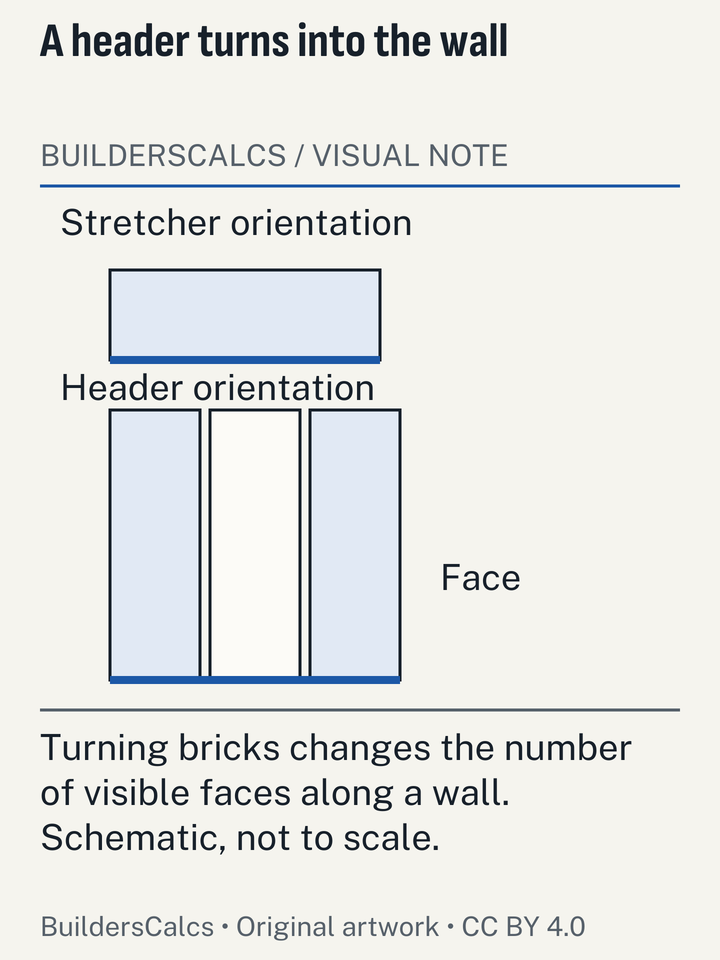
Bonds with headers add brick, because each header shows only its end on the face. BIA's correction factors are the net increase over the running-bond count, before waste. English bond adds a half and Flemish bond a third. BIA's own example: standard brick, 3/8 in joints, common bond with headers every fifth course gives 655 + 655 ÷ 5 = 786 per 100 sq ft (Brick Industry Association). Apply the factor, then the waste, in that order.
| Bond | Add to brick count | Add to mortar |
|---|---|---|
| Common bond, full headers every 5th course | one-fifth (+20%) | one-fifteenth (+6.7%) |
| Common bond, full headers every 6th course | one-sixth (+16.7%) | one-eighteenth (+5.6%) |
| Common bond, full headers every 7th course | one-seventh (+14.3%) | one twenty-first (+4.8%) |
| English bond (full headers every 2nd course) | one-half (+50%) | one-sixth (+16.7%) |
| Flemish bond (headers and stretchers alternate in every course) | one-third (+33.3%) | one-ninth (+11.1%) |
| Cross bond, Flemish headers every 6th course | one-eighteenth (+5.6%) | one fifty-fourth (+1.9%) |
| Flemish cross bond (Flemish headers every 2nd course) | one-sixth (+16.7%) | one-eighteenth (+5.6%) |
| Double-stretcher garden wall bond | one-fifth (+20%) | one-fifteenth (+6.7%) |
| Triple-stretcher garden wall bond | one-seventh (+14.3%) | one twenty-first (+4.8%) |
How much mortar do bricks need?
About 8 to 10 cu ft per 1,000 modular bricks, depending on the joint, before 15–25% waste. The BIA mortar columns above give it per 100 sq ft. One cubic foot (or m³) of loose, damp sand yields about one cubic foot (or m³) of mortar. That makes the sand order easy: it equals the mortar volume.
Bag yields are where the sources split. Quikrete says up to 37 bricks per 80 lb bag of mortar mix, Sakrete about 40, and NCMA about 16 CMU or 50 brick-size units for preblended mortar (Concrete Masonry & Hardscapes Association (formerly NCMA)). The Type N, S and M mortar mixes page covers which type to use. For block walls, the cinder block count works the same way at 1.125 blocks/sq ft for 8 × 16 in faces.
Is brick still a common wall material?
Less than it was in new US homes, while British deliveries rose in 2025 without returning to their 2018 level. Census Bureau data show Brick was the primary exterior wall on 16% of new US single-family homes completed in 2025, down from 20% in 2023 and 35% in 1973 (Census Bureau, Characteristics of New Housing). (US Census Bureau) That share covers new single-family homes only, not repairs or garden walls. In Great Britain, Great Britain brick deliveries were 1,481 million bricks in 2025, up from 1,401 million in 2024 but below 2,050 million in 2018, per DBT Table 9c. (Department for Business and Trade (DBT), UK (data from ONS, DBT and Mineral Products Association)) For a self-builder, the practical effect is that a short order may be a part pack from a merchant, so check the pack size before rounding.
When does the wall-area method go wrong?
- Corners and piers. Return corners and attached piers add brick the face area doesn't show. Measure piers as their own small walls.
- Two leaves or wythes. A cavity wall with brick both sides, or a solid two-wythe wall, doubles the count; BIA's collar-joint table adds the mortar between wythes.
- Soldier and rowlock courses. Bricks on end or edge show a different face, so count those courses separately by length.
- Non-modular or EU formats. Our fact base has no counts for EU formats such as DF or NF. Use the 1 ÷ ((L + joint) × (H + joint)) formula with the maker's size.
- Mixed units. Keep the whole sum in feet or in metres; the construction unit conversions page has the factors.
What to order
Take the net area, multiply by the published bricks per unit area for your exact brick, apply the bond factor, then add at least 5%, or more for a wall with many cuts. Order mortar by volume plus 15–25%, and match bags to the maker's stated yield. The waste allowances by material guide explains why the mortar margin is larger than the brick one. The wider set of wall and masonry calculators covers block, plaster and paint.
Brick counting questions
How many bricks are in a square metre of wall?
About 60 bricks/m² UK bricks in a half-brick wall with 10 mm joints, or 72.7 US modular bricks with 3/8 in joints, both before waste.
Do I subtract windows and doors when counting bricks?
Yes. BIA's method works from net wall area, gross area less openings. Add the bricks for sills or soldier courses over the openings separately.
How many bricks does one bag of mortar lay?
Quikrete says up to 37 standard bricks per 80 lb bag of mortar mix, Sakrete about 40, and NCMA about 50 brick-sized units for preblended mortar. A 70 lb bag of masonry cement mixed with sand lays far more, about 144 per Quikrete.
Does a thicker mortar joint mean fewer bricks?
Not for modular brick. BIA lists the same 675 per 100 sq ft at 3/8 and 1/2 in joints, because the brick is made smaller to keep the module. The mortar rises from 5.5 to 6.9 cu ft per 100 sq ft.
Sources (13)
- Angelus Block Co.
- CMU Basics: Dimensions and Sizes, checked
- Brick Industry Association
- Technical Note 10: Dimensioning and Estimating Brick Masonry (Feb 2009), checked
- Concrete Masonry & Hardscapes Association (formerly NCMA)
- TEK 04-02A Estimating Concrete Masonry Materials, checked
- Department for Business and Trade (DBT), UK (data from ONS, DBT and Mineral Products Association)
- Monthly Bulletin of Building Materials and Components, September 2026 (Bulletin 617), data tables, checked
- Designing Buildings Ltd (industry wiki)
- Brick sizes, checked
- Forterra
- Commons 65mm brick datasheet, checked
- SAKRETE of North America
- SAKRETE Type N Mortar Mix technical data sheet (REV 7-10), hosted by Home Depot, checked
- Tarmac
- Ready-to-use Mortar Mix product data sheet (10 kg tub), hosted by Wickes, checked
- Tarmac (Blue Circle)
- Quality Assured Mortar product data sheet (August 2018), hosted by MKM, checked
- The Quikrete Companies
- QUIKRETE Mortar Mix No. 1102 Data Sheet, checked
- Safety Data Sheet C1: Portland Cement Based Concrete Products (rev. Feb-23), checked
- US Census Bureau
- Characteristics of New Housing 2025: Primary Type of Exterior Wall Material of New Single-Family Houses Completed, checked
- US Occupational Safety and Health Administration (29 CFR, via Cornell LII)
- 29 CFR 1926.1153 Respirable crystalline silica (construction), checked
Every number on this page is taken from these documents. How we choose and check sources.