

Fence calculator
Type the fence length, the corners and the gates, and this fence calculator counts the posts, the panels or the rails and pickets, and the concrete to set every post. A 100 ft run of US wood panels on 8 ft centres with one 4 ft gate takes 15 posts and 13 panels. Set in 24 in holes, those posts need about 9.68 cu ft of concrete, or 26 bags of 50 lb mix.
Fence calculator
v1 · US and metricEnter the fence length, corners and gates, then pick ready-made panels or a site-built picket fence. The result gives posts, panels or rails and pickets, and the concrete and premix bags to set every post.
Result
Enter your measurements and press Calculate.
Formula and assumptions
Sections = (length − gate openings) ÷ post spacing, rounded up, + 1 per corner and per gate; posts = sections + gates + 1- Ready-made panels (US 8 ft, UK 1.83 m):
Post spacing = 8 ft on center (US panels); metric:Post spacing = 1.83 m panel + post width (UK panels) - Site-built rails and pickets:
Rails = sections × rails per section; pickets = (fence length without gates + gap) ÷ (picket width + gap), rounded up Concrete per post (cu in) = (π × hole diameter² ÷ 4 − post width²) × (hole depth − gravel − top gap); bags = total ÷ bag yield, rounded up; metric:Concrete per post (mm³) = (π × hole diameter² ÷ 4 − post width²) × (hole depth − gravel − top gap); bags = total ÷ bag yield, rounded up- Panels: US pre-built wood panels are set with posts 8 ft on center. Standard UK fence panels are 1.83 m (6 ft) wide. Post center-to-center equals the panel width plus one post width.
- Rails: Use two backer rails on short fences, three on 6 ft fences and four on 8 ft fences. Jacksons featherboard panels use two or three rails depending on height.
- The section count allows one part-length section for every corner and gate, so legs that divide evenly by the spacing need fewer. Gate posts are counted; gates, hinges and latches are not.
- Holes: Dig the post hole about three times the width (diameter) of the post. Put about 6 in of gravel in the bottom of each hole for drainage. Fill fast-setting mix to 3-4 in below the top of the hole and finish with soil. The post is square and takes up its own volume in the hole.
- Bag yields: A 50 lb bag of concrete mix yields about 0.375 cu ft (10.6 L). An 80 lb bag of concrete mix yields about 0.60 cu ft (17 L). A 30 kg (66 lb) bag of Sakrete Rapid Post yields about 0.014 m³ (1/2 cu ft). A Hanson MaxiPack20 bag of Multipurpose or Instant Concrete makes about 0.009 m³.
- UK panels in contact with the ground need gravel boards.
How many fence posts and panels do I need for 100 feet?
A 100 ft fence of US pre-built wood panels with one 4 ft gate needs 15 posts and 13 panels. Take the gate out first: 100 − 4 leaves 96 ft of fence. At 8 ft per panel that is exactly 12 panels, and the calculator adds one more section to allow for the gate splitting the run, giving 13. Posts are the sections plus one for each gate plus one to close the line, so 13 + 1 + 1 = 15. These are the numbers the calculator shows when it loads.
Change the fence type to rails and pickets with two corners added and the count becomes 15 sections, 17 posts, 45 rails and 210 pickets, using 1×6 pickets laid tight for privacy. The UK version of the starting fence, 30 m long with a 1.2 m gate and 1.83 m panels, comes to 17 panels and 19 posts.
The figure to get right before you type is the length. Measure each straight leg on the level and add them up, gate openings included, since the calculator subtracts the gates itself. Then count the corners: every change of direction, including the turn back towards the house. The measuring a fence line guide covers slopes, curves and finding the boundary.
How does the fence calculator count posts, rails and pickets?
It divides the fence length, less the gates, by the post spacing, rounds up, and then allows one part-length section for every corner and every gate. That allowance is deliberate. A corner ends one straight leg and starts another, and a leg rarely divides into whole panels, so each corner usually leaves one short section. Gates do the same to the run they sit in.
- Sections: (length − gates × gate width) ÷ spacing, rounded up, + corners + gates.
- Posts: sections + gates + 1. Each gate opening needs a post on both sides, and the line needs one post to finish.
- Rails (site-built): sections × rails per section.
- Pickets: (fence length without gates + gap) ÷ (picket width + gap), rounded up. Adding one gap to the length accounts for the last picket, which has no gap after it.
- Post spacing: fixed at 8 ft for US panels, the UK panel width plus your post width for UK panels, and your own figure for a site-built fence.
Worked example: a picket fence with two corners
Take 100 ft of site-built privacy fence with two corners, one 4 ft gate, 8 ft post spacing, three rails per section and 1×6 pickets with no gap. The fence without the gate is 96 ft, and 96 ÷ 8 = 12 sections, plus 2 for the corners and 1 for the gate, makes 15. Posts are 15 + 1 + 1 = 17. Rails are 15 × 3 = 45. For pickets, 96 ft is 1,152 in. A nominal 1x6 board is 5-1/2 in (140 mm) wide when dry and dressed. So 1,152 ÷ 5.5 = 209.5, rounded up to 210 pickets.
If your legs do divide evenly by the spacing, the corner allowance gives a section or two more than you need. That is the safe side. Our measuring guide counts each leg separately instead, which gives the exact figure when you know the length of every leg.
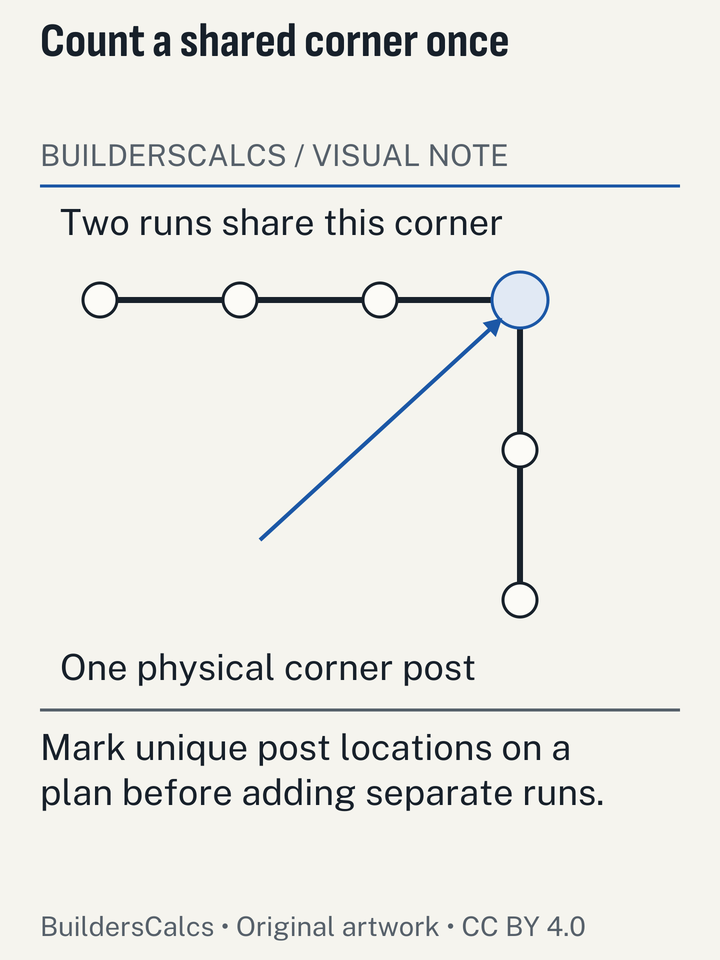
Illustration sources
- Barrette Outdoor Living — Wood Fence Installation Instructions (BOM-WOODFENCE), hosted by The Home Depot
- The Home Depot (manufacturer not named on document) — Wood Fence Kits Installation Instructions
- NIST / American Lumber Standard Committee — Voluntary Product Standard PS 20-20, American Softwood Lumber Standard
- USDA Forest Service, Forest Products Laboratory — Wood Handbook (FPL-GTR-282), Chapter 6: Commercial Lumber, Round Timbers, and Ties
| Fence | Inputs | Posts | Sections | Rails and pickets | Concrete |
|---|---|---|---|---|---|
| US panels | 100 ft, 1 gate of 4 ft, 4×4 posts, 24 in holes | 15 | 13 panels | n/a | 9.68 cu ft, 26 × 50 lb bags |
| US panels, deeper holes | As above, 12 in holes 36 in deep | 15 | 13 panels | n/a | 1.58 cu ft per post, 40 × 80 lb bags |
| US privacy pickets | 100 ft, 2 corners, 1 gate, 8 ft spacing, 3 rails | 17 | 15 | 45 rails, 210 pickets | As set by hole size |
| US spaced pickets | 50 ft, no gate, 6 ft spacing, 2 rails, 3.5 in pickets with 2 in gaps | 10 | 9 | 18 rails, 110 pickets | As set by hole size |
| UK panels | 30 m, 1 gate of 1.2 m, 89 mm posts, 600 mm holes | 19 | 17 panels | n/a | 25 × 30 kg Rapid Post bags |
How far apart should fence posts be?
For US pre-built wood panels, posts go 8 ft (2.44 m) apart, centre to centre. US pre-built wood panels are set with posts 8 ft on center. Post center-to-center equals the panel width plus one post width. (Barrette Outdoor Living and The Home Depot (manufacturer not named on document)) UK panels are narrower. Standard UK fence panels are 1.83 m (6 ft) wide. With a 4×4 post, the calculator sets UK post centres at the panel width plus the post's actual width.
One belief worth correcting is that panels are the same size on both sides of the Atlantic. They are not, and a UK plan drawn with US spacing would end up a panel or more short on a long run.
For a site-built fence, the spacing is yours to choose, usually the length of the rails you buy. We found no extension-service or code source that fixes a spacing for post-and-rail fences, so the calculator starts at the US panel figure and lets you change it.
Rounding up has one quirk worth knowing. In the UK example above, 28.8 m of fence divided by the post centre spacing comes to just over 15, so the calculator calls for 16 panels before the gate allowance. A sliver like that is better solved by moving one post or trimming one panel than by buying a whole extra panel, so look at the steps under the result when a division lands just past a whole number.
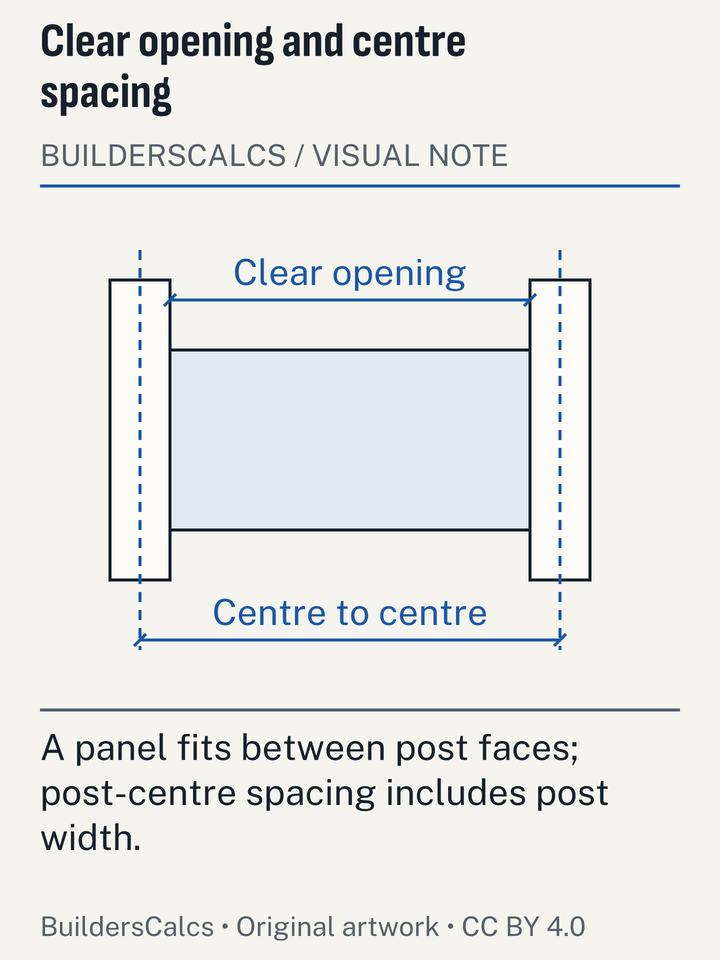
Illustration sources
- Barrette Outdoor Living — Wood Fence Installation Instructions (BOM-WOODFENCE), hosted by The Home Depot
- The Home Depot (manufacturer not named on document) — Wood Fence Kits Installation Instructions
- Jacksons Fencing — Featherboard Panel - Flat Top specification sheet (2019)
- Grange Fencing — Grange Fencing Brochure 2021
How deep should fence post holes be?
Most US makers say to bury about a third of the post, and the UK minimum is 600 mm, but the sources measure that third in different ways. Concrete makers say to dig about one-third (up to one-half) of the post's above-ground height. A wood fence kit guide says to bury 1/3 of the post length, 6 in deeper for end, corner and gate posts. UK guidance: set posts at least 600 mm deep; a 1.8 m fence needs a 2.4 m post. (Jacksons Fencing)
Frost overrides all of these. Where ground freezes, post holes go below the frost line (check local code). Many people assume one-third is always deep enough, but in cold climates the frost line can sit lower than a third of the post, and a post above it can heave. The calculator defaults to 24 in in US mode and 600 mm in metric mode, and warns when a metric depth is shallower than the UK guidance. It does not know your frost depth, so enter the deeper of your chosen rule and your local frost line.
Post length follows from the hole: fence height plus hole depth. A 6 ft fence in a 2 ft hole takes an 8 ft post; a 1.8 m UK fence in a 600 mm hole takes a 2.4 m post.
How much concrete does each fence post need?
A 4×4 post in a 24 in hole takes about 0.65 cu ft of concrete, once the gravel base and soil cap are taken out and the post's own volume is subtracted. The calculator works it out like this:
- Hole diameter: three times the post width unless you enter your own. Dig the post hole about three times the width (diameter) of the post. A nominal 4x4 post is 3-1/2 in (89 mm) square when dry and dressed. So the default hole is 10.5 in across.
- Concrete depth: hole depth less the gravel and the soil cap. Put about 6 in of gravel in the bottom of each hole for drainage. Fill fast-setting mix to 3-4 in below the top of the hole and finish with soil. The calculator uses the smaller cap, so a 24 in hole holds 15 in of concrete.
- Volume per post: (π × diameter² ÷ 4 − post width²) × concrete depth. For the default hole, (86.59 − 12.25) × 15 = 1,115 cu in, or 0.645 cu ft.
- Bags: total for all posts ÷ the bag's yield, rounded up. Fifteen posts need 9.68 cu ft, and 9.68 ÷ 0.375 = 25.8, so 26 bags of 50 lb mix.
Widen the hole and the bag count climbs fast. Change the default to 12 in holes 36 in deep with 80 lb bags, and each post takes 1.58 cu ft, so the fence needs 40 bags. The sources disagree on the gravel too. Quikrete, Barrette and the kit guides give the 6 in the calculator uses, Sakrete gives a range, 4–6 in, and Jacksons in the UK asks for a thinner layer of ballast, so deepen the concrete figure by hand if you plan a thinner base.
As a cross-check, Sakrete's own rule of thumb is close to the calculator's default. Sakrete: about two bags of Fast Setting Concrete per hole for a standard 6 ft fence. Its chart is more generous for a slightly wider, deeper hole. Sakrete's post-setting chart lists 3 bags of 50 lb Fast Setting mix for an average 10 in (254 mm) hole 30 in (762 mm) deep. For per-hole figures with fast-setting mixes, the bags of concrete per post hole calculator follows those charts.
| Bag | Market | Yield per bag |
|---|---|---|
| 50 lb concrete mix | US | 0.375 cu ft (10.6 L) |
| 80 lb concrete mix | US | 0.6 cu ft (17 L) |
| 30 kg Sakrete Rapid Post | UK and EU | 0.5 cu ft (0.014 m³) |
| 20 kg Hanson MaxiPack20 | UK | 0.009 m³ |
How many rails and pickets go in each section?
Most 6 ft privacy fences take three rails per section, and the number of pickets depends only on the picket width and the gap. Use two backer rails on short fences, three on 6 ft fences and four on 8 ft fences. (The Home Depot (manufacturer not named on document)) The calculator multiplies the rails per section by the number of sections, so a 15-section fence with three rails needs 45 rails, each one post spacing long.
For a closed privacy fence, leave the gap at zero and the pickets sit edge to edge. An 8 ft section is 96 in, and 96 ÷ 5.5 = 17.45, so 18 pickets per bay. Spaced pickets change the sum quickly: on a 50 ft fence with 3.5 in pickets and 2 in gaps, (600 + 2) ÷ (3.5 + 2) = 109.5, so 110 pickets. The calculator counts pickets over the whole fence rather than per section, so it does not round up once in every bay.
UK closeboard fencing works the same way with different parts. Jacksons featherboard panels use two or three rails depending on height. A Jacksons featherboard panel carries 22 pales 100 mm wide. Featherboard pales overlap rather than sit apart, and the calculator cannot model an overlap, so if you build closeboard on site, set the gap to zero and add the extra pales the overlap needs.
How much extra fencing should I order?
None of the fence makers in our sources publishes a waste percentage, so the calculator adds no allowance to posts, panels, rails or pickets. That is a gap in the published guidance, not a claim that nothing gets wasted. Rounding up already builds in some spare: part sections are counted as whole panels, and the corner and gate allowance can add a section where a leg divides evenly.
Pickets are the item most likely to run short, because split or badly bowed boards get rejected at the fence line. Check a few from each bundle before you start and buy a handful more if the stock is rough. Concrete bags are already rounded up per job; a spare bag costs less than a second trip with a post wobbling in a half-filled hole.
Lumber prices are not stored in the calculator, because they move too much to stay accurate. US producer prices for softwood lumber rose 14.2% in the year to September 2026 but were still 50.4% below the May 2021 peak and only 3.0% above the 2020 average (BLS PPI). Take the counts to your supplier for a current quote.
What changes between US and UK fences?
Nearly everything you buy is a different size, so switch to metric before you start. In metric mode, lengths are in metres, posts and holes in millimetres, panels are 1.83 m wide, and the bag choice changes to 30 kg Rapid Post or 20 kg Hanson premix. The default post width is the metric size of a 4×4, 89 mm, so check it against the posts your merchant sells, which may be a different square size.
Two UK details are not in the US method. UK panels in contact with the ground need gravel boards. The calculator does not count gravel boards, so add one per panel. And the quick-set post mixes sold in the UK have limits on what they are for. Postcrete is for domestic fence, decking, washing-line and small gate posts (gates under 1 m wide), not general concreting or where a specified strength is needed. For a wide or heavy gate, ask the gate maker what the posts should be set in.
UK and US post holes also start from different rules: a fixed 600 mm minimum in the UK, and a fraction of the post in the US, as covered above.
How many fence injuries and fence projects are there each year?
Both are counted in national US data, and both are large. The 2024 injury figure was similar to 2025. An estimated 118,863 people (95% CI 101,226–136,500) were treated in US hospital emergency departments in 2024 for injuries involving fences or fence posts (code 1871), per our analysis of CPSC NEISS data. CPSC publishes the same figure, 118,863, in its 2024 NEISS Data Highlights. The jump in many NEISS series between 2023 and 2024 is partly a change in method. CPSC's 2024 NEISS estimates come from a redesigned sample of 100 hospitals, of which 77 reported, while 2023 estimates used the older 96-hospital sample, so 2023-to-2024 changes are not clean trends (the all-product estimate jumps from 12.74 million to 15.07 million).
On the project side, the Harvard Joint Center for Housing Studies, tabulating the 2023 American Housing Survey, gives this count: About 2.85 million US homeowners reported fencing or wall projects in 2023, totalling about $10.7 billion (Harvard JCHS Table A-1, 2023 AHS). That count includes walls, so not every project is a fence. Our page of emergency-room injury figures for DIY jobs breaks down fences, ladders, stairs and other home-project groups.
When is the result wrong or doesn't apply?
- Slopes. The calculator assumes level panels. Racked or stepped fences on a slope need the horizontal length, and stepped panels need longer posts on the downhill side.
- Legs of known length. The corner allowance can overcount by a section per corner. If you know every leg, count each one separately.
- Gates. Gate posts are counted, but the gate leaves, hinges, latches and drop bolts are not. Heavy or wide gates may need bigger posts and deeper holes than the fence posts.
- Chain-link, vinyl and metal fences. Their post spacings and fittings come from the system maker. Use the custom spacing in picket mode for the post count, but ignore the rail and picket lines.
- Round or flared holes. The concrete figure assumes a straight-sided round hole. A hole dug wider at the bottom or wider than three times the post holds more.
- Gravel. The 6 in drainage layer is subtracted from the concrete but not counted as gravel. The gravel in cubic yards or tonnes calculator sizes it, or a path along the fence.
- Boundaries and permits. Height limits, planning rules and boundary positions are local. The calculator assumes you have settled where the fence goes.
As an Amazon Associate I earn from qualifying purchases. Links to Amazon below can earn us a commission at no cost to you. Affiliate disclosure.
Tools for laying out and setting fence posts
These tools match the jobs the calculator counts: lining up the posts, digging the holes and setting the posts plumb. They were chosen from the makers' published specifications, not from use. Links go to Amazon; see our affiliate relationships.
-
MARSHALLTOWN ML339

MARSHALLTOWN Braided Mason's Line, 500 ft, Fluorescent Yellow
A string line stretched between the end posts keeps every post in the run on one line. Holds 500 feet of line. Braided nylon line. Fluorescent yellow.
Check price on Amazon Opens Amazon in a new tab -
True Temper 2704200
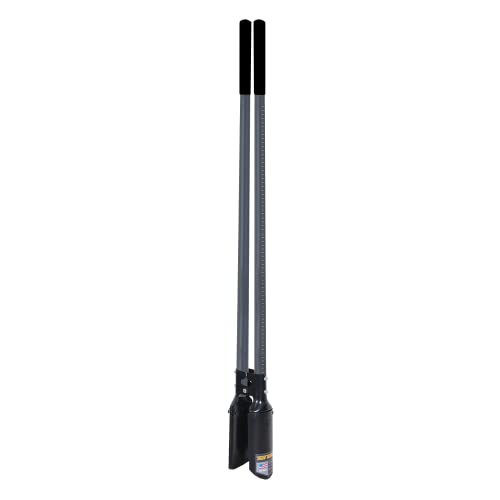
Post Hole Diggers with Ruler and Cushion End Grips on Fiberglass Handles
A two-handled digger for the holes the concrete figure is based on. Handles are 48-inch fiberglass. A ruler on the handle helps check hole depth. The maker does not state the widest hole it digs.
Check price on Amazon Opens Amazon in a new tab -
Swanson Tool Co. PL001M

Post Level
Holds itself on the post so both hands stay free while the concrete goes in. Reads plumb on two perpendicular faces at once; rotate to check the third axis. Strip magnets hold it on steel posts; an elastic strap holds it on wood, vinyl or composite.
Check price on Amazon Opens Amazon in a new tab
Which calculator do I need after the fence?
The post holes are the next job. The post hole calculator uses the bag makers' own charts for fast-setting mix, which is handy if you prefer that to the volume method above. A gravel strip or path along the fence line is a job for the gravel calculator. If the fence borders a new deck, the board count for a new deck takes the same kind of inputs.
Paths, beds and edging are covered on the yard and garden material tools page, alongside the mulch, topsoil and paver calculators.
Fence calculator questions
Does the fence calculator count the gate itself?
No. It removes the gate opening from the fence length and adds the gate posts, but the gate leaf, hinges and latch are not counted. Buy the gate to fit the opening you entered, measured post face to post face.
Why does each corner add a whole section?
Because a straight leg seldom divides into whole panels, each corner usually leaves one part-length section. Counting it as a full section is the cautious choice. If your legs are exact multiples of the post spacing, you can subtract one section, and one post, per corner.
How many pickets does one 8 ft privacy section take?
Eighteen 1×6 pickets laid edge to edge. A 1×6 is 5.5 in (140 mm) wide, and 96 in ÷ 5.5 in = 17.45, rounded up. Leave a gap between pickets and the count drops.
Should I use 50 lb or 80 lb bags for fence posts?
Either works; the calculator converts the same concrete volume to whichever you pick. The 50 lb bag is easier to lift and pour into a narrow hole, while 80 lb bags mean fewer to buy. The volume per post does not change with the bag.
Can I use this calculator for a chain-link or vinyl fence?
For the post count and post concrete, yes: choose rails and pickets and enter the post spacing from the fence maker's instructions. Ignore the rail and picket lines, because chain-link and vinyl use their own fittings, rails and fabric.
Add the fence calculator to your website
Sources (35)
- AMES Companies (Home by AMES)
- True Temper Post Hole Diggers with Ruler and Cushion End Grips on Fiberglass Handles (2704200), checked
- American Wood Council
- DCA 6 - Prescriptive Residential Wood Deck Construction Guide (2015 IRC version, (c)2018, incl. Commentary), checked
- Barrette Outdoor Living
- Wood Fence Installation Instructions (BOM-WOODFENCE), hosted by The Home Depot, checked
- Grange Fencing
- Grange Fencing Brochure 2021, checked
- Hanson (Heidelberg Materials UK)
- Instant Concrete technical data sheet, checked
- Multipurpose Concrete technical data sheet (updated August 2020), checked
- Health and Safety Executive (UK)
- Construction hazardous substances: Cement, checked
- Jacksons Fencing
- Featherboard Panel - Flat Top specification sheet (2019), checked
- How to Dig Post Holes: Expert Tips, checked
- Joint Center for Housing Studies of Harvard University
- Improving America's Housing 2025, checked
- King Packaged Materials / Sika Canada (SAKRETE Canada)
- SAKRETE Rapid Post product data sheet, checked
- MARSHALLTOWN
- Part # ML339 - Mason's Line - MARSHALLTOWN, checked
- NIST / American Lumber Standard Committee
- Voluntary Product Standard PS 20-20, American Softwood Lumber Standard, checked
- National Institute of Standards and Technology
- Handbook 44 (2026), Appendix C: General Tables of Units of Measurement, checked
- Special Publication 811 (2008), Guide for the Use of the International System of Units (SI), Appendix B.8, checked
- QUIKRETE Companies
- Setting Posts (QUIKRETE at-home project instructions), checked
- SAKRETE of North America
- SAKRETE Fast Setting Concrete Mix technical data sheet, hosted by Home Depot, checked
- SAKRETE High Strength Concrete Mix technical data sheet (REV 7-10), hosted by Home Depot, checked
- Sakrete (Oldcastle APG)
- Pro Tips: How To Set Posts & Poles, checked
- Swanson Tool Co.
- Post Level PL001M, checked
- Tarmac (Blue Circle)
- Multi-Purpose Concrete product data sheet (March 2014), hosted by Wickes, checked
- POSTCRETE product data sheet (April 2014), hosted by Wickes, checked
- The Home Depot (manufacturer not named on document)
- Wood Fence Kits Installation Instructions, checked
- The Quikrete Companies
- Project guide: Setting Posts, checked
- QUIKRETE Concrete Mix No. 1101 Data Sheet (revised Oct 2022), checked
- QUIKRETE Fast-Setting Concrete Mix No. 1004 Data Sheet, checked
- Safety Data Sheet C1: Portland Cement Based Concrete Products (rev. Feb-23), checked
- UK Parliament (legislation.gov.uk)
- Weights and Measures Act 1985, Schedule 1, checked
- US Bureau of Labor Statistics
- Producer Price Index by commodity (series WPU0811, WPU083, WPU137, WPU1322, WPU1333, WPU1321, WPU1342, WPU1344, WPU1361, WPU1392, WPU0621, WPU1231, WPU1232, WPUIP2321001), checked
- US Consumer Product Safety Commission
- NEISS Data Highlights – Calendar Year 2023, checked
- NEISS Data Highlights – Calendar Year 2024, checked
- NEISS annual data files 2015–2025 (neiss<year>.xlsx, NEISS_FMT code sheet), checked
- US Consumer Product Safety Commission (Federal Register)
- Agency Information Collection Activities; NEISS — FR Doc. 2021-23302, Docket CPSC-2009-0102, checked
- US Occupational Safety and Health Administration (29 CFR, via Cornell LII)
- 29 CFR 1926.1153 Respirable crystalline silica (construction), checked
- USDA Forest Service, Forest Products Laboratory
- Wood Handbook (FPL-GTR-282), Chapter 6: Commercial Lumber, Round Timbers, and Ties, checked
Every number on this page is taken from these documents. How we choose and check sources.