

Fiberglass vs foam vs mineral wool: R-value per inch and what to order
Foam gives the most R-value per inch, fiberglass the widest range of forms, and mineral wool sits close to fiberglass. The DOE's Building America figures put fiberglass batts and boards at R-2.5 to 4 per inch, mineral wool board at R-3 to 4, and foam from about R-3.8 for EPS to about R-6 for polyiso and high-density spray foam (U.S. DOE Building America Solution Center (PNNL) and National Institute of Standards and Technology). Pick by the space and the R-value your code asks for, then count: batts by package, blown fiberglass by bags and depth, boards by thickness.
Which insulation gives the most R-value per inch?
Rigid polyiso and high-density spray polyurethane foam, at about R-6 per inch in the DOE Building America table. XPS follows at R-5, EPS at R-3.8 to 4.4, mineral wool board at R-3 to 4, and fiberglass at R-2.5 to 4 (U.S. DOE Building America Solution Center (PNNL) and National Institute of Standards and Technology). Those are typical figures for each material type. The R-value printed on the product you buy is the one that counts for code.
R-value per inch matters most where depth is limited: a 2×4 wall, a cathedral ceiling, or continuous insulation over sheathing. In an open attic, where depth is free, it matters less, and the deciding questions are how the product is installed and how many bags or packs you need. This page compares what each type asks you to calculate and check. It does not compare price, and we hold no sourced fire or moisture ratings, so it leaves those out.
| Material | R per inch (IP) | RSI per 25 mm |
|---|---|---|
| fiberglass batt or board | 2.5–4 | 0.44–0.70 |
| mineral wool rigid board | 3–4 | 0.53–0.70 |
| EPS | 3.8–4.4 | 0.67–0.77 |
| XPS | 5 | 0.88 |
| polyiso | about 6 | about 1.06 |
| high-density spray polyurethane | about 6 | about 1.06 |
How do the three compare at a glance?
Fiberglass and foam are each several products. The rows below split them where the counting method differs.
| Attribute | Fiberglass | Foam (EPS, XPS, polyiso, spray) | Mineral wool |
|---|---|---|---|
| Forms in our sources | Batts and rolls; loose-fill for blowing | Rigid boards; spray foam | Rigid board (US); loft rolls (UK) |
| How it is counted | Batts: sq ft per package. Blown: bags per 1,000 sq ft plus minimum depth | Boards: area per board at the thickness for your R. Spray: by the installer | Board: area and thickness. Rolls: area per roll |
| R per inch (DOE) | See the table above | Highest of the three; varies by foam type | Board only, in the table above |
| Thickness for R-13 (computed from DOE R per inch) | 3.5 in batt (Owens Corning) | About 2.2 in of polyiso, 2.6 in of XPS | About 3.3–4.3 in of board |
| Waste allowance stated | None found | None found | None found |
| Handling (maker's sheet) | Skin, eye and airway irritation; cover up | Not in our sources | Not in our sources |
| England lofts, 2024 | Counted with mineral wool by the EHS | A small minority (see below) | Most insulated lofts, with glass fibre |
How is each type counted?
Fiberglass batts and rolls
Match the batt to the framing, then divide the area by the package coverage. Batts for 16 in o.c. framing are 15 in (381 mm) wide and for 24 in o.c. framing 23 in (584 mm) wide; 16 and 24 in widths also exist. A 15 x 93 in batt covers 9.7 sq ft (0.90 m2). Package coverage varies by R-value because thicker batts pack fewer pieces, as the Owens Corning table shows.
Blown fiberglass
Count by the bag chart, and meet both columns. A stated blown-in R-value needs both the minimum bags per 1,000 sq ft and the minimum thickness. AttiCat needs at least 25 bags per 1,000 sq ft (93 m2) at 17 in (432 mm) for R-49. Code compliance uses the settled R-value (International Code Council). Cellulose, the main blown alternative, needs far more bags for the same R: GreenFiber INS515LD needs at least 56 bags per 1,000 sq ft for R-49 (14.82 in initial, 13.34 in settled).
Foam and mineral wool boards
Work out the thickness first: required R ÷ R per inch, rounded up to a stocked thickness. Then divide the area by the board's face area. We hold no board sizes, so read them from the product sheet. Spray foam is quoted and installed by a contractor, who works out the thickness for your target.
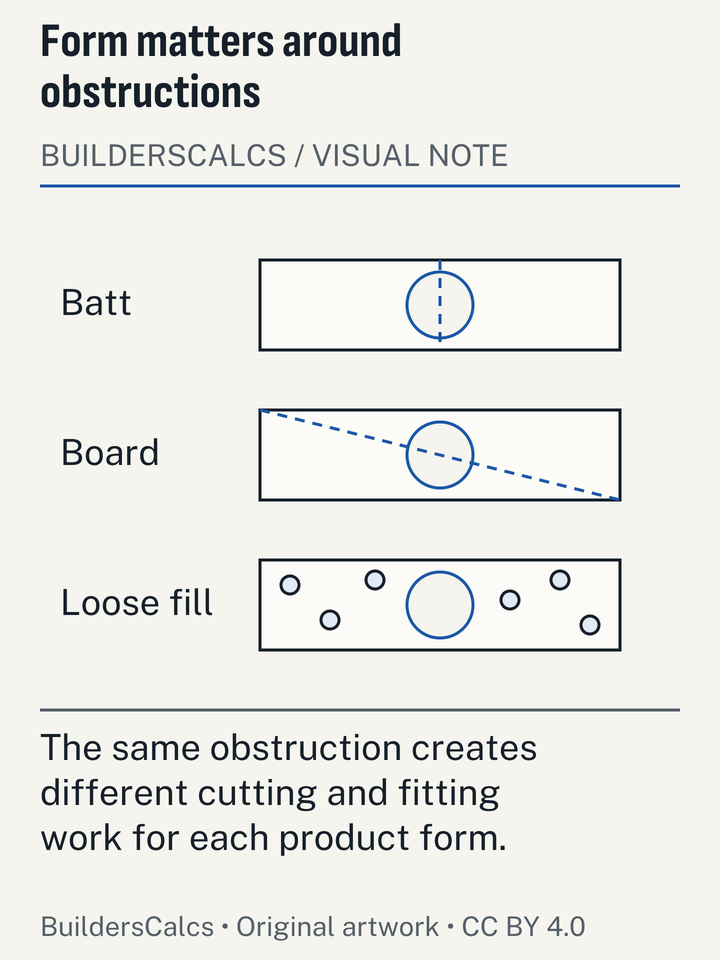
Illustration sources
- Owens Corning — EcoTouch PINK FIBERGLAS Insulation Manufacturers Fact Sheet (Pub. 10017881-A)
- Owens Corning — AttiCat Expanding Blown-in PINK FIBERGLAS Insulation Application Instructions (Pub. 10009393-E)
- GreenFiber — GreenFiber INS515LD Loose Fill Formula attic card (PM-6.3-324 Rev E)
- International Code Council — 2021 IECC Residential, Chapter 4 (Tables R402.1.2, R402.1.3; Sections R402.1.4, R402.2.1)
| R-value | Thickness (in) | Width (in) | Length (in) | sq ft per piece | Pieces per package | sq ft per package |
|---|---|---|---|---|---|---|
| 13 | 3.5 | 15 | 93 | 9.7 | 11 | 106.6 |
| 13 | 3.5 | 23 | 93 | 14.9 | 11 | 163.4 |
| 15 | 3.5 | 15 | 93 | 9.7 | 8 | 77.5 |
| 19 | 6.25 | 15 | 93 | 9.7 | 8 | 77.5 |
| 19 | 6.25 | 23 | 93 | 14.9 | 8 | 118.8 |
| 21 | 5.5 | 15 | 93 | 9.7 | 8 | 77.5 |
| 30 | 9.5 | 16 | 48 | 5.3 | 10 | 53.3 |
| 30 | 9.5 | 24 | 48 | 8 | 10 | 80 |
| 38 | 12 | 16 | 48 | 5.3 | 8 | 42.7 |
| 38 | 12 | 24 | 48 | 8 | 8 | 64 |
Worked example: R-13 in a 2×4 wall, or R-5 over the sheathing
A 2×4 stud bay is 3-1/2 in deep. R-13 fiberglass batts are 3.5 in (89 mm) thick, sized for 2x4 walls. So fiberglass fills the cavity to R-13 exactly. To reach the same R-13 in that depth with board, you would need at least 3.7 R per inch, which rules out the low end of fiberglass board and mineral wool board.
Continuous insulation is where foam's density pays. The IECC wall options in colder zones include R-20 cavity plus R-5 continuous (International Code Council). R-5 continuous is 1 in of XPS at R-5 per inch, about 0.8 in of polyiso (so a 1 in board), or 1.1 to 1.3 in of EPS. Mineral wool board at R-3 to 4 would need 1.25 to 1.7 in. The thicker board pushes out window and door trim, which is a detail to plan before ordering.
For the cavity, the insulation calculator counts batts or bags for your wall or attic area. Over insulation, the wall still needs its board: our plasterboard sheet count tool handles that step.
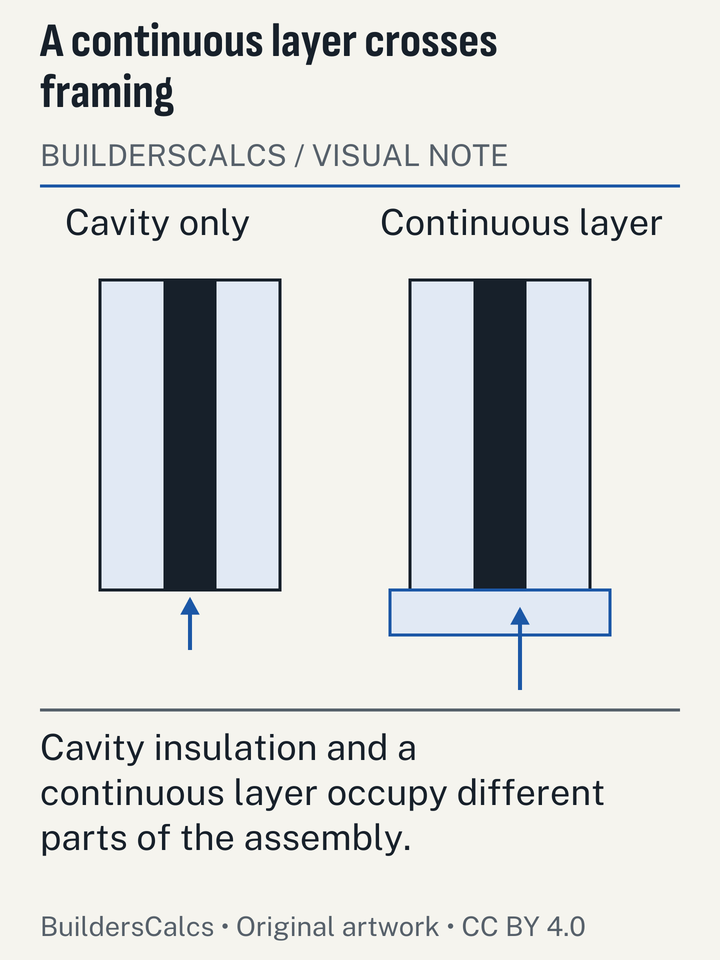
Illustration sources
What R-value does the code ask for?
In the US, the IECC sets minimum R-values by climate zone. IECC 2021 requires R-60 (RSI 10.6) ceiling insulation in climate zones 4-8. Code R-values count insulation only, not drywall, sheathing or air films; cavity and continuous insulation are checked separately. Any of the three materials can meet a ceiling target in an attic; walls are where depth limits the choice. The guide to insulation targets by zone covers each zone in detail.
In England, Approved Document L sets U-values instead. New-dwelling walls in England must not exceed U = 0.26 W/m2K. A U-value covers the whole wall, every layer and the surface films included, so it cannot be turned into an insulation R-value by taking 1 ÷ U. Multiply an imperial R-value by 0.1761 to get RSI (m2·K/W); multiply RSI by 5.678 for imperial R. The metric and imperial conversion reference has the other factors.
| Climate zone | Ceiling R | Wood-frame wall R (cavity & continuous) | Floor R |
|---|---|---|---|
| 0 | 30 | 13 or 0&10ci | 13 |
| 1 | 30 | 13 or 0&10ci | 13 |
| 2 | 49 | 13 or 0&10ci | 13 |
| 3 | 49 | 20 or 13&5ci or 0&15ci | 19 |
| 4 except Marine | 60 | 30 or 20&5ci or 13&10ci or 0&20ci | 19 |
| 5 and Marine 4 | 60 | 30 or 20&5ci or 13&10ci or 0&20ci | 30 |
| 6 | 60 | 30 or 20&5ci or 13&10ci or 0&20ci | 30 |
| 7 and 8 | 60 | 30 or 20&5ci or 13&10ci or 0&20ci | 38 |
How common is each type, and how well insulated are homes?
Mineral wool and glass fibre dominate lofts in England. 94% of English dwellings with loft insulation (just under 18 million) used mineral wool or glass fibre in 2024, against 4% rigid foam board and 1% spray foam (EHS home insulation fact sheet). Coverage still has gaps. In 2024, 42% of dwellings in England had 200mm or more of loft insulation, up from 39% in both 2014 and 2022 (English Housing Survey 2024-25, MHCLG). Over 2.7 million households in England lived in homes with less than 100mm of loft insulation in 2024-25; 1.2 million of them (43%) also had uninsulated solid walls (EHS home insulation fact sheet, May 2026). 54% of dwellings in England had cavity or solid wall insulation in 2024, up from 48% in 2014; among cavity-wall homes, 73% of owner-occupied but only 60% of private rented had it insulated (English Housing Survey 2024-25).
In the US, About 20% of US primary homes (26.8 million of 132.5 million) were reported as poorly insulated (23.3 million) or not insulated (3.4 million) in EIA's 2024 Residential Energy Consumption Survey (preliminary). Draughts are common too. About 14% of US homes (18.2 million) were reported too drafty in winter most or all of the time, and another 54.8 million some of the time, in EIA's 2024 RECS (preliminary). About 1.53 million US homeowners reported insulation projects in 2023, totalling about $3.5 billion (Harvard JCHS Table A-1, 2023 AHS).
Heating is why it matters. Space heating used 4,026 of 9,481 trillion Btu of US household site energy in 2020 (about 42%), and air conditioning 866 trillion Btu (about 9%), per EIA's 2020 RECS, the latest end-use edition (2024 RECS consumption data due 2027). Space heating took 61.5% of EU household final energy consumption in 2024 (space plus water heating 77.1%), and households used 26.0% of all EU final energy (Eurostat). ENERGY STAR estimates the return: ENERGY STAR estimates homeowners save an average of 15% on heating and cooling costs (11% of total energy costs) by air sealing and adding insulation to attics, crawlspace floors and basement rim joists. That is a modelled national average, not a promise for one house. More figures are on the home insulation statistics page.
How have insulation prices moved?
Faster than most building materials. US producer prices for insulation materials were 50.3% above the 2020 average in September 2026 and 2.7% higher than a year earlier (BLS PPI). Mineral wool on its own tracks the same path: the BLS series for mineral wool envelope insulation was 52.0% above January 2020 in September 2026 (US Bureau of Labor Statistics). In the UK, UK producer prices for thermal and acoustic insulating materials stood at 206.7 in August 2026, roughly double 2015 levels, and 4.3% higher than a year earlier (DBT Table 2, ONS data). These are producer prices, not shelf prices, so use them to judge how quickly a quote dates rather than to estimate cost.
When does this comparison not apply?
- Your product states a different R. The DOE ranges are typical; the label value is the one that counts.
- Blown insulation filled to depth but short on bags. The R-value will be lower than the chart claims.
- UK projects. Compliance is by U-value for the whole element, so a manufacturer's U-value calculation, not an R-per-inch sum, decides the thickness. We hold no UK roll sizes.
- Fire, moisture and vapour control. We hold no sourced ratings for these, and they can rule a material in or out regardless of R-value.
- Open-cell spray foam and cellulose R per inch. We found no government figure, so they are not in the table.
Which insulation suits your project?
- Open attic floor: blown fiberglass or batts. Depth is available, so R per inch matters little; meet both the bag count and the depth.
- 2×4 or 2×6 wall cavity: fiberglass or mineral wool batts sized to the stud depth, unless the target needs more R than the cavity allows.
- Continuous insulation over sheathing, or a thin roof build-up: foam board, because it reaches a given R in the least thickness.
All three can meet the IECC ceiling targets. The space, the code route and the installer decide the rest. The insulation and R-value tools turn your target into a quantity.
Questions about choosing insulation
Is mineral wool a better insulator than fiberglass?
Not by much per inch. The DOE table gives R-3 to 4 per inch for mineral wool board and R-2.5 to 4 for fiberglass batts and boards, so the ranges overlap. Choose on the product's stated R and how it suits the space.
How thick does foam board need to be for R-10?
About 2 in of XPS at R-5 per inch, or about 1.7 in of polyiso at about R-6, which in practice means the next stocked thickness up. EPS at R-3.8 to 4.4 per inch needs about 2.3 to 2.6 in.
Can I compare a US R-value with a UK U-value?
Not directly. An R-value is for the insulation alone, while a U-value is for the whole wall or roof, including other layers and surface films. Convert R to RSI to compare the insulation, but meet the UK U-value with a full calculation.
Why does blown insulation list both bags and depth?
Because the R-value depends on density as well as depth. Filling to the depth with fewer bags than the chart gives a fluffier, less effective layer. Owens Corning and GreenFiber both state a minimum for each.
Sources (22)
- Eurostat
- Energy consumption in households (Statistics Explained; data nrg_d_hhq, extracted June 2026), checked
- GreenFiber
- GreenFiber Cellulose Fiber Insulation Product Guide (DM-6.3-343 Rev A), checked
- GreenFiber INS515LD Loose Fill Formula attic card (PM-6.3-324 Rev E), checked
- International Code Council
- 2021 IECC Residential, Chapter 4 (Tables R402.1.2, R402.1.3; Sections R402.1.4, R402.2.1), checked
- Joint Center for Housing Studies of Harvard University
- Improving America's Housing 2025, checked
- National Institute of Standards and Technology
- NIST Guide to the SI (SP 811), Appendix B.9 Factors for units listed by kind of quantity, checked
- Owens Corning
- AttiCat Expanding Blown-in PINK FIBERGLAS Insulation Application Instructions (Pub. 10009393-E), checked
- EcoTouch PINK FIBERGLAS Insulation Manufacturers Fact Sheet (Pub. 10017881-A), checked
- PROPINK L77 Loosefill Insulation product data sheet (Pub. 43942-W), checked
- U.S. DOE Building America Solution Center (PNNL)
- Typical R-values and vapor retarder classifications of common insulation materials, checked
- U.S. EPA ENERGY STAR
- Recommended Home Insulation R-Values, checked
- UK Department for Business and Trade
- Construction building materials: tables September 2026, checked
- UK Government (DLUHC)
- Approved Document L, Volume 1: Dwellings, 2021 edition incorporating 2023 amendments (Tables 4.1-4.3), checked
- UK Ministry of Housing, Communities and Local Government (MHCLG)
- English Housing Survey 2024 to 2025: Headline Report on Housing Quality and Energy Efficiency, checked
- English Housing Survey 2024 to 2025: home insulation - fact sheet, checked
- US Bureau of Labor Statistics
- PPI series catalog files wp.series and pc.series (official series titles and index base dates), checked
- Producer Price Index by commodity (series WPU0811, WPU083, WPU137, WPU1322, WPU1333, WPU1321, WPU1342, WPU1344, WPU1361, WPU1392, WPU0621, WPU1231, WPU1232, WPUIP2321001), checked
- Producer Price Index monthly data, series WPUIP2311001, WPUIP2321001, WPU0811, WPU083, WPU0831, PCU321219321219, WPU137, WPU13710102, WPU1333, WPU1322, WPU1331, WPU13314101, WPU1342, WPU1321, WPU1361, WPU1392, WPU13920105, WPU062101, WPU1344, WPU1017, WPU1074051 (Jan 2020-September 2026), checked
- US EPA ENERGY STAR
- Methodology for Estimated Energy Savings from Cost-Effective Air Sealing and Insulating, checked
- US Energy Information Administration (EIA)
- 2020 RECS Table CE3.1: Annual household site end-use consumption in the United States, totals and averages, checked
- 2024 RECS Table HC2.1: Structural and geographic characteristics of U.S. homes, by housing unit type (preliminary), checked
- 2024 RECS Table HC2.3: Structural and geographic characteristics of U.S. homes, by year of construction (preliminary), checked
Every number on this page is taken from these documents. How we choose and check sources.