

Insulation calculator
Enter the area and your IECC climate zone, pick batts or blown-in, and this insulation calculator returns the packages or bags to buy and the code R-value to aim for. For an attic in zones 4 to 8, the IECC 2021 ceiling minimum is R-60: over 1,000 sq ft (93 m²) that is 32 bags of Owens Corning AttiCat blown at least 20.5 in deep. Batts are counted by the square feet printed on each package, so the answer depends on the R-value and width you choose.
Insulation calculator
v1 · US and metricEnter the area to insulate and your IECC climate zone, then choose batts or blown-in attic insulation. The result shows the code R-value for that zone and the packages or bags to buy, with the minimum blown depth and total weight.
Result
Enter your measurements and press Calculate.
Formula and assumptions
- Fiberglass batts:
Packages = area (sq ft) ÷ coverage per package, rounded up; metric:Packages = area (m²) ÷ 0.0929 → sq ft ÷ coverage per package, rounded up - Blown-in loose fill (attic floor):
Bags = area (sq ft) ÷ 1,000 × bags per 1,000 sq ft at the target R-value, rounded up; metric:Bags = area (m²) ÷ 0.0929 → sq ft ÷ 1,000 × bags per 1,000 sq ft, rounded up RSI = R × 0.1761- Code targets: IECC 2021 requires R-30 (RSI 5.3) ceiling insulation in climate zones 0-1. IECC 2021 requires R-49 (RSI 8.6) ceiling insulation in climate zones 2 and 3. IECC 2021 requires R-60 (RSI 10.6) ceiling insulation in climate zones 4-8. IECC 2021 floor insulation is R-13 in zones 0-2, R-19 in 3-4, R-30 in 5-6 and R-38 in 7-8.
- Where R-49 is required, R-38 over the whole attic counts if full-height R-38 extends over the wall top plate at the eaves (R-49 likewise for R-60). Code R-values count insulation only, not drywall, sheathing or air films; cavity and continuous insulation are checked separately.
- Blown-in: A stated blown-in R-value needs both the minimum bags per 1,000 sq ft and the minimum thickness. For blown-in insulation, code compliance uses the manufacturer's settled R-value. The GreenFiber figures are for attics with no framing adjustment.
- Batt coverage is from the Owens Corning EcoTouch fact sheet. Batts fill the cavities between framing, so a gross area slightly overstates what you need; no extra is added for waste because no maker publishes a waste figure.
- Multiply an imperial R-value by 0.1761 to get RSI (m2·K/W); multiply RSI by 5.678 for imperial R. A U-value is the reciprocal of the total RSI of all layers including surface resistances, so it cannot be compared directly with an insulation-only R-value.
- UK: In England, new-dwelling roofs must not exceed U = 0.16 W/m2K (limiting value). New-dwelling walls in England must not exceed U = 0.26 W/m2K. Approved Document L's limiting U-values are backstops; some elements usually need to be significantly better to meet overall targets.
How much insulation do I need for a 1,000 sq ft attic?
In climate zone 4, a 1,000 sq ft attic needs R-60 to meet the IECC 2021 ceiling minimum, which is 32 bags of AttiCat blown fiberglass at a depth of at least 20.5 in, weighing 880 lb in all. If you choose batts instead, the calculator's default of R-38 batts 24 in wide takes 16 packages, covering 1,024 sq ft, and it warns that one layer of R-38 falls short of the zone 4 target.
Measure the attic floor, not the roof. Length times width of the space inside the walls is the area; the roof slope does not matter for insulation laid on the ceiling. For walls, measure the wall area and subtract large windows and doors. For a floor over a crawl space or garage, use the floor area. In metric mode, enter m² and the calculator converts to square feet internally, because every package and bag chart it uses is published in square feet.
Your climate zone comes from the IECC map, which assigns one to each US county. The R-value by climate zone guide explains what each zone requires and how to top up an existing attic.
How does the calculator count batts and blown-in bags?
Batts are counted as area ÷ coverage per package, rounded up. Blown-in bags are area ÷ 1,000 × the maker's minimum bags per 1,000 sq ft at the target R-value, rounded up. The R-value is shown in both US units and RSI, using RSI = R × 0.1761102.
Worked example: batts on an attic floor
A 1,000 sq ft attic in zone 4 with R-38 batts 24 in wide: An Owens Corning EcoTouch R-38 package of 24 x 48 in pieces (8 pieces) covers 64.0 sq ft. So 1,000 ÷ 64 = 15.6, rounded up to 16 packages. Each batt is 12 in thick. The R-value is R-38 (RSI 6.69), while the zone 4 target is R-60 (RSI 10.57), so the calculator adds a note suggesting a higher R-value or a second layer.
Worked example: blown cellulose
A 1,200 sq ft attic filled with GreenFiber INS515LD to R-38: GreenFiber INS515LD needs at least 40.9 bags per 1,000 sq ft for R-38. So 1,200 ÷ 1,000 × 40.9 = 49.1, rounded up to 50 bags, or 1,500 lb of material at 30 lb a bag. GreenFiber INS515LD is installed at least 11.6 in thick for R-38. GreenFiber INS515LD settles to at least 10.44 in for R-38.
In metric, 93 m² of attic in zone 2 converts to 1,001 sq ft. AttiCat to R-49 needs 1,001 ÷ 1,000 × 25 = 25.03, rounded up to 26 bags, at least 432 mm deep and 324 kg in all.
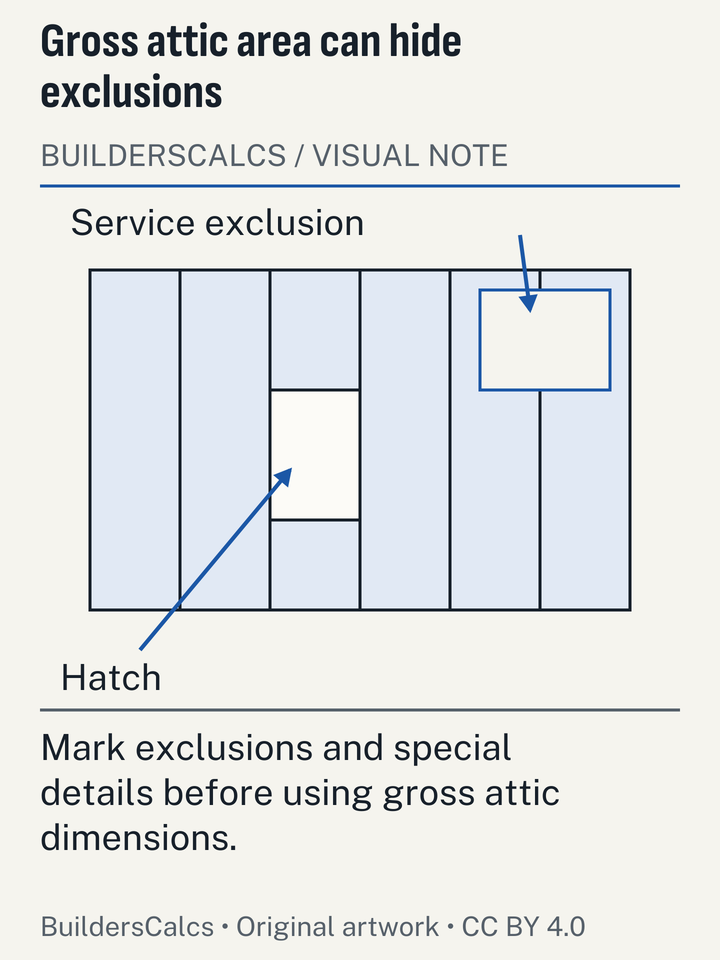
Illustration sources
- NIST — NIST Guide to the SI (SP 811), Appendix B.9 Factors for units listed by kind of quantity
- Owens Corning — EcoTouch PINK FIBERGLAS Insulation Manufacturers Fact Sheet (Pub. 10017881-A)
- International Code Council — 2021 IECC Residential, Chapter 4 (Tables R402.1.2, R402.1.3; Sections R402.1.4, R402.2.1)
- U.S. EPA ENERGY STAR — Recommended Home Insulation R-Values
- GreenFiber — GreenFiber INS515LD Loose Fill Formula attic card (PM-6.3-324 Rev E)
- Owens Corning — AttiCat Expanding Blown-in PINK FIBERGLAS Insulation Application Instructions (Pub. 10009393-E)
| Job | Inputs | Code target | Buy | Depth | Notes |
|---|---|---|---|---|---|
| Attic, batts | 1,000 sq ft, zone 4, R-38 × 24 in | R-60 (RSI 10.57) | 16 packages (1,024 sq ft) | 12 in | One layer is below the target |
| Floor, batts | 500 sq ft, zone 5, R-30 × 24 in | R-30 (RSI 5.28) | 7 packages (560 sq ft) | 9.5 in | Meets the target |
| Wall, batts | 400 sq ft, R-13 × 15 in | Not shown (walls) | 4 packages (426.4 sq ft) | 3.5 in | Check the wall table by zone |
| Attic, AttiCat | 1,000 sq ft, zone 4 | R-60 (RSI 10.57) | 32 bags (880 lb) | 20.5 in minimum | Meets the target |
| Attic, GreenFiber | 1,200 sq ft, zone 4, R-38 | R-60 (RSI 10.57) | 50 bags (1,500 lb) | 10.44 in settled (11.6 in installed) | Below the target |
| Attic, AttiCat (metric) | 93 m², zone 2 | R-49 (RSI 8.63) | 26 bags (324 kg) | 432 mm minimum | England U-value note shown |
| Attic, batts (metric) | 50 m², zone 1, R-30 × 24 in | R-30 (RSI 5.28) | 7 packages (52 m²) | 241 mm | England U-value note shown |
What R-value does the code require in my climate zone?
For attics, the IECC 2021 minimum is R-30 in zones 0 and 1, R-49 in zones 2 and 3, and R-60 in zones 4 to 8 (International Code Council). The calculator picks the ceiling or floor target from the zone and location you choose. IECC 2021 floor insulation is R-13 in zones 0-2, R-19 in 3-4, R-30 in 5-6 and R-38 in 7-8.
Walls are different. The code gives a menu of cavity and continuous insulation combinations rather than one number, so the calculator shows no single wall target and points you to the table. Two rules make the attic figures less strict than they look. Where R-49 is required, R-38 over the whole attic counts if full-height R-38 extends over the wall top plate at the eaves (R-49 likewise for R-60). And the code counts only the insulation: Code R-values count insulation only, not drywall, sheathing or air films; cavity and continuous insulation are checked separately.
These are minimums for new work, and states adopt code editions on their own timetable, so check which edition your building department enforces.
| Climate zone | Ceiling R | Wood-frame wall R | Floor R |
|---|---|---|---|
| 0 | 30 | 13 or 0&10ci | 13 |
| 1 | 30 | 13 or 0&10ci | 13 |
| 2 | 49 | 13 or 0&10ci | 13 |
| 3 | 49 | 20 or 13&5ci or 0&15ci | 19 |
| 4 except Marine | 60 | 30 or 20&5ci or 13&10ci or 0&20ci | 19 |
| 5 and Marine 4 | 60 | 30 or 20&5ci or 13&10ci or 0&20ci | 30 |
| 6 | 60 | 30 or 20&5ci or 13&10ci or 0&20ci | 30 |
| 7 and 8 | 60 | 30 or 20&5ci or 13&10ci or 0&20ci | 38 |
How many packages do fiberglass batts cover?
It depends on the R-value and width, because thicker batts fit fewer pieces in a bag. A package of R-13 batts 15 in wide covers 106.6 sq ft per package, while R-38 in the 16 in width covers only 42.7 sq ft per package. Batts for 16 in o.c. framing are 15 in (381 mm) wide and for 24 in o.c. framing 23 in (584 mm) wide; 16 and 24 in widths also exist. Pick the width that matches your framing: 15 or 23 in batts for wall studs, and the wider attic batts where the joists allow.
The coverage figures are from the Owens Corning EcoTouch fact sheet. Other brands package differently, and Johns Manville and Knauf figures were not available to us, so check the square feet printed on the bag you buy. If they differ, divide your area by that figure yourself.
| R-value | Thickness (in) | Width (in) | Length (in) | Sq ft per piece | Pieces per package | Sq ft per package |
|---|---|---|---|---|---|---|
| 13 | 3.5 | 15 | 93 | 9.7 | 11 | 106.6 |
| 13 | 3.5 | 23 | 93 | 14.9 | 11 | 163.4 |
| 15 | 3.5 | 15 | 93 | 9.7 | 8 | 77.5 |
| 19 | 6.25 | 15 | 93 | 9.7 | 8 | 77.5 |
| 19 | 6.25 | 23 | 93 | 14.9 | 8 | 118.8 |
| 21 | 5.5 | 15 | 93 | 9.7 | 8 | 77.5 |
| 30 | 9.5 | 16 | 48 | 5.3 | 10 | 53.3 |
| 30 | 9.5 | 24 | 48 | 8 | 10 | 80 |
| 38 | 12 | 16 | 48 | 5.3 | 8 | 42.7 |
| 38 | 12 | 24 | 48 | 8 | 8 | 64 |
Is the blown-in depth enough to reach the R-value?
No. A blown-in R-value is only reached when both the minimum bag count and the minimum depth are met. A stated blown-in R-value needs both the minimum bags per 1,000 sq ft and the minimum thickness. Fluffing the material to the right depth with too few bags leaves it less dense than the maker rated, so the R-value falls short even though the ruler says otherwise. That is why the calculator gives both numbers and why the bag count is a minimum, not an estimate.
Cellulose also settles after it is blown. For blown-in insulation, code compliance uses the manufacturer's settled R-value. The calculator shows the settled and installed depths for GreenFiber, and a single minimum depth for AttiCat, as each maker states them. The two products need very different bag counts. Owens Corning AttiCat blown fiberglass comes in 27.5 lb (12.5 kg) bags. GreenFiber INS515LD cellulose comes in 30 lb (13.6 kg) nominal bags. At R-49, AttiCat needs 25 bags per 1,000 sq ft and GreenFiber 56, so a cellulose job moves far more weight into the attic.
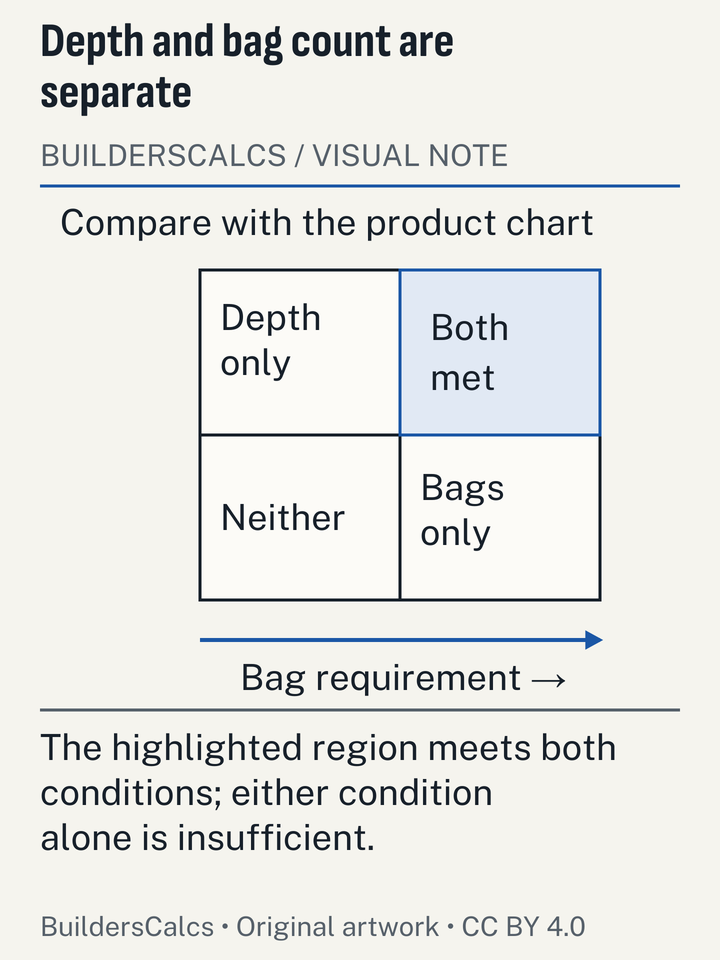
Illustration sources
- Owens Corning — AttiCat Expanding Blown-in PINK FIBERGLAS Insulation Application Instructions (Pub. 10009393-E)
- GreenFiber — GreenFiber INS515LD Loose Fill Formula attic card (PM-6.3-324 Rev E)
- International Code Council — 2021 IECC Residential, Chapter 4 (Tables R402.1.2, R402.1.3; Sections R402.1.4, R402.2.1)
| R-value | Minimum bags per 1,000 sq ft | Maximum sq ft per bag | Minimum lb per sq ft | Minimum thickness (in) |
|---|---|---|---|---|
| 13 | 5.9 | 169.8 | 0.162 | 5 |
| 19 | 9 | 110.7 | 0.248 | 7 |
| 22 | 10.5 | 94.8 | 0.29 | 8 |
| 26 | 12.6 | 79.3 | 0.347 | 9.5 |
| 30 | 14.6 | 68.5 | 0.402 | 10.75 |
| 38 | 19 | 52.6 | 0.523 | 13.5 |
| 44 | 22.4 | 44.6 | 0.616 | 15.5 |
| 49 | 25 | 39.9 | 0.688 | 17 |
| 60 | 31.5 | 31.8 | 0.866 | 20.5 |
| R-value | Installed depth (in) | Settled depth (in) | Minimum bags per 1,000 sq ft | Maximum sq ft per bag |
|---|---|---|---|---|
| 11 | 3.38 | 3.04 | 9.8 | 102.5 |
| 13 | 4.01 | 3.61 | 11.8 | 84.9 |
| 19 | 5.88 | 5.29 | 18.1 | 55.2 |
| 22 | 6.8 | 6.12 | 21.5 | 46.6 |
| 26 | 8.02 | 7.22 | 26.1 | 38.4 |
| 30 | 9.22 | 8.3 | 30.8 | 32.4 |
| 38 | 11.6 | 10.44 | 40.9 | 24.4 |
| 44 | 13.36 | 12.03 | 49 | 20.4 |
| 49 | 14.82 | 13.34 | 56 | 17.9 |
| 60 | 17.99 | 16.19 | 72.4 | 13.8 |
Should I add extra insulation for waste?
The calculator adds none, because neither Owens Corning nor GreenFiber publishes a waste figure, and we found no other source that does. Two things already give you a margin. Packages and bags round up, so the default attic buys 1,024 sq ft of batts for 1,000 sq ft. And batts sit between the framing, so the gross area you enter slightly overstates the area of insulation needed.
For blown-in, do not cut the bag count to save money. It is the maker's minimum for the rated R-value. If the bags run out before the whole attic reaches the depth markers, buy more rather than spreading what you have thinner.
How do UK U-values compare with US R-values?
They measure different things, so one cannot be converted into the other by flipping it. A U-value is the reciprocal of the total RSI of all layers including surface resistances, so it cannot be compared directly with an insulation-only R-value. In England, Approved Document L sets U-values for whole elements: In England, new-dwelling roofs must not exceed U = 0.16 W/m2K (limiting value). Approved Document L's limiting U-values are backstops; some elements usually need to be significantly better to meet overall targets. In metric mode the calculator shows the England limits as a note, but the package and bag counts still come from US products.
UK loft rolls are sold in different sizes from US batts, and sourced roll coverage for Knauf, Rockwool or Isover was not available to us. For a UK loft, use the calculator's m² area and divide by the coverage printed on the roll. Scotland, Wales and Northern Ireland set their own limits, which are not covered here.
| Element | New dwelling (W/m²K) | New element, existing dwelling | Existing: threshold | Existing: improved to |
|---|---|---|---|---|
| roof | 0.16 | 0.15 | 0.35 | 0.16 |
| wall | 0.26 | 0.18 | 0.7 | 0.55 cavity / 0.30 internal or external |
| floor | 0.18 | 0.18 | 0.7 | 0.25 |
| window | 1.6 | 1.4 | None | None |
| door | 1.6 | 1.4 | None | None |
How many homes are under-insulated?
About one in five US homes, by their occupants' own account. About 20% of US primary homes (26.8 million of 132.5 million) were reported as poorly insulated (23.3 million) or not insulated (3.4 million) in EIA's 2024 Residential Energy Consumption Survey (preliminary). Age is the biggest factor: About 37% of US homes built before 1950 (7.4 million of 20.25 million) were reported poorly insulated or not insulated in 2024, versus about 9% of homes built 2020 to 2024 (EIA RECS 2024, preliminary). Comfort complaints follow: About 14% of US homes (18.2 million) were reported too drafty in winter most or all of the time, and another 54.8 million some of the time, in EIA's 2024 RECS (preliminary).
England has a similar gap. In 2024, 42% of dwellings in England had 200mm or more of loft insulation, up from 39% in both 2014 and 2022 (English Housing Survey 2024-25, MHCLG). Over 2.7 million households in England lived in homes with less than 100mm of loft insulation in 2024-25; 1.2 million of them (43%) also had uninsulated solid walls (EHS home insulation fact sheet, May 2026). Most of what is up there is glass or mineral fibre: 94% of English dwellings with loft insulation (just under 18 million) used mineral wool or glass fibre in 2024, against 4% rigid foam board and 1% spray foam (EHS home insulation fact sheet). The under-insulated homes data page has the full series.
Is adding insulation worth it?
Heating is the largest single use of energy in most homes, so insulation works on the biggest part of the bill. Space heating used 4,026 of 9,481 trillion Btu of US household site energy in 2020 (about 42%), and air conditioning 866 trillion Btu (about 9%), per EIA's 2020 RECS, the latest end-use edition (2024 RECS consumption data due 2027). In Europe the share is higher: Space heating took 61.5% of EU household final energy consumption in 2024 (space plus water heating 77.1%), and households used 26.0% of all EU final energy (Eurostat). ENERGY STAR estimates homeowners save an average of 15% on heating and cooling costs (11% of total energy costs) by air sealing and adding insulation to attics, crawlspace floors and basement rim joists. That ENERGY STAR estimate assumes air sealing as well as insulation, so sealing gaps around pipes, flues and the attic hatch first is part of the job.
Many homeowners do it every year. About 1.53 million US homeowners reported insulation projects in 2023, totalling about $3.5 billion (Harvard JCHS Table A-1, 2023 AHS). Prices have risen: US producer prices for insulation materials were 50.3% above the 2020 average in September 2026 and 2.7% higher than a year earlier (BLS PPI). The calculator stores no prices, so check current bag and package prices before you compare batts with blown-in. For R per inch and the trade-offs between materials, see fiberglass vs foam vs mineral wool.
As an Amazon Associate I earn from qualifying purchases. Links to Amazon below can earn us a commission at no cost to you. Affiliate disclosure.
Protective gear and tools for insulating
Batts and blown insulation need cutting, fixing and protection from the fibres. These items are chosen from their makers' published specifications; we have not used or measured them. Links go to Amazon, as explained in our affiliate disclosure.
-
3M 8511

3M Cool Flow Valve Particulate Respirator 8511, N95
GreenFiber tells installers to wear an N95 mask when blowing cellulose, and fiberglass dust irritates airways. NIOSH-approved N95: at least 95% filtration efficiency against certain non-oil-based particles. Cool Flow exhalation valve releases warm, moist exhaled air.
Check price on Amazon Opens Amazon in a new tab -
Milwaukee 48-73-2012

Milwaukee Safety Glasses - Clear Fog-Free Lenses
Eye protection for overhead work, where fibres fall towards your face. Meets ANSI Z87.1+. Fog-free lenses that also resist scratching.
Check price on Amazon Opens Amazon in a new tab -
Arrow HT50GR-4

Arrow HT50-4 Chromed Steel Hammer Tacker Stapler
For stapling the flanges of faced batts to studs or joists. Takes Arrow T50 staples in 5/16 in, 3/8 in or 1/2 in leg lengths (8, 10 or 12 mm). Rear-load magazine holds two staple strips to cut down on reloads.
Check price on Amazon Opens Amazon in a new tab
When is the insulation count wrong?
- Existing insulation. The calculator counts a full depth from bare joists. If there is already some in the attic, you need less. ENERGY STAR suggests adding R-25 to R-49 over 3-4 in of existing attic insulation, depending on zone.
- Walls. Wall targets combine cavity and continuous insulation, so the calculator counts batts but does not judge compliance.
- Cathedral ceilings and knee walls. These are sloped or vertical, so blown-in attic charts do not apply. Use batts and measure each surface.
- Batt thickness and framing depth. Batts are sized for particular framing: R-13 fiberglass batts are 3.5 in (89 mm) thick, sized for 2x4 walls. R-21 batts fit 2x6 walls at 5.5 in (140 mm). Pick the batt that matches your studs or joists rather than forcing a thicker one in.
- Other products. Only the listed Owens Corning batts and the two blown products are modelled. For anything else, use the coverage on the bag.
Insulation often goes in just before the walls or ceiling are closed up; the plasterboard sheet count calculator handles that next step. If the roof is being replaced at the same time, the roofing calculator counts squares and bundles. Both sit with the other tools in the thermal insulation category.
Insulation calculator questions
How many packages of R-38 batts cover 1,000 sq ft?
16 packages of the 24 in wide Owens Corning EcoTouch batts, at 64 sq ft per package each. In the 16 in width, which covers 42.7 sq ft per package per package, it takes 24 packages.
How heavy is blown-in insulation for an attic?
Multiply the bag count by the bag weight. AttiCat bags weigh 27.5 lb and GreenFiber INS515LD bags 30 lb, so R-60 over 1,000 sq ft is 880 lb of AttiCat. The calculator shows the total with every blown-in result.
Which IECC climate zone am I in?
The IECC map assigns a zone to every US county, and your building department can confirm the one it uses. Zone 4 Marine is listed separately in the calculator because its floor target, R-30, differs from the R-19 that applies in the rest of zone 4.
Why doesn't the insulation calculator add waste?
Because no insulation maker in our sources publishes a waste allowance. Rounding up to whole packages and bags already leaves a little spare, and the gross area you enter includes the framing that batts do not cover.
Embed the insulation calculator
Sources (24)
- 3M
- 3M Cool Flow Valve Particulate Respirator 8511, checked
- Arrow Fastener (Arrow Tool Group)
- Arrow HT50-4 Chromed Steel Hammer Tacker Stapler, checked
- Eurostat
- Energy consumption in households (Statistics Explained; data nrg_d_hhq, extracted June 2026), checked
- GreenFiber
- GreenFiber Cellulose Fiber Insulation Product Guide (DM-6.3-343 Rev A), checked
- GreenFiber INS515LD Loose Fill Formula attic card (PM-6.3-324 Rev E), checked
- International Code Council
- 2021 IECC Residential, Chapter 4 (Tables R402.1.2, R402.1.3; Sections R402.1.4, R402.2.1), checked
- Joint Center for Housing Studies of Harvard University
- Improving America's Housing 2025, checked
- Milwaukee Tool
- Safety Glasses - Clear Fog-Free Lenses | Milwaukee Tool, checked
- National Institute of Standards and Technology
- Handbook 44 (2026), Appendix C: General Tables of Units of Measurement, checked
- NIST Guide to the SI (SP 811), Appendix B.9 Factors for units listed by kind of quantity, checked
- Special Publication 811 (2008), Guide for the Use of the International System of Units (SI), Appendix B.8, checked
- Owens Corning
- AttiCat Expanding Blown-in PINK FIBERGLAS Insulation Application Instructions (Pub. 10009393-E), checked
- EcoTouch PINK FIBERGLAS Insulation Manufacturers Fact Sheet (Pub. 10017881-A), checked
- PROPINK L77 Loosefill Insulation product data sheet (Pub. 43942-W), checked
- U.S. EPA ENERGY STAR
- Recommended Home Insulation R-Values, checked
- UK Government (DLUHC)
- Approved Document L, Volume 1: Dwellings, 2021 edition incorporating 2023 amendments (Tables 4.1-4.3), checked
- UK Ministry of Housing, Communities and Local Government (MHCLG)
- English Housing Survey 2024 to 2025: Headline Report on Housing Quality and Energy Efficiency, checked
- English Housing Survey 2024 to 2025: home insulation - fact sheet, checked
- UK Parliament (legislation.gov.uk)
- Weights and Measures Act 1985, Schedule 1, checked
- US Bureau of Labor Statistics
- Producer Price Index by commodity (series WPU0811, WPU083, WPU137, WPU1322, WPU1333, WPU1321, WPU1342, WPU1344, WPU1361, WPU1392, WPU0621, WPU1231, WPU1232, WPUIP2321001), checked
- US EPA ENERGY STAR
- Methodology for Estimated Energy Savings from Cost-Effective Air Sealing and Insulating, checked
- US Energy Information Administration (EIA)
- 2020 RECS Table CE3.1: Annual household site end-use consumption in the United States, totals and averages, checked
- 2024 RECS Table HC2.1: Structural and geographic characteristics of U.S. homes, by housing unit type (preliminary), checked
- 2024 RECS Table HC2.3: Structural and geographic characteristics of U.S. homes, by year of construction (preliminary), checked
Every number on this page is taken from these documents. How we choose and check sources.