

How to measure for fencing: corner posts, gates and slopes
Measure each straight run between corners on the level, not along the ground, then divide by the post spacing: 8 ft (2.44 m) (2.44 m) on centre for US pre-built panels, or a 1.83 m UK panel plus one post width. Round up and add one post to finish each run, subtract openings for gates first, and count each corner post once. A three-sided 216 ft yard with one gate works out at 29 posts and 27 panels.
How do you measure for a fence, step by step?
Eight steps, from boundary to shopping list. Do them in order: a post position fixed before the gate is placed is the commonest reason for a part panel in the wrong spot.
- Confirm the line. Find the boundary from your deed plan, plat or survey, and check local rules on height and set-back with the building department, council or homeowners' association before you set anything out.
- Have utilities marked. Book underground utility marking before any digging, and plan post positions around the marks.
- Stake the corners and ends. Drive a stake at every corner, every end and both sides of each gate.
- Run a string line. Tie a mason's line tight between stakes, a little above ground. The line, not the ground, is your fence.
- Measure each run. Measure along the line from stake centre to stake centre, with a tape on short runs or a measuring wheel on long ones. Write each run down separately.
- Measure the fall on slopes. Level the line with a line level from the high stake and measure straight down to the ground at the low stake. That is the drop.
- Place gates, then posts. Subtract each gate opening from its run, then mark post centres along the rest at your spacing. Push any part panel to the least visible end.
- Count materials. Posts, panels or rails and pickets, concrete and gravel for each hole.
How far apart do fence posts go?
US pre-built wood panels are set with posts 8 ft on center. (Barrette Outdoor Living and The Home Depot (manufacturer not named on document)) Standard UK fence panels are 1.83 m (6 ft) wide. (Jacksons Fencing and Grange Fencing)
The rule that ties these together: Post center-to-center equals the panel width plus one post width. (Barrette Outdoor Living and The Home Depot (manufacturer not named on document)) So measure the actual panel you are buying, add your post's actual width, and use that as the spacing. A UK 1.83 m panel between 100 mm posts sets the centres 1.93 m apart, not 1.83 m. Skip the post width and every bay ends up short, and the error compounds along the run.
The counting formulas the fence calculator uses come from a fence kit guide (The Home Depot (manufacturer not named on document)):
- Posts in a straight run: run length ÷ spacing, rounded up, plus 1.
- Panels in a run: run length ÷ (panel width + post width), rounded up.
- Pickets per section: (section width + gap) ÷ (picket width + gap), rounded up.
A common mistake is to assume US and UK panels are interchangeable sizes. They are not, so a US plan in feet cannot be bought panel-for-panel from a UK merchant.
Worked example: a three-sided back yard with a gate
A yard fenced on three sides, 60 ft, 96 ft and 60 ft, with a 4 ft gate at the house end of the last side, needs 29 posts and 27 panels with US panels on 8 ft centres.
- Side A, 60 ft: 60 ÷ 8 = 7.5, so 8 sections (7 full and one 4 ft part panel) and 9 posts.
- Side B, 96 ft: 96 ÷ 8 = 12 sections and 13 posts.
- Side C, 60 ft with a 4 ft gate: fence length 60 − 4 = 56 ft, so 7 sections and 8 posts, plus 1 gate post at the house side of the opening: 9 posts.
- Corners: 9 + 13 + 9 = 31, less the 2 corner posts that A–B and B–C share, gives 29 posts.
- Panels: 8 + 12 + 7 = 27, one of them cut down.
- Rails, if stick-built: Use two backer rails on short fences, three on 6 ft fences and four on 8 ft fences. At three rails for a 6 ft fence, 27 sections take 81 rails (The Home Depot (manufacturer not named on document)).
The gate width here is the opening between post faces. Hinges, latch and swing clearance come off that width, and those depend on the gate's hardware, so read its instructions before fixing the opening.
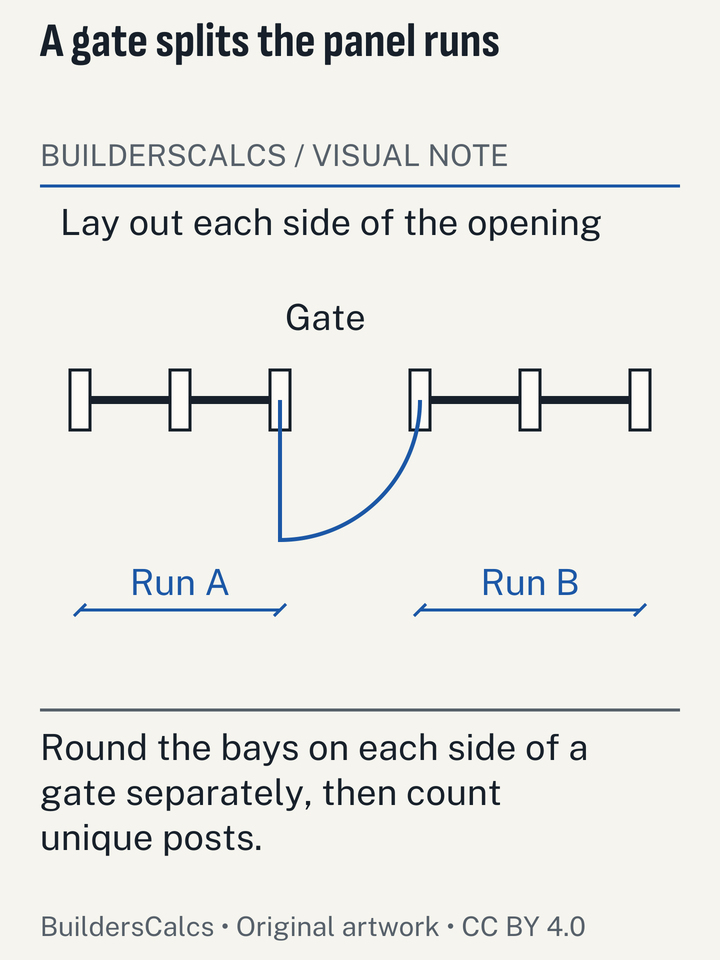
The example yard, run by run
| Run | Length | Fenced length | Sections | Posts |
|---|---|---|---|---|
| Side A | 60 ft (18.3 m) | 60 ft | 8 (1 part panel) | 9 |
| Side B | 96 ft (29.3 m) | 96 ft | 12 | 13 |
| Side C with 4 ft gate | 60 ft (18.3 m) | 56 ft | 7 | 9 (incl. gate post) |
| Shared corners | −2 | |||
| Total | 216 ft (65.8 m) | 212 ft | 27 | 29 |
How do you measure a fence line on a slope?
Measure the horizontal distance, not the distance along the ground, because panels and post spacings are horizontal widths. On a slope the ground distance is always the longer of the two.
Finding the drop
Tie a string to the uphill stake at ground level, run it to the downhill stake, and slide a line level onto it. Raise the string at the low end until the bubble centres, then measure from the string down to the ground. That is the total drop over the run.
Correcting a wheel or tape reading
A wheel or a tape laid on the ground reads the slope length. The horizontal run is √(slope length² − drop²). For a 50 ft wheel reading with a 5 ft drop, that is √(2,500 − 25) = 49.75 ft. On a gentle slope the difference is small, about 3 in here, but on a steep bank it can cost a panel.
Stepping the panels
Rigid panels on a slope are stepped: each one sits level, a little lower than the last. Divide the drop by the number of sections to get the step. On the run above, 49.75 ÷ 8 = 6.2, so 7 sections, and 60 in ÷ 7 = 8.6 in (218 mm) per step. The downhill post at each step needs to be that much longer above ground, and the triangular gaps under each panel need filling with gravel boards or soil. Some panels can instead be racked to follow the slope; check the panel's own instructions before planning on it.
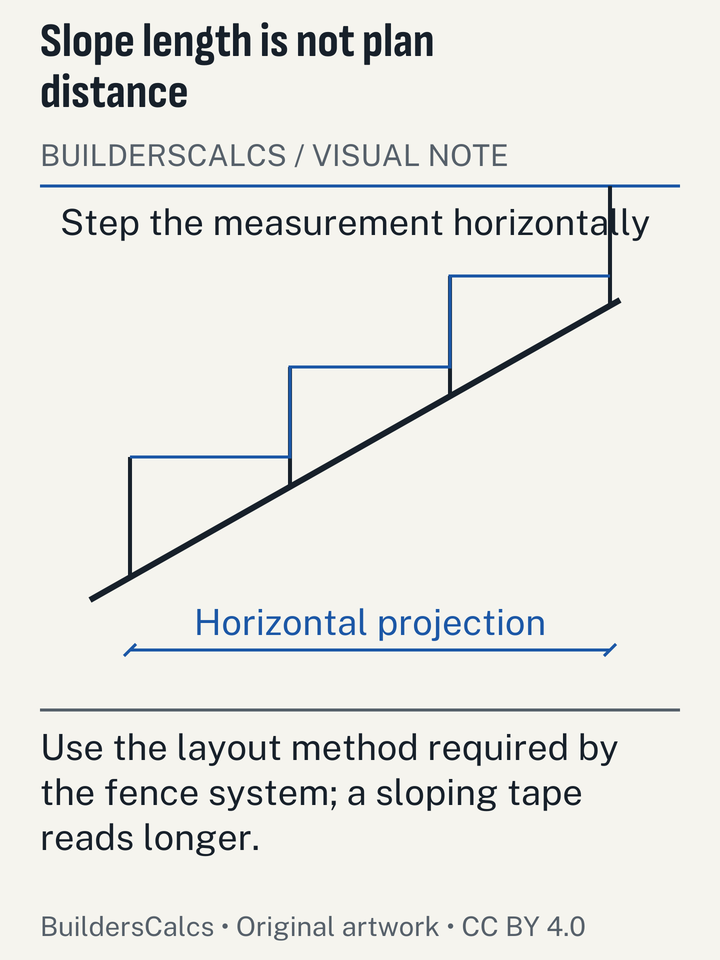
How long do the posts need to be?
Post length is fence height plus hole depth, and the sources disagree on the hole depth, so pick one rule and check it against your frost line.
- Concrete makers say to dig about one-third (up to one-half) of the post's above-ground height. (QUIKRETE Companies and Sakrete (Oldcastle APG))
- A wood fence kit guide says to bury 1/3 of the post length, 6 in deeper for end, corner and gate posts. (The Home Depot (manufacturer not named on document))
- UK guidance: set posts at least 600 mm deep; a 1.8 m fence needs a 2.4 m post. (Jacksons Fencing)
- Where ground freezes, post holes go below the frost line (check local code). (Barrette Outdoor Living and Sakrete (Oldcastle APG))
The belief that one-third is always deep enough fails in cold climates, where the hole must reach below the frost line plus the gravel base, which can be deeper than a third (QUIKRETE Companies, Sakrete (Oldcastle APG) and others). Sakrete's example pairs a 6 ft fence with a 2 ft hole and an 8 ft post.
The hole itself
Dig the hole about three times the post width (4 in post -> 12 in hole). Then put about 6 in (150 mm) of gravel in the bottom for drainage (QUIKRETE Companies, Barrette Outdoor Living and others). For a 4x4, which measures 3½ in, that is a 10½ in hole. Across the 29 holes in the example, a 6 in gravel base in 10½ in holes comes to about 8.7 cu ft (0.25 m³) of stone, about a third of a cubic yard; the same loose-versus-compacted point covered in the guide to gravel for a driveway applies when you tamp it.
Concrete
Sakrete: about two bags of Fast Setting Concrete per hole for a standard 6 ft fence. (Sakrete (Oldcastle APG)) For 29 posts, that is about 58 bags. For a count based on your actual hole size and post, with the post's own volume subtracted, use the tool for bags of concrete per post hole.
What changes for UK panel fences?
The method is the same; the sizes are metric and the parts differ. Jacksons featherboard panel heights run from 0.6 m to 1.8 m. Jacksons featherboard panels use two or three rails depending on height. A Jacksons featherboard panel carries 22 pales 100 mm wide. (Jacksons Fencing)
UK panels in contact with the ground need gravel boards. Allow for a gravel board under every panel when counting, and add its height to the post length. For the 18.3 m side in the example, 1.83 m panels on 100 mm posts set at 1.93 m centres give 18.3 ÷ 1.93 = 9.5, so 10 panels and 11 posts.
How common is a fence project?
Common enough that suppliers stock the parts year-round. Harvard's Joint Center for Housing Studies, tabulating the 2023 American Housing Survey, counts about 2.85 million US homeowners reporting a fencing or wall project in 2023 (Joint Center for Housing Studies of Harvard University). That figure covers fences and walls together, done by owners and contractors alike, so it measures how often households take the job on rather than how many fences are self-built.
As an Amazon Associate I earn from qualifying purchases. Links to Amazon below can earn us a commission at no cost to you. Affiliate disclosure.
Tools for measuring a fence line
Three tools cover the measuring steps above. They were chosen from the manufacturers' published specifications; we have not handled or measured them. Links go to Amazon; read how affiliate links work here.
-
Keson RR318N

Roadrunner Large Measuring Wheel
For long runs where a tape sags. One revolution equals 3 ft (circumference). The 5-digit magnified counter reads to 9,999 ft 11 in. It reads the ground distance, so correct slope readings as shown above. The maker does not state an accuracy figure; check it against a tape over a known distance.
Check price on Amazon Opens Amazon in a new tab -
Swanson LLA001

Line Level
For measuring the drop on a sloping run. Open hooks slide along string or filament without catching. The level is 4 inches long. Swanson lists finding low spots in fence runs among its uses. It does not publish a vial sensitivity.
Check price on Amazon Opens Amazon in a new tab -
MARSHALLTOWN ML339

MARSHALLTOWN Braided Mason's Line, 500 ft, Fluorescent Yellow
The string line every measurement is taken from. Holds 500 feet of line. Braided nylon line. The maker says the line is not affected by extreme moisture or dryness. No tensile strength is published.
Check price on Amazon Opens Amazon in a new tab
When do fence measurements go wrong?
- The boundary is assumed. An old fence or a hedge line is not proof of the boundary. If in doubt, get the survey before the posts go in.
- Curves. A curved line is a series of short straight runs. Measure each chord between posts, not the curve.
- Rough ground under the wheel. Tussocks and ruts add distance. On rough ground, use a tape pulled tight along the string.
- Existing posts and walls. Where a run starts at a house wall or an old post, measure from its face and note whether it will carry a panel.
- Steep banks. Where the step per panel gets large, or the fence also retains soil, it stops being a simple fence. See the landscaping calculators for retaining walls, and get an engineer's design for any wall above your local code's height limit.
Bottom line
Set out with stakes and a tight string, measure each run on the level, place gates before posts, and space posts at the panel width plus the post width. Count posts per run, then take off one for every shared corner. On slopes, measure the drop with a line level and step the panels by drop ÷ sections. Post depth is where the sources disagree, so use the deeper of your chosen rule and the frost line.
Fence measuring questions
How many fence posts does a 100 ft straight run need?
With posts 8 ft on centre: 100 ÷ 8 = 12.5, rounded up to 13 sections, plus 1 = 14 posts. With UK 1.83 m panels on 100 mm posts, a 30.5 m run needs 16 panels and 17 posts.
Should I measure a fence line along the ground or level?
Level. Panels are a fixed horizontal width, so measure horizontally or correct a ground measurement with √(slope length² − drop²).
Do corner posts count twice when adding up runs?
No. Each run's count includes the posts at both ends, so subtract one post for every corner two runs share.
How long should posts be for a 1.8 m UK fence?
Jacksons gives 600 mm in the ground as the minimum, so a 1.8 m fence needs a 2.4 m post, before adding any gravel board height.
Sources (18)
- American Wood Council
- DCA 6 - Prescriptive Residential Wood Deck Construction Guide (2015 IRC version, (c)2018, incl. Commentary), checked
- Barrette Outdoor Living
- Wood Fence Installation Instructions (BOM-WOODFENCE), hosted by The Home Depot, checked
- Grange Fencing
- Grange Fencing Brochure 2021, checked
- Health and Safety Executive (UK)
- Construction hazardous substances: Cement, checked
- Jacksons Fencing
- Featherboard Panel - Flat Top specification sheet (2019), checked
- How to Dig Post Holes: Expert Tips, checked
- Joint Center for Housing Studies of Harvard University
- Improving America's Housing 2025, checked
- Keson
- Contractor Grade Measuring Wheels (RR318N), checked
- MARSHALLTOWN
- Part # ML339 - Mason's Line - MARSHALLTOWN, checked
- QUIKRETE Companies
- Setting Posts (QUIKRETE at-home project instructions), checked
- Sakrete (Oldcastle APG)
- Pro Tips: How To Set Posts & Poles, checked
- Swanson Tool Co.
- Line Level LLA001, checked
- Tarmac (Blue Circle)
- Multi-Purpose Concrete product data sheet (March 2014), hosted by Wickes, checked
- POSTCRETE product data sheet (April 2014), hosted by Wickes, checked
- The Home Depot (manufacturer not named on document)
- Wood Fence Kits Installation Instructions, checked
- The Quikrete Companies
- QUIKRETE Concrete Mix No. 1101 Data Sheet (revised Oct 2022), checked
- Safety Data Sheet C1: Portland Cement Based Concrete Products (rev. Feb-23), checked
- US Occupational Safety and Health Administration (29 CFR, via Cornell LII)
- 29 CFR 1926.1153 Respirable crystalline silica (construction), checked
Every number on this page is taken from these documents. How we choose and check sources.