

How to read coverage and yield on bags, cans, boxes and rolls
A coverage or yield figure says how much one sold unit does under the conditions the maker states: a thickness, a depth, a trowel notch, a coat or an exposure. It is net of nothing. It assumes no cuts, breakage or spillage. An 80 lb bag of concrete yields 0.6 cu ft (17 L), not a cubic foot. Three bundles of a popular laminated shingle cover 98.4 sq ft, not a full square. Read the condition first, then the number.
What does a coverage figure on a label promise?
It promises an area or volume per unit at one stated condition, measured without waste. Change the condition and the figure changes: a thicker paint film, a deeper notch, a wider joint or a longer exposure all use more material per square foot. So every coverage figure has two parts, the number and the condition behind it. The number is useless without the condition.
Most figures are also a best case. Paint makers give a range or an "up to" figure. Tile setting materials give a range per notch size. Roll goods state net coverage after the laps they assume. None of them include the allowance you add for cuts, which is a separate step covered in the guide on why you order extra material.
Which condition sits behind each coverage figure?
Every row comes from a manufacturer or trade source in our fact base. The third column is the part people skip.
| Material | Sold as | Coverage stated as | Condition behind the figure | Example |
|---|---|---|---|---|
| Bagged concrete | Bag by weight | Cubic feet or litres per bag | Mixed with the stated water; no spillage | 0.6 cu ft (17 L) per 80 lb bag |
| Interior paint | Can or tin | Area per gallon or litre, per coat | A stated wet film thickness on a smooth, sealed surface | Sherwin-Williams SuperPaint Interior Latex Flat covers 350-400 sq ft per gallon (8.59-9.82 m2/L) at 4 wet mils. |
| Thinset mortar | 50 lb (22.7 kg) bag | Area per bag | The trowel notch size | Three brands in the table below |
| Sanded grout | Bag or box | Area per bag | Tile size, tile thickness and joint width | Custom Polyblend chart |
| Asphalt shingles | Bundle | Bundles per square | The product's exposure | 3 bundles cover 98.4 sq ft (GAF Timberline HDZ) |
| Laminate or vinyl plank | Carton | Area per carton | Plank face size, no cutting loss | 18.91 sq ft per Shaw Paragon carton |
| Porcelain tile | Box | Pieces and area per box | Actual tile face size | Marazzi 60 × 60 cm: 3 pieces per box |
| Blown insulation | Bag | Bags per 1,000 sq ft and minimum depth | Both at once, for a stated R-value | AttiCat at R-38: 19 bags |
| Mulch | Bag by volume | Area at a stated depth | The depth printed on the bag | A 2 cu ft bag spread 3 in deep covers 8 sq ft, as printed on Scotts Nature Scapes mulch bags. |
| Roof underlayment | Roll | Squares per roll | Net of the maker's own laps | GAF FeltBuster: 10 squares per roll |
| Metal roof panels | Panel by length | Coverage width | Side ribs overlapped | 36 in (Metal Sales Pro-Panel II) |
| Wallpaper | Roll | Area per roll | Before pattern match and trimming | 56.4 sq ft per US roll |
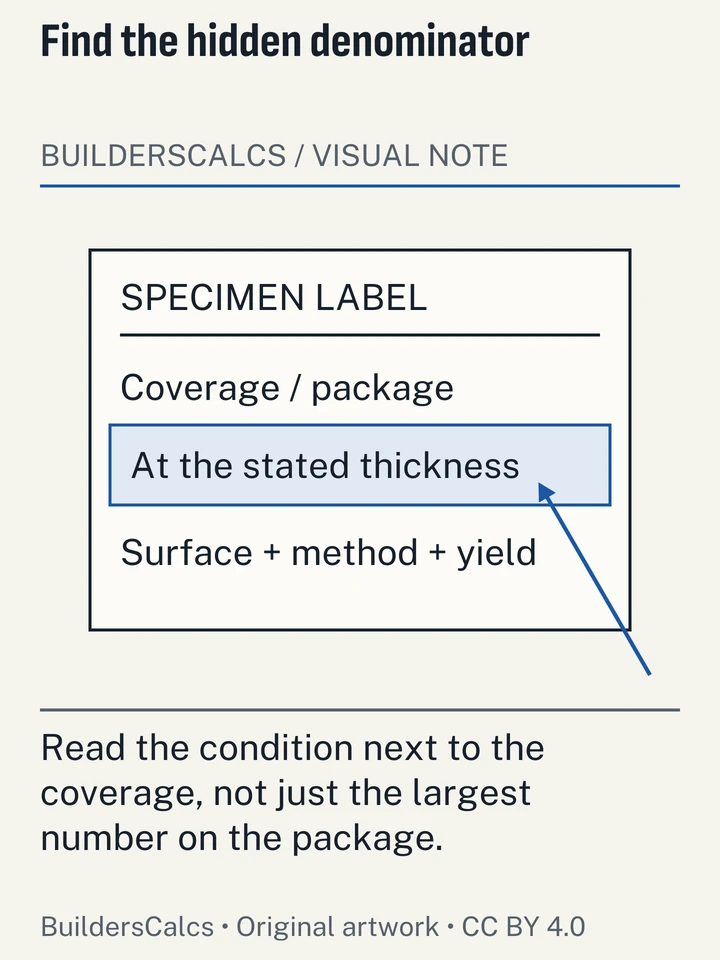
Illustration sources
- The Quikrete Companies — QUIKRETE Concrete Mix No. 1101 Data Sheet (revised Oct 2022)
- SAKRETE of North America — SAKRETE High Strength Concrete Mix technical data sheet (REV 7-10), hosted by Home Depot
- Sherwin-Williams — SuperPaint Interior Latex Flat A86 Series product data sheet (101.02A)
- GAF — Installation Instructions: Timberline HDZ, UHDZ, AS II, CS, HDZ RS (©2023, 4/23)
- GAF — Timberline HDZ Shingles data sheet (©2019)
- Shaw Floors — Paragon 7in Plus Floorte PRO direct selling sheet (11.01.2018)
- Owens Corning — AttiCat Expanding Blown-in PINK FIBERGLAS Insulation Application Instructions (Pub. 10009393-E)
- Scotts Miracle-Gro (label text as shown on Ace Hardware listing) — Scotts Nature Scapes Color Enhanced Mulch 2 cu ft
- TAMKO — TAMKO No. 15 ASTM Saturated Felt data sheet (Phillipsburg)
- TAMKO — TAMKO No. 30 ASTM Saturated Felt data sheet (Phillipsburg)
- GAF — FeltBuster High-Traction Synthetic Roofing Felt data sheet (©2014, 7/14)
- Metal Sales Manufacturing Corp. — Pro-Panel II summary brochure (©MSMC 3-2026)
- Metal Sales Manufacturing Corp. — Pro-Panel II technical data sheet MS1280PP (01-2011)
- Brewster Home Fashions — Westley Grey Plaid Wallpaper 4147-27384 product page
How do you read a concrete bag's yield?
Read it as volume per bag, then turn it round into bags per volume. About 45 bags of 80 lb concrete make one cubic yard (before waste). The common mistake is to assume a bag makes about a cubic foot, which would put the count near half the real figure. Smaller bags scale down in proportion, as the table shows.
UK and EU bags are stated differently and are smaller. A bag of Blue Circle ready-to-use concrete makes about 0.01 m³, so roughly 100 bags per m³. A Hanson MaxiPack20 bag of Multipurpose or Instant Concrete makes about 0.009 m³. German SAKRET gives a yield per kilogram instead, which you multiply by the bag weight. Whichever way it is printed, divide your volume by the yield and round up.
| Product | Bag (lb) | Bag (kg) | Yield (cu ft) | Yield (L) | Bags per cu yd | Bags per m³ |
|---|---|---|---|---|---|---|
| Quikrete Concrete Mix 1101 | 40 | 18.1 | 0.3 | 8.5 | 90 | 117.7 |
| Quikrete Concrete Mix 1101 | 50 | 22.6 | 0.375 | 10.6 | 72 | 94.2 |
| Quikrete Concrete Mix 1101 | 60 | 27.2 | 0.45 | 12.7 | 60 | 78.5 |
| Quikrete Concrete Mix 1101 | 80 | 36.2 | 0.6 | 17 | 45 | 58.9 |
| Quikrete Concrete Mix 1101 (regional) | 90 | 40.8 | 0.675 | 19.1 | 40 | 52.3 |
| Sakrete High Strength Concrete Mix | 40 | 18.1 | 0.3 | 8.5 | 90 | 117.7 |
| Sakrete High Strength Concrete Mix | 60 | 27.2 | 0.45 | 12.7 | 60 | 78.5 |
| Sakrete High Strength Concrete Mix | 80 | 36.2 | 0.6 | 17 | 45 | 58.9 |
| Sakrete High Strength Concrete Mix | 90 | 40.8 | 0.68 | 19.3 | 39.7 | 51.9 |
| Quikrete Fast-Setting Concrete Mix 1004 | 50 | 22.6 | 0.375 | 10.6 | 72 | 94.2 |
| Quikrete Fast-Setting Concrete Mix 1004 | 60 | 27.2 | 0.45 | 12.7 | 60 | 78.5 |
| Sakrete Fast Setting Concrete Mix | 50 | 22.6 | 0.38 | 10.8 | 71.1 | 92.9 |
| Sakrete Rapid Post (Canada) | 66 | 30 | 0.5 | 14 | 54 | 70.6 |
How do you read a paint spread rate?
Read it as area per gallon or litre for one coat, on the surface the maker describes. Sherwin-Williams ties its SuperPaint figure to a film of 4 wet mils (Sherwin-Williams). Multiply your wall area by the number of coats before dividing by the spread rate. A paint-and-primer label does not cancel the second coat on new drywall: Sherwin-Williams' system is two coats either way (Sherwin-Williams).
US and UK labels use different units. To compare them, Multiply sq ft per US gallon by 0.024542 to get m2 per litre (divide by it for the reverse). UK figures are also often stated as a maximum. Dulux Trade Weathershield Smooth Masonry covers up to 16 m2/L on smooth, low-porosity render. On textured surfaces such as pebbledash the same masonry paint covers only 4-6 m2/L. So the surface can cut real coverage far below the headline figure. Use the low end of a range for rough or porous walls. The how much paint a room needs tool lets you set the spread rate from your can.
| Product | Type | sq ft per US gal | m² per L | Region |
|---|---|---|---|---|
| Sherwin-Williams SuperPaint Interior Latex Flat | interior topcoat | 350–400 | 8.59–9.82 | US |
| Sherwin-Williams Premium Wall & Wood Primer | interior primer | 400 | 9.82 | US |
| Behr Premium Plus Interior Flat | interior paint & primer | 250–400 | 6.14–9.82 | US |
| Benjamin Moore Regal Select Matte | interior topcoat | 400–450 | 9.82–11.04 | US |
| Dulux Trade Vinyl Matt | interior emulsion | up to 693 | up to 17 | UK |
| Dulux Trade Weathershield Smooth Masonry (smooth render) | exterior masonry | up to 652 | up to 16 | UK |
| Dulux Trade Weathershield Smooth Masonry (pebbledash) | exterior masonry | 163–244 | 4–6 | UK |
How do you read thinset and grout coverage?
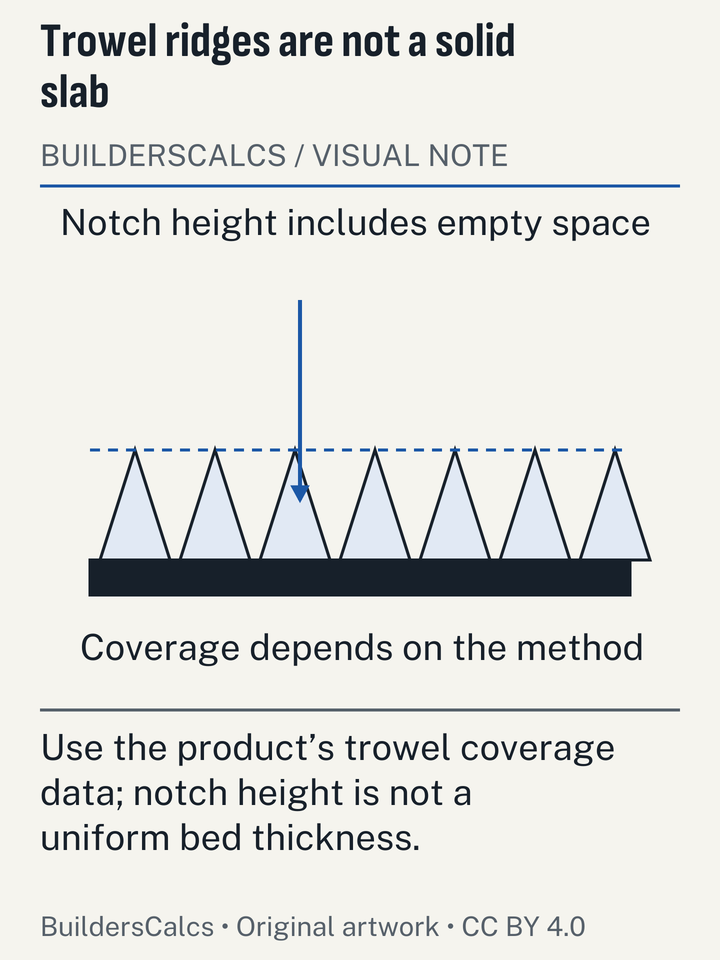
Find your trowel notch first, then read across. A deeper notch leaves more mortar per square foot, so a bag covers less. With a 1/2 × 1/2 in notch, Custom's VersaBond covers less than half the area it covers with a 1/4 × 1/4 in notch (Custom Building Products). Brands disagree slightly at each notch size, and that spread is real, so use the sheet for the bag you buy. UK sheets state the other way round, as weight per area: UK weberset plus uses about 3.0 kg/m2 with a 6 x 6 mm notched trowel, 4.5 kg/m2 for a 3 mm solid bed.
Grout charts have two inputs, the tile size and the joint width, because grout fills the joints and not the face. Small mosaic tile with wide joints uses many times more grout per square foot than large tile with narrow joints. MAPEI publishes its chart in kg per m², Custom in square feet per bag. Pick the row for your tile and the column for your joint.
| Product | Trowel notch | sq ft min | sq ft max | m² min | m² max |
|---|---|---|---|---|---|
| Custom VersaBond | 1/4 x 1/4 x 1/4 in square | 90 | 100 | 8.4 | 9.3 |
| Custom VersaBond | 1/4 x 3/8 x 1/4 in square | 60 | 67 | 5.6 | 6.2 |
| Custom VersaBond | 1/2 x 1/2 x 1/2 in square | 42 | 47 | 3.9 | 4.4 |
| LATICRETE 253 Gold | 1/4 x 1/4 in (6 x 6 mm) | 80 | 95 | 7.4 | 8.8 |
| LATICRETE 253 Gold | 1/4 x 3/8 in (6 x 9 mm) | 60 | 70 | 5.6 | 6.5 |
| MAPEI Ultraflex 2 | 1/4 x 1/4 x 1/4 in (6 x 6 x 6 mm) | 75 | 90 | 6.97 | 8.36 |
| MAPEI Ultraflex 2 | 1/4 x 3/8 x 1/4 in (6 x 10 x 6 mm) | 55 | 65 | 5.11 | 6.04 |
How do you read a shingle bundle wrapper?
Look for two numbers: bundles per square and the coverage of that square. One roofing square is 100 sq ft (9.29 m2) of roof surface. Many laminated shingles pack three bundles to a square, but those three cover 98.4 sq ft rather than a full 100. Heavier lines use more bundles: Owens Corning Duration Premium is packed 4 bundles per square (98.4 sq ft); heavier shingles need more bundles. Starter strip and hip and ridge caps are separate products with their own coverage in linear feet, so the field bundle count never includes them.
How do you read flooring cartons and tile boxes?
Use the area printed on the carton or box, not the nominal piece size times the count. Box coverage differs by product and size, so use the coverage printed on the box or data sheet. The printed area is worked out from the actual face size, which for tile can be a little smaller than the nominal inch size. Marazzi's boxes show this well: its 60 × 60 cm and 30 × 60 cm boxes both cover 1.08 m², while the 75 × 75 cm box holds two pieces and covers 1.13 m² (Marazzi Group (Italy)). A box of large tile is also heavy, so the data sheet's weight per box is worth reading before you carry it.
How do you read an insulation coverage chart?
For batts, read the square feet per package. A batt that is 15 × 93 in covers 9.7 sq ft, and the bag holds a set number of pieces. For blown-in insulation, the chart has two columns that both matter. A stated blown-in R-value needs both the minimum bags per 1,000 sq ft and the minimum thickness. Filling to the depth with fewer bags gives a lower density and a lower R-value than the label claims. Cellulose and fiberglass also need very different bag counts for the same R-value: GreenFiber INS515LD needs at least 56 bags per 1,000 sq ft for R-49 (14.82 in initial, 13.34 in settled). The batts or rolls of insulation tool reads the chart for you.
Why does a roll or panel cover less than its size?
Because part of it overlaps the next one. Underlayment is rated by net squares, after the maker's laps: GAF FeltBuster synthetic: 48 in x 250 ft (1.23 x 76.2 m) roll covers 1,000 sq ft (92.9 m2), 10 squares, excluding laps. Metal panels are sold by coverage width, not by sheet width, because the ribs at the edges overlap. Metal Sales Pro-Panel II covers 36 in (914 mm) per panel, 5/8 in rib height, ribs at 9 in centres. Wallpaper loses length to the pattern match. A 20.5 in x 33 ft roll covers about 56.4 sq ft (5.24 m2) before pattern and trimming waste. Graham & Brown points out that the repeat and match type decide how many full strips a roll gives (Graham & Brown), so dividing wall area by roll area undercounts.
Mulch bags are the simplest case. The volume is printed, and some bags also print the area at a given depth. Halve the depth and the area doubles. The mulch calculator works from depth and bag volume.
Is label coverage what you will actually use?
No. Label coverage is the material that ends up on the job under ideal conditions. Real sites waste some of it. The RICS whole life carbon standard, used for UK carbon assessments, sets default site waste rates by material: The RICS whole life carbon standard (2nd edition, 2023) sets a default UK site waste rate of 4% for plasterboard, 6% for clay brickwork and 6% for tile floor finishes. Those are rates of loss on delivered material, not ordering advice, but they show why coverage and purchase quantity are different numbers.
The purchase quantity is: net quantity × (1 + allowance), divided by the label coverage, rounded up. Round once, at the end. The guide to estimating renovation material costs carries that number into a budget.
When does a coverage figure mislead?
- The condition doesn't match your job: a different notch, joint, exposure or film thickness.
- The surface is rough or porous, so paint and masonry coatings spread less.
- The figure is a maximum ("up to"), not a typical value.
- The product changed. Coverage is product-specific, and an old sheet may describe a different bag size or formula.
- Depth is met but bag count isn't, for blown insulation.
The short version
Find the condition, then the number. Use the low end of a range on rough or uncertain surfaces, multiply by coats or layers where the label is per coat, add the stated allowance, and round up once. Every material page in the guide library names the maker behind its coverage figures.
Questions about reading coverage figures
Why does my paint can give a range instead of one number?
Because coverage depends on the surface and how thickly the paint goes on. Smooth, sealed walls reach the top of the range; rough or porous ones fall to the bottom. Behr Premium Plus Interior Flat covers 250-400 sq ft per gallon (6.14-9.82 m2/L).
Does a shingle bundle always cover a third of a square?
Not always. Some products cover 98.4 sq ft per three bundles, and Three bundles per square is the most common packaging, but some products use 4 or 5. Read the wrapper for the product you buy.
Why does trowel size change how much thinset I need?
A deeper notch leaves a thicker bed of mortar. Custom's VersaBond covers Custom VersaBond: 90-100 sq ft per 50 lb with a 1/4 x 1/4 in square notch, 60-67 with 1/4 x 3/8, 42-47 with 1/2 x 1/2.
What does net coverage mean on an underlayment roll?
It is the roof area the roll covers after the maker's standard laps, not the roll's length times its width. Extra laps at valleys and end joints still come out of it.
Sources (44)
- Asphalt Roofing Manufacturers Association (ARMA)
- Residential Asphalt Roofing Manual - Design and Application Methods, 2014 edition (Ch. 5 Estimating; Ch. 6 Safety), checked
- Behr
- BEHR PREMIUM PLUS Interior Flat product sheet, checked
- Benjamin Moore
- Regal Select Waterborne Interior Paint - Matte (N548) product page, checked
- Brewster Home Fashions
- Westley Grey Plaid Wallpaper 4147-27384 product page, checked
- Custom Building Products
- Polyblend Sanded / Non-Sanded Grout color card and coverage chart (©2011), checked
- VersaBond Professional Tile Mortar product page - coverage table, checked
- Dulux Trade (AkzoNobel)
- Dulux Trade Vinyl Matt product page, checked
- Dulux Trade Weathershield Smooth Masonry Paint datasheet, checked
- Dulux Trade Weathershield Smooth Masonry Paint product page, checked
- Fine Homebuilding (Taunton Press), Mike Guertin
- Don't Fall Short on Shingles: How to Estimate Materials for Roofing Projects (excerpt from Roofing with Asphalt Shingles), checked
- GAF
- FeltBuster High-Traction Synthetic Roofing Felt data sheet (©2014, 7/14), checked
- Installation Instructions: Timberline HDZ, UHDZ, AS II, CS, HDZ RS (©2023, 4/23), checked
- Timberline HDZ Shingles data sheet (©2019), checked
- Graham & Brown
- How to measure for wallpaper, checked
- GreenFiber
- GreenFiber Cellulose Fiber Insulation Product Guide (DM-6.3-343 Rev A), checked
- GreenFiber INS515LD Loose Fill Formula attic card (PM-6.3-324 Rev E), checked
- Hanson (Heidelberg Materials UK)
- Instant Concrete technical data sheet, checked
- Multipurpose Concrete technical data sheet (updated August 2020), checked
- King Packaged Materials / Sika Canada (SAKRETE Canada)
- SAKRETE Rapid Post product data sheet, checked
- LATICRETE International
- 253 GOLD sell sheet DS-167.6-EN-SP-0726 (©2026), checked
- MAPEI Corporation
- Ultraflex 2 technical data sheet (version Aug. 5, 2013), checked
- Marazzi Group (Italy)
- Plaster collection catalogue - formats and packing table, checked
- Metal Sales Manufacturing Corp.
- Pro-Panel II summary brochure (©MSMC 3-2026), checked
- Pro-Panel II technical data sheet MS1280PP (01-2011), checked
- National Institute of Standards and Technology
- NIST Guide to the SI (SP 811), Appendix B.9 Factors for units listed by kind of quantity, checked
- National Ready Mixed Concrete Association
- CIP 8 - Discrepancies in Yield (rev. 2016), checked
- Owens Corning
- AttiCat Expanding Blown-in PINK FIBERGLAS Insulation Application Instructions (Pub. 10009393-E), checked
- EcoTouch PINK FIBERGLAS Insulation Manufacturers Fact Sheet (Pub. 10017881-A), checked
- PROPINK L77 Loosefill Insulation product data sheet (Pub. 43942-W), checked
- Owens Corning / Lowe's
- The Roofing Collection Product Guide (©2017) - Duration, Starter and Hip & Ridge specifications, checked
- Royal Institution of Chartered Surveyors (RICS)
- Whole life carbon assessment for the built environment, 2nd edition (professional standard, September 2023), checked
- SAKRETE of North America
- SAKRETE Fast Setting Concrete Mix technical data sheet, hosted by Home Depot, checked
- SAKRETE High Strength Concrete Mix technical data sheet (REV 7-10), hosted by Home Depot, checked
- Saint-Gobain Weber (UK)
- weberset plus tile adhesive - NBS Source product data, checked
- Scotts Miracle-Gro (label text as shown on Ace Hardware listing)
- Scotts Nature Scapes Color Enhanced Mulch 2 cu ft, checked
- Shaw Floors
- Paragon 7in Plus Floorte PRO direct selling sheet (11.01.2018), checked
- Sherwin-Williams
- Premium Wall & Wood Interior Latex Primer B28W08111 product data sheet (108.38), checked
- SuperPaint Interior Latex Flat A86 Series product data sheet (101.02A), checked
- TAMKO
- TAMKO No. 15 ASTM Saturated Felt data sheet (Phillipsburg), checked
- TAMKO No. 30 ASTM Saturated Felt data sheet (Phillipsburg), checked
- Tarmac (Blue Circle)
- High Strength Concrete (40N) product data sheet (June 2014), hosted by Wickes, checked
- Multi-Purpose Concrete product data sheet (March 2014), hosted by Wickes, checked
- The Quikrete Companies
- QUIKRETE Concrete Mix No. 1101 Data Sheet (revised Oct 2022), checked
- QUIKRETE Fast-Setting Concrete Mix No. 1004 Data Sheet, checked
Every number on this page is taken from these documents. How we choose and check sources.