

Wallpaper calculator
Wallpaper is hung in whole strips, so count strips, not square feet. A 12 × 10 ft room with 8 ft walls needs 26 strips of a 20.5 in wide roll; each 33 ft roll gives 4 full strips, so that is 7 rolls, or 8 with Graham & Brown's advised 10% extra. A pattern repeat makes each strip longer and can cut a roll to 3 strips, which is why the repeat changes the order more than the wall size does.
Wallpaper calculator
v1 · US and metricEnter the walls, the roll size and the pattern repeat. The calculator counts the strips (drops) you need, how many whole strips each roll gives, and the rolls to buy.
Result
Enter your measurements and press Calculate.
Formula and assumptions
- A room (four walls):
Wall width = 2 × (length + width) Strips = wall width ÷ roll width, rounded up; strip length = wall height + pattern repeatStrips per roll = roll length ÷ strip length, rounded down; rolls = strips ÷ strips per roll × (1 + extra % ÷ 100), rounded up- Graham & Brown recommends not deducting doors and windows, so the excess acts as a margin.
- Roll sizes: A common US (Brewster) roll is 20.5 in (521 mm) wide and 33 ft (10.06 m) long. The common UK/European roll is 0.53 m wide x 10.05 m long.
- Only whole strips are counted from each roll; the offcut at the end of a roll is treated as waste.
- Graham & Brown advises allowing an extra 10% for waste and mistakes.
- No trimming allowance is added at the top and bottom of each strip; add one to the wall height if your installer wants it.
How many rolls of wallpaper do I need for a 12 × 10 room?
Eight rolls of the common US 20.5 in × 33 ft size, for 8 ft walls with no pattern to match and 10% extra. That is the default the calculator opens with. The four walls run 44 ft around the room, which takes 26 strips side by side. Each strip is 8 ft long, so one roll gives 4 whole strips and a 1 ft offcut. 26 strips ÷ 4 per roll = 6.5 rolls, and the extra brings it to 7.15, rounded up to 8. Without the extra, the answer is 7.
In metric, a 3.6 × 3 m room with 2.4 m walls needs 7 rolls of the common UK and European size. The walls run 13.2 m, which takes 25 strips of 0.53 m. Each 10.05 m roll gives 4 strips of 2.4 m, so 25 ÷ 4 × 1.1 = 6.9 rolls, rounded up to 7.
Measure the walls, not the floor
Choose A room and enter the length and width along the floor and the height from floor to ceiling; the calculator adds the four walls. For a feature wall, a chimney breast or a hallway, choose One wall or some walls and enter the total width of the walls you are covering. Do not take doors and windows off. Graham & Brown recommends not deducting doors and windows, so the excess acts as a margin. The paintable area walkthrough covers measuring around alcoves and sloped ceilings, and the wall measurements it takes are the ones you need here.
How does the calculator count wallpaper rolls?
It works out how many strips cover the width of the walls, how many whole strips each roll gives at your wall height, and divides one by the other. Square footage plays no part in the count. The steps are:
- Width to cover: 2 × (length + width) for a room, or the total wall width you enter.
- Strips: width ÷ roll width, rounded up.
- Strip length: wall height, plus one pattern repeat for a straight or offset match. A free match adds nothing.
- Strips per roll: roll length ÷ strip length, rounded down, because a part strip cannot be hung.
- Rolls: strips ÷ strips per roll × (1 + extra % ÷ 100), rounded up.
The calculator also shows the wall area, with doors and windows left in, so you can compare it with a shop's own estimate. It is there for reference only.
Worked example: a straight match with a repeat
Take the default US room and choose a straight match with a 21 in repeat. Each strip is now 8 ft + 21 in = 9.75 ft, so a 33 ft roll gives only 3 whole strips: 33 ÷ 9.75 = 3.38, rounded down. The room still needs 26 strips, so 26 ÷ 3 × 1.1 = 9.53, rounded up to 10 rolls. The repeat added 2 rolls to an 8 roll order, a quarter more paper, without the room changing at all.
| Walls | Roll | Match and repeat | Strips | Strips per roll | Rolls |
|---|---|---|---|---|---|
| 12 × 10 ft room, 8 ft high | 20.5 in × 33 ft | Free | 26 | 4 | 8 (7 with no extra) |
| 12 × 10 ft room, 8 ft high | 20.5 in × 33 ft | Straight, 21 in | 26 | 3 | 10 |
| 3.6 × 3 m room, 2.4 m high | 0.53 × 10.05 m | Free | 25 | 4 | 7 |
| 3.6 × 3 m room, 2.5 m high | 0.53 × 10.05 m | Offset, 64 cm | 25 | 3 | 10 |
| 30 ft of 9 ft wall | 0.53 × 10.05 m | Free | 18 | 3 | 7 |
| 12 × 10 ft room, 8 ft high | 27 in × 27 ft | Free | 20 | 3 | 8 |
Why does a few inches of wall height change the roll count?
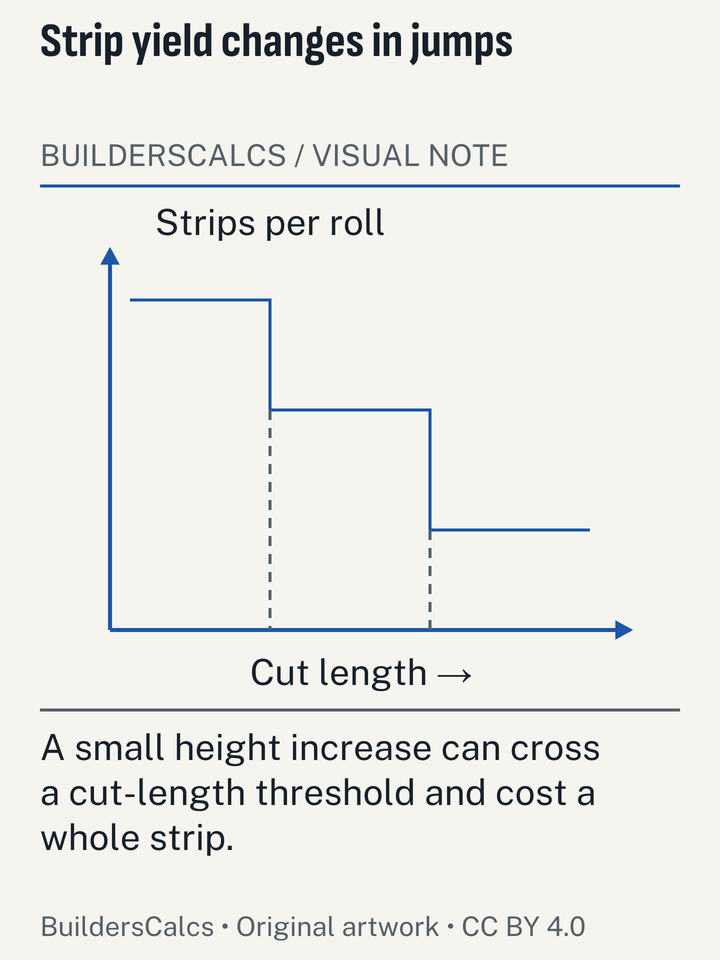
Because the number of whole strips per roll steps down suddenly. A 33 ft roll gives 4 strips for any wall up to 8 ft 3 in, then only 3 strips for anything taller, up to 11 ft. A room with 8 ft 6 in walls therefore needs about a third more rolls than one with 8 ft walls, though the walls are only 6 percent taller. The 9 ft wall in the table shows the effect: each roll gives 3 strips and the rest of the roll, around 6 ft, is offcut.
The metric roll behaves the same way. At 2.4 m, a 10.05 m roll gives 4 strips with 45 cm to spare; at 2.5 m it still gives 4, with just 5 cm left. Go a little higher, or add a pattern repeat, and it falls to 3. The 2.5 m room with a 64 cm offset repeat in the table needs 10 rolls rather than 7 for that reason.
Two things follow. Measure the height accurately, at several points, because a sagging ceiling or a raised floor can tip you over a step. And note that the calculator adds no trimming allowance at the top and bottom of each strip, because no source we trust gives a figure. If your installer wants one, add it to the wall height before you enter it, and watch whether that pushes the strips per roll down.
How much extra does a pattern repeat need?
The calculator adds one full repeat to every strip for a straight or offset match. The repeat is the distance before the design starts again, printed on the roll label, and you lose up to one repeat on each strip by cutting it so the design lines up with the strip beside it. Wallpaper comes in free, straight or offset (drop) match; offset match wastes more per strip.
Offset, or drop, matches are treated the same as straight matches in the calculator, adding one repeat per strip. Graham & Brown notes that an offset match wastes more on each strip, because alternate strips start part way down the repeat, so if you are close to a roll boundary with an offset match, buy the extra roll. The pattern repeat and drop matching guide shows how each match is cut, with diagrams.
A common misconception is that rolls equal wall area ÷ roll area. A 20.5 in x 33 ft roll covers about 56.4 sq ft (5.24 m2) before pattern and trimming waste. By area alone, the default 352 sq ft room would need about 6.2 rolls. The strip count gives 6.5 before any extra, and the 21 in repeat pushes it to 8.7. Area only works for a plain paper on walls whose height happens to divide neatly into the roll length.
What size is a roll of wallpaper?
Roll sizes differ by market and by maker, so read the label before you trust any calculator, including this one.
| Market | Width | Length | Area |
|---|---|---|---|
| US (Brewster example) | 20.5 in (0.521 m) | 33 ft (10.06 m) | 56.4 sq ft (5.24 m2) |
| UK/EU standard | 0.53 m (20.9 in) | 10.05 m (33.0 ft) | 5.33 m2 (57.3 sq ft) |
What is the difference between US and UK wallpaper rolls?
The two common sizes are close in area but not the same. A common US (Brewster) roll is 20.5 in (521 mm) wide and 33 ft (10.06 m) long. The common UK/European roll is 0.53 m wide x 10.05 m long. One 0.53 x 10.05 m roll covers 5.33 m2 (about 57.3 sq ft). The European roll is slightly wider, so it takes fewer strips to cross a long wall, and the lengths are almost identical.
Roll naming in the US is the bigger trap. US papers are often priced per single roll but packed and sold as double rolls. Brewster's 33 ft roll is the double-roll-sized unit, and naming differs between makers. Check whether the price and the quantity on the label refer to the same unit before you order. If the length on the label differs from the presets, choose Other roll and enter the width and length printed there. The test case in the table above uses a 27 in × 27 ft roll this way.
You can mix systems. Choose the European roll with the calculator in US mode, as in the 30 ft wall example, and it converts the roll to feet before counting strips.
How much extra wallpaper should I buy?
The calculator defaults to 10%, which is Graham & Brown's figure. Graham & Brown advises allowing an extra 10% for waste and mistakes. It is applied after the strip count, so it covers a spoiled strip, an awkward corner or a mistake, not the pattern repeat, which is already in the strip length. Set it to zero if you only want the plain count.
Buy all the rolls from the same batch, sometimes called the lot or shade number, because colour can vary between print runs. A roll bought later to finish a wall may not match, which is the best argument for ordering the extra at the start. For how this allowance compares with tile, timber and board, see the waste allowance explainer.
When is the wallpaper result wrong?
The calculator handles straight walls of one height. It does not handle:
- Stairwells and sloped ceilings. Strips on a staircase wall vary in length. Measure the longest strip and use that height for the section, or split the wall into parts of different heights and run each.
- Ceilings. Papering a ceiling is not modelled. Treat the ceiling as a wall whose height is the room length, with the room width as the width to cover.
- Walls taller than one roll. If a strip is longer than the roll, the calculator says so and gives no roll count. You need a longer roll or a mural made to height.
- Murals and panels. These are sold to fit a given wall, not by the roll.
- Lining paper. If you hang lining paper first, run the calculator again with its roll size and a free match.
Is wallpaper still widely bought?
Less than a few years ago, at least in the UK. Office for National Statistics production data show that UK manufacturers sold £73.2 million of wallpaper and similar wall coverings in 2025, down from a peak of £136.4 million in 2021 (−46%), per ONS Prodcom (product 17241100; 2025 figures provisional). The drop in the most recent year was steep: UK wallpaper manufacturer sales fell 18.9% in a year, from £90.3 million in 2024 to £73.2 million in 2025, per ONS Prodcom; volume figures break after 2023, so only values are compared. These are sales by UK manufacturers, not what UK households spent, and imported paper is not in them.
Which calculator do I need next?
Few rooms are papered on every wall. For the painted walls, ceiling and woodwork, the paint calculator gives gallons or litres of paint from the maker's coverage. If you are boarding or reboarding before you paper, start with the drywall calculator. All of the wall tools sit together on the calculators for interior walls page.
Wallpaper calculator questions
How many rolls of wallpaper for one feature wall?
Choose One wall or some walls, enter the wall width and height, and pick your roll and repeat. A 12 ft wide, 8 ft high wall with a free-match US roll needs 8 strips at 4 per roll, so 2 rolls, or 3 with the 10% extra rounded up. A large repeat can change that, so enter the one on the label.
What happens to the offcut at the end of each roll?
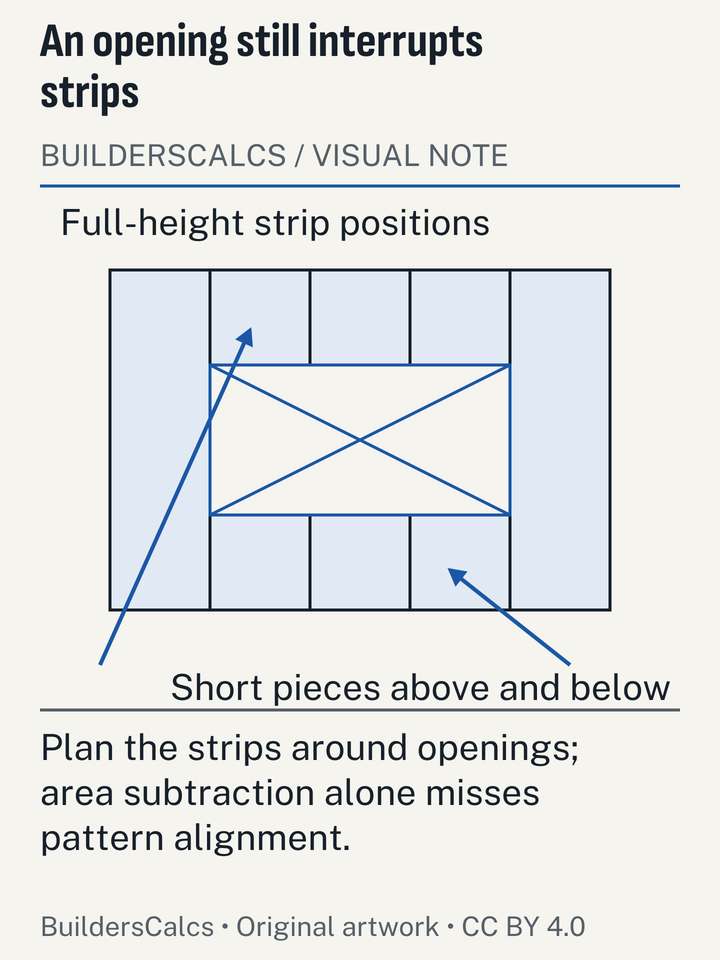
The calculator counts it as waste. Offcuts are often long enough for the short strips above a door or below a window, which is why you should not deduct openings; the spare offcuts and the extra paper even each other out.
Does a wider roll mean fewer rolls?
Fewer strips, not always fewer rolls. A 27 in × 27 ft roll needs only 20 strips for the default room, but it gives 3 strips of 8 ft instead of 4, so the order is the same 8 rolls as the 20.5 in × 33 ft roll. Compare the strips per roll, not just the width.
Can I use this for lining paper or wallpaper borders?
For lining paper, yes: enter its roll size under Other roll and choose a free match. Borders are sold by length, so add up the length of wall the border runs along instead.
Embed this wallpaper calculator
Sources (9)
- Brewster Home Fashions
- Westley Grey Plaid Wallpaper 4147-27384 product page, checked
- Graham & Brown
- How to measure for wallpaper, checked
- National Institute of Standards and Technology
- Handbook 44 (2026), Appendix C: General Tables of Units of Measurement, checked
- NIST Guide to the SI (SP 811), Appendix B.9 Factors for units listed by kind of quantity, checked
- Special Publication 811 (2008), Guide for the Use of the International System of Units (SI), Appendix B.8, checked
- Office for National Statistics
- UK manufacturers' sales by product (Prodcom) 2025, released 24 July 2026, checked
- UK Parliament (legislation.gov.uk)
- Weights and Measures Act 1985, Schedule 1, checked
- Victory Colours (retailer)
- Anaglypta Supaglypta Howard RD0648 listing (0.53 m x 10.05 m), checked
- Wickes (retailer)
- Arthouse White Brick Wallpaper 10.05m x 53cm listing, checked
Every number on this page is taken from these documents. How we choose and check sources.