

How to estimate wallpaper with pattern repeat matching
Add the pattern repeat to the wall height to get the length of each strip, count how many whole strips one roll gives, and divide the strips you need by that number. The common UK/European roll is 0.53 m wide x 10.05 m long. On 2.4 m walls that roll gives four strips with no repeat but only three with a 64 cm repeat, so a 14 m run of wall needs 10 rolls rather than 8, including Graham & Brown's 10% extra.
How do you estimate wallpaper with a pattern repeat?
Wallpaper is hung in vertical strips, and each strip has to start at the same point in the pattern as the one beside it. So the sum counts strips, not square metres.
- Measure the width of every wall to be papered. Add them into one total. Graham & Brown advises not deducting doors and windows, so the paper over them becomes part of your margin (Graham & Brown).
- Measure the wall height. Measure from skirting or floor to ceiling at the tallest point. Old houses vary from wall to wall, so measure each.
- Read the roll label. Note the roll width and length, the pattern repeat and the match type: free, straight or offset.
- Work out the strip length. Strip length = wall height + pattern repeat. With a free match, the repeat is zero.
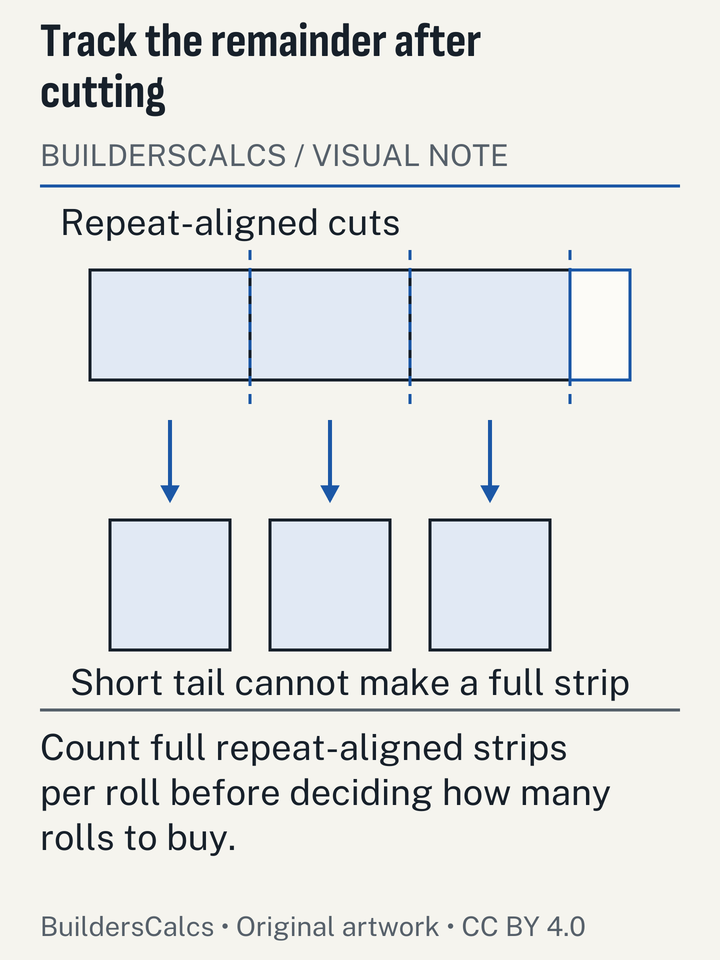
- Count whole strips per roll. Strips per roll = roll length ÷ strip length, rounded down. The leftover piece is too short for a full strip.
- Count the strips you need. Strips = total wall width ÷ roll width, rounded up.
- Convert to rolls and add the margin. Rolls = strips needed ÷ strips per roll, then add 10% as Graham & Brown suggests, and round up. Buy every roll from the same batch.
What is a pattern repeat, and what is a drop match?
The pattern repeat is the vertical distance before the design starts again, printed on the roll label. The match type says how neighbouring strips line up. Wallpaper comes in free, straight or offset (drop) match; offset match wastes more per strip. (Graham & Brown)
- Free match. Stripes, textures and plain papers have no motif to align. Any strip can sit next to any other, so nothing is lost to the repeat.
- Straight match. The motif sits at the same height on every strip. Each new strip starts at the same point in the repeat.
- Offset or drop match. The motif on each strip sits lower than on the one before, so alternate strips start at different points in the repeat. This is the match that wastes the most.
Adding one full repeat to every strip, as the formula does, gives enough length to find the match point for either matched type. With an offset match you use that extra length more often, which is why it costs more paper.
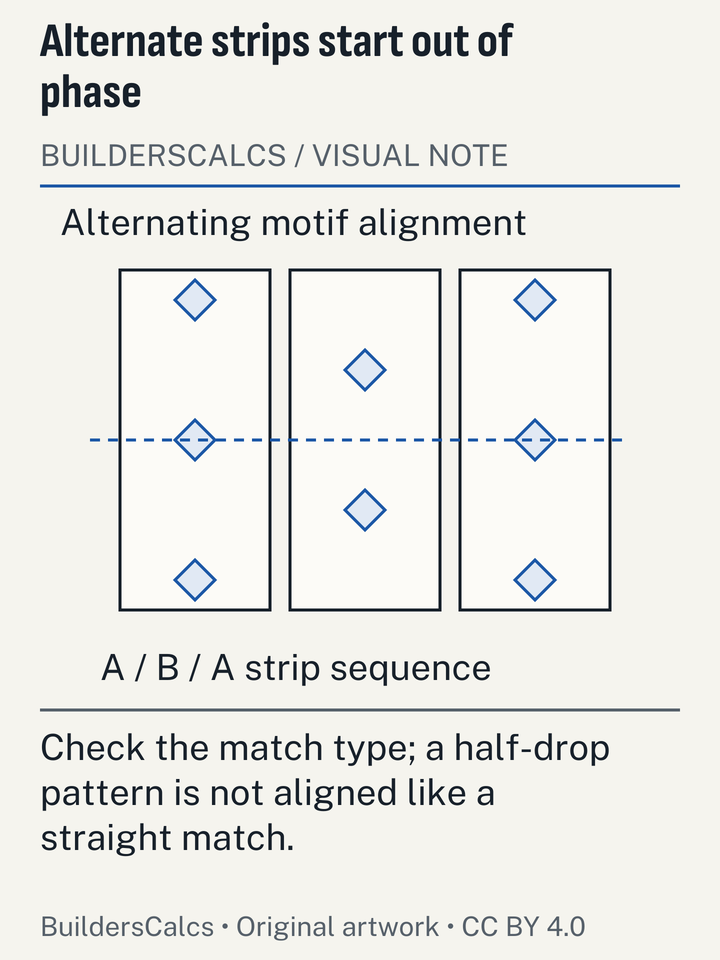
Illustration sources
Why can't I just divide the wall area by the roll area?
Because rolls are used as whole strips, and the offcut from each roll is usually too short to hang. Dividing area by area assumes every centimetre of paper ends up on the wall. Graham & Brown's own guidance ties the quantity to the repeat and the match, not just the area (Graham & Brown).
The gap can be large. On the UK example below, the area sum says 7 rolls; the strip method with a 64 cm repeat says 10. Most of the difference is offcut: each roll gives three strips of 3.04 m, which is 9.12 m, leaving 0.93 m of every roll on the floor.
Worked example 1: a UK room with 0.53 × 10.05 m rolls
A 4 × 3 m bedroom has 2.4 m walls, so the total width to paper is 14 m. One 0.53 x 10.05 m roll covers 5.33 m2 (about 57.3 sq ft).
Free match
Each strip is 2.4 m. 10.05 ÷ 2.4 = 4.19, so four strips per roll. 14 ÷ 0.53 = 26.4, so 27 strips. 27 ÷ 4 = 6.75 rolls, and with 10% extra, 7.4, so 8 rolls.
A 64 cm repeat
Each strip is 2.4 + 0.64 = 3.04 m. 10.05 ÷ 3.04 = 3.3, so three strips per roll. The same 27 strips now need 9 rolls, or 9.9 with the margin, so 10 rolls. The repeat costs two rolls on this room.
The area shortcut
14 × 2.4 = 33.6 m², and 33.6 ÷ 5.33 = 6.3, so 7 rolls. That would leave the patterned room three rolls short.
Worked example 2: a US room with 20.5 in × 33 ft rolls
A 12 × 14 ft room has 8 ft (96 in) walls, so the total width is 52 ft, or 624 in. A common US (Brewster) roll is 20.5 in (521 mm) wide and 33 ft (10.06 m) long. That roll is 396 in long.
Free match
396 ÷ 96 = 4.1, so four strips per roll. 624 ÷ 20.5 = 30.4, so 31 strips. 31 ÷ 4 = 7.75, plus 10%, is 8.5, so 9 rolls.
A 21 in repeat
Each strip is 96 + 21 = 117 in. 396 ÷ 117 = 3.4, so three strips per roll. 31 ÷ 3 = 10.3, plus 10%, is 11.4, so 12 rolls. By area, 416 sq ft ÷ 56.4 sq ft = 7.4, or 8 rolls, which would be four rolls short.
The two rooms side by side
| Room | Area shortcut | Strip method, free match | Strip method, with repeat |
|---|---|---|---|
| UK, 14 m of 2.4 m wall, 0.53 × 10.05 m roll | 7 rolls | 8 rolls | 10 rolls (64 cm repeat) |
| US, 52 ft of 8 ft wall, 20.5 in × 33 ft roll | 8 rolls | 9 rolls | 12 rolls (21 in repeat) |
How does wall height interact with the repeat?
The number of whole strips per roll drops in steps, so a few centimetres of wall height or repeat can cost a full strip from every roll. The table works the strip count for a 10.05 m roll at three wall heights and three example repeats. Read your own repeat from the label; these are only sample values.
| Wall height | No repeat | 27 cm repeat | 53 cm repeat |
|---|---|---|---|
| 2.2 m | 4 strips | 4 strips | 3 strips |
| 2.4 m | 4 strips | 3 strips | 3 strips |
| 2.6 m | 3 strips | 3 strips | 3 strips |
Are US and European rolls the same size?
Close, but not the same, and the naming differs. A UK or European roll is 0.53 m wide and 10.05 m long. A typical US roll from Brewster is 20.5 in by 33 ft. The US roll is narrower but about the same length, so it covers slightly less.
| Market | Width | Length | Area |
|---|---|---|---|
| US (Brewster example) | 20.5 in (0.521 m) | 33 ft (10.06 m) | 56.4 sq ft (5.24 m2) |
| UK/EU standard | 0.53 m (20.9 in) | 10.05 m (33.0 ft) | 5.33 m2 (57.3 sq ft) |
What is a US single roll versus a double roll?
Many US papers are priced per single roll but sold packed as double rolls. Brewster's 33 ft roll is the double-roll-sized unit, and the naming is not consistent between makers (Brewster Home Fashions). We have not found a primary source that defines either term, so check the length on the label rather than trusting the word “roll”. A price per single roll on a product that ships only in doubles means you buy twice as many “rolls” as the strip count suggests.
Does the 10% margin cover the repeat?
No. The repeat is already in the strip length; the 10% is for mistakes, damaged lengths and the odd strip hung upside down. Graham & Brown is the only maker in our fact base that states an allowance (Graham & Brown). The waste percentage by job guide sets it against the allowances for flooring, tile and decking.
Keep a roll back after the job if you can. Rolls are printed in batches, and a later batch can differ slightly in shade, which is why every roll should come from one batch. A spare from the same batch is the only reliable repair stock.
Is wallpaper still widely bought?
Less than a few years ago, at least by what UK factories sell. ONS Prodcom data show UK manufacturers sold 73.2 million pounds' worth of wallpaper and similar wall coverings in 2025 (provisional), well below their 2021 peak (Office for National Statistics). The fall in the latest year alone was -18.9%, by value; ONS volume figures break after 2023, so only values can be compared. These are UK manufacturers' sales by value, so they leave out imported paper and say nothing about how many rooms were papered. For a buyer, the practical point is to check stock of your batch before you start, because a discontinued pattern cannot be topped up later.
When does the strip method give the wrong answer?
- Walls of very different heights. Work out strips per roll for each height, such as a chimney breast or a stair wall, instead of using the tallest everywhere.
- Large windows or a wide doorway. Graham & Brown's no-deduction rule is a margin. For a wall of patio doors, the short strips above and below can be cut from offcuts; count them separately.
- Trimming. Most hangers leave extra at the top and bottom of each strip for trimming. We have found no published figure for it, so it is not in the formula; add your own if you want one.
- Ceilings. Strips run across the room, so use the room width as the strip length and the room length as the width to cover.
- Murals and panel sets. These are sold as fixed panels for a wall size, not by the roll.
Next steps
Measure each wall, read the repeat and the match from the label, and count strips. The paintable area walkthrough shows how to measure awkward walls, and the same measurements feed the gallons or litres of paint tool for the walls you paint instead. Every wall and paint tool is in the walls category.
Wallpaper repeat questions
How much extra wallpaper do I need for a pattern repeat?
One full repeat on every strip. With a 64 cm repeat on 2.4 m walls and 0.53 × 10.05 m rolls, that drops each roll from four strips to three, so a 14 m run of wall needs 10 rolls instead of 8.
Does offset match use more paper than straight match?
Yes. Graham & Brown says an offset or drop match wastes more per strip than a straight or free match, because alternate strips start at different points in the repeat.
Should I subtract doors and windows when ordering wallpaper?
Graham & Brown says no: leave them in and treat the extra as part of your margin. Subtract them only for very large openings, and count the short strips around them separately.
How many strips of wallpaper come from one roll?
Divide the roll length by the wall height plus the repeat and round down. A 10.05 m roll gives four 2.4 m strips with a free match, or three once a repeat of more than about 11 cm is added.
Sources (7)
- Brewster Home Fashions
- Westley Grey Plaid Wallpaper 4147-27384 product page, checked
- Graham & Brown
- How to measure for wallpaper, checked
- National Institute of Standards and Technology
- NIST Guide to the SI (SP 811), Appendix B.9 Factors for units listed by kind of quantity, checked
- Office for National Statistics
- UK manufacturers' sales by product (Prodcom) 2025, released 24 July 2026, checked
- US Consumer Product Safety Commission
- NEISS annual data files 2015–2025 (neiss<year>.xlsx, NEISS_FMT code sheet), checked
- Victory Colours (retailer)
- Anaglypta Supaglypta Howard RD0648 listing (0.53 m x 10.05 m), checked
- Wickes (retailer)
- Arthouse White Brick Wallpaper 10.05m x 53cm listing, checked
Every number on this page is taken from these documents. How we choose and check sources.